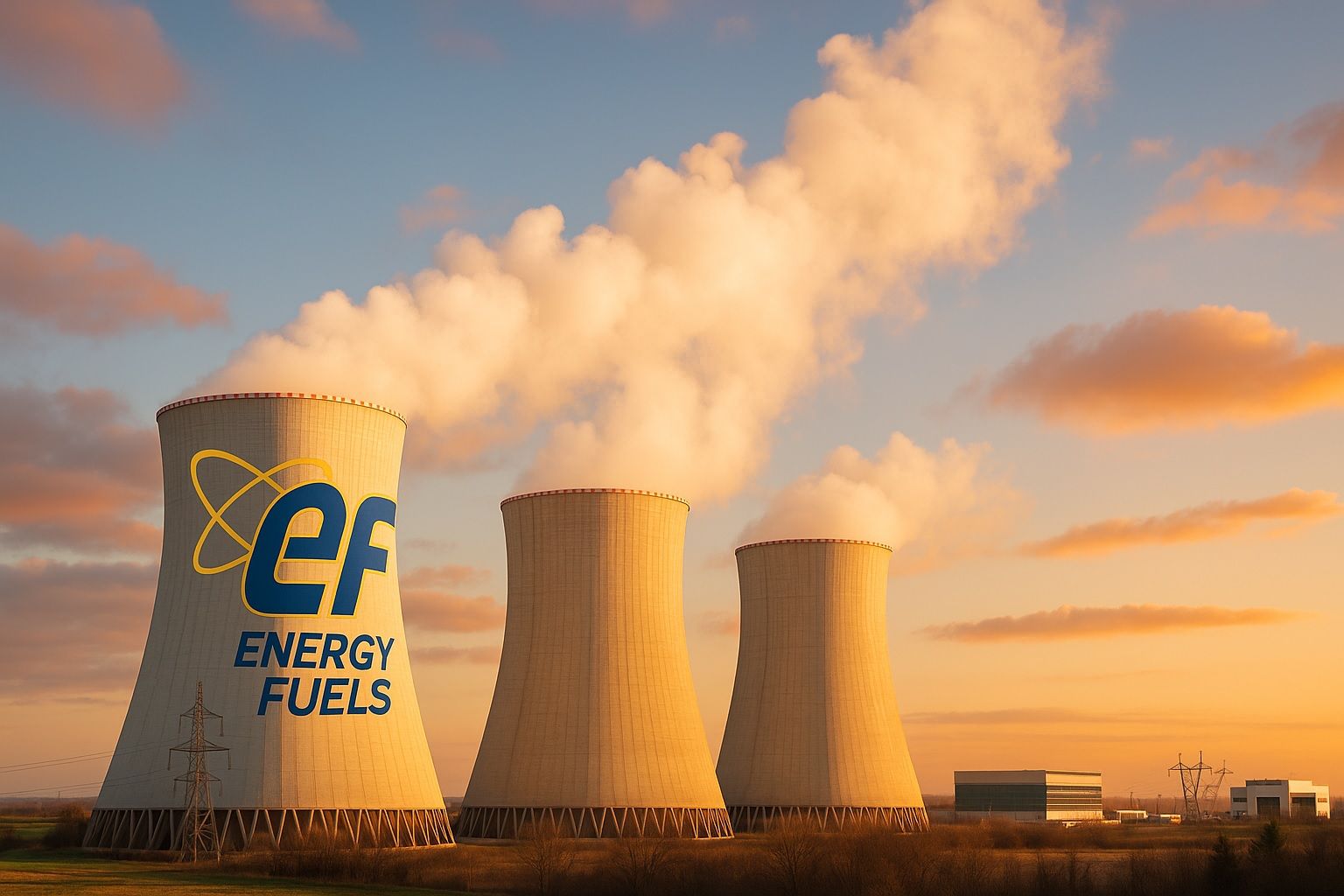

- Rare-Earth Export Clampdown: China in early October 2025 imposed sweeping new export controls on five additional rare-earth elements reuters.com. This “dramatic” policy tightening prompted a global rally in critical-minerals stocks, with U.S. producers like Energy Fuels surging to multi-year highs app.stocks.news investing.com. Energy Fuels (UUUU) jumped to an all-time high intraday (above ~$23) by Oct. 9–13, 2025 app.stocks.news sharewise.com.
- Dual Uranium‑REE Business: Energy Fuels is America’s leading domestic uranium miner and an emerging rare-earth processor. Its White Mesa Mill in Utah is touted as “the only fully licensed and operating conventional uranium and rare earths processing plant” in the Western Hemisphere rareearthexchanges.com. The company processes uranium ore (for nuclear fuel) and also extracts rare-earth oxides (NdPr, Dy, Tb, etc.) from monazite sands.
- Rare-Earth “Mine‑to‑Magnet” Strategy: EF’s CEO Mark Chalmers emphasizes a “mine-to-magnet” U.S. supply chain for EV and defense magnets ts2.tech. He called the firm’s recent NdPr magnet breakthrough a “decisive breakthrough” toward a supply chain independent of China ts2.tech. The company plans commercial production of heavy RE oxides (Dy/Tb) by 2026 ts2.tech to complement the light REEs already qualified for magnets.
- Stock Surge & Analyst Moves: UUUU has been extremely volatile – up ~10–18% intraday Oct. 9–13 (briefly touching ~$23+ on Oct. 13 pre-market ts2.tech). B. Riley just raised its 12‑month target to $22 (from $11) citing rare-earth catalysts nasdaq.com ts2.tech. But Wall Street’s consensus price targets (~C$13.38 or $11.73 USD) remain far below the current price nasdaq.com ts2.tech. Analysts warn EF “isn’t consistently profitable” (Q2’25 loss $21.8 M ts2.tech) and caution that the rally may be “extremely overbought” absent execution of its projects ts2.tech.
- Nuclear Boom Tailwind: Separately, global uranium demand is forecast to surge (WNA projects +28% by 2030, +100% by 2040) reuters.com. EF’s Pinyon Plain mine produces exceptionally high-grade U₃O₈, and U.S. policy (DOE reserve purchases, quotas on Russian uranium) is driving renewed interest in domestic supply. As one analyst notes, the U.S. “nuclear fleet depends heavily on foreign supply” and EF is a key local supplier ts2.tech.
Rare-Earth Export Controls Fuel Rally
This month’s headlines were dominated by China’s rare-earth clampdown. On Oct. 9, Beijing expanded export curbs to five more rare-earth elements and tightened oversight on high-tech users reuters.com. The move came right before a planned Trump–Xi summit and was widely seen as a geopolitical play. “We’re likely entering a period of structural bifurcation,” says Benchmark Mineral Intelligence analyst Neha Mukherjee – with China “localizing its value chain and the U.S. and allies accelerating their own” reuters.com. As China produces over 90% of processed REEs globally reuters.com, U.S. miners immediately benefit. Indeed, in early Oct. U.S.-listed rare-earth shares jumped: USA Rare Earth +19%, MP Materials +15%, Critical Metals +37% pre-market on Oct. 14, and Energy Fuels +10% intraday on Oct. 10 ts2.tech investing.com (settling +4% that day). On Oct. 13 UUUU closed at $23.77 (up 16.9%) app.stocks.news finance.yahoo.com, an all-time high. In one day, Energy Fuels “surged to a new all-time high” as Beijing’s policies rattled investors app.stocks.news sharewise.com.
These swings reflect fear of supply-chain disruption. Energy Fuels itself commented that it is “working to boost U.S. rare earths production” and that its pilot magnet project “showcases the technical capabilities of an American company on American soil” ts2.tech. The White Mesa Mill (Blanding, UT) sits at the center of this strategy: it not only produces uranium concentrates but also separates mixed RE carbonates into NdPr and Dy oxides. As Rare Earth Exchanges notes, White Mesa is “the only fully licensed and operating conventional uranium and rare earths processing plant” in the Western Hemisphere rareearthexchanges.com. That unique capability – turning domestic monazite sands into magnet-grade RE oxides – is precisely what markets rewarded in this trade war.
Energy Fuels: Uranium Mining and Rare Earths Combined
Energy Fuels (UUUU on NYSE American, EFR on TSX) has long been known as a top U.S. uranium miner. In fact, from 2017–2023 it supplied roughly two-thirds of all U.S.-mined uranium ts2.tech. Its flagship Pinyon Plain mine in Arizona is extremely high-grade (all-in costs only ~$23–30/lb U₃O₈ ts2.tech), giving EF an edge if prices rebound. The company was also the first to secure U.S. DOE contracts for domestic uranium under the Strategic Uranium Reserve program ts2.tech. Energy Fuels’ Q2 2025 results show modest uranium revenue ($3.85M) and operations ramping – losses widened (Q2 net loss $21.8M vs. $6.4M year-ago) due to development spending ts2.tech – but it carries a strong balance sheet ($253M working capital, essentially no net debt) thanks to recent financings ts2.tech.
Crucially for this rally, EF has aggressively pivoted into rare earths. In 2024–25 the company upgraded White Mesa to process rare-earth-bearing monazite sands. It now produces mixed rare-earth carbonate in Utah, which it had been shipping to Europe for separation ts2.tech. In late 2025 EF commissioned a pilot line to separately extract heavy RE oxides (99.9% pure DyOₓ achieved) and aims for full-scale heavy-REE output by 2026 ts2.tech. Earlier this year EF announced that NdPr oxide from its Utah mill had been made into EV motor magnets by a major auto supplier ts2.tech. These technical wins underpin CEO Mark Chalmers’ “mine-to-magnet” vision: he says EF’s recent magnet breakthrough is a “decisive breakthrough in building a supply chain independent of China” ts2.tech. In other words, EF intends to onshore the EV magnet chain from ore to magnet blanks (with partner Vulcan Elements) ts2.tech.
What’s Fueling the Stock Spike?
Two main drivers powered the latest surge. First, geopolitics and rare-earth demand. With Chinese curbs announced, investors pile into any domestic REE play. Funds tracking critical minerals have lit up – on Oct. 14 morning, Energy Fuels was up ~13% pre-market along with peers investing.com. Second, analyst optimism. B. Riley Securities on Oct. 8 reaffirmed a Buy rating and shockingly doubled EF’s 12-month target to $22 (from $11) nasdaq.com ts2.tech, citing the new rare-earth catalysts. A Fintel/NASDAQ report notes EF priced its recent $700M convertible note at ~$20.34/share, and CEO Chalmers said this strong demand “reflects strong investor sentiment not only regarding our rare earth initiatives, but also our low-cost, U.S.-leading uranium production” ts2.tech. In short, both the trade news and corporate funding success have created a bullish feedback loop.
Investors have taken note: a recent Zacks report tallied an astonishing ~194% rally in three months for EF shares, driven by these milestones ts2.tech. GuruFocus likewise observes the stock “gained 3.25%” on Oct. 10 amid the rare-earth tensions gurufocus.com. Today (Oct. 14), UUUU is trading in the mid-$20s range (it closed around $23.77 on Oct. 13 finance.yahoo.com and premarket action extended gains by another ~16% investing.com).
Global Nuclear Tailwinds
Beyond rare earths, EF is riding a long-term uranium bull market. The World Nuclear Association reports nuclear reactor uranium demand will jump ~28% by 2030 and double by 2040 as countries seek carbon-free baseload power reuters.com. This surge means new mines and restart of old ones will be needed. EF’s role as a domestic supplier is crucial: analysts note the U.S. “nuclear fleet depends heavily on foreign supply” and EF is a key local source ts2.tech. Accordingly, U.S. policy has shifted to favor domestic uranium – the DOE is building a strategic reserve and restricting Russian imports ts2.tech reuters.com. These moves underlie a broader bull thesis: EF, with Tier-1 U.S. output, stands to benefit if uranium prices climb. (For context, uranium spot is near multi-year highs around $75–80/lb as of Oct. 2025 reuters.com.)
Analyst Views & Valuation
Not surprisingly, EF’s stock explosion has polarized Wall Street. The bullish case highlights secular onshoring trends and the company’s unique assets. B. Riley’s actions (target $22) echo that view nasdaq.com ts2.tech. TechSpace2 (TS2) notes consensus is “Buy/Strong Buy” with price targets all over the map ($12–22) ts2.tech. On the other hand, skeptics point out EF’s fundamentals are still early-stage. Q2’25 revenue was just $4.21M ts2.tech, and Public.com reports an average analyst target of only C$13.38 (about $10.50 USD) ts2.tech – far below the current ~$25 price. As one TS2 summary states, “EF is trading far above traditional value benchmarks” given the tiny sales so far ts2.tech. Even Motley Fool cautions that Energy Fuels “isn’t consistently profitable” and is suitable only for risk-tolerant investors ts2.tech.
In short, most analysts admit there is “high upside potential if uranium prices hit $80+ and REE projects deliver,” but they warn of execution and dilution risks ts2.tech. Indeed, TS2 notes EF carries a massive $700M convertible note due 2031 (which could dilute equity), and current valuation metrics (EV/Sales ~15.7x) are very rich ts2.tech ts2.tech. Many have stepped aside (short interest ~12% of float ts2.tech), betting on a pullback. The stock’s chart is showing strong momentum – it trades well above its 50-day SMA (~$12) and 200-day SMA (~$7) ts2.tech – but on such steep gains even a pause could be sharp if news cools.
Outlook & Forecasts
Looking ahead, Energy Fuels’ own roadmap hinges on its big projects. The company expects uranium cash flows as Pinyon Plain ramps further, and rare-earth profits once separation capacity is online by 2026. This October EF is holding an Open House at White Mesa (Oct 14–15) to showcase its operations rareearthexchanges.com rareearthexchanges.com – a PR push to underscore its strategic role. Next catalysts include Q3’25 results (due late Oct.) and any updates on the monazite separation or heavy-oxide plants.
Market forecasts remain wildly divergent. B. Riley sees $22/share by next year nasdaq.com, while consensus was under $12 nasdaq.com. Some Wall Street outlets have upgraded EF in recent days, but many still call it a speculative play. Importantly, trading around $25 means the stock is carrying lofty expectations. If China’s rare-earth threat proves temporary or EF’s ramp-up delays, the stock could retrace toward its 50-day line ($18–20) ts2.tech. Conversely, a sustained trade war or further policy support (e.g. new U.S. subsidies for critical minerals) could keep bids high.
Bottom Line: Energy Fuels sits at the intersection of two hot trends – nuclear revival and rare-earth onshoring. Its recent stock surge reflects both (and also investor chase of momentum) sharewise.com ts2.tech. The company’s leadership in U.S. uranium production and unique White Mesa Mill make it a key beneficiary of policy shifts away from China. However, the business is still speculative: current earnings are losses and the stock trades at very rich valuations ts2.tech ts2.tech. Investors should weigh the long-term story (28%+ growth in uranium demand reuters.com, potential dual-revenue streams) against execution risk. As one TS2 analyst put it: EF has “high upside potential” if all goes right, but only risk-tolerant players should jump in now ts2.tech.
Sources: Recent news and analysis were drawn from Yahoo Finance/Stocks.News, Reuters, Motley Fool, TS2.tech, Investing.com, company releases and financial commentary sharewise.com app.stocks.news nasdaq.com investing.com ts2.tech nasdaq.com reuters.com ts2.tech ts2.tech rareearthexchanges.com, among others. All quotes and data are cited above.
Related articles: Stock Market