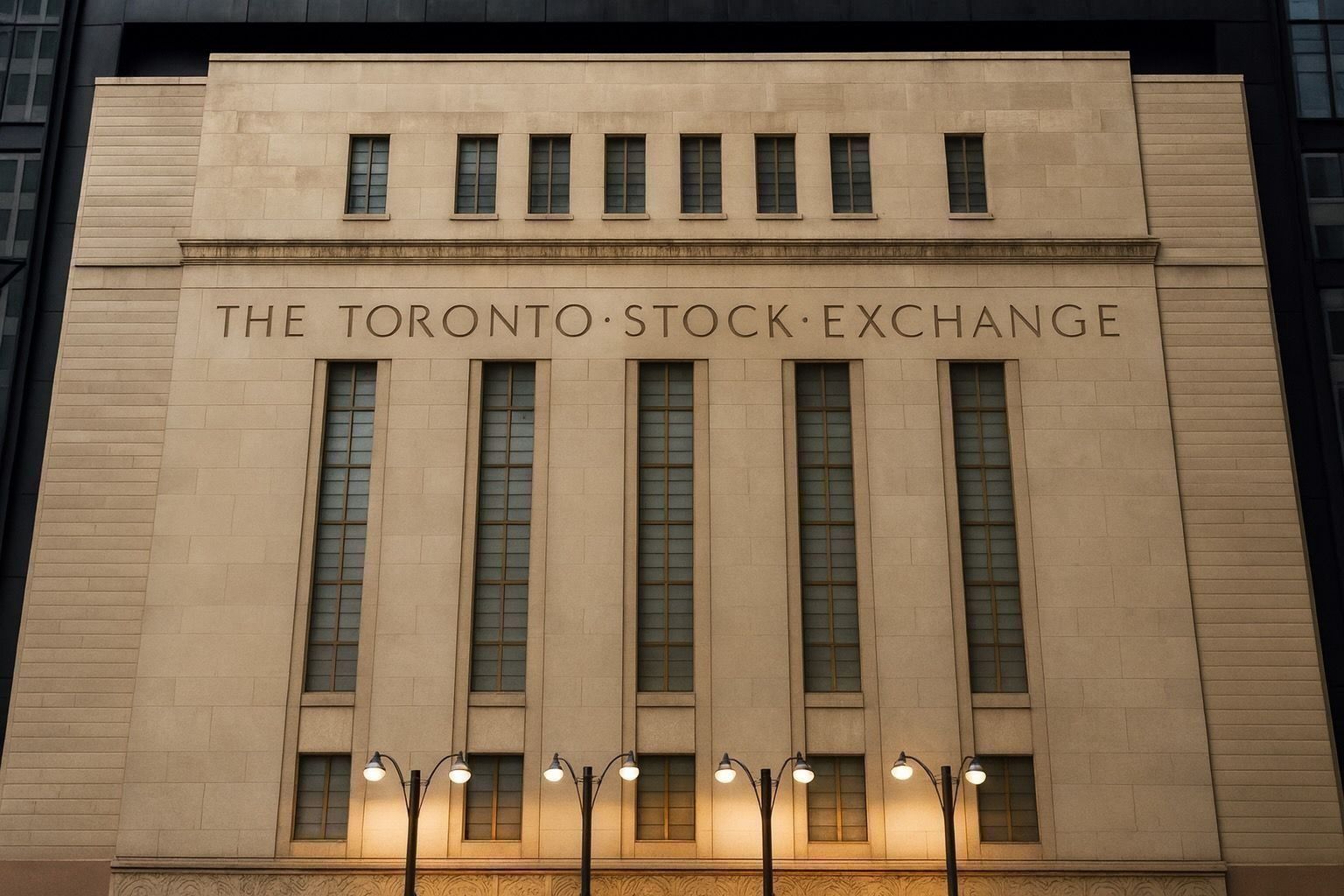
TORONTO — Canada’s S&P/TSX Composite heads into the week of Dec. 15–19, 2025 with momentum still broadly intact—but with a sharper spotlight on inflation and consumer demand after a volatile, headline-heavy stretch that included a Bank of Canada hold, a U.S. Federal Reserve rate cut, record highs, and a tech-led pullback.
The TSX finished Friday at 31,527.39, down 0.4% on the day but up 0.7% on the week, after Thursday’s record close was followed by a drop in technology shares and an outsized surge in cannabis names.
What happens next may hinge on a familiar December question: Is inflation cooling enough to keep rate expectations anchored—without cooling growth too much? With Canadian CPI due Monday and retail sales due Friday, investors will be watching whether the holiday-period rally can extend into thinner, year-end liquidity.
What moved Canadian stocks this week (Dec. 8–13): central banks, metals, and a tech reality check
The week began with a cautious tone as investors positioned for policy decisions on both sides of the border. On Monday, the TSX closed down 141.44 points (0.45%) at 31,169.97, with profit-taking and a wait-and-see approach ahead of the Bank of Canada and Fed meetings.
By Tuesday, the story pivoted back to the TSX’s commodity DNA. The index rose 0.2% to 31,244.37, led by materials as silver jumped 4.5% to a record high, while investors also digested a major mining deal milestone: Anglo American and Teck Resources shareholders approved their previously announced merger, leaving regulatory approvals as the final hurdle.
Wednesday delivered the week’s marquee catalyst: central bank decisions. The TSX ended up 0.8% at 31,490.85, a record close at the time, after the Bank of Canada held its benchmark rate at 2.25% and the Federal Reserve cut rates by a quarter-point while signaling a likely pause consistent with expectations.
Thursday pushed the benchmark to another record close. The TSX finished up 0.5% at 31,660.73, helped by metals and “upbeat domestic economic data,” including Canada’s swing to a September trade surplus after seven straight monthly deficits. In Reuters’ reporting, portfolio manager Elvis Picardo framed the TSX as a “diversified play” this year, with gains spread across financials, energy, technology, and materials—a contrast to the U.S. market’s heavier concentration in tech. Reuters
Friday’s pullback was driven by tech, with a cross-border echo from U.S. AI valuation concerns. Reuters noted technology fell 3.4%, including Celestica down 12.9%, while healthcare surged largely on cannabis strength after a report about potential U.S. policy shifts.
Bank of Canada vs. the Fed: why “policy divergence” is back in focus
The Bank of Canada’s decision to hold the overnight rate at 2.25% set a steady domestic policy backdrop, even as the central bank acknowledged ongoing uncertainty tied to U.S. trade protectionism and a volatile global environment.
In its Dec. 10 communication, the BoC pointed to:
- Q3 GDP growth of 2.6% (stronger than expected, largely reflecting trade volatility),
- an improving labour market, with the unemployment rate at 6.5% in November, and
- inflation that has been close to the 2% target for more than a year, even though core measures remain higher.
Crucially for markets, the BoC also cautioned that near-term CPI could be “choppy” and temporarily higher, partly due to base effects linked to last year’s GST/HST holiday. Bank of Canada
Meanwhile, Reuters reported the Canadian dollar posted a third straight weekly gain, supported by investor expectations that the BoC is done cutting while the Fed continues easing—an outlook that can shift sector leadership on the TSX by moving the loonie, yields, and commodity-linked cash flows.
The Canada stock market week ahead: key catalysts (Dec. 15–19)
Here are the high-impact Canadian events investors are watching next week, based on bank previews and market calendars:
Monday, Dec. 15: Canadian CPI and housing data — the week’s first big test
- CPI (Nov.) is due Monday morning. Reuters highlighted an expectation of 2.3% year-over-year inflation for November ahead of the release.
- RBC Economics expects headline CPI to hold at 2.2% (unchanged from October), with ex-food-and-energy inflation at 2.7% and core measures staying near the upper end of the target range.
- CIBC Capital Markets’ week-ahead calendar shows consensus CPI Y/Y at 2.3% and CPI M/M at 0.1% for November.
- Housing and manufacturing data also land Monday, including housing starts and manufacturing shipments (per CIBC’s calendar).
Why it matters for TSX investors:
A CPI print that’s meaningfully hotter than expected can push bond yields higher and pressure rate-sensitive segments. A softer print can support sentiment—but may also revive debate about growth durability. Either way, it’s a volatility trigger in thin December markets.
Tuesday, Dec. 16: Governor Macklem speech + market plumbing
Scotiabank flagged a Governor Tiff Macklem speech on Tuesday with a full press conference—an event that can shape how investors interpret the BoC’s “hold” posture and its tolerance for near-term inflation noise. Scotiabank
CIBC’s calendar also lists Macklem as a scheduled speaker Tuesday. CIBC Wood Gundy
Thursday, Dec. 18: Employment/payroll detail
RBC highlighted the Survey of Employment, Payrolls and Hours (SEPH) as a key check on labour-market momentum, noting past divergences versus the Labour Force Survey. RBC
CIBC’s calendar also includes payroll/employment/earnings/hours on Thursday.
Friday, Dec. 19: Retail sales and the consumer reality check
CIBC’s calendar points to retail trade (Oct.) on Friday, including total retail trade and ex-auto, with house forecasts and consensus shown. CIBC Wood Gundy
Scotiabank also highlighted retail sales as important for tracking consumer spending.
Watch the U.S. data catch-up: why it still matters for Bay Street
Even if the week is “Canada-first” on the calendar, U.S. releases could dominate global risk sentiment.
RBC expects overdue U.S. inflation and payroll reports as the U.S. works through a backlog after a prolonged government shutdown, and it lays out forecasts for:
- U.S. payrolls around 90,000 per month for October and November,
- core U.S. CPI holding around 3% year-over-year, and
- the Fed potentially delivering one more 25 bps cut in January before pausing.
Scotiabank similarly warned that two U.S. payroll reports, U.S. CPI, and U.S. retail sales would “catch up” from the shutdown-related backlog—global inputs that can spill into TSX leadership, especially in tech, financials, and commodities. Scotiabank
Sector playbook: where Canadian investors may see the biggest moves
Materials and miners: still the TSX’s tailwind—if metals stay firm
This week reinforced how quickly the TSX can respond to metals: silver’s record move helped lift materials early in the week, and Thursday’s rally featured strength tied to rising gold and copper prices. Reuters+1
If global growth fears re-emerge or the U.S. dollar strengthens sharply, that tailwind can fade quickly.
Deal watch: The Anglo–Teck merger approval is a reminder that large-scale mining M&A remains a live theme—important for index performance given materials’ weight.
Energy: oil prices matter, but geopolitics and macro signals are the bigger drivers
Oil settled around the high-$50s this week in Reuters reporting, and energy shares were mixed even as the TSX reached record highs—illustrating that energy is not always the lead domino in a diversified rally.
Financials: supported by a steady BoC, but sensitive to CPI surprises
Financials participated in the post-central-bank rally, and they remain central to any “soft landing” narrative—especially if inflation data keeps policy expectations stable. Reuters+1
Technology: sentiment can swing fast in an AI-valuation tape
The late-week drop showed how quickly “AI skepticism” can cross the border. Canadian Press reporting highlighted Celestica’s sharp decline tied to AI concerns and U.S. mega-cap volatility. Advisor.ca+1
For TSX tech, the near-term question isn’t only earnings—it’s whether global markets keep rewarding high-multiple growth into year-end.
Consumer and retail: Dollarama’s results underline a split economy
Dollarama raised its annual sales outlook after beating quarterly expectations, pointing to steady demand from price-sensitive consumers in a still-inflation-conscious environment. Reuters
That theme makes next week’s retail sales data especially important: it can validate (or challenge) the idea that consumers are coping—just differently across income brackets.
Cannabis: headline-driven, high-volatility exposure
Cannabis stocks were the week’s “outlier” trade. Canadian Press reporting cited large one-day moves in Tilray and Canopy Growth after reports of potential U.S. policy easing. Advisor.ca
This remains a sector where newsflow can overwhelm fundamentals in the short run, making risk management crucial for anyone trading it.
Three scenarios to watch after Monday’s CPI
- CPI comes in hotter than expected (inflation re-acceleration fears):
Bond yields can rise, the loonie can strengthen, and rate-sensitive equities can wobble—even if the BoC remains on hold. The TSX may rotate toward cash-flow-heavy names and away from high-multiple growth. - CPI lands near expectations (status quo holds):
This is the “extend the rally” setup—especially with the BoC stressing inflation near target while acknowledging short-term choppiness. Bank of Canada - CPI surprises to the downside (disinflation wins):
Risk assets often like softer inflation, but a big downside miss can also rekindle concerns that demand is weakening faster than the BoC expects—raising sector dispersion.
Bottom line: the TSX enters a pivotal December week with records in sight—and CPI in the driver’s seat
Canada’s stock market closes this stretch near record territory after a week where monetary policy delivered clarity, commodities delivered support, and technology delivered a reminder that valuation still matters.
For the week ahead, the checklist is straightforward:
- Monday’s inflation print (and how it reshapes rate expectations),
- signals on the consumer via Friday retail sales and the broader data pulse,
- commodities and currency moves, which remain decisive for a resource-heavy index,
- and U.S. data catch-up volatility, which can spill over into Canadian tech and overall risk appetite.
As always, liquidity can thin into the holidays—meaning surprises may travel further than usual, in both directions.
This article is for informational purposes only and is not investment advice.