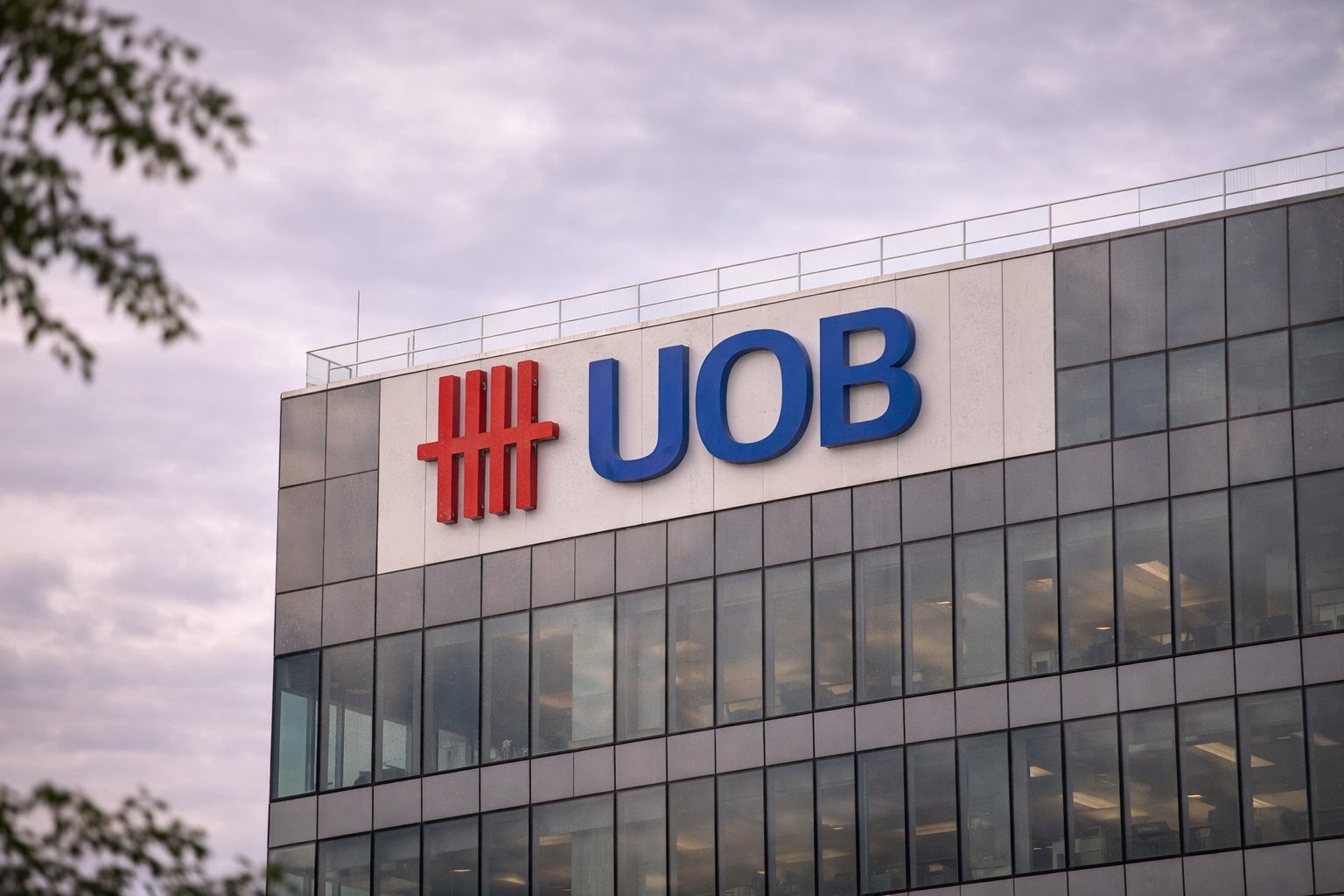
Singapore, February 2, 2026, 15:03 SGT — Regular session
- Shares of United Overseas Bank dipped in afternoon trading, tracking the softer broader market in Singapore.
- Gold and silver took a steep dive, unsettling risk assets throughout Asia and driving investors to seek safety in cash.
- Traders are eyeing UOB’s full-year results later this month, seeking hints on margins and credit costs.
Shares of United Overseas Bank Limited dipped Monday afternoon amid a sharp drop in precious metals that spilled over into Asian equities. By 2:48 p.m. local time, the stock had fallen 18 Singapore cents, or 0.47%, to S$38.09. Trading ranged from S$38.05 to S$38.55 on volume of roughly 1.8 million shares.
The scene was chaotic and quick to unfold. Gold and silver continued last week’s steep drop, triggering margin calls that forced investors to add cash to maintain positions. That soured sentiment across the board, sending the Asia-Pacific equity index outside Japan down as much as 2.8%. This week also features key central bank meetings and major economic reports, events that can swiftly shift rate expectations.
“It’s risk off and de-leveraging—a flushing out of leverage in the system,” said Christopher Forbes, head of Asia and Middle East at CMC Markets. Mark Matthews from Julius Baer noted that metals prices “had already gone parabolic,” adding: “Once profit taking started, it just snowballed.” Reuters
Singapore’s benchmark Straits Times Index slipped 0.79% to 4,866.3 in delayed trading. Banking giants moved lower alongside it. DBS Group Holdings Ltd dropped 1.03% to S$58.59, and Oversea-Chinese Banking Corp slid 1.37% to S$20.94.
UOB is turning its focus to earnings season. According to a Singapore Exchange filing, the bank will publish its full-year 2025 financial results on Feb. 24, ahead of market open.
Investors are zeroing in on the net interest margin — the difference between what banks earn on loans and pay on deposits — for clues of strain amid shifting rate expectations. Loan growth, fee income, and provisions for bad loans will also be closely monitored.
The metals sell-off carries a straightforward mechanical risk: ongoing liquidations could weigh on stocks, even absent new company updates. Banks often behave like “macro” plays in these scenarios, moving with shifts in bond yields and currency fluctuations.
The downside isn’t the whole story. If forced selling eases and volatility calms, financials might find their footing fast, particularly as earnings approach. Those results could either reset expectations or disappoint, depending on how margins and credit costs shake out.
UOB’s FY25/4Q25 results, set for release on Feb. 24, stand out as the next major catalyst, according to the bank’s investor-relations calendar.