
Austin, August 11, 2026, 08:20 EDT
- Second-quarter sales rose 89.7% to $33.9 million, beating the FactSet consensus by 7.6%.
- The adjusted loss was $0.07 a share, versus the $0.26 loss analysts expected.
- Third-quarter sales guidance of $36 million to $37 million also topped Wall Street’s view.
- Management expects second-half sales to more than double, but chip supply is tight.
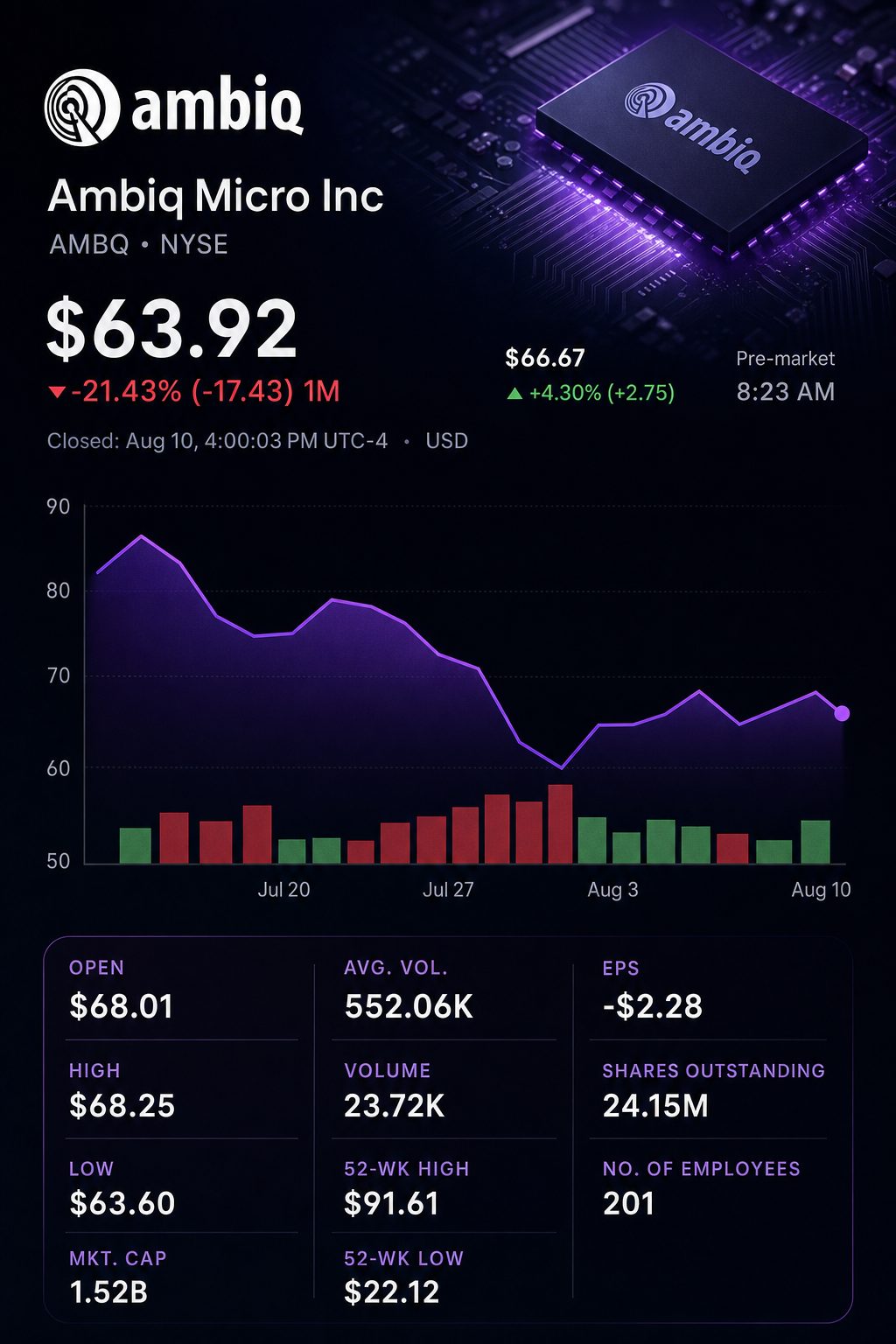
Ambiq Micro, Inc. NYSE:AMBQ delivered a clean beat-and-raise quarter before Tuesday’s open. The edge-AI chipmaker paired 90% sales growth with a smaller loss. Its shares rose 6% to $67.75 in premarket trading.
The numbers shift the investor debate. Demand is no longer the main uncertainty. Supply and conversion now matter more.
Ambiq beat FactSet’s second-quarter sales estimate by $2.4 million. Its adjusted loss was 19 cents narrower than expected. The midpoint of third-quarter sales guidance was 7.4% above consensus.
| Measure | Company result or guide | FactSet consensus | Difference |
|---|---|---|---|
| Q2 net sales | $33.9 million | $31.5 million | 7.6% above |
| Q2 adjusted EPS | -$0.07 | -$0.26 | $0.19 better |
| Q3 sales, midpoint | $36.5 million | $34.0 million | 7.4% above |
| Q3 adjusted EPS, midpoint | -$0.16 | -$0.27 | $0.11 better |
The quarter also showed better operating leverage. GAAP gross margin widened 4.9 percentage points from a year earlier. The non-GAAP loss fell by $4.1 million.
| Quarterly measure | Q2 2026 | Q1 2026 | Q2 2025 |
|---|---|---|---|
| Net sales | $33.901 million | $25.060 million | $17.873 million |
| GAAP gross margin | 45.0% | 43.5% | 40.1% |
| GAAP net loss | $7.115 million | $10.171 million | $8.496 million |
| Non-GAAP net loss | $1.772 million | $5.046 million | $5.862 million |
Chief Executive Fumihide Esaka put the constraint plainly. “Given the rapid acceleration in AI demand, we and the broader semiconductor industry are facing supply constraints.” The company still expects second-half sales to more than double from last year. Ambiq
That makes the June stock offering more relevant than simple dilution math. Ambiq raised about $168 million after fees. Cash reached $366.8 million at June 30.
Working capital rose with the order book. Inventory increased 73% in six months. Receivables more than doubled, while first-half operating cash use almost doubled. Those movements suggest a faster build, not yet a self-funding one.
| Balance-sheet or cash-flow measure | June 30, 2026 | Comparison period | Change |
|---|---|---|---|
| Cash and equivalents | $366.774 million | $140.275 million at Dec. 31 | +161.5% |
| Inventory | $29.365 million | $16.937 million at Dec. 31 | +73.4% |
| Accounts receivable | $17.528 million | $7.286 million at Dec. 31 | +140.6% |
| Six-month operating cash use | $20.678 million | $10.549 million a year earlier | +96.0% |
The growth pattern began before this quarter. In May, Needham analyst Quinn Bolton said, “The company is seeing uplift across both units and ASPs, though unit growth remains the larger driver.” Ambiq’s first-quarter sales had risen 59%. Investor’s Business Daily
Wall Street’s targets show how much execution is already in question. The latest published calls span $44 to $125. The four cited recommendations all predate Tuesday’s results.
| Date | Firm and analyst | Recommendation | Price target |
|---|---|---|---|
| July 14, 2026 | Roth Capital — Suji Desilva | Buy | $125 |
| May 13, 2026 | UBS — Timothy Arcuri | Neutral | $70 |
| May 12, 2026 | Needham — Quinn Bolton | Buy | $70 |
| April 21, 2026 | Northland — Gus Richard | Outperform | $44 |
Ambiq remains young as a public company. It priced its July 2025 initial offering at $24. Shares later reached an intraday high of $91.61 on June 18, then retreated during a wider semiconductor selloff.
The previous week left the stock below that peak and short of key moving averages. Tuesday’s premarket gain only recovered part of the decline. The regular New York session had not opened at publication time.
Risks: Ambiq is still loss-making and depends on external manufacturing. Supply limits could delay sales. A richer product mix could also reverse, while the larger share count from the offering dilutes per-share gains.
The week ahead offers a direct test. Ambiq needs only 7.7% sequential growth to reach the third-quarter midpoint. Yet its second-half pledge requires sustained acceleration. Capacity, not demand, now sets the ceiling.
Related articles: Semiconductors