
NEW YORK, August 14, 2026, 07:23 EDT — U.S. markets are in premarket trading.
The Cboe Volatility Index stood at 14.6 before Friday’s open. That reading prices an approximate 0.92% one-standard-deviation daily move for the S&P 500. It is a notably calm signal after Thursday’s record close.
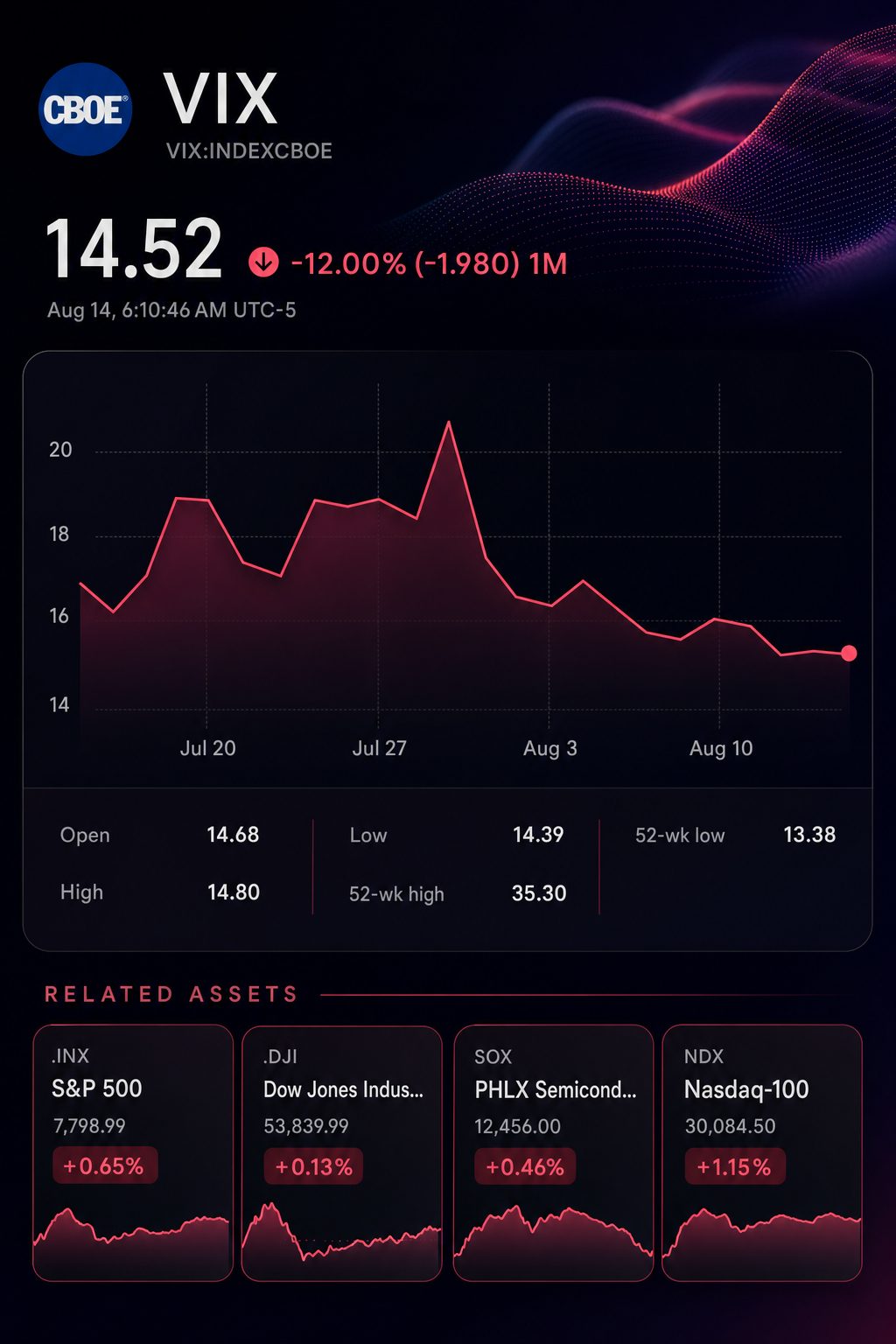
The investor angle is the gap between event risk and option prices. The VIX is heading for a fourth weekly fall, its longest such run since May 2025. Yet geopolitical risks remain active, while policy guidance is scarce.
| Premarket measure | Latest indication | Investor read-through |
|---|---|---|
| Cboe VIX | 14.6, flat | Sub-1% implied daily S&P move |
| S&P 500 futures | Flat | Pause after a record close |
| Nasdaq-100 futures | Flat | Growth shares holding steady |
| Dow futures | Down 0.1% | Blue chips lag modestly |
| S&P 500, Thursday | 7,798.99, up 0.65% | 27th record close of 2026 |
Cboe defines the VIX as a 30-day, annualized expectation. It derives the reading from real-time prices for S&P 500 options. A VIX near 16 corresponds to roughly 1% daily volatility.
| Horizon | Implied one-standard-deviation move | S&P 500 points from 7,798.99 |
|---|---|---|
| One trading day | 0.92% | About 72 points |
| Five trading days | 2.06% | About 160 points |
| 21 trading days | 4.21% | About 329 points |
| One year | 14.60% | About 1,139 points |
The daily translation matters more than the headline level. A 0.92% move equals roughly 72 S&P points from Thursday’s close. That is the option market’s one-sigma yardstick, not a promised trading range.
| VIX scenario | Implied daily move | Approximate S&P points | Change versus 14.6 |
|---|---|---|---|
| 14.6 current | 0.92% | 72 | Baseline |
| 16 | 1.01% | 79 | 7 points wider |
| 20 | 1.26% | 98 | 26 points wider |
| 30 | 1.89% | 147 | 75 points wider |
Thursday’s tape helps explain the calm. Moderating wholesale inflation eased rate fears. The S&P 500 rose 0.65%, while the Nasdaq Composite gained 0.81%.
Earnings have also absorbed macro shocks. About 85% of reporting S&P 500 companies have beaten earnings estimates, according to LSEG data cited by Reuters. Profits rose 32.7% after excluding two mark-to-market gains.
Analyst recommendations and positioning calls
| Strategist | Recommendation or stance | Evidence cited |
|---|---|---|
| Mike Howell, CrossBorder Capital | Allocate more defensively; reduce credit risk and favor commodities and gold | He argues global liquidity has peaked |
| Andy Pratt, Burney Company | Stay constructive on equities | More upside guidance and limited guidance cuts |
| Chris Grisanti, MAI Capital Management | Remain equity-positive while earnings hold | Strong balance sheets support large AI investment |
| John Sidawi, Federated Hermes | Keep tail-risk protection in view | Current low risk premiums may not persist |
The disagreement is useful. Howell sees weaker liquidity and favors defense. Pratt and Grisanti see earnings strength carrying more weight. Sidawi says the low-volatility equilibrium is unlikely to last.
“Markets appear willing to tolerate a significant amount of uncertainty,” Sidawi said. His warning is that escalation could trigger a larger volatility response than markets now price. Reuters
Friday’s first test arrives with the cash open. Flat futures suggest no broad retreat. However, the 14.6 VIX leaves less room for surprises than a higher-volatility regime would.
Risks: The VIX is not a directional forecast and cannot be bought directly. Futures and exchange-traded products can diverge from the spot index. A sharp policy, earnings or geopolitical shock can also reprice options within minutes.
Related articles: Stock Market