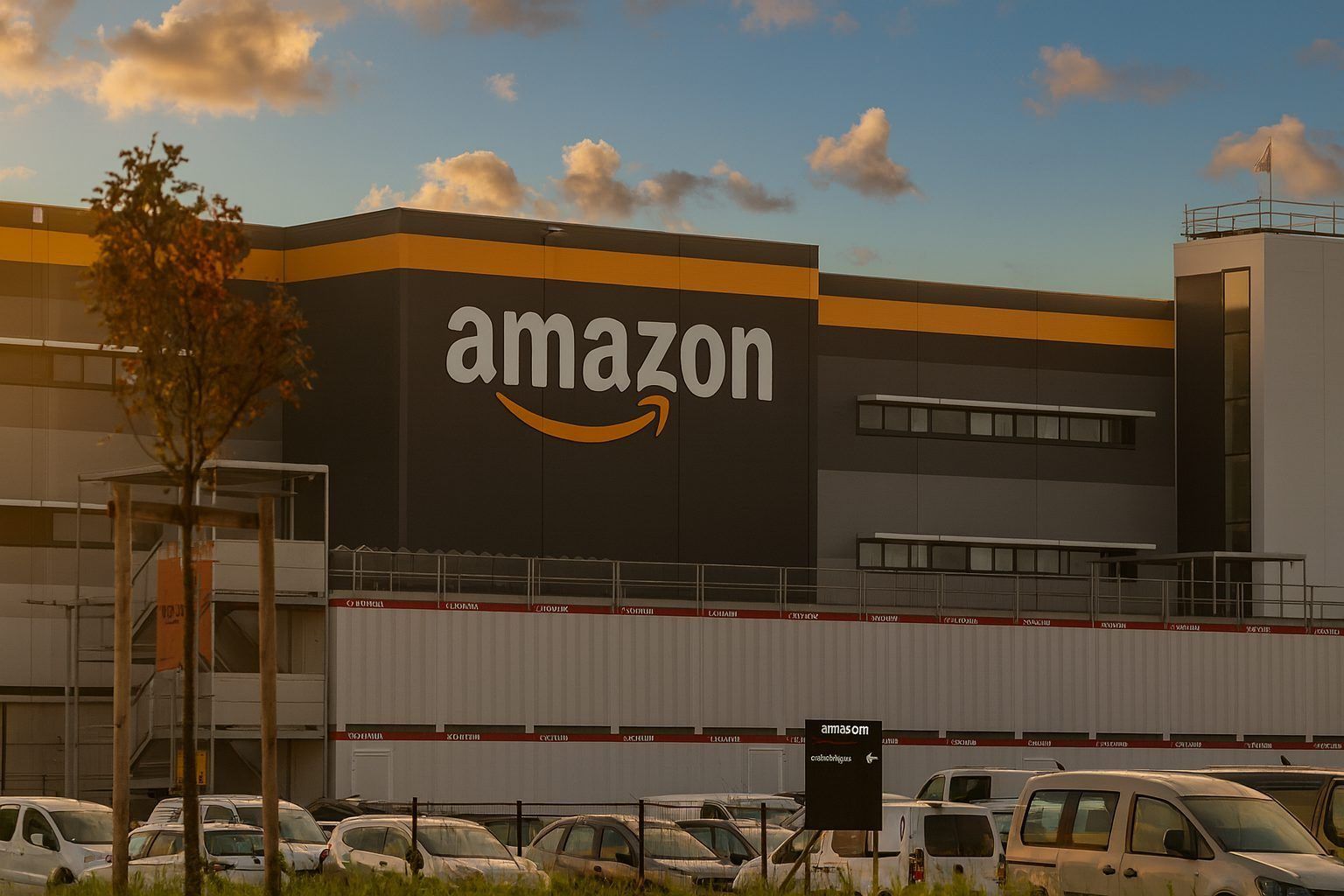
Amazon.com, Inc. (NASDAQ: AMZN) is back at the center of Wall Street’s AI and e‑commerce story. On Wednesday, December 3, 2025, investors are digesting a flood of news from AWS re:Invent, new ultrafast delivery pilots, and another round of bullish analyst upgrades that push some price targets well above $300 per share.
Amazon Stock Today: Price, Valuation, and Recent Performance
As of late morning trading in New York on December 3, Amazon shares change hands around $232 (AMZN), down roughly 1% on the day. That gives the company a market capitalization of about $2.48 trillion. Over the last twelve months, the stock has traded between $161.38 and $258.60. StockAnalysis
On a trailing twelve‑month basis, Amazon has generated about $691.3 billion in revenue and $76.5 billion in net income, for earnings per share of $7.08 and a P/E ratio near 33 (forward P/E just above 31). StockAnalysis
Despite those hefty profits and a huge AI narrative, Amazon has been a relative laggard among the “Magnificent Seven” in 2025. MarketWatch/Morningstar data cited in recent coverage show the stock up only mid‑single digits year‑to‑date, even after a strong rebound from the 2022–2023 tech slump. TS2 Tech
In other words, the business looks much stronger than it did a few years ago—but the share price hasn’t fully reflected that yet, which is exactly what many analysts are trying to capitalize on.
Q3 2025: AWS Re‑Accelerates and the “Core Engine” Roars Back
Much of today’s bullishness traces back to Amazon’s Q3 2025 earnings, reported on October 30:
- Revenue: $180.17 billion, up about 13.4% year over year (above Wall Street expectations).
- EPS: $1.95 vs. $1.57 expected.
- The stock jumped roughly 9–11% on the results. Reuters
Within those numbers, Amazon Web Services (AWS) is the star:
- Q3 AWS revenue climbed to about $33 billion, up 20.2% year over year, a clear re‑acceleration after a slower period. Reuters
- A recent Seeking Alpha analysis notes AWS produced $11.4 billion in operating income and now sits on an AI‑driven backlog of roughly $200 billion, reflecting large, multi‑year cloud and AI commitments. Alphaspread
Meanwhile, Amazon’s advertising business has grown into a second profit engine: ad revenue reached roughly $17.7 billion in Q3, up more than 20% year over year, while first‑party retail grew at a slower pace. Reuters
Industry data compiled by Marketplace Pulse and others show that only about 40% of Amazon’s revenue now comes from first‑party retail, with around 60% from higher-margin services such as AWS, advertising, marketplace fees, and subscriptions—a mix that structurally supports stronger profitability than in Amazon’s earlier, mostly‑retail era. TS2 Tech
AWS re:Invent 2025: Trainium3 Chips, AI Factories, and “Frontier Agents”
This week’s AWS re:Invent 2025 conference in Las Vegas is the single biggest short‑term catalyst for AMZN. Amazon used the event to showcase an aggressive push in custom AI chips, agentic AI, and hybrid cloud infrastructure.
Trainium3 and Trainium4: Amazon’s AI Chip Offensive
At re:Invent, AWS announced the Trainium3 AI chip and new EC2 Trn3 UltraServers powered by its first 3‑nanometer AI accelerator: Reuters
- Trainium3 UltraServers pack 144 chips per server, delivering over 4x the performance of the prior generation while using about 40% less power for large AI training workloads.
- The chips are already being used by early customers to cut AI training costs and speed up deployment of large models. Investors
Looking ahead, AWS also plans a Trainium4 chip that will incorporate Nvidia’s NVLink Fusion interconnect, tightening Amazon’s partnership with Nvidia even as it competes with Nvidia’s own GPUs. Reuters
Analysts at outlets like Invezz and Bloomberg say Trainium3 is a clear attempt to chip away at Nvidia’s dominance in high‑end AI hardware, but note that Amazon is pursuing a hybrid strategy: expanding its own silicon while still offering state‑of‑the‑art Nvidia platforms on AWS. Invezz
AWS AI Factories: On‑Prem AI for Regulated Customers
AWS also unveiled AI Factories—a new offering that lets enterprises and governments deploy AWS’s full AI stack inside their own data centers: TradingView
- AI Factories bundle Nvidia’s accelerated computing platform, Trainium chips, AWS networking, and AI services into dedicated infrastructure.
- Customers provide floor space, power, and basic networking; AWS designs, deploys, and operates the integrated AI environment.
For organizations with strict data sovereignty or regulatory requirements, this hybrid approach is viewed as a way to adopt cutting‑edge AI while keeping data physically on‑premises.
Nova 2 Models, Nova Forge, and Nova Act
Amazon is also expanding its Nova family of foundation models and tools: About Amazon
- Nova 2 Lite & Nova 2 Pro: general‑purpose multimodal models for reasoning, code, and agentic workflows, with competitive benchmark performance versus leading models from OpenAI, Google, and Anthropic.
- Nova 2 Sonic: a speech‑to‑speech model for real‑time conversational AI.
- Nova 2 Omni: a high‑end multimodal model that can handle long documents, audio, and video in a single workflow.
The new Nova Forge service lets enterprises build their own “frontier” variants of Nova by mixing proprietary data into training checkpoints. Customers gain early access to Nova 2 Pro and Omni and can use reinforcement learning and custom safety tooling to tailor models to their business. Amazon Web Services, Inc.
Complementing that, Nova Act provides tools for building highly reliable browser‑automation agents, with Amazon claiming around 90% success rates on early customer workflows like CRM updates, website testing, and insurance claims handling. About Amazon
“Frontier Agents”: Long‑Running AI Co‑Workers
Finally, AWS introduced “frontier agents”, a new class of autonomous agents designed to work for hours or even days on complex tasks: The Wall Street Journal
- Kiro autonomous agent focuses on software development, learning each team’s coding standards and operating as a virtual developer.
- AWS Security Agent scans code and infrastructure for security issues and suggests fixes.
- AWS DevOps Agent automates deployment and operational tasks.
TechCrunch’s coverage highlights AWS CEO Matt Garman’s claim that Kiro can be assigned a complex task from the backlog and carry it through largely independently, maintaining persistent context over time. TechCrunch
Overall, the re:Invent rollout is widely interpreted as Amazon’s statement that it intends to close any perceived AI gap with Microsoft Azure and Google Cloud by offering a full stack: chips, models, agents, and hybrid infrastructure.
Logistics and Retail: 30‑Minute “Amazon Now” Delivery and the Bazaar Push
Amazon’s stock story isn’t just about data centers and AI chips—its core commerce and logistics engine is still evolving fast.
“Amazon Now” 30‑Minute Deliveries
A new ultrafast delivery pilot, branded Amazon Now, is being tested in Seattle and Philadelphia. According to Business Insider, customers in those markets can order from thousands of everyday items—diapers, milk, pet food, electronics—and receive them in 30 minutes or less. Business Insider
The program uses nearby warehouses where items are picked and bagged, then handed off to Amazon Flex drivers, who must depart within about two minutes of accepting an order. Amazon has also expanded its same‑day service to roughly 4,000 additional smaller U.S. communities this year. Business Insider
Logistics experts quoted in the same report warn that pushing below a 30‑minute window would require a massive increase in fulfillment centers, inventory, and drivers, raising questions about long‑term economics. Still, the test underscores Amazon’s determination to push the frontier on delivery speed—a key component of its competitive moat against Walmart and emerging ultra‑fast services.
Amazon Bazaar: Low‑Cost Global Expansion
On the retail side, Amazon has been expanding Amazon Bazaar, a low‑cost marketplace (called “Haul” in the U.S.) offering items priced as low as $2–$10 to compete with fast‑fashion giants Shein and Temu. CoinCentral
Recent reporting notes that:
- Bazaar has expanded into 14 additional international markets, including countries like Hong Kong, the Philippines, Nigeria, and Taiwan.
- Q3 2025 international revenue rose around 10% year over year to about $40.9 billion. CoinCentral
Analysts see Bazaar as a long‑term play for emerging markets and cost‑conscious consumers—one that leverages Amazon’s logistics and compliance infrastructure at a time when new tariffs and import rules are squeezing some overseas rivals. CoinCentral
Mega‑Cap Capex: Amazon’s $125B AI Spend and $50B Government Cloud Bet
Behind all the AI announcements is a huge bill.
Following Q3, multiple analyses and management commentary indicate Amazon expects around $125 billion in capital expenditures for full‑year 2025, up sharply from prior years, with even more planned for 2026—much of it tied to AI and data center capacity. Substack
A key piece of that strategy is a landmark commitment to U.S. federal AI and supercomputing:
- In late November, Amazon announced plans to invest up to $50 billion to expand AI and high‑performance computing infrastructure for U.S. government agencies. Inside HPC & AI News
- The multi‑year buildout will add roughly 1.3 gigawatts of secure compute capacity across AWS Top Secret, Secret, and GovCloud regions, giving federal customers tighter access to services like SageMaker, Bedrock, Nova, Anthropic Claude, and Trainium‑based hardware. Inside HPC & AI News
- AWS already serves more than 11,000 government agencies worldwide, reinforcing its entrenched position in public‑sector cloud. Data Centre Magazine
This AI/HPC mega‑build could be a powerful long‑term revenue driver—but also heightens near‑term pressure on free cash flow and margins, a central concern for more cautious investors.
Wall Street Today: Strong Buy Consensus and $300+ Price Targets
Fresh Analyst Moves on December 3, 2025
The re:Invent news cycle has brought another wave of price‑target hikes and reiterated “Buy” ratings:
- Bank of America reiterated a Buy rating and raised its price target from $272 to $303, implying roughly 30% upside from current levels. GuruFocus
- Cantor Fitzgerald reaffirmed an Overweight rating and a $315 target, highlighting the pace of AWS’s AI roll‑outs and the broader “Strong Buy” consensus across the Street. TS2 Tech
- Stifel Nicolaus recently boosted its target to $295 while maintaining a Buy, citing renewed confidence in AWS growth as data‑center capex feeds into higher‑margin cloud revenue. Investing
- Wells Fargo raised its target to $295, arguing that if industry supply constraints persist, Amazon’s plan to double AWS capacity by 2027 could add as much as $150 billion in annual revenue longer term. 24/7 Wall St.
- Other firms—including Morgan Stanley, Goldman Sachs, Barclays, HSBC, Oppenheimer, Mizuho, Bernstein, and Loop Capital—have targets generally clustered between the high‑$200s and mid‑$300s, with Loop Capital notably at $360, one of the highest on the Street. MarketBeat
Consensus Forecasts
Several independent datasets converge on a broadly bullish outlook:
- StockAnalysis: 46 analysts rate AMZN a “Strong Buy” with an average 12‑month target of $282.54, about 22% upside from today’s price. StockAnalysis
- MarketBeat: “Moderate Buy” consensus (overwhelmingly Buy/Strong Buy) and a mean target around $296.11. MarketBeat
- Nasdaq / Fintel: average target roughly $294.40 (high near $369, low around $229), implying about 26% upside at recent trading levels. Nasdaq
- GuruFocus: survey of 71 analysts shows an average target near $290, with some top‑end estimates at $360. GuruFocus
- TipRanks (via recent coverage): around mid‑$290s average, with almost all ratings at Buy or Strong Buy and very few holds, no notable sells. TipRanks
Some research, including a MarketWatch/Morningstar note titled along the lines of “How Amazon’s stock could soar 30% thanks to its cloud business,” explicitly argues that AWS’s AI‑driven growth alone could justify about 30% upside from current levels. TS2 Tech
Alternative Takes: AI Models Forecasting AMZN
Even AI‑driven research is getting in on the action. A new Finbold “AI Agent” analysis published today attempts to predict Amazon’s 2026 stock price after the Trainium3 chip launch, suggesting meaningful upside if Amazon successfully leverages its custom AI hardware strategy. While the piece is more of a thought experiment than rigorous valuation work, it reflects how AI expectations are themselves feeding into sentiment on AMZN. Finbold
What Other Analysts and “Smart Money” Are Saying
Commentary from long‑term investors and hedge funds adds texture to the story:
- A Motley Fool piece titled “2 Reasons I’ll Never Sell Amazon Stock” underscores the company’s dual engines—e‑commerce and AWS—plus its decade‑long return of more than 500%, framing AMZN as a classic long‑term compounder rather than a short‑term trade. StockAnalysis
- Contrasting that, a recent Seeking Alpha article, “Amazon: Better But Still Losing Ground (Rating Upgrade)”, upgraded the stock but stresses that Amazon still appears to be ceding some AI mindshare to Microsoft and Google, and notes that Q4 guidance looks relatively soft, suggesting the rebound is not risk‑free. Hotcandlestick
- On the fund‑flow side, a report relayed by Finviz notes that billionaire David Tepper’s Appaloosa fund trimmed its Amazon position by about 7.4% in Q3, even as Wall Street analysts stayed overwhelmingly bullish. Importantly, Amazon remains one of Appaloosa’s top holdings, so the move looks more like portfolio reshaping than a wholesale bearish call. Finviz
- At the same time, filings tracked by MarketBeat show firms like Golden State Wealth Management and other institutions increasing their AMZN stakes, and overall institutional ownership sits above 70%. MarketBeat
Bull Case vs. Bear Case for Amazon Stock in Late 2025
Bull Case: Why Many See 20–30% Upside
Supporters of AMZN today tend to focus on a few key themes: TS2 Tech
- Re‑accelerating AWS, powered by AI
- 20%+ growth, a $200B backlog, and expanding AI partnerships (Anthropic, government clouds) suggest a multi‑year upcycle in high‑margin cloud revenue.
- Shift toward high‑margin services
- With the majority of revenue from services (AWS, advertising, marketplace, subscriptions), incremental dollars increasingly drop to the bottom line.
- AI chips and full‑stack differentiation
- Trainium3, Nova models, frontier agents, and AI Factories position AWS as a “full‑stack” AI platform rather than a commodity infrastructure provider.
- Logistics and retail moat
- Initiatives like 30‑minute Amazon Now delivery and the global Bazaar rollout deepen Amazon’s hold on both convenience and value‑conscious shoppers. Business Insider
- Government and enterprise tailwinds
- The $50B AI/HPC commitment for U.S. federal agencies and broader enterprise adoption of Nova and Bedrock could lock in long‑duration, mission‑critical workloads. Inside HPC & AI News
Bear Case: What Could Go Wrong
Skeptics aren’t short on concerns: LinkedIn
- Massive capex and cash‑flow pressure
- With capex around $125B in 2025 and rising, free cash flow has been squeezed. If AI demand or pricing disappoints, Amazon could be left with under‑utilized infrastructure.
- Intense cloud and AI competition
- Microsoft and Google have moved faster in some generative‑AI use cases and boast strong model ecosystems. Re:Invent narrows the gap, but doesn’t eliminate multi‑cloud or rival‑cloud risk. WIRED
- Regulatory and ESG headwinds
- Ongoing antitrust scrutiny, labor disputes, and questions about the environmental impact of data‑center build‑outs remain unresolved. WIRED
- Valuation and macro risk
- At ~33x trailing earnings and heavily exposed to consumer spending and digital ad budgets, Amazon could underperform if the economic backdrop weakens or if the AI investment cycle cools faster than expected. StockAnalysis
Key Things for Investors to Watch Next
Looking beyond today’s headlines, several milestones will be crucial in determining whether Amazon lives up to the bullish forecasts:
- Adoption of Trainium3, Nova 2, and AI Factories
- Evidence that these offerings are driving incremental AWS revenue and backlog, rather than simply substituting for existing GPU‑based workloads. Reuters
- Q4 2025 and Holiday Results
- Upcoming earnings (likely late January or early February 2026) will reveal how much ultrafast delivery, Amazon Bazaar, and Prime’s ad ecosystem contributed during peak shopping season. FinanceCharts
- Capex vs. Free Cash Flow Trajectory
- Whether Amazon can begin stabilizing or growing free cash flow while sustaining AI infrastructure investment will be a major driver of sentiment and valuation multiples. LinkedIn
- Government & Enterprise AI Deals
- Progress on U.S. federal AI/HPC programs and large enterprise Nova Forge deployments will show how quickly Amazon is monetizing its massive AI bet. Inside HPC & AI News
Bottom Line
On December 3, 2025, Amazon stock sits in an unusual spot:
- The business—especially AWS and advertising—is firing on more cylinders than ever, with AI at the center of nearly every major announcement.
- Wall Street remains overwhelmingly bullish, with 20–30% average upside baked into 12‑month price targets and multiple firms now comfortably above $300 per share.
- Yet the stock price is only modestly above where it started the year, and Amazon is committing staggering sums to capex that will take time to pay off.
For now, AMZN is being treated as a long‑duration AI and cloud infrastructure play with substantial upside if its Trainium chips, Nova models, and mega‑scale government and enterprise deals deliver the returns management is betting on.
As always, this article is for information and news purposes only and does not constitute investment advice. Anyone considering an investment in Amazon should evaluate their own risk tolerance, time horizon, and portfolio needs, and, if necessary, consult a qualified financial advisor.