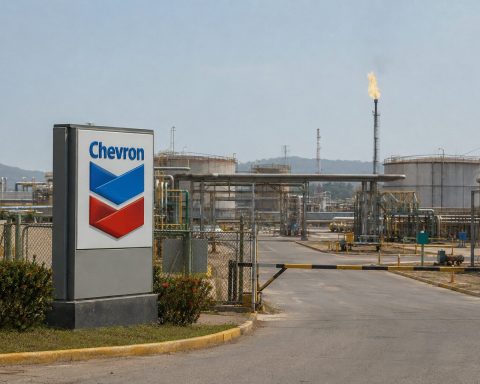

Chevron Corporation’s stock was higher Monday as a fresh wave of Venezuela-related shipping headlines pushed oil prices up and put energy names back in focus during a holiday-shortened week.
As of midday Monday, Chevron NYSE:CVX traded around $150, up roughly 1.6% on the session. MarketWatch reported Chevron was also a notable driver of the Dow’s intraday gain, reflecting the stock’s outsized influence inside the price-weighted index.
Below is what’s moving Chevron today, what analysts and markets are watching next, and how the company’s capital-return and spending plans frame the longer-term bull and bear cases for CVX.
Why Chevron stock is up today: oil prices jump on Venezuela and Russia supply fears
Energy stocks tend to take their cues from crude. On Dec. 22, that cue was clear: oil prices rose on renewed fears of supply disruptions, after U.S. actions near Venezuela and ongoing risks tied to the Russia–Ukraine conflict. Reuters reported Brent crude gained about 2.3% to roughly $61.85 a barrel in late morning U.S. trading, with WTI also up about 2.3% near $57.81.
For Chevron investors, the key detail wasn’t just the move in oil—it was Chevron’s direct connection to one of the day’s biggest geopolitical catalysts.
Venezuela tanker interceptions ripple into Chevron’s real-world barrels
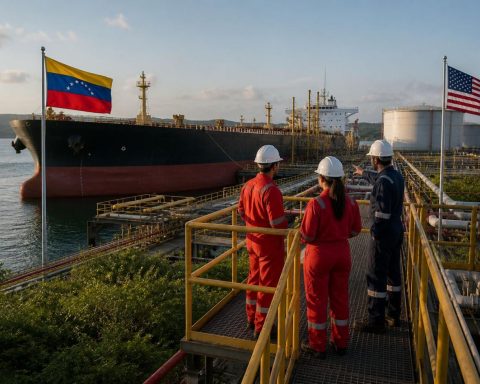
Reuters reported that tanker loading activity in Venezuela slowed, with ships increasingly moving cargoes domestically after new U.S. actions against additional vessels, while PDVSA grappled with operational disruption tied to a cyberattack.
Critically for Chevron:
- Reuters reported Chevron exported a 500,000-barrel cargo of Venezuelan oil on Sunday, headed for the U.S. Gulf Coast under its U.S. authorization.
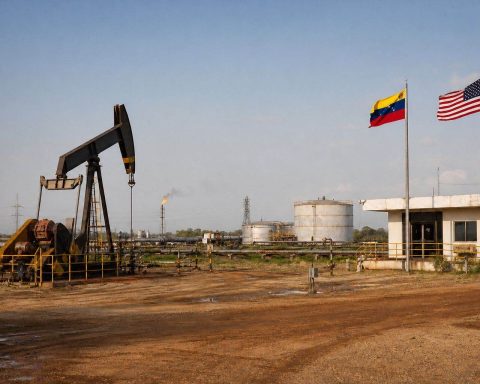
- Reuters also said Venezuela’s oil minister stated deliveries to Chevron had not been interrupted.
- And Reuters reported Chevron exported seven cargoes of Venezuelan oil to the U.S. this month, each in the ~300,000–500,000 barrel range, according to monitoring data.
For markets, this combination—(1) enforcement headlines, (2) visible friction in exports, and (3) confirmation that Chevron-linked cargoes are still moving—creates a tug-of-war that can increase volatility even if Chevron’s near-term flows continue.
Chevron’s market impact: CVX helps lift the Dow
Chevron’s move mattered beyond energy ETFs. MarketWatch noted that gains in Chevron (alongside Merck) helped drive a meaningful share of the Dow’s intraday rise.
That index effect doesn’t change Chevron’s fundamentals, but it does reflect something important for investors heading into year-end: large, liquid, dividend-heavy blue chips can attract flows quickly when macro news (rates, oil, geopolitics) starts to dominate trading.
The “so what” for investors: does the oil pop change Chevron’s outlook?
A one-day rally in crude rarely rewrites the thesis for an integrated major. But it can reset the conversation around three core questions that matter for CVX into 2026:
- How durable is the “geopolitical premium” in oil prices?
- Can Chevron keep growing cash flow while keeping spending disciplined?
- Will shareholder returns (dividends + buybacks) stay resilient in a $50–$70 oil world?
Chevron’s recent guidance and planning assumptions are built to answer those questions—even if oil stays choppy.
Chevron’s spending plan: 2026 capex targets $18–$19 billion
On the cost and investment side, Chevron has been emphasizing capital discipline.
Reuters reported earlier this month that Chevron expects 2026 capital expenditures of $18 billion to $19 billion, as it focuses on U.S. production and investments tied to its Guyana position (stemming from the Hess deal).
Reuters’ breakdown included several investor-relevant details:
- About $17 billion of the 2026 program is expected to go to upstream, with roughly $9 billion allocated to the United States.
- Chevron said it expects to spend $6 billion on American shale and plans to produce more than 2 million barrels of oil equivalent per day from the U.S. next year.
- Offshore spending of about $7 billion would support Guyana, the Eastern Mediterranean, and the U.S. Gulf of Mexico.
In plain English: Chevron is trying to lean into high-return barrels while keeping total spending contained—an approach designed to protect free cash flow if oil prices weaken.
The longer-term growth pitch: free cash flow expansion through 2030
Chevron’s longer-range narrative has been centered on cash flow growth and efficiency.
At its investor day, Reuters reported Chevron said it plans to grow free cash flow by more than 10% annually through 2030 and increase oil and gas production, supported by lower costs and reduced capital expenditure.
Key points from Reuters’ investor-day coverage include:
- Chevron’s plan assumes Brent at $70 per barrel and targets >10% annual growth in free cash flow and EPS through the end of the decade under that assumption.
- The company expects oil and gas production to grow 2% to 3% per year.
- Chevron said it would be able to cover capex and the dividend through 2030 even if Brent is around $50 per barrel.
That last point is central to the “defensive Chevron” argument: management is explicitly trying to signal that shareholder payouts are not solely dependent on high oil prices.
Hess integration: the Guyana catalyst that reshaped Chevron’s portfolio
Chevron’s 2025 acquisition of Hess remains one of the biggest structural changes to the company’s growth profile.
In a July 18, 2025 news release filed to the SEC, Chevron announced it completed its acquisition of Hess, noting it now owns a 30% position in Guyana’s Stabroek Block, described as having more than 11 billion barrels of oil equivalent in discovered recoverable resource (as stated in the release).
The same SEC exhibit also highlighted expected integration benefits, including:
- A target of $1 billion in annual run-rate cost synergies by the end of 2025.
- An expectation that the combined company’s capital expenditures budget would be $19–$22 billion (as described at that time).
Those historical figures matter today mainly as a reference point: investors are now judging whether Chevron is meeting or exceeding the synergy and discipline implied by the Hess rationale—especially with Guyana positioned as a long-duration, high-margin growth engine.
Dividend and buybacks: why income investors keep circling back to CVX
Chevron remains, at its core, a “shareholder returns” stock.
Dividend snapshot
Multiple market data sources currently list:
- Annual dividend: about $6.84 per share
- Dividend yield: roughly 4.5%–4.6% (varies with price)
- Dividend growth streak:38 consecutive years of dividend increases StockAnalysis
That yield becomes especially relevant in a market where investors may be weighing the outlook for interest-rate cuts and looking for large-cap income with liquidity.
Buyback plan through 2030
Chevron has also tied its longer-term equity story to repurchases. A Nasdaq-hosted summary of Chevron’s investor-day plan reported the company anticipates annual share repurchases of $10–$20 billion through 2030, tied to an oil-price framework.
For investors, the combined message is straightforward: even if oil prices don’t surge, Chevron aims to deliver a material portion of total return via cash distributions.
What analysts are forecasting for Chevron stock: price targets and ratings
Analyst views vary by provider and methodology, but the broad picture is consistent: Chevron is generally seen as a high-quality, income-heavy major with moderate upside tied to oil and execution.
For example:
- Benzinga data shows a consensus price target around $173 (with a high target of $206 and a low of $124) and a consensus rating indicated as Buy on its summary page.
- MarketBeat’s compiled view shows an average price target around the mid-$160s, with the same general high/low range and a consensus rating that can differ depending on its scoring model and included firms.
Investors should treat these as directional rather than definitive—targets often change quickly when oil assumptions or macro conditions shift.
Oil price forecasts that matter to Chevron heading into 2026
Chevron’s operational execution matters, but the dominant variable is still commodity price.
One notable datapoint for macro-oriented investors: Reuters reported the Dallas Fed’s Q4 2025 energy survey found respondents, on average, expected WTI around $62 per barrel by the end of 2026 (with Henry Hub gas also forecast higher).
That kind of “moderate recovery” oil outlook—neither boom nor bust—fits the environment Chevron has been describing in its own planning: discipline, efficiency, and payouts rather than spending aggressively for growth at any cost.
The risks investors are pricing in right now
Even with today’s rally, Chevron’s setup into 2026 comes with real risks—some company-specific, others macro-driven.
1) Venezuela and sanctions uncertainty
Today’s Venezuela headlines are a reminder that policy and enforcement actions can move crude—and also create operational uncertainty for companies tied to sanctioned regions. Reuters’ reporting makes clear the situation remains fluid, even as Chevron-linked cargoes continue to move.
2) Geopolitics vs. fundamentals
Reuters quoted market commentary suggesting oil may remain supported by geopolitical risk premiums, but also described expectations for consolidation amid thinner holiday volumes. Reuters That tension—risk premium vs. underlying supply/demand—can drive sharp reversals.
3) Execution and integration
Hess integration benefits are meaningful on paper, but investors will keep tracking synergy capture, cost performance, and any operational downtime that could affect quarterly results.
What to watch next for Chevron (CVX): near-term catalysts
Heading into late December and early 2026, the catalysts most likely to move CVX include:
- Any escalation or de-escalation in Venezuela tanker enforcement, including whether broader flows are disrupted or discounts widen further.
- Oil price direction—especially whether Brent holds the low $60s or fades as the market reassesses supply risks.
- Updates on Chevron’s capex execution and whether spending stays within the $18–$19 billion 2026 band outlined by Reuters.
- The next earnings cycle (late January/early February estimates vary by data provider), which could refocus attention on downstream margins, upstream realizations, and Hess integration progress.
Bottom line
Chevron stock’s move on Dec. 22 is a classic example of how quickly macro + geopolitics can reprice energy—especially when headlines touch both global supply risk and Chevron’s real barrels in Venezuela.
For longer-term investors, the debate is less about today’s oil spike and more about whether Chevron can keep delivering on three promises: capital discipline, resilient dividends, and meaningful buybacks, while using Hess/Guyana to extend its growth runway into the next decade.
Related articles: NYSE:CVX