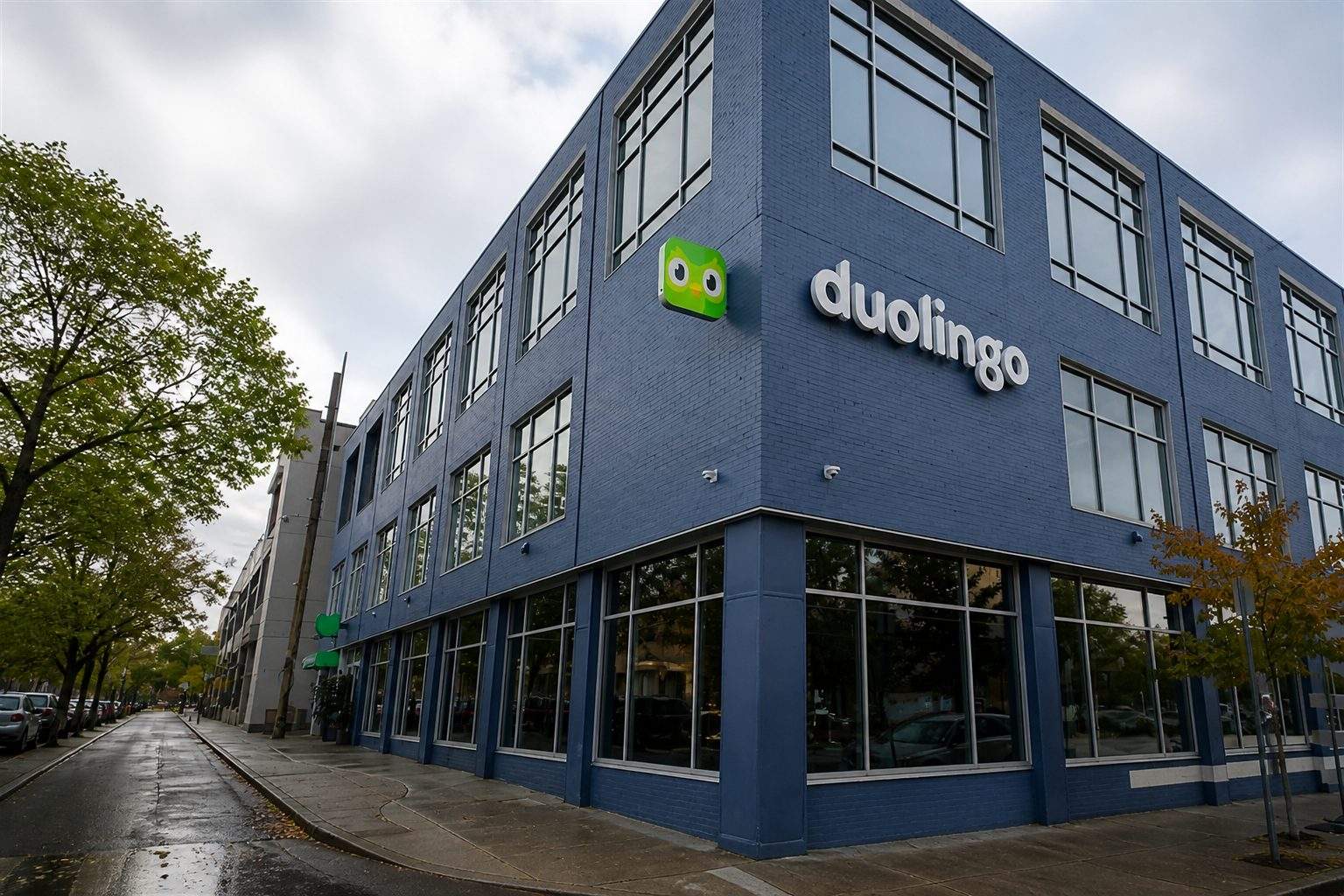

Pittsburgh — May 4, 2026, 17:00 EDT
Duolingo Inc. dropped roughly 10% in after-hours trading Monday. The language-learning company topped first-quarter expectations, but signaled again that 2026 will bring slower growth, higher costs, and a sharper focus on user engagement over immediate monetization.
This wasn’t just a reaction to last quarter’s numbers. Duolingo is essentially telling investors: back us while we overhaul the free offering, layer in more speaking features and AI tech, and trust that better retention and upticks in paid users will follow down the line.
“We are making long-term bets, and the returns on the investments we’re making are going to be 2027 and beyond,” Chief Financial Officer Gillian Munson told Reuters. That’s significant as investors gauge if the company can sustain paid subscriber growth with less focus on immediate monetization. Reuters
Duolingo is targeting 2026 bookings of $1.28 billion, a 10.5% increase, while second-quarter bookings are expected to reach $283.5 million, up 5.8%. Bookings, which represent orders and payments received ahead of revenue recognition, provide an early look at demand. For the full year, the company projects revenue of $1.205 billion and notes that revenue growth should slow during the latter half of the year.
First-quarter results beat expectations. Revenue jumped 27% to $292.0 million, with total bookings up 14% at $308.5 million. Daily active users advanced 21% to 56.5 million, and paid subscribers also gained 21%, reaching 12.5 million.
Duolingo posted earnings of 89 cents a share, beating the consensus at 79 cents, with revenue coming in ahead of the $288.49 million expectation, according to Benzinga. Still, shares dropped 9.96%, landing at $99.25 in after-hours trading Monday.
The stock wrapped up the session down 0.9% at $110.23. After hours, Barron’s flagged a roughly 14% slide, highlighting the choppy action despite beats on revenue, users, and profit.
Chief Executive Luis von Ahn said the company “made progress on the strategy we laid out last quarter,” with speaking now “a core part of the learning experience.” He noted Duolingo remains in the early stages of its 2026 plan and is focused on “long-term engagement and loyalty.” Duolingo, Inc.
The shareholder letter lays out plans for expanded access to Video Call, new spoken-answer drills, more flashcards, and the “Speaking Adventures” feature. Duolingo, for its nine most-learned languages, has also rolled out content through Duolingo Score 129—this matches the CEFR B2 level, which counts as upper-intermediate for European languages. The company said it released 20,500 course units in the quarter. Duolingo, Inc.
Management has set its sights on hitting 100 million daily active users by 2028. The company is intentionally prioritizing user growth and engagement—improving teaching quality, making the app smoother for free users, and rolling out stickier features—before ramping up efforts to raise revenue per user.
Competition is only intensifying. In its latest annual filing, Duolingo flagged rivals across online and app-based language tools, traditional offline classes, and as it broadens, new areas like literacy, math, music, and chess. The company also cautioned about the threat of generative AI products scaling up quickly and shaking up the space.
The catch: the reward might be a ways off. Duolingo flagged a decline in gross margin, expecting it to slip to roughly 69% by Q4 as more users tap into AI features. The company’s own filings list potential pitfalls—user retention, rivals, profits, and AI rollouts could all pose trouble.
Duolingo finished the quarter sitting on $1.1 billion in cash and cash equivalents. Net income came in at $43.5 million, and adjusted EBITDA—stripping out interest, taxes, depreciation, amortization and a few other expenses—hit $83.4 million. The company bought back about $50.6 million worth of stock, or close to 514,000 shares, through May 1. That repurchase program kicked off in February.
The question now: Will investors see the second quarter as a low point, or proof that Duolingo’s growth may be losing steam? Executives had a 5 p.m. ET webcast with analysts lined up for Monday to go over the numbers.




![Asia Stock Market Today 27/08/2026 [UPDATE: 00:10 SGT] [Chip Losses Narrow as KASE Global Enters Final Hour]](https://ts2.tech/wp-content/uploads/2026/08/Asia-market-dashboard-2026-08-27-0010-480x384.jpg "Asia Stock Market Today 27/08/2026 [UPDATE: 00:10 SGT] [Chip Losses Narrow as KASE Global Enters Final Hour]")