NEW YORK, July 29, 2026, 09:00 EDT – GE HealthCare stock climbed after the company reported better-than-expected second-quarter earnings and a new record for orders.
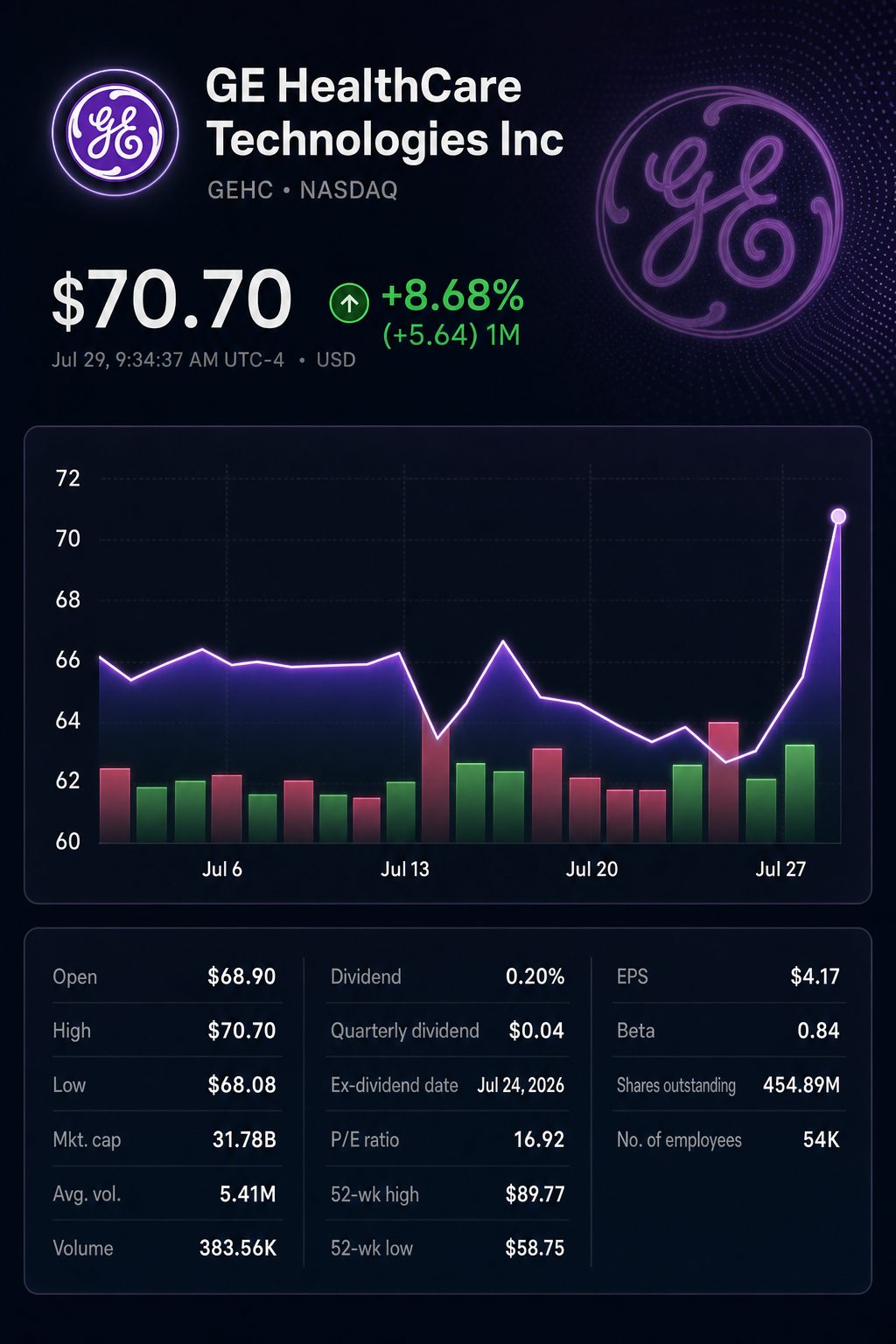
Shares of GE HealthCare Technologies Inc. NASDAQ:GEHC gained 9.9% to $70.43 ahead of Wednesday’s opening bell. U.S. cash trading was yet to start.
The decision came after a quarterly earnings outperformance, with orders providing the key indication.
Organic orders rose 11.1%, accelerating from a 1.1% increase in the prior quarter. The backlog hit an all-time high of $23.9 billion, advancing from $21.8 billion in the previous three months.
The book-to-bill ratio, which compares orders to revenue, increased to 1.15 from 1.07. Organic sales, which exclude both acquisitions and currency effects, grew by just 3.5%. GE HealthCare now enjoys greater forward revenue coverage.
Revenue for the second quarter climbed 5.7% to $5.295 billion, surpassing the analyst projection of $5.26 billion. Adjusted earnings per share reached $1.13, compared to the anticipated $1.04. Net income rose to $561 million from $486 million.
Earnings quality showed a mixed picture. Tariff refunds increased net income by $129 million. Adjusted earnings before interest and tax, or EBIT, totaled just $23 million. The company left out an additional $106 million associated with 2025.
The adjusted EBIT margin reported dropped by 40 basis points to 14.2%. Without factoring in the $23 million refund received this year, the calculated margin stood near 13.7%. This indicates an approximate annual decrease of 90 basis points.
GE HealthCare merged Imaging and Advanced Visualization into a single segment during the quarter. This move has created a clear division in the portfolio.
The combined column uses company data for its calculation. Segment numbers are not audited.
The two expanding divisions were responsible for generating 87% of the company’s total revenue. Patient Care Solutions shifted from an EBIT of about $60 million to a loss of $26 million. Based on these figures, nearly 80% of the EBIT increase from the other divisions was offset by this reversal.
CEO Peter Arduini reported that GE HealthCare achieved “record orders and backlog.” He added that the company was “reviewing strategic options” for Patient Care Solutions. SEC
Royal Philips AMS:PHIA posted a 4% rise in comparable sales this week, while its comparable order intake slipped by 1%. The adjusted EBITA margin, as defined by the company, stood at 16.4%, boosted by a 4.2 percentage point benefit from a tariff refund. GE HealthCare recorded firmer order growth.
GE HealthCare maintained its projection for organic growth at 3% to 4% and its adjusted EBIT margin forecast at 15.4% to 15.7%. The company reiterated its adjusted EPS outlook of $4.80 to $5.00. Guidance for free cash flow stayed at approximately $1.6 billion.
Cash conversion continues to be an area of concern. Free cash flow for the quarter reached $68 million, benefiting from a $107 million cash refund. Excluding this refund, free cash flow would have shown an outflow of about $39 million.
Risks: Resolving or divesting Patient Care Solutions could be a lengthy process. GE HealthCare maintains its forecast for approximately $250 million in chip, oil, and freight cost inflation this year. The company’s backlog needs to translate into revenue without additional margin decline.
The stock’s rise continues to leave a substantial price gap. Shares at $70.43 are still around 22% under their January 8 peak. Investors now look to see if the record backlog will convert to higher-margin revenue.
What is causing the significant movement in GE HealthCare's stock today?
GEHC ended Tuesday's session at $64.11, up 4.89% for the day. FactSet indicated $70.24 at 8:57 a.m. ET, representing a 9.56% increase before Wednesday’s opening bell. Other data sources showed rises between 8% and 13%, indicating swift changes in premarket trading. The movement sharply outpaced the S&P 500 futures, which gained just 0.24%. The spread suggests earnings, rather than broader index action, are the main driver.
What was the size of the earnings beat in the second quarter?
Adjusted EPS was $1.13, topping the $1.04 consensus from LSEG by 8.7% and showing a 6.6% increase year-on-year. Revenue came in at $5.295 billion, up 5.7% from the same quarter last year and beating the $5.26 billion expectation by about $35 million. Organic revenue rose 3.5%, in line with management’s midpoint for full-year guidance.
What portion of the quarter was attributed to tariff refunds?
Net income totaled $561 million, buoyed by $129 million in tariff refunds. GAAP diluted EPS rose 16.5% year over year to $1.24. On an adjusted basis, GEHC excluded $106 million related to 2025 tariffs while keeping $23 million—equivalent to around $0.04 per share—from 2026 refunds. Adjusted EBIT margin slipped 40 basis points to 14.2%. The quarter was solid, though not without exceptions.
Has management increased its 2026 outlook?
No. GE HealthCare maintained all key full-year guidance, with no official changes. Expectations for organic revenue growth remain at 3% to 4% for 2026. Adjusted EBIT margin is still forecast at 15.4% to 15.7% for the year. Adjusted EPS guidance remains in the range of $4.80 to $5.00, representing 4.6% to 9% growth. The outlook for free cash flow is unchanged at about $1.6 billion for 2026. Management continues to anticipate around $250 million in inflation-related expenses this year.
How do orders and backlog indicate prospects for future expansion?
Organic orders surged 11.1%, representing the company’s highest quarterly growth on record. The book-to-bill ratio reached 1.15, indicating that incoming orders significantly topped recognized revenue for the quarter. Backlog hit a company high of $23.9 billion, up $2.1 billion from the previous quarter, or nearly 9.6%. Conversion timing and product mix continue to be variable, particularly with large imaging systems. Nevertheless, these figures back management’s organic growth outlook of 3% to 4%.
Which segments contributed positively to the quarter, and which lagged?
Advanced Imaging Solutions posted a 7.9% year-on-year revenue rise to $3.771 billion, with EBIT up 15.4% and segment margin improving by 90 basis points. Pharmaceutical Diagnostics revenue rose by 15.6% to $843 million from a year earlier. Patient Care Solutions revenue fell 13.3% to $675 million year-on-year, with the unit posting a $26 million loss and a negative segment margin of 3.8%. Management is currently exploring strategic options for the underperforming Patient Care Solutions unit.
Does the cash flow sufficiently back the outlook?
Debt amounted to $10.1 billion, while available cash was $2.1 billion. Free cash flow for the second quarter was just $68 million, which included a $107 million refund from previous tariffs. Free cash flow in the first half of the year rose 70% year-over-year to $180 million. As a result, GEHC requires around $1.42 billion in the second half. That amount is about 89% of the company’s annual cash target. Following today’s report, cash conversion is still the most important execution metric.
Does GEHC remain fairly valued following today’s increase?
GEHC is priced around $70, which equates to approximately 14.3 times the midpoint of management’s EPS forecast. This figure is based on the company’s $4.90 adjusted earnings midpoint. FactSet data shows average analyst price targets at $78.82 and a median of $80. Current analyst estimates range from $65 to $98. Shares at $70.24 are still about 22% below the 52-week peak. Some analyst targets may not yet account for today’s results.
What is an updated outlook for the GEHC share price?
My 12-month base scenario forecasts a price bracket of $76 to $82. This is based on adjusted EPS approaching $4.90 and a valuation multiple between 15.5 and 16.7. An optimistic scenario projects $88 to $98, contingent on PCS stabilizing and orders being fulfilled. The downside scenario sees a move back to $62 to $66 if cash conversion falls short. FactSet’s $80 median target is within the base-case range outlined here. These are scenario-based projections and do not represent assured market results.
Is there significant risk associated with the chief financial officer's transition?
Jay Saccaro will depart on August 14 to take on a larger position outside the medical technology sector. Controller George Newcomb is set to act as interim chief financial officer. Newcomb, who has been controller since 2016, has 38 years of experience. GE HealthCare has begun the process of finding a permanent replacement. Strong second-quarter performance helps alleviate immediate worries over financial disruption. However, investors are advised to keep a close eye on succession planning and consistency in capital allocation.
Jerzy Lewandowski is a senior markets editor at TS2.tech. His coverage ranges from stocks and semiconductors to AI and the broader global markets. He studied economics at the University of Warsaw and worked in investment analysis before becoming a financial journalist. Follow Jerzy Lewandowski on Google News.
Surprising starts and permits data can impact homebuilders, mortgage-sensitive stocks, Treasury yields, and the dollar if results deviate significantly from consensus estimates.
#02
Home Depot Q2
The results and outlook provide key insights into housing turnover, renovation demand, professional customer activity, and U.S. discretionary spending.
#03
09:15 ET industrial production
A robust or disappointing factory or utilities report can shift expectations for economic growth, cyclical stocks, bond yields, and the Federal Reserve’s policy direction.