NEW YORK, July 29, 2026, 08:05 EDT — U.S. premarket
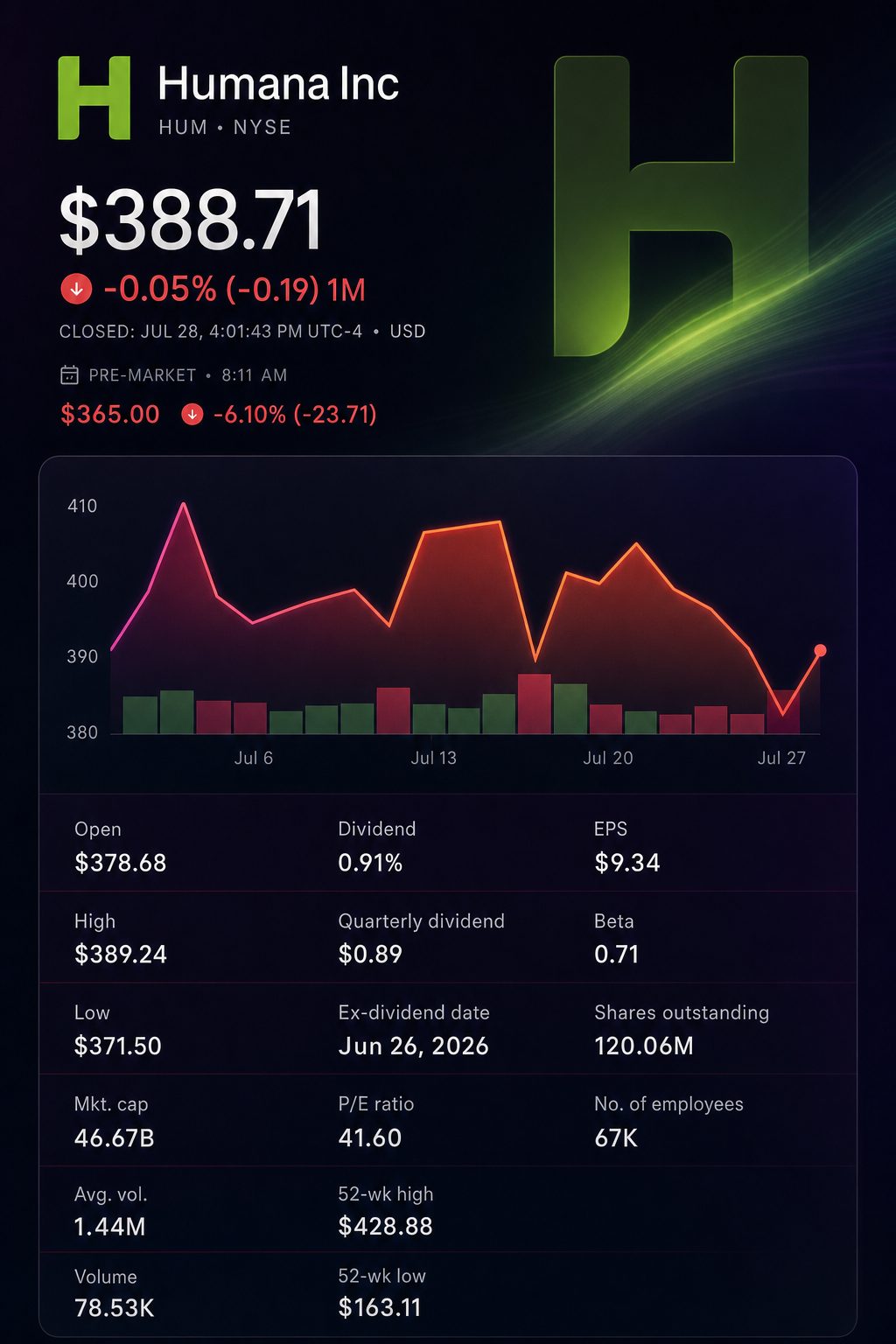
Shares of Humana dropped roughly 8% after the health insurer maintained its adjusted EPS outlook at “at least” $9. Reuters
Adjusted EPS for the first half reached $17.91, amounting to 199% of the company’s annual guidance minimum.
Quarterly profit and revenue exceeded projections. Medical expenses stayed nearly in line with estimates.
Shares of Humana Inc. NYSE:HUM dropped approximately 8% ahead of Wednesday’s market open. The health insurer maintained its adjusted EPS floor for 2026 at $9.
The announcement eclipsed an otherwise solid quarterly performance. Anticipation had increased following better-than-expected outcomes from other managed care providers.
The main concern centers on the earnings bridge. Humana reported $17.91 in adjusted EPS for the first half.
This represents 199% of the yearly minimum. When set at $9, initial calculations indicate an $8.91 adjusted loss for the second half.
The discrepancy is highlighted by the reported numbers and LSEG benchmarks.
Investor check
2026 figure
Reference point
Q2 adjusted EPS
$7.61
$6.27 in the previous year; $7.22 LSEG
Q2 revenue
$40.87 billion
$32.39 billion a year ago; $40.61 billion LSEG
First-half adjusted EPS
$17.91
199% of the annual minimum
Full-year adjusted EPS floor
At least $9.00
47.5% lower than the 2025 amount of $17.14
Second-half floor case, preliminary
−$8.91
Calculated; not official outlook
Q3 adjusted EPS outlook
About −$1.00
Official company forecast
Q4 floor case, preliminary
About −$7.91
Calculated; not official outlook
The floor-case numbers represent initial estimates rather than forecasts from management. Annual results exceeding $9 would reduce the implied losses.
The company forecasts an adjusted loss per share of about $1 for the third quarter. Management noted that second-quarter results accounted for 80% to 85% of the year’s adjusted earnings.
The quarter delivered strong results. Adjusted earnings per share increased by 21% to $7.61, surpassing the LSEG estimate of $7.22. Revenue rose 26.2% to $40.87 billion, topping the $40.61 billion analysts expected.
Medical costs remained in line with expectations. The Insurance benefit ratio reached 91.2%, closely aligning with LSEG’s 91.19% forecast. That figure increased from 89.9% in the same period last year.
Humana largely countered the impact through reduced overhead expenses. The Insurance operating-cost ratio dropped by 120 basis points to 7.1%.
There were three primary factors driving the year-on-year rise in costs. According to Humana, these were Star-rating pressure, the composition of new members, and less favorable reserve development.
Management reported that medical and pharmacy trends continued in the high single-digit range. Inpatient costs were modestly better, particularly for members with value-based providers.
Enrollment continued to climb rapidly. Individual Medicare Advantage membership rose by 1.204 million, or 23%, as of June. Humana continues to project about 25% growth for the year.
Chief Executive Jim Rechtin stated the first half “went well.” He also noted that Humana was “right where we said we’d be.” SEC
Investors were looking for a larger boost. UnitedHealth Group Inc. NYSE:UNH lifted its 2026 adjusted EPS forecast to $19.50-$20 earlier this month. Morningstar analyst Julie Utterback noted that Humana shareholders were hoping for “a significant increase in expectations.” Reuters
Humana lowered its minimum GAAP EPS guidance to $6.52, down from $8.36. The company continues to aim for a sustainable pretax margin of no less than 3% by 2028.
Concentration of risks continues. Humana projects its Insurance benefit ratio will top 94% in the third quarter. Pressure on star-rating bonuses is ongoing. After 2026, CMS plans to discontinue its standalone Part D premium-stabilization demonstration. Humana’s Part D membership has increased 50% so far this year.
Upcoming tests are imminent. Investors are set to track third-quarter utilization, review the finalized Medicare plan landscape for September, and monitor Humana’s investor update scheduled for December 10.
What is causing Humana shares to drop even after reporting better-than-expected earnings?
Shares traded close to $354 ahead of Wednesday’s session, about 9% under Tuesday’s closing price of $388.71. Humana surpassed quarterly projections, yet maintained its adjusted 2026 EPS forecast. Investors had anticipated an upward revision following stronger results from peers and Humana’s 52% rally in the year so far. The decline reflects high expectations rather than a shortfall in earnings. The quote could change rapidly.
How significant was the outperformance in second-quarter earnings?
Adjusted EPS was $7.61, topping the LSEG consensus forecast of $7.22. Barron’s reported a slightly higher consensus of $7.26. Revenue increased by 26.2% to $40.87 billion, above the Wall Street consensus of $40.61 billion. GAAP EPS was $5.73, compared with $4.51 a year ago. The results surpassed expectations.
Is Humana seeing an improvement in medical costs?
The data presents a mixed picture. The Insurance benefit ratio came in at 91.2%, in line with both company guidance and analyst forecasts. This compares to 89.7% in the same quarter of the previous year. Management continues to project medical and pharmacy cost increases in the high single digits for the entire membership base. Inpatient expenses were slightly more favorable, particularly for members with value-based providers. This result does not indicate a systemic reset in costs.
What caused GAAP guidance to decline while adjusted guidance remained the same?
Humana reiterated its adjusted EPS outlook of no less than $9.00 for 2026, while lowering its GAAP EPS forecast to at least $6.52 from $8.36. The updated reconciliation now factors in $1.47 per share related to put/call valuation adjustments, $1.27 for value-creation initiatives, and $0.17 for impairments. Since these figures are not included in adjusted EPS, the company’s adjusted EPS outlook remains unchanged.
Why does the full-year EPS minimum remain $9, even though $17.91 was posted by June?
Humana posted adjusted EPS of $17.91 through the first half. The company’s management forecasts third-quarter adjusted EPS at around negative $1.00 and anticipates the Insurance benefit ratio will slightly exceed 94%. Management did not provide a fourth-quarter EPS outlook in its prepared remarks on Wednesday. As a result, the $9 floor indicates potential for notable losses in the second half.
Does Humana’s swift increase in enrollment result in profit?
Individual Medicare Advantage enrollment grew by 1.204 million, or 23%, as of June. Humana maintains its forecast for about 25% growth in this segment for the full year. The company’s Group Medicare Advantage division added 159,000 members, and standalone Part D enrollment rose by 1.139 million. Cost trends for both new and continuing members were consistent with high-single-digit targets. The adjusted operating cost ratio dropped by 120 basis points to 9.7%. Growth is tracking as planned, though margins have yet to be fully confirmed.
How will the 2027 Medicare Advantage bids impact 2028 earnings?
Humana expects its individual bids for 2027 to help drive margin recovery in 2028. The company is still aiming for a sustainable pretax Medicare Advantage margin of at least 3%. There was no detailed guidance on 2027 EPS, margin, or membership in the prepared materials. A virtual investor update will be held on December 10, 2026. The balance between pricing and growth remains uncertain until then.
Could Humana be impacted if Medicare Part D premium support ends?
CMS will discontinue the standalone Part D Premium Stabilization Demonstration after 2026. This is notable as Humana gained 1.139 million standalone members, marking a 50% rise. CMS announced the 2027 national average monthly bid at $296.05, while the base beneficiary premium stands at $41.33. Final plan specifics are expected in September. Humana has not disclosed the expected earnings or retention effects, which remain unclear.
Is the pace of improvement in Medicare Star Ratings sufficient?
The 2026 adjusted forecast continues to reflect a notable Star Ratings earnings pressure. Humana aims for top-quartile placement in Medicare bonus year 2028. Eleven of the twelve selected quality metrics saw improvement outpacing their four-year historical averages. Still, these metrics alone do not ensure the final CMS ratings. Humana's appeal regarding the 2025 ratings outcome has yet to be resolved.
Are CenterWell’s expansion and capital measures sufficient to offer a buffer?
As of June 30, CenterWell Primary Care had around 622,000 patients—an increase of 130,900, or 27%, from year-end 2025. The segment operated 398 centers, up by 63 year over year. Debt-to-capitalization dropped to 42.7%, still higher than Humana’s roughly 40% target. In May, Humana set up $1.5 billion in contingent capital facilities. The upcoming sale of its Gentiva stake is valued at about $900 million. These actions increase financial flexibility, but do not eliminate underlying Medicare margin risks.
Leokadia Głogulska is a financial and technology journalist at TS2.tech. Her coverage ranges from stocks and artificial intelligence to space technology and developments across global markets. She graduated from Wrocław University of Economics and Business and worked in financial analysis before becoming a business journalist.
Surprising starts and permits data can impact homebuilders, mortgage-sensitive stocks, Treasury yields, and the dollar if results deviate significantly from consensus estimates.
#02
Home Depot Q2
The results and outlook provide key insights into housing turnover, renovation demand, professional customer activity, and U.S. discretionary spending.
#03
09:15 ET industrial production
A robust or disappointing factory or utilities report can shift expectations for economic growth, cyclical stocks, bond yields, and the Federal Reserve’s policy direction.