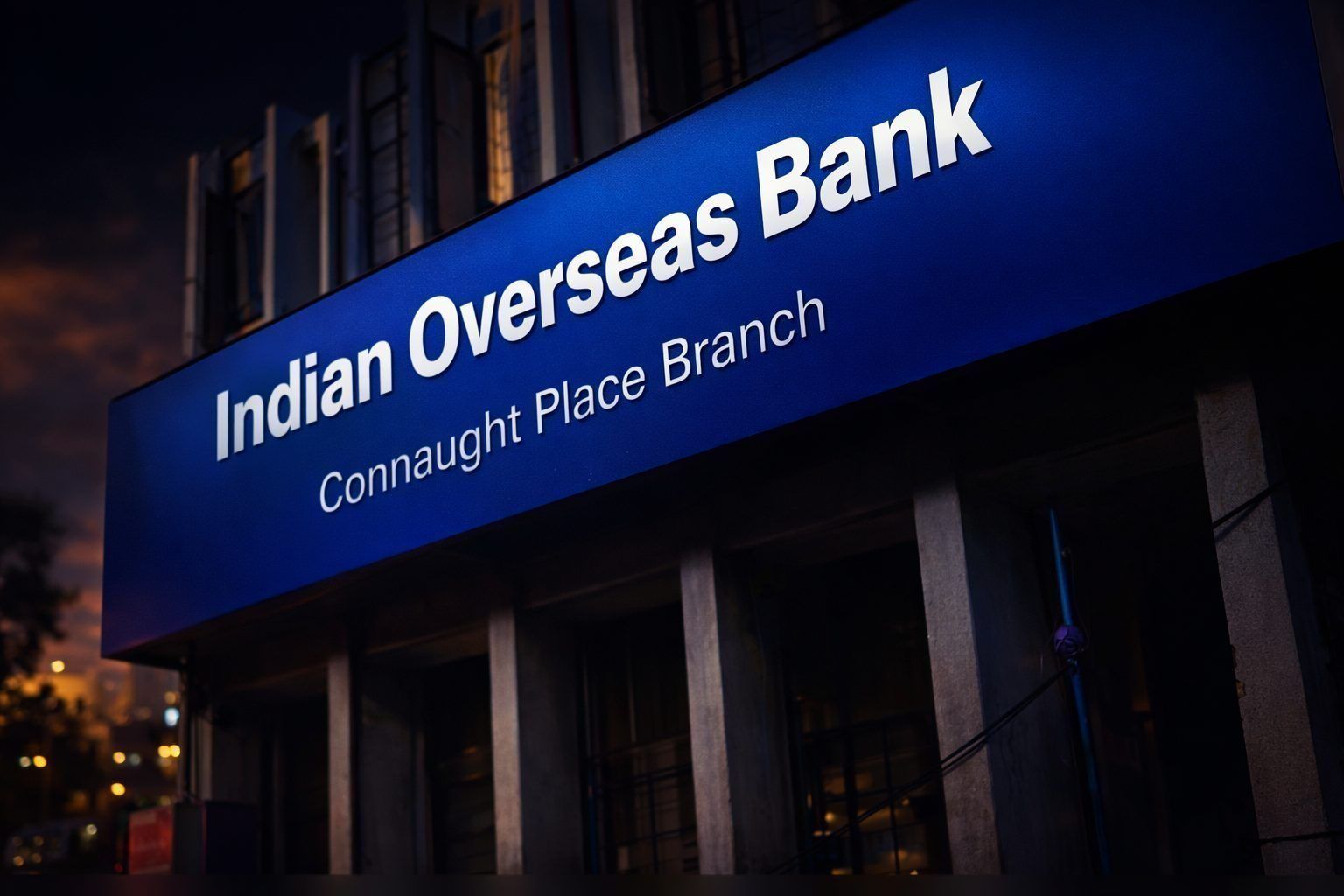

Indian Overseas Bank (IOB) is back in the spotlight on Thursday, December 18, 2025, as the Government of India’s offer for sale (OFS) moves into the retail window—one day after the stock saw sharp pressure following the institutional (non-retail) book opening.
The key development on Dec 18: IOB informed exchanges that the seller has partly exercised the oversubscription (green shoe) option, expanding the OFS by an additional 7.61 crore shares (about 0.395%), taking the total offer size to up to 46.12 crore shares (about 2.395%).
What’s happening with IOB share price on Dec 18
The OFS announcement and pricing created immediate volatility in the stock over the last 24 hours. On Wednesday (Dec 17), IOB shares dropped notably as the market reacted to a large supply hitting the screen at a discounted floor price.
On Thursday morning (Dec 18), IOB was trading around ₹34.08 (down about 0.64%) on BSE at the time of the update shown on Moneycontrol, keeping the stock in tight range around the OFS floor.
IOB OFS: The essentials (floor price, dates, categories, reservations)
Here are the core terms retail investors are tracking today:
- Floor price:₹34 per share Business Standard+1
- OFS schedule: Two trading days
- Dec 17 (T day): Non-retail investors
- Dec 18 (T+1 day): Retail investors, employees, and non-retail investors who carry forward unallotted bids Business Standard+1
- Trading hours (both days):9:15 a.m. to 3:30 p.m. IST Business Standard
- Base offer size: Up to 38.51 crore shares (2%) Business Standard+1
- Oversubscription option: Up to 19.25 crore shares (1%), i.e., up to 3% in total was originally enabled through the OFS structure Business Standard+1
- Latest update (Dec 18): Additional 7.61 crore shares (0.395%) added via partial green shoe exercise; total now up to 46.12 crore shares (2.395%) Business Today+1
- Retail reservation: Minimum 10% of offer shares reserved for retail category, subject to valid bids Business Standard+1
- Mutual funds & insurers reservation: Minimum 25% reserved for mutual funds and insurance companies, subject to valid bids Business Standard+1
- Employee portion: Up to 1,50,000 shares; eligible employees may apply up to ₹5,00,000 worth of shares Business Standard+1
- Retail & employee discount:Nil (no additional discount stated in the notice) Business Standard
One important practical point for individuals: the OFS notice defines a retail investor as an individual whose bids total not more than ₹2,00,000 across stock exchanges.
Why the government is selling IOB shares
The Government of India remains the dominant shareholder in Indian Overseas Bank, with multiple reports pegging its stake at 94.61% as of the end of the September quarter (FY26 Q2 period).
The sale is positioned as part of the broader push to meet minimum public shareholding (MPS) norms applicable to listed companies, including public sector companies. Equitymaster notes that 25% public shareholding is the requirement and points to August 2026 as the compliance deadline being referenced in market commentary around this OFS.
Why IOB shares fell after the OFS announcement
IOB’s decline is a classic “supply event” reaction, amplified by the pricing structure:
- Discounted floor price: The OFS floor of ₹34 was widely reported as a meaningful discount versus the prior close (about a 7% discount in several reports), which often pulls the traded price closer to the offer price during the OFS window.
- Supply overhang: A large promoter sell-down—especially when the promoter holds over 90%—can create near-term pressure as the market absorbs incremental float.
- Broader market volatility: Equitymaster noted that benchmarks were weak and the banking index also came under pressure on Dec 17, adding to risk-off trading in bank names.
By end of day Dec 17, Capital Market reported IOB stock slumped 6.15% to close at ₹34.32 after the OFS plan was announced, underscoring how quickly prices can reset around an exchange-based stake sale.
Green shoe (oversubscription option) kicked in: what changed on Dec 18
The timeline matters:
- On Dec 17 (non-retail day), the OFS saw strong demand. A DIPAM-linked update quoted by major publications said bids came in for more than 41 crore shares against about 34.66 crore shares available in the non-retail window, prompting the decision to invoke the green shoe mechanism.
- Capital Market’s end-of-session snapshot also showed the non-retail portion was subscribed 115.25% (about 39.95 crore shares) versus the 34.66 crore non-retail offer size, reinforcing the oversubscription narrative.
- On Dec 18 (retail day), IOB disclosed that the seller has partly exercised the oversubscription option—adding 7.61 crore shares—bringing the total to 46.12 crore shares.
This nuance is important: while the OFS framework allowed up to 3% (2% base + 1% oversubscription), the latest disclosed step indicates an expansion to about 2.395% (not necessarily the full 3%).
At the ₹34 floor, selling the full 46.12 crore shares would imply minimum proceeds of roughly ₹1,568 crore (46.12 crore × ₹34), before considering any price discovery above the floor.
Retail bidding today: how it works and what to watch
Retail participation in an OFS can feel different from a regular market buy order because it happens in a dedicated OFS window during market hours.
Key mechanics from the OFS notice:
- Retail bids are accepted on T+1 day (Dec 18) during the OFS window.
- If the retail portion is oversubscribed, allocation is typically done as per the OFS allocation methodology laid out in the notice (including proportionate approaches depending on bid aggregation at the clearing price).
- The notice explicitly states “Retail and Employee Discount: Nil,” meaning retail buyers should not assume an extra markdown beyond how the cut-off/clearing price is determined. Business Standard
- Employee participation is enabled with a stated cap of ₹5,00,000 per eligible employee in the notice.
Practical tip for investors following the OFS closely today: watch whether the traded price stays anchored near ₹34 and whether the oversubscription trend extends into the retail window—because those two signals often shape near-term sentiment after the OFS closes.
Fundamentals check: IOB’s recent earnings vs short-term selling pressure
While the stock action is dominated by the OFS headline this week, IOB’s latest reported quarterly metrics have been comparatively stronger:
- Upstox reported IOB’s Q2FY26 standalone net profit rose 58% YoY to ₹1,226 crore, with net interest income up 20.53% YoY to ₹3,059 crore, and gross NPA down to 1.83% (from 2.72% a year earlier).
- Capital Market also highlighted the profit jump (net profit ₹1,226.42 crore) alongside higher total income for Q2FY26.
That said, the share price trend going into this event had already been weak in 2025. Upstox noted the stock had tumbled about 32% since the beginning of 2025 and had also been down across shorter time frames, suggesting the OFS arrived during a fragile phase for the scrip.
What happens after the OFS closes
Once the retail window shuts today, the market will focus on:
- The final clearing/cut-off price (relative to the ₹34 floor)
- The extent of oversubscription across categories
- The final size of the stake sold, especially after the partial green shoe exercise disclosed on Dec 18 Business Today+1
In the near term, price action often reflects two competing forces: a potential confidence boost from strong demand (oversubscription) versus the immediate reality of increased float and the psychological “cap” created by the offer price during settlement.
Related articles: Stock Market