Updated December 4, 2025
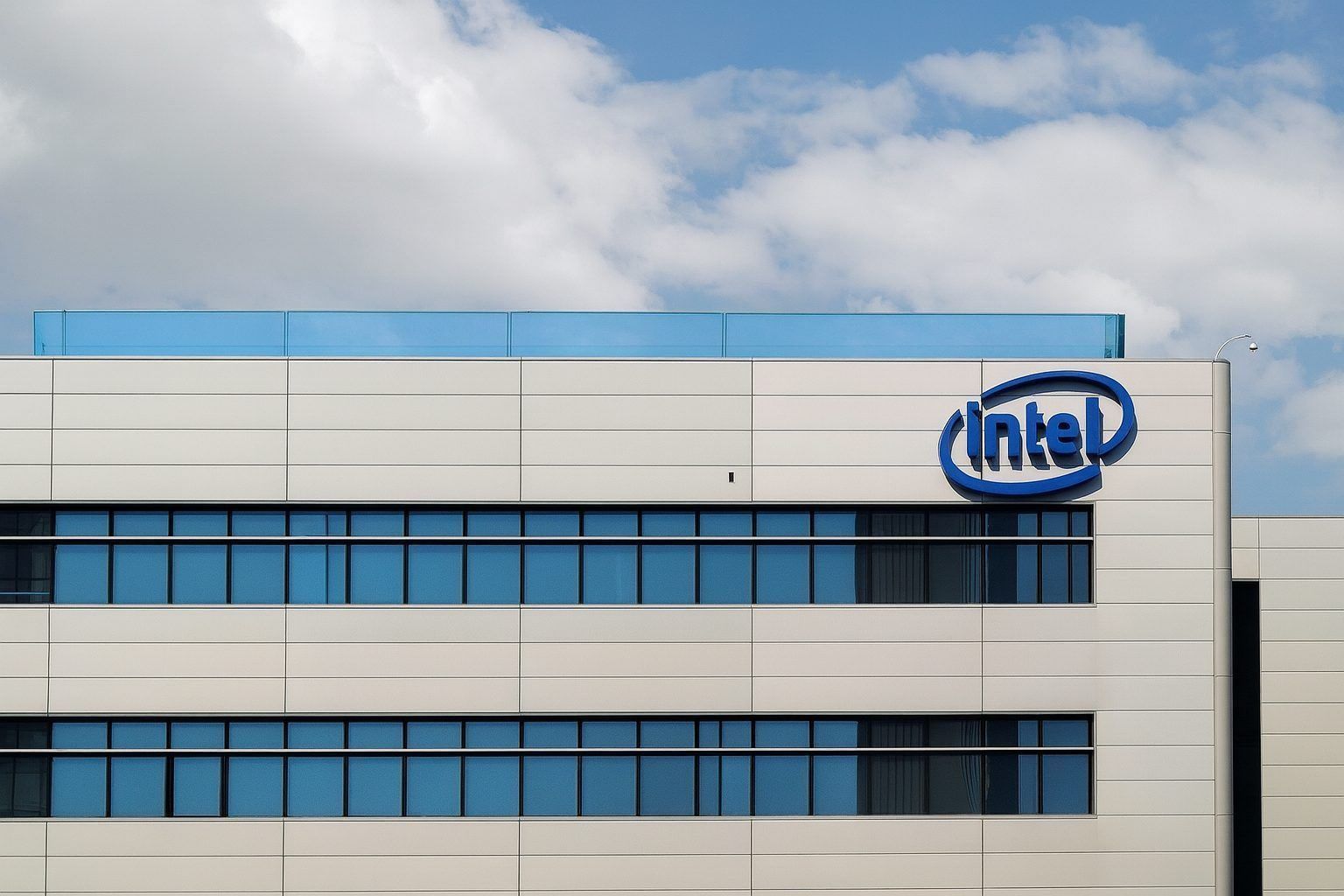
Intel Corporation (NASDAQ: INTC) is trading just below a new 52‑week high as investors digest a flurry of headlines: progress toward a potential foundry deal with Apple, fresh manufacturing investment in Malaysia, a strategic U‑turn on its networking division, and still‑mixed Wall Street forecasts.
As of early afternoon on December 4, Intel shares trade around $43.76, up slightly on the day. That leaves the stock within striking distance of its 52‑week high of $44.02 and far above its 52‑week low of $17.67. [1]
Key takeaways
- Price & valuation: INTC trades near a 52‑week high around $44, more than doubling over the past year, with a trailing price‑to‑earnings ratio inflated by still‑thin net margins. [2]
- Apple foundry rumors: Multiple reports say Apple is evaluating Intel’s 18A process for low‑end M‑series Mac chips, with potential volume from 2027 if Intel hits yield and tooling milestones. [3]
- Manufacturing build‑out: Intel will invest an additional $208 million in Malaysia assembly and test facilities, on top of a previously announced $7 billion advanced packaging plant. [4]
- NEX stays in‑house: After exploring a sale or spin‑out, Intel has decided to keep its networking and communications (NEX) unit, citing tighter integration across AI, data center and edge platforms. [5]
- Earnings & guidance: Q3 2025 beat expectations on revenue and margins, driven by AI and PC demand, but Q4 guidance points to slower growth and margin pressure as foundry losses persist. [6]
- Wall Street stance: Despite the rally, the average 12‑month analyst price target sits in the mid‑$30s – below the current share price – with a consensus rating around “Hold/Reduce.” [7]
Intel stock today: strong price action, stretched fundamentals
According to MarketBeat’s latest snapshot, Intel opened Thursday at $43.76, with a market capitalization of about $209 billion. The shares carry a 52‑week range of $17.67–$44.02, a beta of 1.34, and a debt‑to‑equity ratio of 0.38. [8]
The rally has been dramatic. Recent coverage notes that Intel’s share price has climbed more than 110% over the last 12 months, roughly matching a 116% year‑to‑date gain, as investors re‑rate the stock on AI and foundry hopes under new CEO Lip‑Bu Tan. [9]
Yet earnings have only recently turned positive. MarketBeat estimates Intel’s trailing P/E ratio at over 4,000, a statistical side‑effect of razor‑thin net margins, while some trading analysis sites peg the P/E in the several‑hundred range – in any case, far above peers. [10] That disconnect between price and near‑term profits is central to the current bull‑versus‑bear debate.
Apple foundry rumors: why 18A matters so much for Intel stock
The single biggest narrative pushing Intel higher is the prospect of Apple returning as a customer – this time for manufacturing, not CPU design.
What’s being reported
- Tom’s Hardware reports that Apple has signed an NDA with Intel and received a pre‑release 18A‑P process design kit (PDK), version 0.9.1. Internal simulations reportedly look good enough that Apple is waiting for 1.0/1.1 PDK releases expected in Q1 2026. [11]
- On that trajectory, analyst Ming‑Chi Kuo expects Intel could begin shipping production silicon in Q2–Q3 2027, starting with low‑end M‑series system‑on‑chips used in MacBook Air and some iPad Pro models. Annual volume is estimated around 15–20 million chips, meaningful for Intel but small relative to Apple’s total chip demand. [12]
- Coverage from Investopedia and other outlets highlights that the rumor of Apple as a “big new customer” helped drive Intel stock more than 10% higher in a single session last week. [13]
- Several analytical pieces argue that such a deal could ultimately generate $500 million to $1 billion in annual revenue for Intel’s foundry segment by the late 2020s, though details remain speculative. [14]
Strategic significance
From Intel’s perspective, Apple would be a flagship “reference customer” for its 18A node, which introduces RibbonFET gate‑all‑around transistors and PowerVia backside power delivery to boost performance‑per‑watt. Intel says 18A is already open for full product design starts, and has announced multiple 18A “wins,” including products from two of the world’s largest cloud providers. [15]
For Apple, a second source beyond TSMC for lower‑complexity Mac SoCs would:
- Diversify its supply chain after pandemic‑era disruptions
- Align with U.S. policy goals for more domestic semiconductor manufacturing, likely leveraging Intel’s Arizona fabs
- Reduce risk without touching its most advanced iPhone and high‑end Mac chips, which are expected to remain with TSMC for now [16]
Crucially, nothing is signed. Apple is still evaluating 18A, and any slip in Intel’s yield, cost or timing could push the plan back or off the table entirely. But the mere possibility of Apple validating Intel’s process at scale is already reshaping investor expectations.
Malaysia expansion: packaging and test capacity ramps up
While the Apple story grabs headlines, Intel is also quietly reinforcing its manufacturing backbone.
On December 2, Malaysia’s prime minister announced that Intel will invest an additional 860 million ringgit (about $208 million) to expand assembly and test operations in the country. [17] Industry sources say this comes on top of Intel’s $7 billion advanced packaging facility in Penang, which is reportedly close to completion and forms part of a broader $2.9+ billion packaging footprint there. [18]
Why this matters for INTC stock:
- Advanced packaging (including 2.5D and 3D stacking) is critical for AI accelerators and high‑end CPUs, where bandwidth and power delivery increasingly limit performance.
- Intel’s own foundry roadmap emphasizes Foveros 3D stacking and EMIB‑based multi‑die packaging, and the company is positioning Malaysia as a key hub in that global network. [19]
- By expanding in lower‑cost Malaysia while ramping leading‑edge wafer fabs in the U.S. and Europe, Intel is trying to balance cost efficiency with geopolitical resilience.
For investors, the Malaysia move is another signal that Intel is doubling down on capital‑intensive manufacturing rather than retreating to a “fab‑light” model.
NEX stays: Intel abandons networking spin‑off plan
Another important piece of news this week: Intel will not spin off or sell its Network and Edge (NEX) division after all.
- Reuters reports that after a strategic review, Intel concluded NEX is “best positioned to succeed within Intel,” emphasizing that keeping the business in‑house “enables tighter integration between silicon, software and systems” across AI, data center and edge offerings. [20]
- Tom’s Hardware notes that NEX, while lower‑profile than Intel’s client CPUs, produces Ethernet controllers, Wi‑Fi solutions, infrastructure processing units (IPUs) and switching gear used everywhere from PCs to telecom infrastructure – effectively one of Intel’s “crown jewels” in connectivity. [21]
Earlier in 2025, Intel had explored outside investment or a spin‑out for NEX alongside a broader restructuring and headcount reduction under CEO Lip‑Bu Tan. [22]
The reversal appears linked to a much stronger balance sheet:
- Over the summer, Intel secured about $8.9 billion of investment from the U.S. government for roughly a 10% stake, plus an additional $7 billion from SoftBank and Nvidia combined, according to Reuters’ summary of management commentary. [23]
With more cash available and government backing in place, Intel is signaling that NEX is strategically important for platform‑level AI and networking solutions, not a non‑core asset to be sold.
Earnings recap: AI‑driven rebound, but foundry losses persist
Intel’s Q3 2025 results, reported October 23, set the backdrop for today’s price action.
Q3 2025 by the numbers
According to an Investing.com summary of Intel’s investor presentation and TradingNews analysis: [24]
- Revenue: about $13.65–$13.7 billion, up roughly 3% year‑on‑year and ahead of guidance.
- Gross margin: around 40% on a non‑GAAP basis, significantly higher than a year ago.
- EPS: approximately $0.23, versus a loss in the prior‑year quarter.
- Non‑GAAP operating income: about $1.5 billion, another sharp turnaround from prior‑year losses.
Segment‑level trends:
- Client Computing Group (CCG):
- Revenue roughly $8.5 billion
- Operating margin above 30%, helped by a stronger‑than‑expected PC market, Windows 11 upgrades and early demand for “AI PCs.” [25]
- Data Center & AI (DCAI):
- Revenue around $4.1 billion
- Margin in the low‑20% range, up dramatically from single digits a year earlier as Xeon upgrades and AI‑related workloads pick up. [26]
- Intel Foundry (IFS):
- Revenue ~$4.2 billion
- Operating loss of roughly $2.3 billion (mid‑50% negative margin), still a major drag on consolidated profitability despite sequential improvement. [27]
On the cash‑flow side, TradingNews highlights that:
- Net income jumped more than 120% year‑on‑year to just over $4 billion
- Free cash flow surged to about $4.08 billion, up more than 2,000% from the prior year
- Cash and short‑term investments reached roughly $31 billion, while total liabilities edged slightly lower, reinforcing Intel’s capacity to fund multi‑year fab projects [28]
Q4 2025 outlook: a bumpier near term
Intel’s guidance for Q4 2025 is more cautious:
- Revenue of $12.8–$13.8 billion, implying a year‑over‑year decline
- Gross margin forecast around 36.5%, below Q3 levels
- EPS around $0.08, down sequentially [29]
Analysts interpret this as evidence that Intel’s turnaround will not be a straight line, with:
- Continued foundry ramp‑up costs
- Ongoing pressure in data center and traditional PC spending
- Heavy capex still weighing on free cash flow, even as it improves
How analysts are valuing Intel now
Despite the spectacular rally, Wall Street remains cautious on INTC at current levels.
Consensus ratings and price targets
- MarketBeat data shows:
- 2 Buy, 24 Hold, 8 Sell ratings
- A consensus rating of “Reduce”
- An average price target of $34.84, implying roughly 20% downside from around $43.76. [30]
- TipRanks, aggregating 34 analysts over the last three months, finds:
- Overall rating: “Hold”
- 3 Buy, 25 Hold, 6 Sell recommendations
- Average 12‑month target of $36.07, with a high of $52 and a low of $20 – about 17% below recent prices. [31]
Short‑term trading calls
Some research and trading sites are even more skeptical in the near term:
- A technical analysis note from DailyForex describes Intel’s valuation as “expensive,” citing a very high price‑to‑earnings ratio and an average analyst target around $37. The author suggests a short trading range between roughly $42.5 and $44, with profit targets in the high‑20s to low‑30s, arguing that the stock has “overshot” fundamentals after the Apple and government‑funding news. [32]
- TradingNews, by contrast, characterizes Intel as a “Hold with a bullish bias,” emphasizing the strength of the Q3 rebound, improving free cash flow and the strategic upside if the Apple foundry deal is confirmed – while still flagging Q4 headwinds and execution risk. [33]
Institutional flows
A fresh MarketBeat “instant alert” highlights that Guggenheim Capital LLC increased its Intel position by about 24% in Q2, to roughly 1.25 million shares worth $28 million, and notes that around 64.5% of Intel’s stock is now owned by institutions and hedge funds. [34]
That institutional interest helps support the stock, but doesn’t change the fact that most sell‑side analysts see limited upside – or even downside – from today’s price unless Intel executes nearly flawlessly.
The bull case: Apple, AI and foundry credibility
Supporters of Intel’s current valuation (or even higher prices) typically point to a multi‑pronged thesis:
- Foundry transformation gaining traction
- Intel’s 18A node is in risk production and expected to reach volume manufacturing in 2025, with 14A already seeded to lead customers via early PDKs. [35]
- The company has announced nine 18A customer “awards” including products from the two largest cloud providers, suggesting that demand for its most advanced process is real, not theoretical. [36]
- Apple as a validation engine
- Even if initial Apple volumes are modest, having Apple’s chip teams qualify 18A could validate Intel’s technology and encourage other premium customers to sign on – a potential “flywheel” that AInvest and others emphasize. [37]
- AI and PC recovery
- Q3 results show PC and data center margins recovering as AI‑related workloads boost Xeon demand and early “AI PC” upgrades pull the market out of its slump. [38]
- Intel is pushing not just CPUs but also Gaudi AI accelerators, networking silicon and advanced packaging, offering a more integrated AI platform than in previous cycles. [39]
- Government and strategic partner backing
- U.S. CHIPS Act incentives, the reported $8.9 billion U.S. government equity stake, and investments from companies like Nvidia and SoftBank collectively provide a funding backstop for Intel’s capital‑intensive roadmap. [40]
In this optimistic view, today’s rich earnings multiples reflect a transition phase: if Intel’s foundry business moves from heavy losses to even mid‑single‑digit margins by the late 2020s, and if Apple becomes a long‑term anchor client, current prices could be justified or even conservative.
The bear case: high expectations, heavy risks
Skeptics counter that a lot of good news is already priced in:
- Valuation vs. current earnings
- With trailing P/E metrics in the hundreds or thousands (depending on the data source) and thin net margins, Intel is far more expensive than historically and pricier than many profitable peers. [41]
- Even the bullish TradingNews framework labels the stock a Hold, not a screaming buy, partly because forward P/E ratios only look reasonable if the Apple deal is confirmed and margins expand meaningfully. [42]
- Foundry execution risk
- Intel’s 18A process uses aggressive technologies like backside‑power delivery, which analysts note increase fabrication complexity and cost. [43]
- TSMC’s competing 2nm (N2) node is expected to reach mass production in 2025, with strong early yields; Samsung is pushing its own next‑gen nodes as well. Intel must catch up on yield and cost while ramping entirely new fab capacity. [44]
- Apple deal is not guaranteed
- Apple is only evaluating 18A; no long‑term contract is public. If Intel misses PDK or yield milestones in 2026, Apple could delay or scale back any engagement, blunting the revenue and “halo effect” investors are banking on. [45]
- Macro and AI‑cycle uncertainty
- Some analysts warn that the broader AI trade looks stretched, and that lower interest rates alone won’t fix structural issues like consumer weakness or enterprise budget constraints. [46]
- If AI and PC demand normalize just as Intel’s capex peaks, the company could face margin compression and renewed free cash‑flow pressure.
In this bear case, Intel’s stock looks vulnerable to a pullback if any one of several high‑stakes bets falters.
What market watchers are focused on next
Heading into 2026, several milestones will likely drive Intel’s share price:
- Q4 2025 earnings (early 2026):
- How closely do results track the already‑cautious guidance?
- Does Intel offer a more upbeat 2026 outlook for AI PCs, data center and foundry revenues?
- 18A and Apple timelines:
- Delivery and validation of 18A/18A‑P PDK versions 1.0 and 1.1 in 2026 [47]
- Any concrete announcement from Apple or Intel about volume foundry orders or joint roadmaps
- Foundry profitability path:
- Evidence that foundry operating losses are narrowing consistently, not just quarter‑to‑quarter noise [48]
- Capital allocation & subsidies:
- Further clarity on CHIPS Act grants, tax credits and any additional government or strategic‑partner equity stakes [49]
- Competitive landscape:
- Updates from TSMC, Samsung, AMD and others on process roadmaps, AI accelerators and server CPU share – all of which will influence how much room Intel has to maneuver. [50]
Bottom line
Intel’s 2025 story is no longer just about a struggling legacy CPU giant. The company is:
- Courting Apple and other blue‑chip foundry customers
- Expanding manufacturing and packaging capacity in both the U.S. and Malaysia
- Reaffirming its commitment to networking and edge silicon
- Demonstrating a real – if uneven – earnings and cash‑flow recovery
At the same time, expectations have risen sharply, and most professional analysts now see limited upside or moderate downside from today’s share price unless Intel executes nearly perfectly on its foundry and AI roadmap.
For readers, the key is to watch execution, not just headlines: 18A yields, Apple’s decisions, foundry losses and the durability of AI and PC demand will all determine whether Intel’s 2025 rally proves the start of a new era – or a temporary overshoot.
Disclosure: This article is for informational purposes only and does not constitute investment, legal or tax advice. Always do your own research or consult a licensed financial advisor before making investment decisions.
References
1. www.marketbeat.com, 2. www.marketbeat.com, 3. www.tomshardware.com, 4. www.reuters.com, 5. www.reuters.com, 6. www.investing.com, 7. www.marketbeat.com, 8. www.marketbeat.com, 9. www.fastbull.com, 10. www.marketbeat.com, 11. www.tomshardware.com, 12. www.tomshardware.com, 13. www.investopedia.com, 14. www.ainvest.com, 15. www.intel.com, 16. www.tomshardware.com, 17. www.reuters.com, 18. evertiq.com, 19. www.intc.com, 20. www.reuters.com, 21. www.tomshardware.com, 22. www.crn.com, 23. www.reuters.com, 24. www.investing.com, 25. www.investing.com, 26. www.investing.com, 27. www.investing.com, 28. www.tradingnews.com, 29. www.investing.com, 30. www.marketbeat.com, 31. www.tipranks.com, 32. www.dailyforex.com, 33. www.tradingnews.com, 34. www.marketbeat.com, 35. www.intc.com, 36. www.intel.com, 37. www.ainvest.com, 38. www.investing.com, 39. www.intc.com, 40. www.reuters.com, 41. www.marketbeat.com, 42. www.tradingnews.com, 43. www.ainvest.com, 44. www.ainvest.com, 45. www.tomshardware.com, 46. www.dailyforex.com, 47. www.tomshardware.com, 48. www.investing.com, 49. www.reuters.com, 50. www.ainvest.com