
December 25, 2025 — KLA Corporation (NASDAQ: KLAC) heads into the Christmas holiday with Wall Street still arguing about the same deliciously modern question: when an “AI infrastructure” theme stock doubles in a year, is that a sign of a durable shift… or the moment optimism quietly turns into overpayment?
With U.S. markets closed for Christmas Day, the latest actionable “stock tape” comes from Wednesday’s close (Dec. 24). KLAC last finished at $1,276.99, after trading between $1,265.00 and $1,279.18 in a lighter-volume holiday week session. StockAnalysis
Today’s coverage (Dec. 25) is dominated by two fresh takes: one that frames KLA’s recent run as a momentum-and-upgrades story, and another that asks whether the market has already priced in a decade of good news.
Where KLA stock stands as of Dec. 25: near highs after a strong December run
KLA’s recent price action has been eye-catching even by 2025 semiconductor standards. A five-day winning streak has been widely cited as a key “year-end momentum” headline, and the stock is sitting within striking distance of its recent peak levels. Trefis
Two data points show why KLAC keeps showing up in “year-end winners” conversations:
- Close (Dec. 24): $1,276.99
- Recent 52-week high (intraday, Oct. 30): $1,284.47 StockAnalysis
That proximity matters because many short-term stories get written around the same technical tension: “breakout to new highs” versus “stall beneath resistance.” (Not investment advice—just how headlines get made.)
What’s driving the latest KLAC narrative: analyst upgrades + “process control intensity” for AI-era chips
The cleanest near-term catalyst has been Jefferies: the firm upgraded KLA to Buy from Hold and raised its price target to $1,500 from $1,100, pointing to optimism around leading-edge semiconductor spending in 2026 and 2027 and rising “process control intensity”—KLA’s home turf. Investing
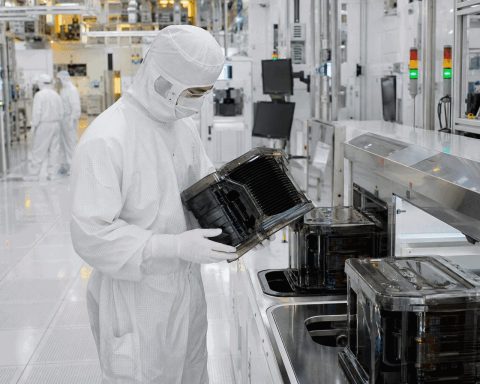
Jefferies’ core logic is straightforward (and very on-brand for KLA): as chips get more complex—especially for AI servers—manufacturing becomes more yield-sensitive, and that increases demand for inspection and metrology tools used to detect defects and improve yields. The same note also flags advanced packaging complexity as another driver that can expand the amount of process control required across the manufacturing flow.
Jefferies also acknowledged a risk investors keep circling: China exposure. In the Investing.com write-up, Jefferies argues KLA’s China revenue is “relatively derisked” at about 25% for calendar 2026, while still noting the topic remains a concern for the group. Investing
Today’s (Dec. 25) analysis: “Opportunity or trap?” versus “Is it too late?”
Two widely circulated analyses dated December 25, 2025 summarize the current split-screen view of KLA stock:
1) Trefis: rally recap, upgrade impact, and a valuation caution flag
A Trefis note published today highlights KLAC’s five-day streak (~9% cumulative gains) and ties the move to a cluster of analyst upgrades and price-target hikes, including Jefferies’ $1,500 target. It also frames the big question as valuation: strong operating performance, but a stock that may be “relatively expensive” after the run. Trefis
2) Simply Wall St: a “100% rally” forces the valuation conversation
Simply Wall St’s Dec. 25 piece leans into the same tension more explicitly: KLA is up about 100% year-to-date, with strong recent momentum, but valuation now matters more because investors are no longer buying a “recovery” story—they’re buying continued excellence. Simply Wall St
The piece notes KLA trading at a P/E around ~39.6x (by its calculations), and contrasts that with broader semiconductor comparisons and an internal “fair ratio” framework that implies the stock may be fully valued depending on one’s growth assumptions. Simply Wall St
The common thread between both analyses: KLA isn’t being debated as a weak company. It’s being debated as a great company at a demanding price.
Fundamentals check: what KLA itself last reported and guided
Beyond headlines, KLA’s most recent official results and guidance provide a hard anchor for the “fundamentals versus valuation” discussion.
Fiscal Q1 2026 results: revenue $3.21B; non-GAAP EPS $8.81
In its fiscal 2026 first-quarter results (quarter ended Sept. 30, 2025), KLA reported revenue of $3.21 billion, GAAP net income of about $1.12 billion, and GAAP EPS of $8.47 (with non-GAAP EPS of $8.81).
In the same release, CEO Rick Wallace pointed to the “AI infrastructure buildout” as a multi-year shift with broad downstream effects—an important clue as to why investors keep classifying KLA as an AI beneficiary even though it doesn’t sell GPUs. KLA Corporation
Fiscal Q2 2026 guidance: revenue ~$3.225B ± $150M; non-GAAP EPS ~$8.70 ± $0.78
For the fiscal second quarter ending in December, KLA guided to:
- Revenue:$3.225 billion ± $150 million
- Non-GAAP gross margin:62.0% ± 1.0%
- Non-GAAP diluted EPS:$8.70 ± $0.78 (implying a range of roughly $7.92 to $9.48) KLA Corporation
Guidance matters here because it’s the bridge between the market’s “AI capex supercycle” narrative and the company’s near-term reality.
Capital returns: dividends + buybacks remain a pillar
KLA also continues to emphasize shareholder returns. In the results release, the company reported (in the quarter ended Sept. 30, 2025) roughly $254 million in dividend payments and about $545 million in stock repurchases—around $799 million of total capital returns for the quarter (figures shown in thousands in the release).
Separately, KLA’s board declared a $1.90 per share quarterly dividend payable Dec. 2, 2025 to shareholders of record as of Nov. 17, 2025.
The macro tailwind KLA investors keep watching: wafer fab equipment spending growth
KLA’s fortunes are tightly linked to semiconductor manufacturing investment. On that front, a major industry forecast cited this month has been supportive.
SEMI expects sales of equipment used to make chip wafers to rise about 9% to $126 billion in 2026 and a further 7.3% to $135 billion in 2027, with AI-related demand helping drive logic and memory capacity expansions. Reuters’ report also lists KLA among the major suppliers positioned in this market.
This is the “rising tide” argument for KLA: if total equipment spending grows and leading-edge complexity increases, process control can grow as a share of that spending—even when customers scrutinize budgets.
Analyst forecasts and price targets: a wide range, with $1,400–$1,500 at the top end
As of late December, the sell-side picture for KLA is less about “is KLA good?” and more about “how much upside is left after the run?”
Here are the notable price-target signals shaping the Dec. 25 conversation:
- Jefferies: upgraded to Buy; price target $1,500 Investing
- BofA:raised price target to $1,450 from $1,400, kept Buy TipRanks
- Argus: raised price target to $1,400 from $1,000, kept Buy TipRanks
On the more “consensus aggregator” side, MarketBeat lists:
- 26 analysts with an average 12-month target of ~$1,275.54,
- a high target of $1,500 and a low target of $800—a reminder that analysts themselves disagree meaningfully on what “fair value” means at this stage of the cycle. MarketBeat
One practical takeaway: when the average target sits close to the current price but the top-end targets are much higher, it often implies that the bullish case depends on specific assumptions (stronger-than-expected 2026–2027 spending, sustained AI-driven node transitions, and/or better-than-feared geopolitical outcomes).
The risk section that keeps showing up in every serious KLAC write-up
The bullish thesis is easy to summarize. The risk thesis is messier—because it’s a bundle of “what ifs” that can hit all at once.
Here are the recurring concerns in recent coverage:
Valuation risk after a 100% year.
Simply Wall St’s Dec. 25 analysis frames KLA as potentially fully valued depending on growth assumptions and highlights a P/E level near ~39–40x in its discussion.
China exposure and export controls.
Jefferies explicitly calls China a concern—even while arguing KLA’s outlook is somewhat “derisked” relative to worst fears. This remains a headline-sensitive factor for the entire U.S. chip equipment space. Investing
Semiconductor cycles are still cycles.
AI can be a supercycle driver, but memory and consumer markets can still wobble, and capex plans can get revised fast if end-demand changes. Even bullish banks warn the path can be volatile.
Customer concentration and “timing risk.”
Process control demand can be lumpy quarter-to-quarter, and “the market already priced it in” is a real issue when a stock rallies hard on upgrades—an argument explicitly raised in today’s Trefis piece. Trefis
What to watch next after Dec. 25
With Christmas Day pausing the market action, attention shifts to the next set of catalysts that can either validate (or puncture) the bullish narrative:
- Fiscal Q2 2026 results and outlook.
KLA already provided December-quarter guidance (revenue and EPS ranges). The next report will matter less for “beat or miss” and more for any change in tone around 2026 demand visibility. KLA Corporation - Earnings date watch.
MarketBeat lists Jan. 29 (after market close) as an estimated upcoming earnings date for Q2. Treat calendars as provisional until confirmed by the company. - Industry capex signals for 2026–2027.
SEMI’s forecast (via Reuters) is one of the cleaner “top-down” indicators investors keep quoting. If that forecast strengthens—or if customers’ guidance contradicts it—expect KLAC headlines to follow. Reuters
Bottom line (as of Dec. 25, 2025): KLA stock is being pulled forward by a potent mix of AI-era manufacturing complexity, supportive equipment-spending forecasts, and aggressive analyst target hikes reaching $1,400–$1,500. The counterweight is simple: after a year like 2025, the market starts demanding near-perfection—and even great companies can stumble when expectations get too tight.