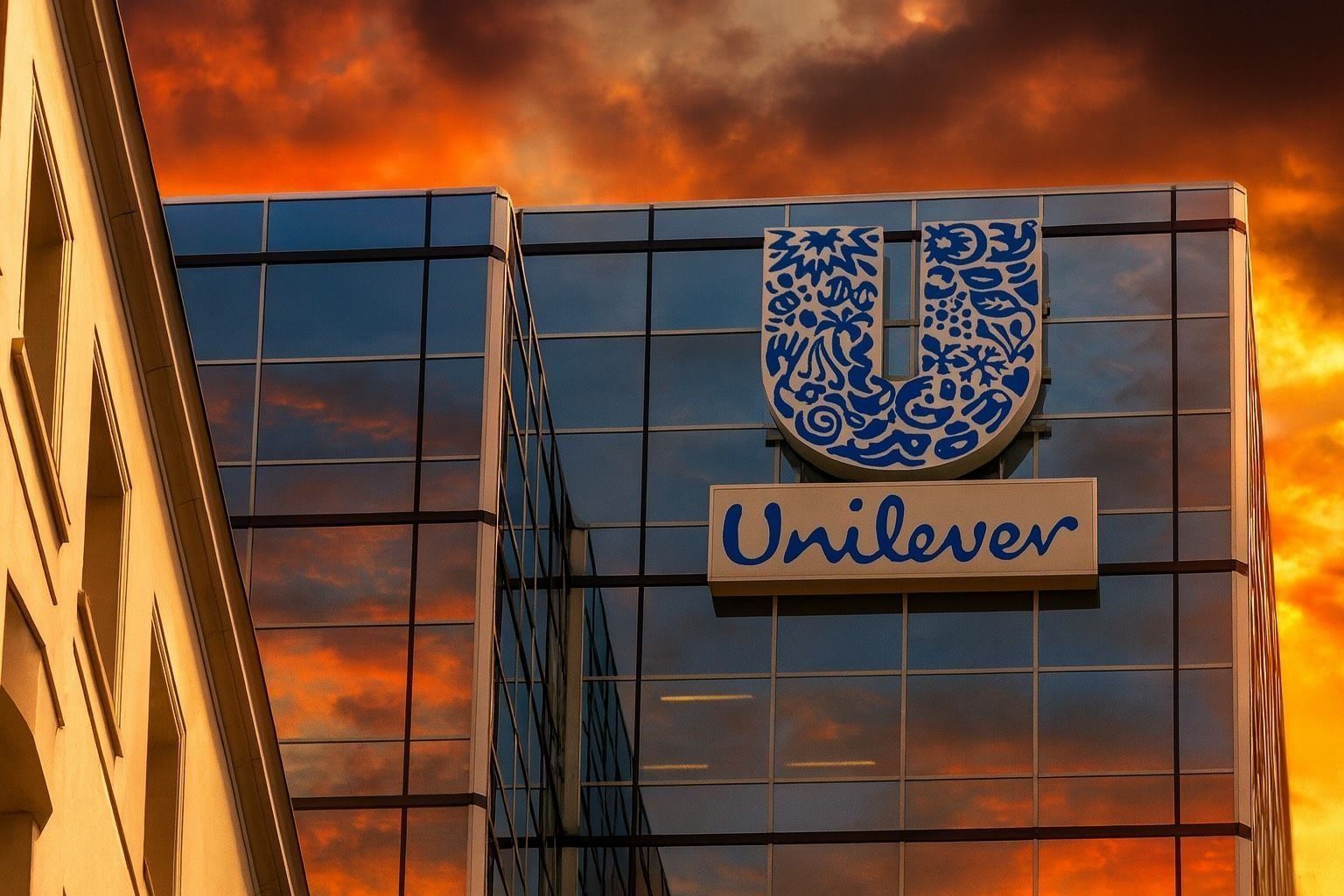
Unilever PLC (LSE: ULVR, NYSE: UL) heads into the final stretch of 2025 with its share price pinned in a tight range while the investment story gets noisier: a blockbuster Magnum Ice Cream Company spin‑off, fresh portfolio disposals, regulatory heat on “green” claims, and a new audit of the Ben & Jerry’s Foundation are all landing at once.
Unilever share price today: how the stock is trading
As of the London open on 3 December 2025, Unilever’s primary listing on the London Stock Exchange trades around 4,477p, down about 0.13% on the day and roughly 4.6% lower over 12 months. The stock’s beta of about 0.5 underlines its classic “defensive staple” profile. [1]
On Wall Street, the New York–listed ADR UL most recently changed hands at about $59.53, with an intraday range near $59–61 and a 52‑week span of $54.32 to $65.66. [2]
Using consensus 2025 earnings per share of roughly €3.01 (around $3.25 using current FX), the stock is trading at just under 20x 2025 earnings, with a forward P/E in the high‑teens. [3] That’s not a bargain‑bin valuation, but it’s also not extravagant for a global consumer‑staples franchise with strong brands and low volatility.
On income, Unilever continues to pay a quarterly dividend. For 2025 so far, the company has declared €0.4528 per share per quarter, up about 3% year‑on‑year and implying an annualised yield in the low‑to‑mid‑3% range at current prices. [4]
Magnum Ice Cream Company spin‑off: the main 2025 catalyst
The biggest structural change in Unilever’s equity story is the imminent separation of its ice cream business into The Magnum Ice Cream Company (TMICC).
Timeline and mechanics
Unilever’s shareholder circular and demerger documentation lay out the key steps: [5]
- The ice cream unit is being separated via a demerger into TMICC, headquartered in the Netherlands.
- Share distribution: for every five Unilever shares or ADSs held at the demerger record time, investors receive one TMICC share, while keeping their existing Unilever stake.
- Unilever will retain about 19.9% of TMICC post‑spin, with ~80.1% in public hands, and plans to sell its retained stake over time.
- TMICC is expected to list in Amsterdam, London and New York, mirroring Unilever’s current footprint.
- A share consolidation at Unilever PLC will reduce the number of Unilever shares in issue so per‑share metrics remain broadly comparable before and after the spin‑off.
After a delay linked to the U.S. government shutdown, Unilever now expects to complete the demerger around 6 December 2025, with Magnum shares debuting on Euronext Amsterdam on or about 8 December, alongside secondary listings in London and New York. [6]
Magnum’s debut in credit markets
Ahead of listing, TMICC has already tested investor appetite in the bond market:
- Magnum raised €3 billion in its debut bond deal, split into four tranches maturing between 2029 and 2037, with coupons of roughly 2.75%–4.0%.
- The books were over seven times oversubscribed, and the notes carry investment‑grade ratings (BBB/Baa2), under an €8 billion EMTN programme. [7]
Separately, Unilever Capital Corporation recently issued long‑dated euro bonds, with a post‑stabilisation notice indicating no stabilisation was needed—another sign of robust credit appetite for the group’s risk. TS2 Tech
For equity holders, the message is pretty simple: both the parent and the spin‑off can raise long‑term funding on decent terms, which reduces balance‑sheet anxiety around the separation.
What “new Unilever” looks like post‑spin
Once TMICC is carved out, Unilever will be a more focused Beauty & Wellbeing, Personal Care, Home Care and Foods group, with ice cream reported as a discontinued operation from Q4 2025. TS2 Tech+1
Management is targeting:
- Underlying sales growth (USG) in the 3–5% range for 2025
- A higher structural margin profile after stranded costs from the ice‑cream separation are offset by an €800 million productivity programme already ahead of plan (c. €650 million in cumulative savings expected by end‑2025). [8]
Bulls argue that shedding a seasonal, capital‑intensive business in favour of premium beauty and home‑care brands should justify a higher multiple over time. Bears worry that ice‑cream demand may be structurally slowing (GLP‑1 weight‑loss drugs are not exactly friends of frozen desserts), meaning the commodity‑like part is being spun to public shareholders while Unilever keeps the more “genteel” growth engine. TS2 Tech
Portfolio pruning: Graze sale and potential food disposals
The Magnum spin‑off isn’t happening in isolation. Unilever has been steadily reshaping its portfolio:
- On 1 December 2025, Unilever agreed to sell its UK snack brand Graze to Katjes International, owner of Candy Kittens, for undisclosed terms. The move is explicitly framed as part of a pivot toward beauty and wellbeing and away from some legacy food lines. [9]
- The same Reuters report notes that Unilever is considering further disposals, potentially including long‑standing British names such as Marmite, Colman’s and Bovril, although no formal sale processes have been confirmed. [10]
Earlier, Unilever had already announced the divestment of local food brands including Unox and Conimex, reinforcing the message that Foods will focus more on cooking aids and condiments rather than an eclectic pantry of regional labels. [11]
Taken together, the company is clearly leaning into a “fewer, bigger, more global brands” strategy: more Dove, Vaseline and Knorr; fewer small, slow‑growing local foods that soak up management time without moving the needle.
Q3 2025 results: beauty and personal care lead growth
Fundamentally, Unilever’s 2025 performance has been resilient rather than spectacular.
Group performance
For Q3 2025, Unilever reported: [12]
- Underlying sales growth (USG): 3.9%, ahead of the ~3.7% analyst consensus
- Volume growth: 1.5%, with 2.4% from pricing
- Ex‑Ice Cream, group USG nudged up to 4.0% with 1.7% volume growth TS2 Tech+1
By geography, growth has been led by North America and key emerging markets such as India and China, while Europe shows solid momentum and parts of Latin America remain softer. [13]
Segment dynamics: beauty doing the heavy lifting
The company’s own Q3 breakdown shows: [14]
- Beauty & Wellbeing: sales up 5.1%, with 2.3% from volume, driven by strong performances from Dove hair, Vaseline, Liquid I.V., Nutrafol, K18 and other premium brands.
- Personal Care: sales up 4.1%, with 1.0% volume, led by science‑driven deodorants and skin‑cleansing products.
- Home Care and Nutrition grew more modestly but remained positive, with trade‑downs and pack‑size shifts in some markets offset by pricing.
For the first half of 2025, the picture is similar: USG of 3.4% (1.5% volume, 1.9% price), a hefty 45.7% gross margin, and underlying operating margin around 19.3%, slightly lower year‑on‑year due to separation costs and FX. [15]
In guidance, management continues to target 3–5% USG and an improvement in underlying operating margin versus 2024, reiterating that productivity savings and portfolio reshaping should outweigh cost inflation and spin‑off frictions. [16]
Cash returns: dividends, buybacks and share count
Unilever is trying hard to keep its “income stock” credentials intact during all this portfolio surgery.
- The quarterly dividend for Q3 2025 of €0.4528 per share matches Q2 and is 3% higher than Q3 2024. The company has flagged that it still expects to pay a full Q4 dividend even after the ice‑cream demerger completes. [17]
- A €1.5 billion share buyback was completed earlier in 2025, and the company retains balance‑sheet flexibility to deploy further buybacks or bolt‑on M&A once the spin‑off dust settles. [18]
A fresh Form 6‑K filed on 1 December 2025 confirms that as of 28 November: [19]
- Unilever PLC had 2,524,997,338 ordinary shares in issue.
- 2,451,918,514 shares carried voting rights (after excluding treasury stock and shares held by group companies).
That denominator matters: it’s the base used to determine ownership thresholds and will also feed into the share consolidation accompanying the Magnum spin‑off.
Governance and ESG: Ben & Jerry’s audit and “greenwashing” scrutiny
The headline Unilever story on 3 December 2025 isn’t a new product launch; it’s governance.
Ben & Jerry’s Foundation audit
A Unilever‑backed audit of the Ben & Jerry’s Foundation, the independent philanthropic arm funded solely by the ice‑cream brand, has identified deficiencies in financial controls, governance and compliance policies, according to a Reuters report published today. [20]
Key points from the audit and subsequent coverage:
- The review, carried out by Magnum (soon to be the direct owner of Ben & Jerry’s), did not find evidence of ethical misconduct or legal violations.
- It did highlight weak conflict‑of‑interest policies, gaps in financial oversight, and incomplete implementation of recommended reforms.
- Governance changes being proposed include a code of ethics, tighter trustee term limits and clearer funding conditions.
- Long‑running tensions between Unilever and the Ben & Jerry’s board over the brand’s political stances—especially around Israel and Palestine—form the backdrop to this audit and have already contributed to one co‑founder stepping down from the foundation’s board. [21]
For investors, this isn’t primarily about a few million dollars of charitable spending; it’s about reputational risk management in a brand that punches far above its weight in media attention.
Sustainability claims under the microscope
Separately, Unilever has been under pressure in the Netherlands for what consumer groups call “large‑scale greenwashing”:
- Dutch consumer association Consumentenbond found that more than half of a sample of Unilever products carried potentially misleading sustainability language or self‑created “green” logos mimicking third‑party ecolabels. [22]
- In response, Unilever agreed in October 2025 to remove unsubstantiated phrases such as “sustainably sourced vegetables” and “sustainable packaging” from its Dutch packaging and to tighten substantiation behind remaining claims, after engagement with the national competition authority ACM. [23]
This doesn’t appear to threaten near‑term earnings, but ESG‑sensitive investors will be watching to see whether Unilever turns this into a cleaner global framework for environmental claims, or whether similar challenges pop up in other markets.
Who’s buying Unilever stock? Institutional flows and “smart money”
One of the subtle shifts in recent months has come from institutional investors quietly adding to positions.
A MarketBeat‑summarised filing shows that Fisher Asset Management LLC increased its stake by about 10.2% in Q2, purchasing 1,989,631 shares and bringing its holdings to roughly 21.6 million UL shares, or 0.88% of the company, worth about $1.32 billion at the time of the filing. [24]
Several smaller firms have also opened or expanded stakes, and total hedge‑fund and institutional ownership sits around 9–10% of the float—low compared with some U.S. consumer peers, but typical for a widely held European staple. [25]
That doesn’t mean “smart money knows something dramatic.” It does suggest that, for long‑term allocators, Unilever remains a go‑to way to get global consumer exposure plus a dependable dividend, even as the corporate structure gets rewired.
Analyst ratings and price targets: a split jury
If you’re looking for a consensus “buy the dip” signal, you won’t find it. Analyst opinion on Unilever is noticeably split.
London line (ULVR)
MarketBeat’s aggregation for the London stock shows: [26]
- 6 analysts have issued ratings in the past 12 months.
- The consensus rating is “Hold”, made up of 3 Buy and 3 Sell recommendations.
- The average 12‑month price target is 4,690p, with a high of 5,700p and a low of 3,800p, implying around 4.5% upside from a current price near 4,489p at the time of calculation.
Recent broker moves include:
- JPMorgan: Overweight, target lifted from 5,400p to 5,700p, implying >25% upside from late‑November levels, based on anticipated margin gains and an under‑appreciated Magnum spin‑off. TS2 Tech
- Bank of America Securities: Buy with a 5,400p target, citing Unilever as a low‑volatility compounder where modest growth, dividend yield and productivity savings add up to attractive total returns. [27]
- Rothschild Redburn: Buy, target £53.50 (~5,350p), leaning into the “simpler, higher‑margin Unilever” thesis post‑spin. TS2 Tech
- UBS: Sell, target 4,120p, arguing that Magnum faces structural demand pressure (including reduced ice‑cream consumption among GLP‑1 users) and that the spin‑off may not deliver enough growth or margin uplift to justify current multiples. TS2 Tech
- Jefferies: Sell/Underperform, with the London target cut to 3,800p in October. [28]
In other words, the spread between bullish and bearish targets is nearly 50% of the current share price, which tells you more about the level of uncertainty than any single target does.
ADR (UL)
For the New York ADR, MarketBeat’s summary indicates a “Moderate Buy” skew, with an average target price around $73, versus the current ~$60 quote. [29]
StockAnalysis’ consensus forecasts call for: [30]
- Revenue 2025: ~€59.2 billion (down 2.6% vs 2024), recovering to €60.2 billion in 2026 (+1.7%).
- EPS 2025:€3.01, up 31.5% year‑on‑year due largely to margin recovery and portfolio changes.
- EPS 2026:€3.15, up a further 4.7%.
That profile—flatish top line, steady premiumisation and mild margin expansion—is exactly what you’d expect from a mature global staple trying to behave a bit more like a beauty company.
Key risks and opportunities for Unilever stock
At this point, the Unilever equity story boils down to a few big moving parts:
Bullish arguments
- Portfolio focus: exiting ice cream and trimming food brands to lean into Beauty & Wellbeing and Personal Care, categories with stronger structural growth. [31]
- Productivity programme: €800m of savings targeted, with most already locked in, potentially boosting margins as separation costs roll off. [32]
- Defensive characteristics: low beta, global diversification, and a long track record of uninterrupted dividends—over three decades of regular payouts. [33]
- Credit and capital markets support: oversubscribed Magnum bond issue and smooth Unilever funding suggest healthy investor confidence in both entities’ balance sheets. [34]
Bearish arguments
- Execution risk on the spin‑off: carving out a global ice‑cream giant while maintaining growth and avoiding stranded costs is not a small operational puzzle.
- Demand headwinds in ice cream: concerns about long‑term ice‑cream consumption, especially in developed markets facing health‑conscious shifts and GLP‑1 adoption, could weigh on Magnum’s valuation and, indirectly, on perceived value creation for Unilever shareholders. TS2 Tech
- Regulatory and reputational risk: greenwashing investigations, changes to sustainability claims and the Ben & Jerry’s governance saga all add low‑level ESG noise that could become more material if mishandled. [35]
- Macro and FX: with significant exposure to emerging markets and a euro‑denominated reporting currency, Unilever is perpetually wrestling FX and category‑mix volatility.
Unilever stock: outlook from here
As of 3 December 2025, Unilever stock looks less like a deep value play and more like a “show‑me” restructuring story wrapped in a defensive staple:
- Valuation: around 20x 2025 EPS and a ~3–3.5% dividend yield positions it in the middle of the global staples pack—neither obviously cheap nor dangerously expensive. [36]
- Growth: consensus expects low single‑digit revenue growth and mid‑single‑digit EPS growth over the next couple of years, assuming the productivity plan and portfolio mix do what they’re supposed to. [37]
- Sentiment: the analyst split (half Buy, half Sell on ULVR) and the wide spread in price targets make clear that investors genuinely disagree on how much value the Magnum spin‑off and portfolio reshaping will unlock. [38]
For income‑oriented or quality‑growth investors, Unilever still offers the classic combination of global brands, steady dividends and moderate growth, now with an extra layer of corporate‑action complexity. For more tactical traders, the key catalysts over the coming weeks will be:
- The final terms and trading behaviour of TMICC once listed.
- Any updates to guidance and margin targets as Unilever reports Q4 and full‑year numbers.
- How the company handles the governance and ESG narrative around Ben & Jerry’s and sustainability claims.
None of this is a guarantee of outperformance, but it does mean Unilever is far from “boring soap and soup” right now. It’s a live experiment in how a century‑old consumer giant rewires itself for a world of GLP‑1s, greenwashing watchdogs and premium skin serums.
References
1. markets.ft.com, 2. www.marketbeat.com, 3. stockanalysis.com, 4. www.unilever.com, 5. www.unilever.com, 6. www.reuters.com, 7. www.reuters.com, 8. www.unilever.com, 9. www.reuters.com, 10. www.reuters.com, 11. www.unilever.com, 12. www.unilever.com, 13. www.unilever.com, 14. www.unilever.com, 15. www.unilever.com, 16. www.unilever.com, 17. www.unilever.com, 18. www.unilever.com, 19. www.stocktitan.net, 20. www.reuters.com, 21. www.reuters.com, 22. www.foodingredientsfirst.com, 23. www.just-food.com, 24. www.marketbeat.com, 25. www.marketbeat.com, 26. www.marketbeat.com, 27. swingtradebot.com, 28. www.insidermonkey.com, 29. www.marketbeat.com, 30. stockanalysis.com, 31. www.unilever.com, 32. www.unilever.com, 33. www.unilever.com, 34. www.reuters.com, 35. www.foodingredientsfirst.com, 36. markets.ft.com, 37. stockanalysis.com, 38. www.marketbeat.com