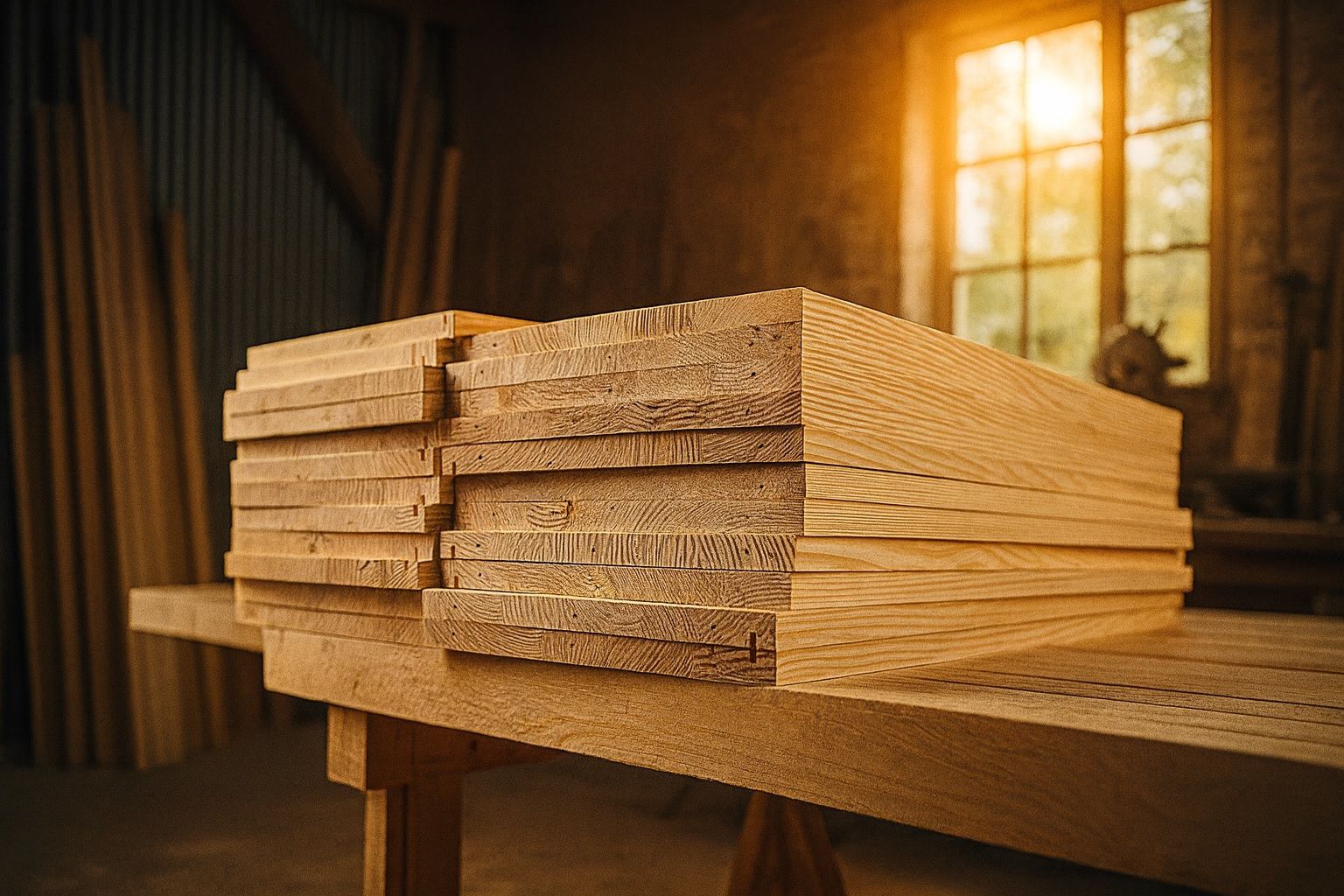

- What is Superwood? InventWood, a Maryland startup, has launched “Superwood” – an engineered timber claimed to be up to 10× stronger by weight than steel and 6× lighter timesofindia.indiatimes.com techcrunch.com. Developed by Professor Liangbing Hu, Superwood is ordinary wood (or even bamboo) treated and compressed at the molecular level timesofindia.indiatimes.com inc.com.
- How it’s made: The process “cooks” wood in an alkaline solution (sodium hydroxide and sulfite) to strip lignin, then hot-presses it to align cellulose nanofibers woodfloorbusiness.com. This densification boosts its strength dramatically: the final material has about 50% more tensile strength than steel and a strength-to-weight ratio ten times better techcrunch.com fastcompany.com.
- Production timeline: After years of R&D, InventWood will begin producing Superwood in 2025. First batches (facade panels for buildings) are rolling out this summer from a new Frederick, MD factory (1 million+ sq ft/yr capacity fastcompany.com). Applications will expand from exteriors (decks, cladding) to interiors (flooring, furniture) and eventually structural beams timesofindia.indiatimes.com .
- Properties & uses: Besides strength, Superwood is fire-rated (Class A), weather-, rot- and pest-resistant techcrunch.com timesofindia.indiatimes.com. It can replace metal fasteners in furniture and potentially compete with steel in construction and automotive parts timesofindia.indiatimes.com inc.com. InventWood plans to source reclaimed/fast-growing trees (including bamboo) to reduce its carbon footprint .
- Environmental impact: Superwood locks carbon and is touted as greener than steel. InventWood says emissions are ~90% lower than making steel timesofindia.indiatimes.com. Experts disagree: Yale researchers argue mass-timber like CLT could cut global CO₂ by dozens of gigatons if done right environment.yale.edu, while a World Resources Institute analysis warns large-scale wood construction may increase emissions unless forests are managed carefully .
- Market outlook: Mass-timber construction is growing rapidly (order of ~20%/yr), with forecasts predicting the market to reach ~$1.8 billion by 2030 (≈7% CAGR) marksparksolutions.com. Major timber firms (e.g. Weyerhaeuser – closed ~$23.92 on Oct 10, 2025 investing.com) and steelmakers (e.g. ArcelorMittal – ~$33.24 on Oct 13 investing.com) are watching the trend. InventWood has raised about $50 million so far (including a $15M Series A led by climate investors techcrunch.com) to scale up Superwood production.
- Expert voices: InventWood’s CEO Alex Lau calls Superwood “the default way to build” – promising lighter, faster and safer construction inc.com. UNSW architecture professor Philip Oldfield notes it may allow “larger spans and more durable finishes” in timber construction timesofindia.indiatimes.com, while civil engineer Shiling Pei (Colorado Mines) finds Superwood “fascinating” but emphasizes practical questions about its size and cost inc.com.
What is Superwood and Who’s Behind It?
“Superwood” is not a sci-fi material but the latest engineered timber from InventWood, a Frederick, MD startup. Based on a breakthrough by Prof. Liangbing Hu (Univ. of Maryland), Superwood is ordinary wood (or even bamboo) transformed into a super-strong material timesofindia.indiatimes.com inc.com. After Hu’s 2018 Nature paper on transparent wood, he spent years refining the process. In 2021 InventWood spun out of academia, and today it holds 140+ patents on wood densification. InventWood CEO Alex Lau says the treated wood “behaves like wood but is much stronger and lighter,” envisioning buildings that are “lighter, cheaper to build, faster to build, and safer to live in” inc.com. Indeed, steel has a typical tensile strength ~400 MPa, whereas Superwood can reach ~600 MPa inc.com – a huge leap for a wood-based product.
How It’s Made: Chemistry and Pressing
The Superwood process has two main steps. First, lumber (even woodchips or bamboo) is “cooked” in a food-grade chemical bath (sodium hydroxide and sodium sulfite). This partially removes lignin and hemicellulose – the rigid polymers that color and stiffen wood woodfloorbusiness.com. Second, the pre-treated wood is hot-pressed at moderate temperature (around 150–200°C) to collapse its cellular structure and force the cellulose fibers into alignment. The result is a completely densified material whose cellulose nanofibers bond together. Remarkably, densifying by 4× yields about 10× the strength (not just 4×) due to extra hydrogen bonding techcrunch.com woodfloorbusiness.com. TechCrunch reports Superwood has 50% higher tensile strength than steel, with a strength-to-weight ratio 10 times better than steel techcrunch.com. In simple terms, a plank of Superwood can out-muscle steel on a pound-for-pound basis. InventWood engineers even note that the hot-pressing process enriches the wood’s natural colors, yielding rich “walnut” and “tropical hardwood” hues without stains techcrunch.com.
Rolling Out Production
After laboratory development, InventWood is now scaling up. A Series-A fundraise (first closing $15 M in April 2025) will finance a 90,000 sq ft plant in Frederick, MD techcrunch.com despatch.com. FastCompany and Wood industry outlets say first commercial batches start in summer 2025, initially for facade and decking panels fastcompany.com woodfloorbusiness.com. CEO Alex Lau emphasizes focusing on the “skin” of buildings first, eventually moving Superwood into structural “bones” (beams and columns) as certification progresses techcrunch.com. The plan: interior finishes (offices and high-end homes) come first, then exterior panels (siding/roofs) by late 2025, then full-length beams “within a few years” fastcompany.com. InventWood projects ~1 million sq ft per year output at the Frederick plant starting this summer fastcompany.com, enough for several mid-size buildings.
Material Properties and Applications
Superwood combines lightness with toughness. It remains machinable by normal woodworking tools – architects and contractors can saw, nail or screw it just like regular wood fastcompany.com. Key advantages include:
- Strength & Weight: 10× steel’s strength-to-weight (so it can support big loads while weighing far less) techcrunch.com .
- Fire and Weather Resistance: It earns a Class A fire rating without added retardants, and resists rot, moisture, pests and UV better than untreated wood techcrunch.com .
- Dimensional Stability: Compressed fibers mean Superwood won’t warp or shrink like normal wood – ideal for precision panels.
- Aesthetics: The natural grain deepens and looks “richer” after pressing techcrunch.com, allowing beautiful exposed timber finishes (no stain needed).
- Compatibility: Lau touts that Superwood can substitute for steel/concrete in many uses. For example, screws, nails and even furniture joints could be made from Superwood instead of metal .
Potential applications range from construction (skyscrapers, bridges, modular housing) to automotive/aerospace (lightweight strong components). Because it locks away carbon in a permanent structure and avoids the extreme heat of steelmaking, InventWood markets Superwood as a “greener” building material timesofindia.indiatimes.com inc.com.
Industry Experts and Market Reaction
Experts are intrigued. UNSW’s Philip Oldfield says Superwood “could allow architects to design larger spans and more durable finishes with wood,” potentially enabling taller timber buildings timesofindia.indiatimes.com. Indeed, wood skyscrapers are already emerging globally (e.g. Milwaukee’s 25-story “Ascent MKE” at 284 ft gbdmagazine.com). Engineers like Shiling Pei (Colorado School of Mines) call Superwood “fascinating,” noting the construction industry always needs higher strength-to-weight materials inc.com. Pei cautions, however, that how Superwood is used (especially connection details in earthquakes or hurricanes) will be key; in one 2023 wood-tower test, only drywall and fasteners failed under a 7.7 quake inc.com.
Financial markets are taking note. Mass-timber construction is projected to grow briskly (industry forecasts ~7–15% annual growth over the decade marksparksolutions.com). Traditional steelmakers are on alert: for example, ArcelorMittal (MT) traded around $33–34 in mid-Oct 2025 investing.com, while timber REIT Weyerhaeuser (WY) was in the mid-$20s investing.com. (Broader markets were volatile too – CNN reported the Nasdaq plunged ~3.6% on Oct 11 amid trade-wars fears abc17news.com, though it partly recovered by Oct 13.) Analysts note that Superwood is currently expensive: InventWood intends to price it at tropical-hardwood levels – roughly $12–25 per pound, versus only $1–2 for steel (by weight) fastcompany.com. In other words, it’s a premium product (for now) targeting high-value uses.
Environmental Implications: Promise vs. Pitfalls
Superwood is championed as eco-friendly – wood is a renewable resource and this process uses relatively mild “food-industry” chemicals. InventWood claims Superwood’s lifecycle CO₂ is far lower than steel’s (steelmaking emits 9–10% of global CO₂). Indeed, Yale researchers (Yuan Yao et al.) modeled widespread use of engineered wood like cross-laminated timber (CLT) and found it could cut carbon emissions dramatically – by 25–39 gigatons by 2100, while even expanding forestland via intensified plantation forestry environment.yale.edu environment.yale.edu. They conclude CLT is a “good greenhouse gas mitigation strategy,” especially if forests are sustainably managed environment.yale.edu.
However, some scientists urge caution. A 2023 World Resources Institute report warns that using more wood for construction “is likely to increase emissions for many decades” if the carbon costs of logging and processing are ignored wri.org. Searchinger et al. explain that much of a tree’s carbon ends up released during harvesting and milling; only a fraction stays sequestered in buildings long-term wri.org wri.org. If new demand for wood isn’t met by well-managed tree plantations, we risk depleting carbon-rich old forests. InventWood plans to use waste timber and certified wood (FSC) to mitigate this, but the industry debate continues.
Forecast: If Superwood proves scalable, it could turbo-charge the mass-timber market, potentially displacing some steel and concrete. However, adoption will depend on cost, regulation, and whether building codes allow more wood structures. For now, many experts advise pilot projects and careful study (New South Wales’s Oldfield notes regulators will need education and trials ).
In summary, Superwood represents a significant breakthrough in materials science – “ten times” stronger than steel on a weight basis timesofindia.indiatimes.com techcrunch.com – but it’s not yet a silver bullet. As Alex Lau puts it, Superwood has “the potential to be the default way to build,” but only time (and engineering) will tell if it truly upends the steel paradigm inc.com.
Sources: Major news outlets and industry experts report on Superwood’s launch and technology timesofindia.indiatimes.com techcrunch.com woodfloorbusiness.com inc.com. Stock prices are from mid-Oct 2025 market data investing.com investing.com. Climate analyses are cited from Yale and WRI studies environment.yale.edu wri.org. All facts are drawn from the linked sources.
Related articles: Innovation