
Updated: November 18, 2025
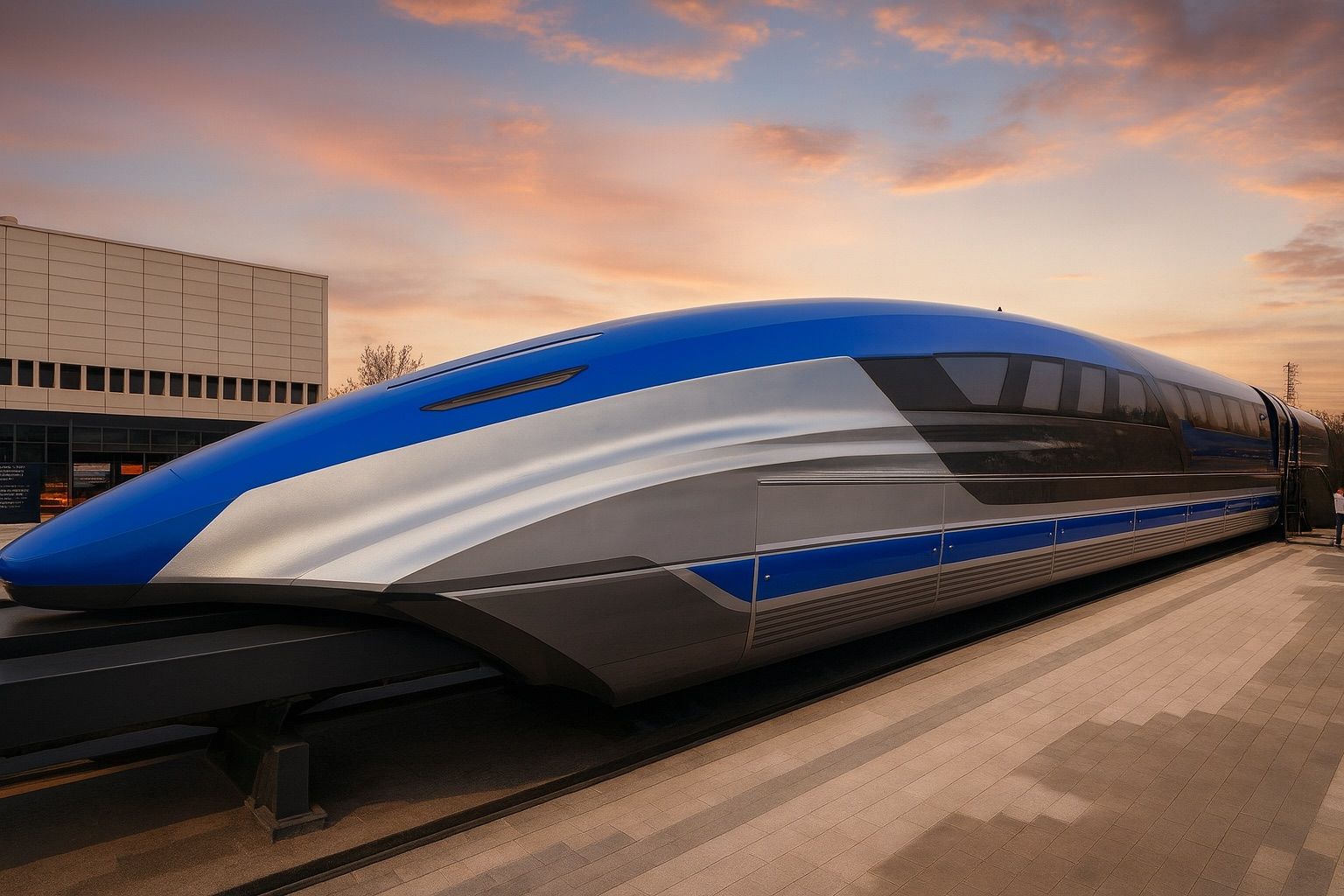
On November 18, 2025, magnetic trains – better known as maglev trains – are back in the global spotlight. A fresh explainer from Travel and Tour World on how magnetic trains float and why they’re greener, new coverage of China’s experimental 1,000 km/h vacuum‑tube train, and a market forecast showing maglev set to double in value by 2035 are all trending across news feeds and Discover cards.
At the same time, photo-led explainers like WION’s “how magnetic trains float at high speed and the technology behind them” are helping a wider audience grasp the science that makes these futuristic trains possible. And the big question for today is simple:
Are magnetic trains finally ready to go faster than planes – and can they really deliver a greener, global transport revolution?
Let’s break down today’s headlines, the tech behind them, and what this means for the future of travel.
What Are Magnetic Trains – and How Do They Float?
Maglev (short for magnetic levitation) is a transport technology that uses magnetic forces to lift and propel a train so it never touches the track. Instead of steel wheels on steel rails, the train “rides” a magnetic field along a dedicated guideway.
Because there is no rolling contact, friction drops dramatically, which:
- allows much higher speeds (over 600 km/h in tests),
- cuts wear and tear on infrastructure and rolling stock,
- and improves energy efficiency compared with conventional high‑speed rail.
Modern maglev systems typically use two main elements:
- Levitating magnets to lift and stabilise the train a few centimetres above the guideway.
- Linear motors built into the track to pull or push the train forward using changing magnetic fields.
EMS vs EDS: Two Ways to Make a Train Hover
The explainer from Travel and Tour World – mirrored today in several languages – highlights the two primary levitation systems used in maglev trains:
- Electromagnetic Suspension (EMS)
- Electromagnets on the train attract it upward toward a ferromagnetic rail.
- The train effectively hangs from the track, with sensors and controllers constantly fine‑tuning the gap to keep it stable.
- This approach is used on systems like Germany’s Transrapid technology.
- Electrodynamic Suspension (EDS)
- Uses repulsive forces between powerful superconducting or permanent magnets on the train and coils in the track.
- At speed, induced currents in the coils create a magnetic field that pushes the train away, causing it to float.
- Japan’s Chūō Shinkansen maglev uses this principle.
In both cases, the result is the same: a train that floats a few centimetres above the guideway, gliding forward with minimal resistance.
Propulsion: Linear Motors Instead of Rotating Wheels
Once the train is levitating, it still needs to move. That’s where linear synchronous motors come in:
- The guideway contains a sequence of coils that can be energised in a controlled pattern.
- By switching these coils on and off in sequence, they create a travelling magnetic wave that pulls (or pushes) the train along.
- The train’s onboard magnets “lock” onto this wave, similar to how a traditional electric motor’s rotor follows a rotating field – but stretched out along tens or hundreds of kilometres. Travel And Tour World
Because the only major resistances are aerodynamic drag and small control losses, maglev trains can sustain high speeds with relatively stable energy demand – especially important as countries look to decarbonise transport.
China’s T‑Flight: A 1,000 km/h Train That Can Beat Planes
The most eye‑catching story feeding Google Discover today comes from coverage of China’s T‑Flight project, a new magnetic-levitation system designed to run inside low‑pressure tunnels.
According to reporting on recent tests in Shanxi province, the T‑Flight system – developed by state‑owned China Aerospace Science and Industry Corporation (CASIC) – aims for:
- Top speed: up to 1,000 km/h, faster than many commercial jetliners on short and medium routes.
- Technology combo: maglev rails + low-pressure (near‑vacuum) tunnels, reducing both mechanical friction and air resistance.
- Test status: full‑scale prototypes have already run on an experimental section near Yanggao in Datong County.
- Target journeys:
- Beijing–Shanghai (currently ~4.5–6.5 hours by high‑speed rail) could be cut to around 1.5 hours.
- Cross‑border distances of roughly 1,000 km could be covered in about 60 minutes.
In earlier trials at lower vacuum levels, Chinese labs have already accelerated maglev vehicles to around 650 km/h on short test tracks, demonstrating that the physics and control systems for such speeds are viable.
Why T‑Flight Is a Big Deal
The T‑Flight concept pushes maglev into “near‑ground flight” territory: a capsule racing through a tube at jet‑like speed, without leaving the ground. China Daily+1
Key potential advantages highlighted in recent coverage include:
- Door‑to‑door time that rivals or beats flying on ~1,000 km routes, once airport transfers and security queues are factored in.
- Lower mechanical wear, because the train never touches the track.
- Lower operating emissions, especially if powered by low‑carbon electricity.
- High capacity, as each train can move hundreds of passengers between city centres.
But the article also stresses the formidable challenges:
- Building hundreds of kilometres of evacuated or low‑pressure tunnel is enormously expensive.
- Routes must be very straight, complicating land acquisition and environmental approvals.
- Safety, evacuation procedures and long‑term maintenance standards for near‑vacuum systems still need to be fully defined and proven.
Even so, the fact that full‑scale T‑Flight tests are now underway – and being widely reported – signals that ultra‑fast maglev is shifting from concept art to serious engineering programme.
Today’s Big Explainer: Magnetic Trains as a Greener, Faster Future
Alongside T‑Flight, Travel and Tour World has published a detailed explainer (dated 18 November 2025) on how magnetic trains are “revolutionising high‑speed travel” and enabling a greener future for global transportation. Travel And Tour World+1
The piece covers several core themes that are dominating rail and climate discussions today:
1. Speed and Efficiency
- Test maglev trains have reached 600+ km/h, and commercial lines (such as Shanghai’s airport maglev) regularly operate around 430 km/h, outpacing conventional high‑speed rail.
- The absence of wheel‑on‑rail friction and the use of linear motors reduce energy losses, making maglev systems more energy‑efficient per passenger‑kilometre than many traditional trains and short‑haul flights, assuming a reasonably clean power mix.
2. Environmental Benefits
The TTW article emphasises that magnetic trains can be a pillar of low‑carbon mobility, because:
- They produce no direct tailpipe emissions.
- They can be powered entirely by renewable electricity, depending on a country’s energy mix.
- Reduced friction means less energy waste and lower noise pollution — important for dense urban corridors.
- Lack of contact between train and track cuts dust, vibration, and long‑term maintenance needs.
3. Passenger Comfort and Stability
Maglev systems are designed for high‑speed stability:
- Magnets not only levitate but also guide and centre the train, reducing lateral movement.
- Advanced sensors and computerized control keep the vehicle level and stable in real time.
Passengers feel fewer jolts and vibrations compared with classic high‑speed rail, which is a major selling point as journey times approach those of flying, but with airline‑style speeds and train‑style comfort.
4. The Next Frontier: Maglev in Vacuum Tubes
The article also notes experiments with maglev in low‑pressure or near‑vacuum tubes, echoing the T‑Flight concept and other hyperloop‑style projects in Europe and Asia, where speeds of 1,000 km/h and beyond are being targeted.
The Money Side: Maglev Market Set to Double by 2035
Today’s news cycle isn’t just about technology; it’s also about big investment. A press release picked up by U.S. regional outlets and based on new research from Allied Market Research forecasts that the global maglev train market will:
- be worth $2.7 billion in 2025,
- grow to $5.6 billion by 2035,
- at a CAGR of around 7.4%.
The report highlights several drivers behind this projected growth:
- Rising demand for safe, fast, and reliable public transport, particularly in crowded inter‑city corridors.
- Government plans to expand high‑speed rail and reduce dependence on domestic flights.
- Pressure to cut transport‑sector emissions in line with net‑zero targets.
- Ongoing prototype testing and pilot lines, which are maturing the technology and building political confidence.
It also notes that:
- Normal‑conducting magnetic levitation (as opposed to superconducting systems) currently dominates growth.
- Inductrack‑style systems (using permanent magnets and passive coils) are gaining attention for reduced energy use and simpler infrastructure.
- The freight segment and “high‑top‑speed” segment are expected to see particularly strong expansion, as logistics companies explore ultra‑fast, low‑emission cargo corridors.
Leading players named in the report include CRRC, Central Japan Railway, Alstom, Hyundai Rotem, BHEL, SwissRapide, Northeast Maglev and others – illustrating that maglev is no longer the domain of just a couple of experimental projects.
Not Just China: South Korea, Japan and Others Join the Race
Today’s stories sit within a wider, fast‑moving landscape of ultra‑high‑speed transport projects:
- South Korea’s K‑Hypertube:
- An ultra‑high‑speed maglev system planned to run in a near‑vacuum tube at up to 1,200 km/h, potentially cutting Seoul–Busan travel to around 20 minutes.
- Backed by the Ministry of Land, Infrastructure and Transport, with work focusing on electromagnets, vehicle design and vacuum‑resistant infrastructure.
- Japan’s Chūō Shinkansen maglev:
- Designed to connect Tokyo, Nagoya and Osaka using superconducting maglev at speeds above 500 km/h.
- Though facing local opposition and delays, it remains one of the most advanced commercial maglev projects globally.
- Conventional vs maglev high‑speed rail:
- China’s wheel‑on‑rail high‑speed network already supports commercial services at up to 350 km/h, while standalone maglev test facilities are pushing beyond 600 km/h.
Together, these projects show that maglev technology is moving from showcase lines and airport shuttles into national‑scale infrastructure planning.
Engineering Challenges: From “Tunnel Boom” to Politics and Cost
Despite the hype, today’s coverage also underlines why maglev is not yet everywhere.
Tackling “Tunnel Boom” at 600+ km/h
As maglev speeds climb, trains pushing air out of tunnels can generate shock waves known as “tunnel boom”, which are loud, potentially damaging pressure pulses.
Chinese researchers recently announced a promising solution: installing 100‑metre‑long porous “soundproofing buffers” at tunnel entrances, combined with specially coated tunnel walls. Early results suggest these structures can cut pressure waves by up to 96%, making ultra‑fast tunnel operations quieter and safer. The Cool Down+3The Guardian+3Interesting E…
This type of work is crucial if 600–1,000 km/h trains are ever to run through dense, tunnel‑heavy corridors.
Political and Financial Hurdles
If maglev is technically feasible, the main obstacles are money, land and local politics – a point underscored by recent U.S. news.
In August 2025, U.S. federal officials cancelled $26 million in grants for the proposed superconducting maglev line between Baltimore and Washington, D.C., citing poor planning, high costs and community opposition.
The project would have:
- cut the DC–Baltimore trip to around 15 minutes at roughly 500 km/h,
- enabled a one‑hour DC–New York run,
- and attracted billions in private investment, according to its backers. But concerns over environmental impacts, property takings and national security implications for nearby federal facilities ultimately derailed it.
This episode highlights a key reality:
Maglev isn’t just a technology problem – it’s a megaproject problem.
Even in countries that are technologically capable, public acceptance, land rights, and long‑term political commitment can make or break a line.
Planes vs Magnetic Trains: Who Wins on Typical Routes?
The emerging consensus in today’s coverage is that maglev trains are not about replacing every flight – but they could dominate specific distance ranges.
For 500–1,500 km city‑to‑city journeys, ultra‑fast maglev could offer:
- Comparable or better total journey time than short‑haul flights, once airport transfers and security screening are included.
- Lower per‑passenger CO₂ emissions, especially if the grid is decarbonising.
- Easier city‑centre access via rail hubs.
- A smoother, quieter on‑board experience.
By contrast, aviation will likely remain dominant for intercontinental trips and extremely long domestic routes, where the advantage of cruising at 30,000 ft still outweighs ground‑based options.
But if projects like T‑Flight and K‑Hypertube succeed, travellers on many busy regional corridors could soon face a genuine choice:
- Fly from airport to airport, or
- Shoot from city centre to city centre in a sealed tube at close to the speed of sound.
What Today’s News Tells Us About the Future
Pulling together the different stories dated around 18 November 2025, a clear picture emerges:
- The core maglev tech is mature.
- We understand how to levitate, guide and propel trains at 400–600 km/h and beyond.
- Ultra‑fast concepts are now in serious test phases.
- China’s T‑Flight low‑pressure maglev and South Korea’s Hypertube are both pursuing 1,000–1,200 km/hoperations in vacuum or near‑vacuum tubes.
- The market is warming up.
- Forecasts for the maglev sector show a doubling of global market size by 2035, backed by multiple major rail and industrial players.
- Environmental and climate goals are pushing policymakers toward rail.
- As countries look for ways to reduce short‑haul flights and meet climate targets, maglev is increasingly seen as a flagship low‑carbon solution for key corridors.
- But megaproject risks remain huge.
- The cancellation of the Baltimore–Washington maglev in the U.S. shows that cost, community impact and politics can still trump technical promise.
For travellers, the takeaway from today’s news is that magnetic trains are no longer just a futuristic curiosity. From airport lines and regional links to experimental 1,000 km/h tubes, maglev is rapidly becoming a central part of the conversation about how we’ll move people – and freight – in a decarbonised, high‑speed world.
If the technical, financial and political pieces fall into place, the headline “Train faster than a plane” may soon describe not just lab tests in Shanxi or plans in Seoul, but the everyday way millions of people move between major cities.
Related articles: Innovation