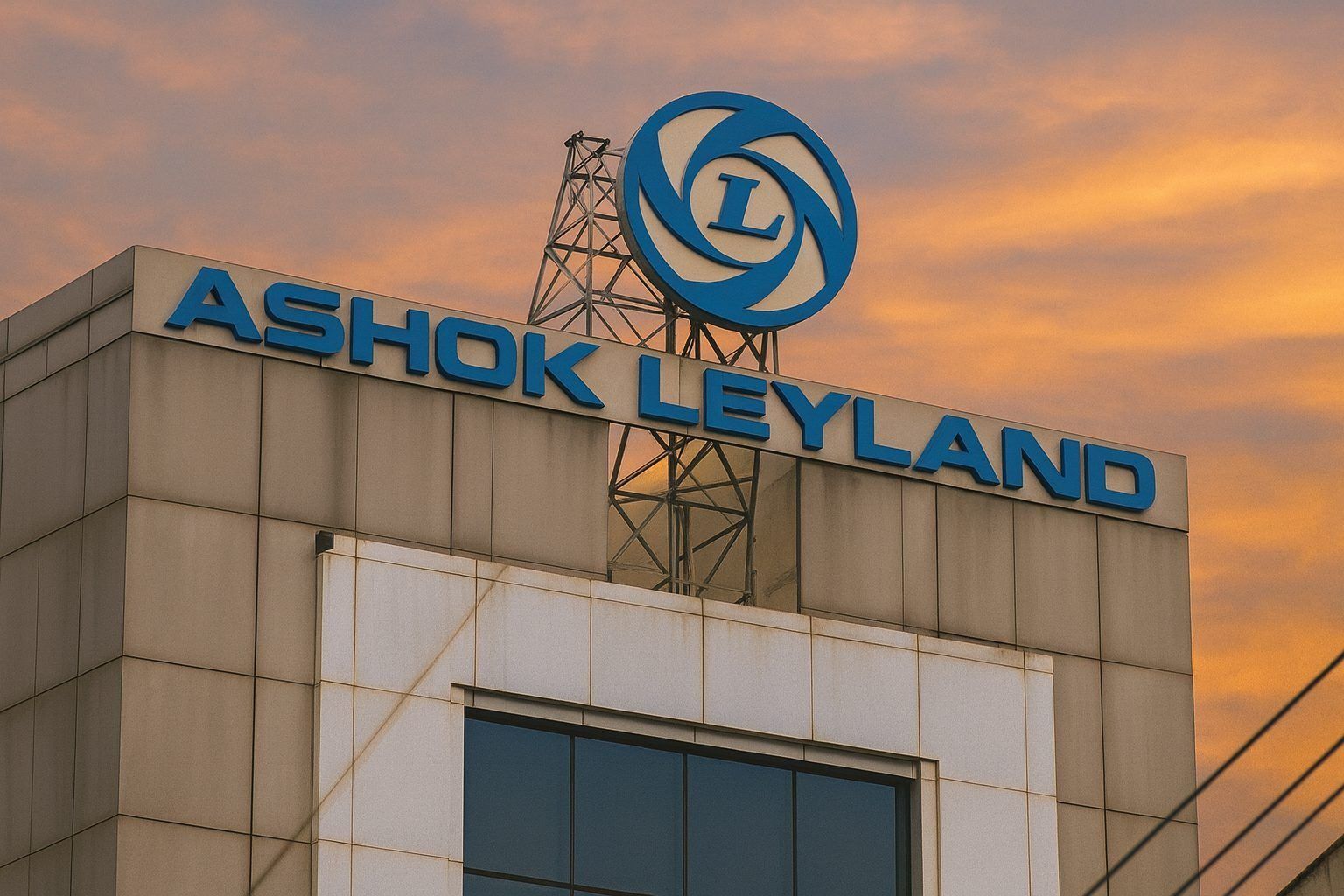

Ashok Leyland’s stock is trading close to record territory on 1 December 2025 as a cluster of positive triggers — a 29% jump in November vehicle sales, a new Saudi Arabian subsidiary, and restructuring of its finance arm — keeps investor interest high.
At around midday on 1 December, Ashok Leyland was trading near ₹160–161 per share on the NSE and BSE, up roughly 1–1.5% versus the previous close of ₹158.1. That puts the stock just below its 52‑week high of about ₹162 and implies a market capitalisation in the ₹93,000–94,000 crore range.
Below is a detailed look at the latest share price, news, forecasts and analysis as of 1 December 2025.
Ashok Leyland share price today: levels, returns and valuation
According to exchange data collated by The Economic Times and INDmoney, Ashok Leyland shares were quoted around:The Economic Times+1
- Price: ₹160.2–₹160.47 (as of ~12:00–12:01 pm IST on 1 December 2025)
- Change (day): up about 1.3–1.5% vs previous close of ₹158.12
- 52‑week range: ₹95.93 (low) to ₹162.00 (high)
- Day’s range (1 Dec): roughly ₹156.63 to ₹161.40
- Volume: about 1.4 crore shares traded by midday
Performance over recent periods remains strong:
- 1 week: ~11% gain
- 1 month: ~13% gain
- 3 months: ~23–25% gain
- 1 year: ~38% gain
- 5 years: ~240–246% gain, turning the stock into a multi‑bagger for longer‑term holders.
On valuation, Ashok Leyland currently trades at:
- Price‑earnings (P/E, TTM): about 28–29x
- Price‑to‑book (P/B): roughly 5.2–5.9x
- Dividend yield: ~3.0–3.9%
- Return on equity (ROE): in the mid‑20s to low‑30s (around 25–33% for FY25/FY26 metrics, depending on source and basis)The Economic Times+2INDmoney+2
These levels place Ashok Leyland at a premium to its own long‑term averages but still at a discount to the broader auto sector P/E, which hovers near 39x, according to INDmoney.
November 2025 sales: 29% YoY jump gives fresh momentum
The key near‑term trigger driving sentiment on 1 December is Ashok Leyland’s November 2025 sales print.
- The company reported total commercial vehicle sales of 18,272 units in November 2025, up 29% year‑on‑year (domestic + exports).
- Domestic sales stood at 16,491 units, with strong contributions from trucks, buses and light commercial vehicles (LCVs).
A broader ANI report on the Indian auto sector, syndicated via Lokmattimes, notes that vehicle sales across categories “performed exceedingly well” in November, helped by lower GST rates on autos and parts that came into effect on 22 September 2025 following the GST Council’s overhaul of slabs.Lokmat Times
For Ashok Leyland specifically:
- The November tally of 18,272 units exceeded some market expectations; for example, INDmoney’s “results alert” cited house estimates of 17,110 units.INDmoney
- Growth was broad‑based across trucks, buses and LCVs, suggesting strength in freight movement, construction and logistics demand — classic drivers of the medium and heavy commercial vehicle (MHCV) cycle.
This robust monthly print reinforces the narrative that the domestic CV cycle remains healthy, aided by infrastructure spending, freight growth and recent tax rationalisation in the sector.
Saudi push: new subsidiary extends Middle East footprint
Another fresh development ahead of the 1 December session is Ashok Leyland’s expanding presence in the Middle East.
ET Now reports that the company’s UAE arm has incorporated a new entity, Ashok Leyland Saudi, with an initial investment of SAR 5 lakh (about ₹1.1 crore). The move is explicitly framed as part of Ashok Leyland’s continued expansion in the region.
This Middle East thrust sits on top of already strong export trends:
- Axis Securities’ Q2FY26 review notes that exports rose 45% YoY to 4,784 units in Q2FY26, led by traction in GCC, SAARC and African markets, with the UAE plant nearing full capacity utilisation and Saudi Arabia highlighted as a “high‑growth geography.”Axis Direct
By formalising a Saudi entity, Ashok Leyland is effectively deepening its local presence in one of the most important GCC markets, potentially improving access to contracts in buses, staff transport and freight, as well as supporting its electric mobility ambitions over time.
Finance arm merger: Hinduja Leyland Finance to merge with NDL Ventures
On 27 November, Ashok Leyland’s stock spiked around 5% intraday to a then 52‑week high of ₹156.45 after news that its NBFC subsidiary Hinduja Leyland Finance Ltd (HLFL) will be merged into NDL Ventures Ltd (formerly NXTDIGITAL).
Key points from The Economic Times report:The Economic Times
- HLFL’s board approved a scheme of merger by absorption with NDL Ventures on 25 November 2025.
- Proposed appointed date: 1 April 2026, subject to approvals from SEBI, NCLT, stock exchanges and other authorities.
- Share swap ratio: shareholders of HLFL will receive 25 equity shares of NDL Ventures (face value ₹10) for every 10 shares of HLFL (face value ₹10) held.
- The transaction is part of Ashok Leyland’s broader strategic realignment of material subsidiaries, a process earlier flagged to stock exchanges in 2022 and August 2025.
For equity investors, the merger has two big implications:
- Potential value unlocking: Moving HLFL into a listed platform like NDL Ventures could, in the long run, create clearer market pricing for the finance business, which is currently embedded in Ashok Leyland’s consolidated numbers and valued via “sum‑of‑the‑parts” models by analysts.
- Structural complexity: Until the transaction closes (likely sometime after April 2026), investors must navigate an additional layer of merger, regulatory and execution risk around the finance vertical.
Q2 FY26 results: double‑digit margins, steady profit growth
The current rally is happening against the backdrop of a solid second quarter (Q2 FY26, quarter ended September 2025).
Consolidated results
Business Standard summarises Q2FY26 consolidated numbers as follows:Business Standard
- Net profit: ₹755.77 crore, up 7.1% YoY from ₹705.64 crore; up 23.7% QoQ from ₹611.07 crore.
- Income from operations: ₹10,543.97 crore, up 9.4% YoY and 7.6% QoQ.
- EBITDA: ₹1,162 crore with 12.1% margin, higher than the ₹1,017 crore a year ago.
- The board declared an interim dividend of ₹1 per share, payable on or before 11 December 2025.
Management commentary in that report emphasises:Business Standard+1
- 11 consecutive quarters of double‑digit EBITDA margins.
- Margin expansion driven by premiumisation, network growth, operational efficiency, cost optimisation and digital tools.
- A positive outlook for the second half of the year, with expectations of maintaining or improving mid‑teen EBITDA margins over the medium term.
Standalone results and segment trends
Axis Securities’ Q2FY26 research update (standalone) adds further colour:Axis Direct
- Net sales: ₹9,588 crore, +9.3% YoY and +9.9% QoQ, broadly in line with estimates.
- EBITDA: ₹1,162 crore (up 14.2% YoY) with a 12.1% EBITDA margin (up 52 bps YoY).
- Adjusted PAT: ₹799 crore (+16.2% YoY).
- Total volumes: 49,116 units, up 10% YoY.
- Domestic MHCV volumes: 26,635 units (+3.7% YoY).
- Domestic LCV volumes: 17,697 units (+6.4% YoY).
- Exports: 4,784 units (+105% YoY).
The report also highlights:
- Net cash position of around ₹1,000 crore at the end of Q2, an improvement of roughly ₹1,500 crore YoY.
- A healthy ROE trajectory, with forecast ROE staying above 20% through FY28E.
- Revenue, EBITDA and PAT expected to grow at about 7–8% CAGR over FY25–FY28E on Axis’s estimates.
Taken together, the Q2 numbers underscore an Ashok Leyland that is riding the commercial vehicle upcycle while maintaining discipline on costs and margins.
EV and new‑energy strategy: Switch Mobility and OHM
Ashok Leyland’s electric mobility push continues to be a key medium‑term pillar.
Axis Securities’ note gives some detail on the group’s EV ecosystem:Axis Direct
- Switch Mobility India (the EV manufacturing arm) sold about 600 electric buses and 600 electric LCVs in the first half of FY26, with an order book exceeding 1,650 buses.
- The company aims for Switch India to become cash‑flow positive by FY27, helped by volume ramp‑up, localisation and cost optimisation.
- OHM Mobility, a Mobility‑as‑a‑Service (MaaS) subsidiary operating electric bus fleets, has around 1,100 buses in operation with >98% fleet availability and targets over 2,500 buses within 12 months.
- Ashok Leyland is expanding a non‑diesel portfolio across electric trucks, electric buses, CNG, LNG and hydrogen variants, as well as planning new heavy‑duty trucks with higher horsepower ratings.
For investors trying to value the stock, these businesses are still in build‑out mode and not fully reflected in near‑term earnings, but they are increasingly central to the “option value” narrative around the company.
Fundamentals: profitability, leverage and cash flows
Looking at the FY25 full‑year numbers (largely pre‑split for historical context):
- On a consolidated basis, Ashok Leyland generated total revenue of about ₹48,894 crore in FY25, up 6.45% YoY, with PAT of ₹3,106.8 crore, up 25% YoY. Net profit margin improved to 6.4% from 5.4% in FY24, while operating profit margin rose to 17.5%.
- On a standalone basis, FY25 revenue was around ₹39,003 crore, with PAT of ₹3,303 crore and net margin of 8.5%, according to ET Markets and Axis data.
Capital structure and returns:
- Axis projects ROE of 26–27% in FY26E, easing to around 21% by FY28E, still comfortably above cost of equity.
- Standalone debt‑to‑equity has fallen close to 0.1x, indicating a relatively conservative balance sheet on the core CV business, though consolidated leverage including finance operations is higher.
INDmoney’s snapshot as of 1 December 2025 shows:INDmoney
- ROE: ~32.5
- ROCE: ~34.8
- P/E: 28.49x vs industry P/E of 38.74x
- Dividend yield: 3.06%
- Book value per share: ~₹20.8 (on their basis)
This mix of high returns and moderate leverage helps explain why the market is now willing to pay a significant premium over the stock’s pre‑cycle multiples.
Technical picture: from all‑time high to 5‑year breakout
Technically, Ashok Leyland is in a clear uptrend:
- On 13 November 2025, MarketsMojo reported that the stock hit an all‑time intraday high of ₹147.45, climbing 4.8% on the day and delivering a one‑year return of about 37% at that time. The article also pointed out strong net sales growth (24% CAGR) and operating profit growth (~39.9%), with the stock trading above its 5‑, 20‑, 50‑, 100‑ and 200‑day moving averages.
- ET’s “Trend Watch” feature on 28 November highlighted Ashok Leyland among five stocks hitting 5‑year swing highs, noting a last 5‑year high of ₹152.94 and a then‑LTP of ₹159.75 — effectively a breakout above a multi‑year resistance zone.The Economic Times
- INDmoney tags the technical setup as “Bullish”, while ET’s metrics show a relatively high beta (around 1.5–2.1), underlining that the stock tends to move more sharply than the market in both directions.The Economic Times+1
In simple terms: the chart is strong, but volatility is non‑trivial.
Analyst sentiment and target prices: consensus vs outliers
Broker research and consensus
Different platforms paint a broadly constructive but nuanced picture of analyst sentiment:
- INDmoney, citing S&P Global data, reports that 36 analysts cover Ashok Leyland. Around 75.7% rate it “Buy”, 16.2% “Hold” and 8.1% “Sell”.INDmoney
- The average 12‑month target price on that dataset is ₹155.08, implying roughly 2% downside from the current ₹160–161 levels, with a high target of ₹180 and a low of ₹123.
- ET Markets’ reco grid similarly shows 36 analysts with a distribution of 12 “Strong Buy”, 13 “Buy”, 7 “Hold” and 4 “Sell”, categorising the stock overall as a Buy.The Economic Times
Axis Securities’ detailed Q2FY26 update is explicitly positive:
- Axis maintains a BUY rating and, in that particular note, sets a target price of ₹160 per share, valuing the core business at 21x FY28E EPS and adding ₹14 per share for its stake in Hinduja Leyland Finance.
- Axis also builds in a 6% volume CAGR over FY25–FY28E and expects revenue, EBITDA and PAT to grow at around 7–8% CAGR over that period.
Meanwhile, ET’s recommendations section lists recent broker targets as high as ₹245–₹250 from some houses (for example, ICICI Securities’ “ADD” at ₹250 and a separate Axis Securities figure of ₹245, according to the ET screen), indicating that parts of the sell‑side see further upside if the cycle and margins hold up.The Economic Times
Smartkarma factor scores
A Smartkarma Newswire piece published on 1 December 2025 notes that Ashok Leyland’s November sales surge coincides with a favourable “Smart Score” profile:Smartkarma
- Factor scores: Value 2, Dividend 5, Growth 5, Resilience 3, Momentum 5 (out of 5).
- Overall Smart Score: 4.0, with commentary that the company exhibits strong performance on dividends, growth and momentum, and moderate resilience.
Algorithmic / AI‑driven forecasts
On the purely quantitative side, WalletInvestor’s technical‑analysis‑based model gives a more mechanical forecast:Walletinvestor.com
- Current reference price (BSE) used: ₹158.15.
- 1‑year forecast: about ₹168.58, implying ~6.6% upside.
- 5‑year forecast (to November 2030): around ₹262.7, suggesting a potential 66% gain over five years in their scenario.
These model‑driven projections are not fundamental equity research and should be treated as indicative, not as investment advice.
Macro backdrop: GST cuts and the commercial vehicle cycle
The November 2025 auto sales beat for Ashok Leyland is occurring against a supportive macro backdrop:
- The 56th GST Council meeting in early September 2025 simplified the GST structure from four slabs (5%, 12%, 18%, 28%) to two principal rates (5% and 18%), plus a 40% “sin/luxury” slab. The changes took effect on 22 September 2025.Lokmat Times
- For autos, this included rate cuts on small cars, buses, tractors and many components, and lower GST on tractor tyres and parts (from 18% to 5%), all of which are indirectly positive for CV demand and replacement cycles.
Commercial vehicles are deeply cyclical and levered to infrastructure activity, mining, construction and overall economic growth. A combination of lower indirect taxes, government capex and improving fleet operator profitability, as highlighted in Axis’s commentary, creates a favourable near‑term demand environment.
Key risks and what could go wrong
Despite the strong narrative, several risks remain:
- Cyclical downturn in CV demand
Medium and heavy commercial vehicles are highly sensitive to GDP growth, freight rates and infrastructure spending. A slowdown in construction, mining or logistics could quickly reverse volume and margin gains. - Competition and pricing pressure
Aggressive competition from domestic peers and global players in both diesel and EV buses/trucks could limit pricing power, particularly if capacity in the industry stays high. - Execution risk in EV and overseas expansion
Scaling Switch Mobility, OHM and new entities like Ashok Leyland Saudi requires sustained capex and flawless execution. Delays in tenders, technology shifts or policy changes could push out profitability timelines. - Regulatory and credit‑cycle risk in the finance arm
The HLFL–NDL Ventures merger must clear regulatory hurdles and then deliver on promised synergies. NBFCs are inherently exposed to credit cycles and funding conditions; any deterioration could spill back into sentiment on the parent. - Valuation risk after a big run‑up
With the stock up more than 35–40% over the past year and trading near record highs, short‑term corrections are always possible, especially if results underwhelm relative to elevated expectations.
What today’s picture means for investors
As of 1 December 2025, the Ashok Leyland story looks like this in summary:
- Momentum is strong: The share price is hovering just below its 52‑week high, with double‑digit gains over 1, 3 and 12 months and a clear breakout above previous multi‑year resistance.
- Business fundamentals are solid: Q2FY26 delivered healthy revenue growth, double‑digit EBITDA margins and a rising PAT trend, alongside an interim dividend and a strengthening balance sheet.
- Growth levers are diversified: Domestic CV recovery, export expansion (especially in GCC and Africa), the Saudi and UAE footprint, and the Switch Mobility / OHM EV ecosystem provide multiple avenues for future growth.
- Analyst stance is positive but valuation‑aware: Most brokerages and consensus datasets still flag the stock as a “Buy”, though average target prices are now close to — or slightly below — the current market price, suggesting the easy valuation rerating may be behind it even as some houses see substantial upside.INDmoney+2The Economic Times+2
For anyone tracking Ashok Leyland, the key variables over the next few quarters will likely be:
- Whether the November sales strength sustains into the rest of FY26.
- How smoothly the finance arm merger progresses.
- The pace at which EV and international businesses translate from “story” to measurable earnings.
Related articles: Stock Market