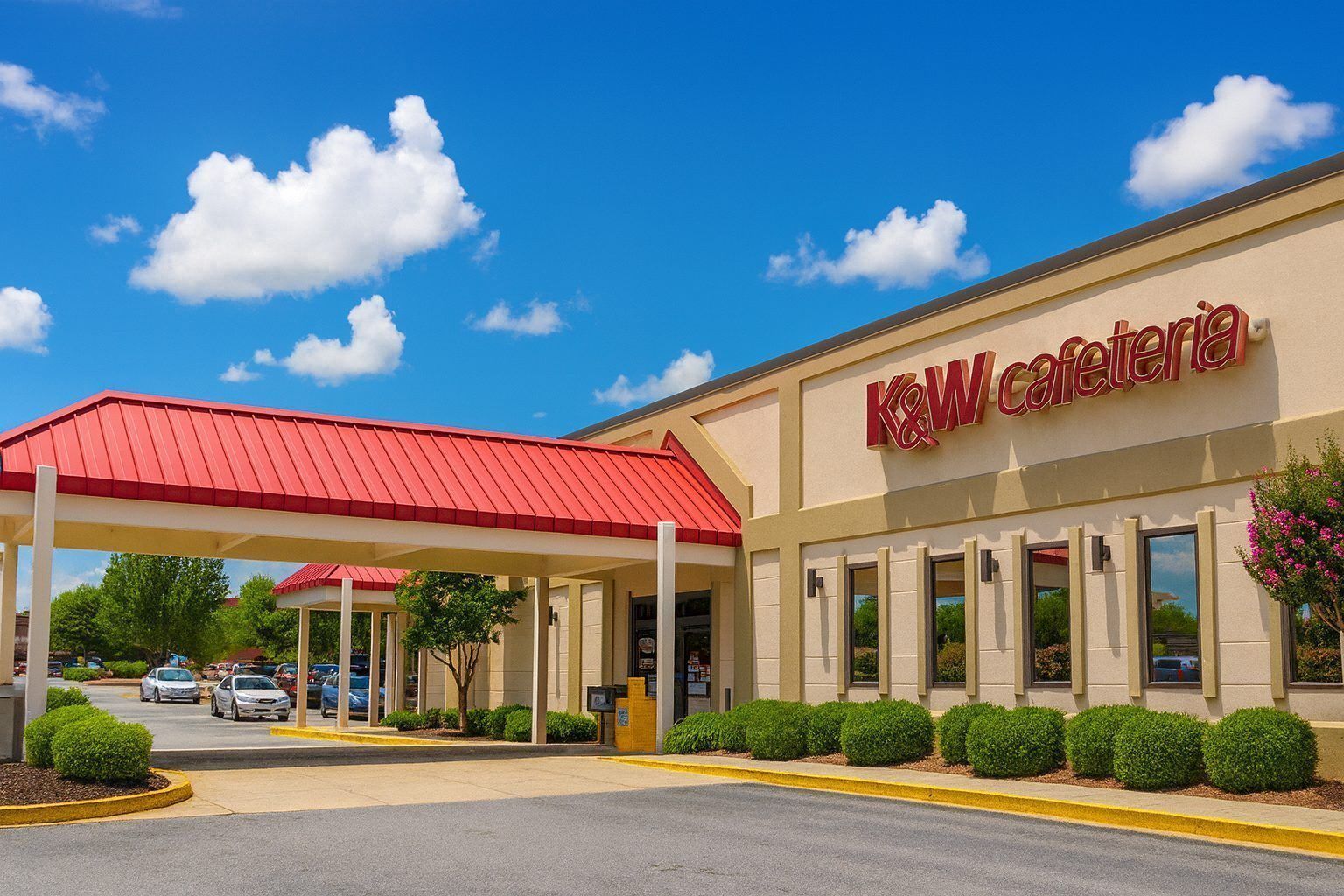
K&W Cafeterias, the Winston-Salem–born Southern cafeteria chain, has shut down all of its remaining restaurants effective immediately, ending an 88‑year run across North Carolina and Virginia.
The company announced on Monday, December 1, 2025, that every one of its final nine locations — eight in North Carolina and one in Virginia — has closed at once, with no advance warning to customers and no public explanation for the decision.
Local stations WXII 12, WFMY News 2 and FOX8 confirmed the closures after the company posted a farewell message on its website and social channels, describing the news as being shared “with a heavy heart” and noting that K&W would be “closing all doors effective immediately.” https://www.wdbj7.com+3WXII+3WFMY News 2+3
Below is a detailed look at what we know today, how the chain got here, and what the shutdown could mean for Southern cafeteria‑style dining.
Key facts at a glance
- Announcement date: December 1, 2025
- Action: Immediate closure of all remaining K&W Cafeterias locations
- Remaining footprint at closure: 9 restaurants (8 in North Carolina, 1 in Virginia)
- Years in business: About 88 years, dating back to the late 1930s in Winston-Salem
- Official reason given: None so far; news outlets report the company has not disclosed a cause
- Recent history: Chapter 11 bankruptcy in 2020, sale to Piccadilly in 2022, steady location closures through 2024–2025
An 88‑year Southern tradition ends overnight
K&W Cafeterias has been woven into the fabric of life in North Carolina since the 1930s, evolving from a Winston-Salem coffee shop into a full cafeteria‑style chain. Wikipedia Generations of families knew the drill: grab a tray, slide it down the rail, and point at fried chicken, turnip greens, mac and cheese and pies that tasted like someone’s grandmother still worked in the kitchen.
By the early 2000s, K&W had spread across the Carolinas and into Virginia, with dozens of locations and a reputation for inexpensive, homestyle food and a loyal senior and church‑going customer base. A 2025 feature in SouthPark magazine described K&W as a regional landmark and noted that, even after years of downsizing, roughly 10 locations were still operating in North Carolina and Virginia as of early spring.
That long arc ended abruptly this week. Local coverage from WXII 12, WFMY News 2 and others makes clear that this is not a temporary pause or a weather‑related closure: doors are locked, signs are going up, and the chain is characterizing the move as permanent.
What the company has said so far
The most complete version of K&W’s farewell message is preserved in local reporting from WDBJ7 and regional radio outlets. In a Facebook post and website statement, the company:
- Acknowledged the news with “a heavy heart”
- Said that all doors are closing effective immediately
- Emphasized that K&W had been more than a restaurant — calling it a gathering place and a home for Sunday traditions for “millions of families”
- Thanked guests for their support and loyalty “for nearly nine decades” https://www.wdbj7.com+2Kiss 95.1+2
While the language is emotional and final, it stops short of explaining why the shutdown is happening. WDBJ notes directly that no reason has been given, a point echoed by other outlets and by Rolling Out’s early write‑up of the closure.
As of the evening of December 1, 2025, there has been:
- No public statement from Piccadilly Restaurants — the company that acquired K&W in 2022
- No detailed breakdown of financials, staffing, or potential plans for any of the closed sites
- Only limited hints that local officials, including Greensboro’s mayor, are being asked for comment on community impact.
Which communities are affected?
In recent years, K&W’s footprint had already shrunk dramatically from its peak, but the cafeterias that remained were concentrated in the places that built the brand: the Triad, the Triangle and a few other North Carolina cities, plus one Virginia location.
Reporting from stations such as Kiss 95.1 and WRAL indicates that at the time of Monday’s announcement, K&W was down to nine locations — eight in North Carolina and one in Virginia. Kiss 95.1+1 Those final units included stores in:
- Greensboro, which WFMY News 2 identified as permanently closing “after 88 years in business,” effective immediately on December 1 WFMY News 2
- The Winston-Salem area, where local coverage has framed the closure as the end of a hometown institution
- Roanoke, Virginia, highlighted by WDBJ7 as one of the out‑of‑state locations now dark
The December 1 shutdown comes after a series of location‑by‑location closures during 2024 and 2025:
- Wilmington, NC: The Hanover Center K&W closed effective December 31, 2024; a sign on the door cited lengthy renovations and an inability to continue operations at that site.
- Fayetteville, NC: The long‑running Owen Drive cafeteria served its last meal on March 25, 2025, after more than 50 years, with local coverage describing “teary‑eyed” employees and customers. Fayetteville Observer+2Fayetteville Observ…
By mid‑2025, articles summarizing restaurant openings and closings in Cumberland County and Charlotte noted K&W’s departures as milestones in the changing dining landscape.
On social media, Facebook groups in Rocky Mount, Raleigh and other communities quickly labeled December 1 “the end of an era,” sharing photos of trays, yeast rolls and orange‑hued cafeterias while confirming that local stores had locked their doors for good. Facebook+1
How K&W Cafeterias got here: bankruptcy, sale and slow contraction
Although Monday’s announcement felt sudden, the chain has been in some form of distress for years.
2020: Chapter 11 amid COVID-19
In September 2020, K&W Cafeterias filed for Chapter 11 bankruptcy protection, citing the impact of the COVID‑19 pandemic on in‑person dining. The company said at the time that it intended to keep operating while restructuring.
A court‑ordered sale process overseen by SC&H Capital marketed 18 remaining cafeteria-style restaurants, down from as many as 35 locations before the pandemic, after at least 10 stores were closed in the early months of 2020.
2021–2022: Emergence from bankruptcy and Piccadilly acquisition
By late 2021, K&W emerged from Chapter 11 with a smaller footprint — from 18 locations down to 14 and with staffing reduced from 1,035 to 834 employees.
In August 2022, K&W’s third‑generation family leadership announced that the chain and its 11 remaining locations had been sold to Piccadilly Restaurants, a Baton Rouge–based cafeteria operator. Baton Rouge Business Report+1 Industry databases and children’s reference entries later summarized the deal as Piccadilly “buying” K&W, with the new owner pledging at the time to keep existing locations open. CB Insights+1
Under the new structure, K&W was listed as part of a broader portfolio of brands connected to Falcon Holdings Management, a restaurant group involved with both Piccadilly and other quick‑service concepts.
2023–2025: Quiet retrenchment
Even after the sale, closures continued:
- Several older locations across North Carolina shut down over the last few years, including units in Mecklenburg County by 2021 and additional sites through 2024.
- By March 2025, SouthPark magazine counted about 10 K&W cafeterias still operating in North Carolina and Virginia.
- By May 2025, Wikipedia and business references put the number at nine locations, the same figure repeated by news outlets on December 1.
Monday’s announcement simply took that slow retreat and compressed the final step into a single, sudden day.
Why did K&W close? What we know — and what we don’t
No official explanation yet
Right now, there is no public, confirmed reason for the December 1 shutdown.
- WDBJ’s report from Roanoke explicitly states that no reason has been given for the decision.
- Rolling Out notes that the Southern chain “gave no reason” for the sudden closure. Rolling Out
- Local TV reports and radio write‑ups repeat the language from the farewell statement but do not add any financial details, lease disputes or corporate strategy quotes.
Until K&W’s owners or Piccadilly issue something more substantive, any specific explanation is speculative.
The broader headwinds: costs, consumer habits and cafeterias
Even without a formal explanation, the context around K&W — and around full‑service and buffet‑style restaurants generally — is hard to ignore:
- Food costs: Data from the National Restaurant Association show that wholesale food prices have spiked again in recent months, with the Producer Price Index for food jumping 1.1% in a single month — the sharpest increase since early 2024.
- Labor costs: Restaurant economic analyses indicate that labor represents roughly a third of sales for many operators, and rising wages in 2024 and 2025 have squeezed profit margins, especially for concepts that rely on a lot of staff for relatively low check averages.
- Post‑COVID shifts: Studies and industry reporting show that diners have increasingly moved toward takeout, delivery, apps and fast‑casual formats since the pandemic, while traditional cafeteria and buffet models have struggled to regain their old traffic levels.
K&W’s model — low‑priced, scratch‑made comfort food served on real plates in sprawling dining rooms that filled up at lunch and after church — is precisely the kind of operation that has been hit hardest by all three trends: higher ingredient prices, higher wages and a customer base that is older and less tied to app‑based ordering.
Add to this the still‑visible scars from the 2020 bankruptcy and the earlier rounds of closures, and it becomes easier to see how the chain might have been operating with little margin for error well before December 2025. But again, the company has not formally linked these pressures to Monday’s decision.
Impact on workers and local economies
K&W has not released job numbers tied to this week’s closures. But its own bankruptcy filings give a rough sense of scale: when the company emerged from Chapter 11 in 2021, it reported 834 employees across 14 locations — roughly 60 workers per store on average.
Even if staffing per unit shrank further after the sale to Piccadilly, the sudden shutdown of nine locations likely affects hundreds of employees in North Carolina and Virginia — cooks, cashiers, line servers, dishwashers and long‑tenured managers whose careers have been tied to the brand.
Local stories from earlier 2025 closings give a preview of the emotional toll. In Fayetteville, one longtime employee described “everybody” — staff and customers — as teary‑eyed on the last night of service. CityView NC+1 Social posts reacting to Monday’s news include former employees reminiscing about first jobs, paying their way through college, or spending decades behind K&W’s cafeteria lines. Facebook+1
For local economies, the impact is twofold:
- Loss of a mid‑priced dining option: In many suburban centers, K&W anchored aging shopping centers or stood near hospitals, churches or office parks, drawing regular weekday and Sunday traffic.
- Uncertain future for real estate: Some recently closed units — like Wilmington’s Hanover Center location — have already been flagged by landlords and city officials as redevelopment opportunities, but others may sit empty for some time.
What happens to K&W’s brand and recipes now?
The December 1 announcement references “K&W Holdings Group LLC” and frames the closure as permanent, but it does not say whether the K&W brand itself is gone for good. WRAL News+1
There are a few possible scenarios — none of which have been confirmed:
- Quiet retirement of the brand: Piccadilly and its related holding companies could simply shutter the operations and focus on their remaining Piccadilly cafeterias, which still number around 28 across the Southeast as of late 2025.
- Future revival or licensing: Other chains have revived legacy cafeteria names in limited form; Piccadilly itself operates one location under the old Morrison’s name in Mobile, Alabama as a nod to history. Wikipedia It’s possible — though entirely speculative — that K&W’s name or recipes could reappear in a smaller concept, a single “heritage” store, or a packaged‑foods line.
- Sale of sites to other operators: Given Falcon Holdings’ experience repositioning distressed restaurant brands, some of K&W’s physical locations could be converted into other concepts rather than sitting empty indefinitely.
Until the owners speak directly, fans shouldn’t assume there will be another K&W — but the history of defunct restaurant brands suggests that nostalgia can fuel limited comebacks.
What K&W’s closure says about cafeteria‑style dining
K&W’s end comes at a complicated moment for the broader cafeteria and buffet segment.
Recent coverage notes that many buffet chains took heavy damage during COVID-19, with franchisee bankruptcies and dozens of permanent closures, even as a smaller number of locations have seen a modest resurgence.
At the same time:
- Inflation and wage growth are pushing traditional, labor‑intensive dining rooms to raise prices or cut hours.
- Customers are more accustomed to ordering on phones, eating off‑premise and visiting fast‑casual chains built for speed rather than lingering conversations over trays.
K&W’s shutdown doesn’t mean cafeteria dining is disappearing altogether — Piccadilly and a handful of regional players remain — but it does underscore how fragile legacy concepts can be when they’re caught between rising costs and shifting habits.
What to watch for next
In the coming days and weeks, several developments will determine how the K&W story is ultimately told:
- A formal statement from Piccadilly or Falcon Holdings
Investors, employees and local officials will be watching for any clarification about why the decision was made and whether alternative options — such as selling individual sites — were considered. - Local redevelopment plans
City planners and landlords in Greensboro, Winston-Salem, Roanoke and other affected markets will decide how to repurpose the large, cafeteria‑style spaces K&W leaves behind. - Support for displaced workers
Community job fairs, hiring events by other restaurant groups and possible public‑sector assistance will shape how painful this is for long‑tenured staff. - The future of Southern cafeterias
Whether remaining chains lean into modernization — smaller footprints, more takeout, dynamic pricing — or double down on nostalgia will help answer the bigger question: is this the end of a specific brand, or a turning point for an entire style of dining?
For now, what’s certain is simple and stark: after nearly nine decades of fried chicken, gelatin salads and Sunday‑after‑church crowds, K&W Cafeterias has turned off the lights at every remaining location. How the South chooses to remember — or reinvent — that experience will be the next chapter.