Published: December 1, 2025
What Happened at Manchester Airport?
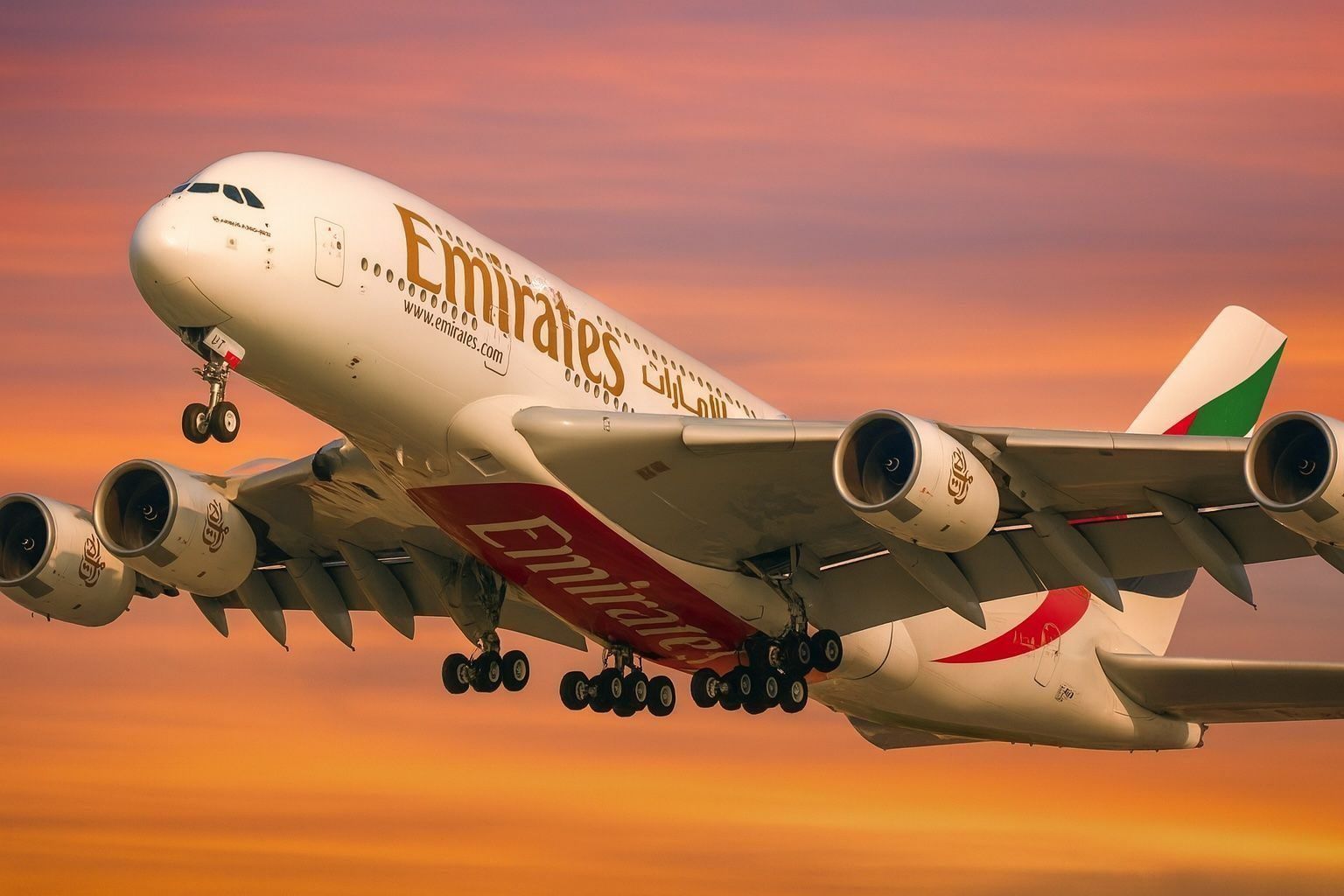
On Friday, 28 November 2025, an Emirates Airbus A380-842 was struck by a fuel truck while parked at a gate at Manchester Airport, forcing the grounding of the aircraft and the cancellation of its return flight to Dubai.
The aircraft, registered A6‑EVP, had just arrived as Emirates flight EK17 from Dubai and was being prepared for the outbound EK18 service back to Dubai when the collision occurred during ground operations.
Key confirmed facts so far:
- Date of incident: Friday, 28 November 2025
- Location: Manchester Airport (MAN), stand at the main terminal complex
- Aircraft: Emirates Airbus A380‑842, registration A6‑EVP, delivered in 2020
- Inbound flight: EK17 Dubai–Manchester (arrived around 10:46 GMT)
- Planned outbound flight: EK18 Manchester–Dubai (scheduled 13:15–20:25)
- Outcome: Visible damage to one engine intake/cowling; EK18 on 28 November cancelled; no injuries reported
Multiple aviation outlets, including specialist site Simple Flying, social media eyewitnesses and industry trackers, all describe the incident in consistent terms: a fuel truck made contact with one of the A380’s engines while the jet was stationary at the gate, causing a tear or dent to the engine intake lip.
Crucially, available reports and posts indicate there was no fuel spill, no fire, and no injuries to passengers or ground staff.
Timeline: From Routine Arrival to EK18 Cancellation
Arrival of EK17
Flight-tracking data shows that EK17 from Dubai (DXB) landed at Manchester at about 10:46 GMT on 28 November, slightly ahead of its scheduled 11:15 arrival.
The aircraft then taxied to a gate where normal turnaround procedures began: disembarkation, baggage unloading, catering, fueling and cleaning, in preparation for operating EK18 back to Dubai later that afternoon.
The Fuel Truck Collision
During this turnaround, a fuel truck came into contact with one of the A380’s engines:
- Aviation safety database Aviation Safety Network records the phase of flight as “standing” and describes a tear in the engine intake lip of one engine.Aviation Safety Network+1
- Travel and tourism outlet Travel And Tour World reports that close-up photos show a jagged tear or dent roughly “hand-sized” on the engine cowling.Travel And Tour World+1
- Social media posts from apron workers and enthusiasts identify the aircraft as A6‑EVP and confirm that it had just completed EK17 when the fuel truck struck the engine area during fueling operations.
Because any structural or cosmetic damage around an engine intake is treated extremely conservatively, Emirates and Manchester Airport operations teams immediately grounded the aircraft for inspection.
EK18 on 28 November: Cancelled
The immediate operational consequence was the cancellation of EK18 on 28 November:
- Flight-tracking history lists EK18 on 28 November as cancelled, with A6‑EVP assigned to the flight but no actual departure recorded.
- Online posts from aviation communities and passengers confirm that customers were informed of the cancellation and rebooked onto alternative services, with some facing long waits at Manchester Airport.
Most reports estimate that hundreds of passengers—potentially up to around 500 given the typical A380 configuration on the Dubai–Manchester route—were affected by the cancelled flight. This figure has not been formally confirmed by Emirates but aligns with the aircraft’s usual capacity.
Has the Emirates A380 Returned to Service?
Yes. As of December 1, 2025, flight-tracking data indicates that the damaged aircraft has already left Manchester:
- On 30 November 2025, A6‑EVP operated Emirates flight EK20 from Manchester to Dubai, departing around 21:24 and arriving in Dubai just after 04:00 local time.
This suggests that:
- The damage was confirmed to be limited and repairable on site, consistent with Aviation Safety Network’s classification of “minor” aircraft damage.Aviation Safety Network+1
- After roughly 48 hours on the ground for inspection and remedial work, the aircraft was cleared to fly again, aligning with social media reports that the jet “remained stuck in Manchester for just over 48 hours while engineers assessed the damage.”Facebook+1
Meanwhile, EK18 itself resumed normal operations the following day:
- On 29, 30 November and 1 December, EK18 Manchester–Dubai was flown by other Emirates A380s (registrations A6‑EUW, A6‑EOI and A6‑EUM), with normal flight times and only minor delays.
For passengers, this means that the disruption was largely limited to the single EK18 rotation on 28 November, with the route stabilizing quickly afterwards.
How Serious Was the Damage?
From a safety perspective, there are several reassuring points:
- No injuries and no fire or fuel spill were reported, despite the involvement of a fuel truck.
- The damage appears to have been confined to the engine cowling/intake lip, rather than the engine core or wing structure.
- The aircraft returned to commercial service within about two days, which would not have been possible if there had been major structural or engine damage.
Aviation safety databases categorize the event as involving minor aircraft damage in the “standing” phase, far from a crash or serious inflight emergency.Aviation Safety Network+1
That said, even minor external damage near an engine intake is treated extremely seriously: any deformation can affect airflow, cause vibration, or lead to further damage if not correctly repaired. Hence the immediate grounding, cancellation of EK18, and careful inspection by Emirates engineers.
Why Ground Collisions Like This Are a Big Deal for Airlines
Although this Manchester incident did not injure anyone, it highlights a broader, costly problem in global aviation: ground damage during turnarounds.
Ground Equipment Striking Parked Aircraft
Industry analyses consistently show that equipment striking parked aircraft—exactly what happened here—is one of the most common ground damage scenarios:
- A turnaround-safety analysis by automation company Assaia found that equipment striking parked aircraft accounts for about 39% of all ground-damage incidents, including collisions involving fuel trucks, baggage loaders and catering vehicles.
- The Flight Safety Foundation’s safety report notes that ground-driven vehicles such as tugs, fuel trucks and baggage loaders were involved in around two dozen accidents between 2017 and 2021.
High Financial Cost
The financial stakes are huge:
- IATA’s ground-operations safety program estimates that preventable ground damage already costs airlines more than US$5 billion annually, and that total ground damage costs could approach US$10 billion per year by 2035 if no further preventive action is taken.
For a premium flagship aircraft like the Emirates A380, a relatively small dent in an engine cowling can:
- Take a high-capacity aircraft out of service for days
- Force cancellations or expensive rebookings
- Require parts that are harder to source in today’s stressed aerospace supply chains
A recent IATA/Oliver Wyman study warned that ongoing global supply chain bottlenecks are adding over US$11 billion in extra costs to airlines in 2025, including higher maintenance costs and more reliance on leased engines and spares.Reuters In this environment, even a “minor” ground incident like the Manchester collision becomes significantly more expensive and disruptive to manage.
What Might Have Caused the Collision? (And What We Don’t Know Yet)
Media coverage and local commentary have raised several possible contributing factors, including human error, congestion on the stand and wet weather, but it’s important to stress that no official cause has been released as of 1 December 2025.
- Travel And Tour World notes that the accident may have involved a maneuvering error by the fuel truck, potentially exacerbated by poor visibility and wet conditions on the apron.
- Social media posts and videos taken that day show a very wet apron at Manchester, consistent with the suggestion of slick conditions.
However:
- The UK Air Accidents Investigation Branch (AAIB) has not yet published a bulletin on the incident.
- Emirates and Manchester Airport have not, at time of writing, issued a detailed public explanation beyond standard remarks about safety and cooperation with investigations.
In line with usual practice for non-fatal, minor-damage ground incidents, investigators are expected to examine:
- Fuel truck routing and speed near the stand
- Ground crew communications and marshalling procedures
- Stand congestion and layout around the parked A380
- Weather and visibility at the time of the collision
- Training, fatigue and staffing levels for ground handling teams
Until that work is complete and an official report is released, any definitive statement about “the cause” would be speculative.
Does This Point to a Wider Safety Issue at Emirates or Manchester?
At this stage, there is no evidence that the Manchester incident reflects a systemic safety failure at Emirates or at Manchester Airport. Rather, it appears to align with a widespread industry challenge: keeping increasingly busy aprons safe as traffic and aircraft size grow.
Some relevant context:
- Emirates remains the world’s largest A380 operator, with around 96 superjumbos in service as of late 2025.
- Manchester Airport is a long-established A380 destination and currently handles up to three daily Emirates A380 flights on the Dubai route, according to airport and reference data.
- Globally, aviation remains very safe, with accidents per million departures at historically low levels, but ground incidents—particularly on busy aprons—are an area where regulators and airlines are pushing for improvement.
What does stand out is that this is not the first time in 2025 that an Emirates-branded aircraft has been involved in a collision with a ground vehicle:
- In October 2025, Emirates SkyCargo Flight 9788—a Boeing 747 freighter operated on behalf of Emirates—left the runway at Hong Kong and struck a patrol vehicle; that accident tragically killed two ground staff, though all four crew survived.
There is currently no indication of a direct link between the Hong Kong cargo accident and the Manchester A380 incident. Still, having two vehicle-related collisions in the same year involving aircraft flying for the same group will likely sharpen internal focus on apron risk management, supplier oversight and ground handler training across the network.
How Long Could Repairs Take, and What Happens Next?
The fact that A6‑EVP has already flown EK20 from Manchester to Dubai suggests that initial repairs or temporary fixes were completed relatively quickly.
Typical next steps likely include:
- Detailed Inspection in Dubai
Once back at Emirates’ home base, the A380 can undergo more extensive borescope inspections, non-destructive testing and any further structural assessments required by Airbus and Emirates Engineering. - Permanent Repair or Replacement of Damaged Parts
Depending on the exact extent of the tear or dent, repairs might involve rework of the cowling, or simply replacing the affected intake lip section. A380 spares are less common than those for smaller aircraft, so lead times and logistics may matter. - Regulatory Sign‑off
Any repair affecting the engine nacelle will be carried out under approved repair schemes and reviewed by Emirates’ engineering quality teams and relevant aviation authorities before the aircraft resumes long-term service.
Given the aircraft has already operated at least one revenue flight post-incident, passengers are unlikely to notice any difference in service on board; the work now is mostly about ensuring long-term structural integrity and documentation.
What This Means for Passengers Flying Emirates to or from Manchester
For passengers booked on Emirates flights between Dubai and Manchester in the coming days:
- The immediate disruption has passed. EK18 on 29 and 30 November and 1 December all operated normally with other A380s.
- Emirates still shows multiple daily DXB–MAN services, primarily using the A380.
- There is no indication of an ongoing schedule reduction on this route specifically tied to the incident.
However, as with any recent operational disruption, it’s sensible to:
- Check your flight status on Emirates’ website or app on the day of travel.
- Allow extra time at the airport in case of knock-on delays in ground operations.
- Keep an eye on your email or SMS for any rebooking notifications.
For most travelers, the Manchester collision will be invisible in day‑to‑day flying, but it will likely feed into behind‑the‑scenes changes in risk assessments, ground‑handler briefings and apron procedures.
Bigger Picture: Ground Safety Will Stay in the Spotlight
This A380 fuel‑truck collision may be a relatively small incident in terms of physical damage, but it sits at the intersection of some persistent industry challenges:
- Crowded aprons as airports handle more widebodies and intensive wave departures
- Human factors: fatigue, workload and communication among ground crews
- Aging and varied ground support equipment, not always equipped with the latest collision‑avoidance tech
- Supply chain and cost pressure, which makes every accident or incident disproportionately expensive
In the months ahead, expect:
- Emirates and its ground‑handling partners in Manchester to review procedures around fueling A380s at busy stands.
- Safety teams across the industry to use the incident in training, alongside other recent ground collisions, as a case study in apron risk.
- Continued pressure—from IATA, regulators and insurers—for more automation, better tracking of ground vehicles, and stronger safety management systems in the ground-handling environment.
For now, the key takeaway is straightforward: no one was hurt, the A380 has already returned to service, and Emirates’ Manchester–Dubai schedule is back to normal. But the images of a fuel truck nudged up against the world’s largest passenger jet will remain a vivid reminder of how much of airline safety happens not in the air, but on the ground.