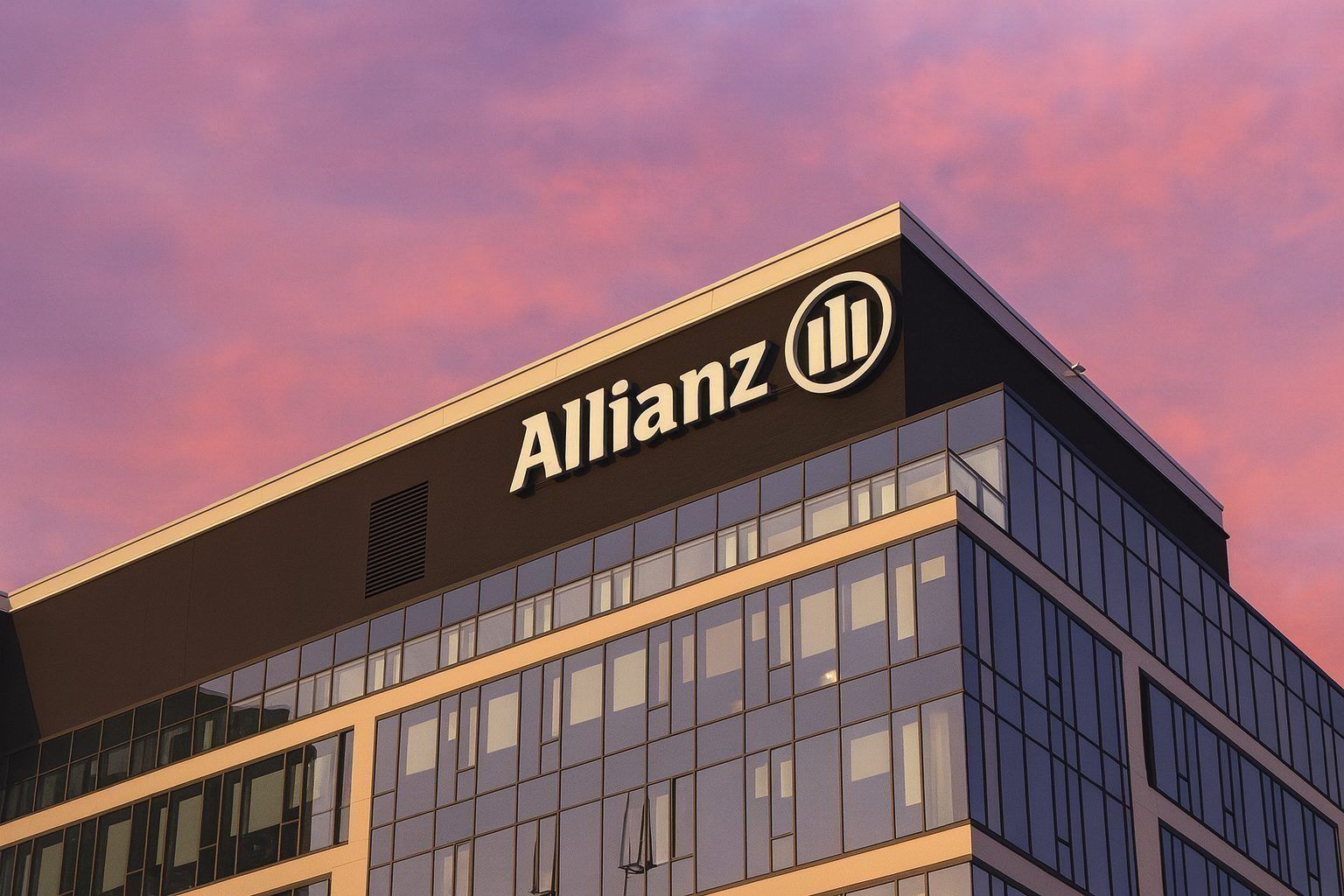

On 2 December 2025, Allianz SE (XETRA: ALV, commonly shown as ALV.DE) is trading close to historic highs, supported by record 2025 profits, a higher earnings outlook and generous shareholder payouts – but also overshadowed by news of thousands of AI‑driven job cuts at its travel insurance subsidiary. Analysts are increasingly split: traditional brokers remain broadly positive, while valuation models range from “deeply undervalued” to “significantly overvalued.” Value Investing+4Allianz.com+4ReinsuranceN…
Below is a structured look at Allianz SE stock as of 2 December 2025, including the latest news, forecasts and analyses relevant for investors and traders.
Allianz SE share price today: near record highs, heavy DAX weight
By late morning on 2 December 2025 (Frankfurt time), Allianz SE shares are changing hands at around €371 per share on Xetra. MarketScreener’s real‑time quote shows about €371.25, up roughly 0.4% on the day and approximately +25% year‑to‑date.
Recent closing data from Investing.com indicates that on 2 December 2025 Allianz:
- Opened around €370.56
- Traded in an intraday range of roughly €369.85–€371.50
- Closed near €370.6, about 0.23% above Monday’s close of €369.70
Key trading context:
- 52‑week range: roughly €286.60–€380.30, leaving the stock only a few percentage points below its 52‑week peak.
- Year‑to‑date performance: about +25–26% in 2025, strongly outperforming many European insurance peers.
- Index role: German outlet Welt notes that Allianz’s free‑float market capitalization is around €140 billion, giving it a DAX weighting of roughly 6.7%, behind only SAP, Siemens and Airbus.
In other words, Allianz is trading near the top of its historical range and is one of the key drivers of Germany’s blue‑chip index.
The latest news moving Allianz SE stock on 2 December 2025
1. Berenberg reiterates “Buy” and lifts growth expectations
On 2 December 2025, private bank Berenberg reiterated its “Buy” rating on Allianz with an unchanged price target of €431 – around 16–17% above the current share price. MarketScreener+1
In a note summarised by dpa‑AFX and MarketScreener, analyst Michael Huttner highlights:
- Investor events in November, where Allianz (alongside Zurich and Uniqa) put growth in focus.
- Confidence in structural growth across key business segments.
- The expectation that dividend growth should benefit from this.
- A forecast that Allianz can grow operating profit by ~9% per year through 2027, notably above the group’s own target of roughly 6%.
Berenberg’s view contrasts with more cautious “Hold/Neutral” consensus signals (see below) and underscores that a segment of the sell‑side still sees meaningful upside in Allianz SE stock.
2. Record 9M 2025 results and upgraded profit outlook
Allianz’s current equity story is built on very strong fundamentals.
In its Q3 and nine‑month 2025 results released on 14 November, Allianz reported:
- Q3 2025 total business volume: €42.8 billion (flat vs. prior year, but +5.2% internal growth).
- Q3 operating profit:€4.4 billion, up 12.6% year‑on‑year.
- Q3 shareholders’ core net income:€2.9 billion, up 12.7%.
For the first nine months of 2025:
- Total business volume:€141.2 billion, up 8.5% vs. 9M 2024.
- Operating profit:€13.1 billion, up 10.4%, described by the company as the highest nine‑month operating profit in its history.
- Shareholders’ core net income:€8.4 billion, up 10.5%.
- Core EPS:€21.43, up 12.2%.
- Annualised core ROE:18.5%, versus 16.9% for full‑year 2024.
- Solvency II ratio:209%, unchanged quarter‑on‑quarter, supported by 19 percentage points of operating capital generation.
On the back of these results, management raised its full‑year 2025 operating profit guidance to at least €17 billion, and now expects to land in a range of €17–17.5 billion, at the very top of the previous €16bn ± €1bn outlook.
This upgraded guidance is a key underpinning of the stock’s re‑rating in 2025.
3. Dividend and share buyback: a powerful shareholder‑return machine
Allianz has also been leaning heavily into shareholder distributions:
- For fiscal 2024, the dividend was increased to €15.40 per share, up 11.6% from €13.80, with the payout approved and paid in May 2025.
- At today’s price around €371, that implies a trailing dividend yield of roughly 4.1–4.3%.
Allianz’s capital management framework goes further:
- Late 2024, the group announced that from 2025–2027 it plans to return at least 75% of net profit to shareholders via dividends and share buybacks (with dividends alone targeted at 60% of net income).
- On 27 February 2025, the company launched a new share buyback program of up to €2 billion, to be completed by 31 December 2025 and fully cancel the repurchased shares.
- The Q3 2025 earnings release confirms that this €2 billion buyback was fully executed by 17 September 2025.
Consensus compiled by MarketScreener shows that analysts expect dividends to continue rising, to about €17.02 per share for 2025 results (paid 2026) and €18.24 for 2026, which would push the prospective dividend yield toward 5% if the share price stays near current levels.
Combined, the high cash yield, consistent dividend growth and completed buyback make Allianz SE one of Europe’s most shareholder‑friendly financials.
4. AI‑driven job cuts at Allianz Partners: efficiency vs. ESG risk
The main negative headline around Allianz in late November and early December concerns large‑scale job cuts at Allianz Partners, the group’s travel insurance and assistance unit.
According to Reuters and several industry outlets:
- Allianz plans to cut between 1,500 and 1,800 jobs at Allianz Partners over the next 12–18 months.
- The reductions would mostly hit call‑centre roles, as artificial intelligence increasingly automates manual claim‑handling and customer‑service processes.
- Allianz Partners employs roughly 22,600 people, so the cuts would affect about 6.6–8% of the workforce.
- Management is currently in confidential talks with works councils; the group has not yet given detailed public guidance on the financial impact.
The planned restructuring is meant to protect margins and improve efficiency, and it fits into Allianz’s broader narrative of using AI and digitalisation to streamline operations.
However, it also raises:
- Headline and reputational risk, especially given Allianz’s strong ESG positioning.
- Potential labour‑relations challenges in key European markets.
For now, markets appear to be treating the move as margin‑supportive rather than thesis‑breaking: the stock has largely held near its highs as investors weigh the cost savings against social and governance considerations.
5. Stable life‑insurance crediting rates support recurring income
Another, quieter piece of news comes from Allianz Leben, the group’s German life‑insurance arm:
- MarketScreener and German financial press report that Allianz Leben will keep its total crediting rate for 2026 broadly stable, in the mid‑3% range (roughly 3.5–3.8%, depending on product).
In an environment where many savers still remember years of ultra‑low yields, stable life‑policy returns reinforce Allianz’s appeal to German retail customers, while the group benefits from still‑elevated interest rates on its reinvested assets.
Analyst ratings and price targets: “Buy” outliers in a broadly Hold/Neutral consensus
Consensus snapshot
Several major data aggregators show that, as of 2 December 2025, Allianz’s share price is close to the average 12‑month target:
- Investing.com: average target €371.9, high €431, low €320; overall rating “Neutral”, based on 16 analysts (5 Buy, 9 Hold, 2 Sell). Investing.com
- MarketScreener: average target €371.9, with a mean consensus of “Outperform” across 16 analysts. MarketScreener+1
- TipRanks / eToro / other aggregators: consensus skewed to “Hold”, with most brokers neutral and a minority clearly bullish. TipRanks+2eToro+2
Given today’s price around €371, this implies only about 0–2% upside vs. the average target, reinforcing the picture of a stock that has already priced in a lot of good news.
Bullish voices: Berenberg and Bank of America
At the optimistic end of the spectrum:
- Berenberg (today’s note) keeps a €431 target and sees ~9% annual operating‑profit growth through 2027, driven by structural growth in core segments and further dividend expansion.
- In early November, BofA Securities upgraded Allianz from Neutral to “Buy”, raising its target from €400 to €410 and calling it one of the highest‑quality and best‑diversified names in its coverage, with an expected EPS CAGR of about 10.5% from 2024–2027. Investing.com
These brokers essentially argue that even after a strong 2025, earnings momentum and capital returns can still drive mid‑single‑digit to high‑single‑digit total returns per year.
Neutral / cautious takes: fair value or fully priced?
Other research houses and valuation models are more restrained:
- Chartmill assigns Allianz a fundamental rating of 5/10, describing its valuation as “correct” rather than cheap and its growth as medium relative to insurance peers. ChartMill+1
- ValueInvesting.io estimates a fair value of around €237 per share, based on a Peter‑Lynch‑style methodology – implying Allianz might be overvalued by ~36% at current prices.
While these models use different assumptions, they highlight a key debate:
Is Allianz now a quality compounder at a fair price, or a cyclical insurer trading above intrinsic value after a strong run?
Independent valuation models: deeply undervalued or modestly expensive?
Beyond broker targets, several independent platforms provide model‑based fair value estimates:
- Simply Wall St’s “Excess Returns” model suggests Allianz is undervalued by about 58.5%, arguing that its fundamental return metrics justify a much higher price even after a 25.8% share‑price rally in 2025. Simply Wall St+1
- AlphaSpread calculates a base‑case intrinsic value around €461 per share, about 19% above current levels, using a blend of discounted cash‑flow and relative‑valuation techniques.
- By contrast, ValueInvesting.io’s Peter Lynch fair‑value method implies Allianz is overvalued by roughly one‑third, as noted above.
These wide swings underscore that valuation is highly sensitive to assumptions about:
- Long‑term growth in premiums and fee income.
- Sustainable margins in property‑casualty and asset management.
- Normalised interest rates and investment returns.
For investors, the lesson is that Allianz’s “true” fair value is model‑dependent; there is no single consensus beyond the relatively tight broker target range.
Short‑term technical outlook: modest upside, low volatility
From a technical perspective, StockInvest.us currently labels Allianz SE a “Buy candidate”: StockInvest+1
- The stock has been in a weak but positive short‑term uptrend, with about 2% gains over the past two weeks.
- Both short‑ and long‑term moving averages are giving buy signals, and the 3‑month MACD is positive.
- For the next three months, the model projects a likely price range of €367–€392.64, with an expected 3.6% rise over that period.
- For 2 December 2025, StockInvest projected a “fair opening price” of €370.17 and an intraday range between roughly €366.9 and €372.5 – broadly in line with actual trading so far.
Crucially, Allianz tends to show relatively low daily volatility (around 1–1.5% average), which is typical for a large, mature insurance group with deep liquidity.
Business fundamentals: earnings power, balance sheet and dividend profile
Earnings and capital strength
Recent years have seen steady growth in Allianz’s top line and earnings:
- 2024: total business volume rose 11.2% to €179.8 billion, with operating profit €16.0 billion and core net income around €10 billion.
- 2025 (9M): operating profit already at €13.1 billion, 82% of the midpoint of the original full‑year outlook, with a raised target of €17–17.5 billion for the year.
Balance‑sheet strength is a core part of the investment case:
- Solvency II ratio stands at 209%, comfortably above regulatory minimums.
- Free‑float is high (about 98.6%) and the group’s market capitalisation is around €141 billion, reinforcing its status as a core holding for global insurers and European equity funds.
Valuation ratios
MarketScreener’s consensus estimates for 2025–2026 suggest:
- P/E 2025E: ~13x
- P/E 2026E: ~12.2x
- Price‑to‑book (P/B): ~2.2x
- Dividend yield 2025E: ~4.6%, rising to nearly 4.9% on 2026 estimates.
These ratios place Allianz at a premium to many European insurers, but arguably justified by its scale, diversification, ROE profile and capital strength.
Dividend growth track record
Allianz has built a strong dividend growth pattern:
- Dividend per share has risen from €9.60 (2020) to €15.40 (2024).
- The three‑year average dividend growth rate is about 13% per year.
- The payout ratio is designed to sit around 60% of core earnings, with buybacks adding an extra ~15% of net profit on average (2025–2027 guidance).
For income‑focused investors, Allianz therefore combines:
- A mid‑single‑digit running yield, and
- High‑single‑digit dividend growth, assuming current policies persist.
Medium‑term outlook (2026–2027): what could drive Allianz SE next?
Company‑specific drivers
Key factors likely to shape Allianz’s performance over the next two years include:
- Execution on growth and efficiency
- Berenberg’s forecast of ~9% annual operating‑profit growth through 2027 assumes continued pricing power in property‑casualty, stable life & health profitability and leverage in asset management.
- AI‑driven efficiency gains, including the controversial Allianz Partners job cuts, could enhance margins if executed without major reputational or operational setbacks.
- Capital‑return framework
- The 75% net‑profit return target (dividends + buybacks) provides a strong underpinning for total shareholder return, particularly if earnings grow in line with or above management targets.
- Strategic diversification
- Allianz’s multi‑segment model – spanning property‑casualty, life/health and asset management (PIMCO & AllianzGI) – continues to be cited by analysts (e.g. TIKR) as a key competitive advantage that dampens cycle risk and supports steady earnings.
Macro backdrop: rates, growth and markets
Allianz’s own asset‑management arm, Allianz Global Investors, expects global GDP growth around 2.7% in 2026 (PPP‑weighted), with AI‑driven investment and gradual rate cuts in Europe and Asia playing a supportive role.
For Allianz SE, this environment implies:
- Moderating but still reasonable investment yields,
- Potential tailwinds for asset‑management inflows, and
- A normalising claims environment where climate‑related losses remain a wild card.
Key risks and what to watch
Even with solid fundamentals, Allianz faces several risks that investors should monitor:
- Operational and reputational risk from AI restructuring
- Poorly handled job cuts at Allianz Partners could trigger labour disputes, regulatory scrutiny or brand damage, particularly given the size of the planned reductions and the sensitivity around AI‑driven layoffs.
- Catastrophe and climate‑related events
- Q3 2025 benefited from relatively benign natural catastrophes and strong underwriting. A severe storm or catastrophe season could rapidly erode underwriting margins and investor confidence.
- Interest‑rate and market risk
- Rapid declines in interest rates could compress investment income and challenge life‑insurance guarantees, even as they support valuations. Prolonged market volatility could also hurt asset‑management fee revenue.
- Regulatory and legal environment
- As a systemically important insurer with global reach, Allianz is exposed to evolving capital rules, conduct regulation and potential litigation risk, all of which can affect capital requirements and shareholder payouts.
Bottom line: how Allianz SE looks to investors on 2 December 2025
As of 2 December 2025, Allianz SE stock can be summarised as follows:
- Price & performance: Trading around €371, very close to the average 12‑month analyst target and within a few percent of its €380.30 52‑week high, after a ~25% YTD rally.
- Fundamentals: Delivering record operating profits, a raised 2025 earnings outlook, and an 18.5% core ROE, backed by a 209% Solvency II ratio.
- Shareholder returns: Offering a ~4–4.5% dividend yield, double‑digit historical dividend growth, and a clearly articulated plan to return at least 75% of net profit through 2027.
- Valuation:
- Traditional broker consensus: near fair value, with broadly Neutral/Hold stances and a few high‑conviction Buy calls (notably Berenberg and BofA).
- Independent models: divided, with some (Simply Wall St, AlphaSpread) seeing significant undervaluation, and others (ValueInvesting.io) seeing material overvaluation at today’s price.
- Key swing factors: The success of AI‑driven efficiency programs, ongoing catastrophe experience, the evolution of interest rates, and whether earnings growth stays closer to management’s ~6% target or Berenberg’s more optimistic ~9%.
For long‑term, income‑oriented investors, Allianz SE continues to look like a high‑quality European insurance and asset‑management franchise with a strong capital position and an attractive payout policy. For valuation‑sensitive or shorter‑term traders, the central question is whether the market will reward further upside after a big 2025 rerating – or whether the stock will consolidate near current levels while earnings and dividends catch up.
Disclaimer: This article is for informational purposes only and does not constitute investment advice, a recommendation, or an offer to buy or sell any securities. Always conduct your own research or consult a licensed financial advisor before making investment decisions.
Related articles: XETRA:ALV