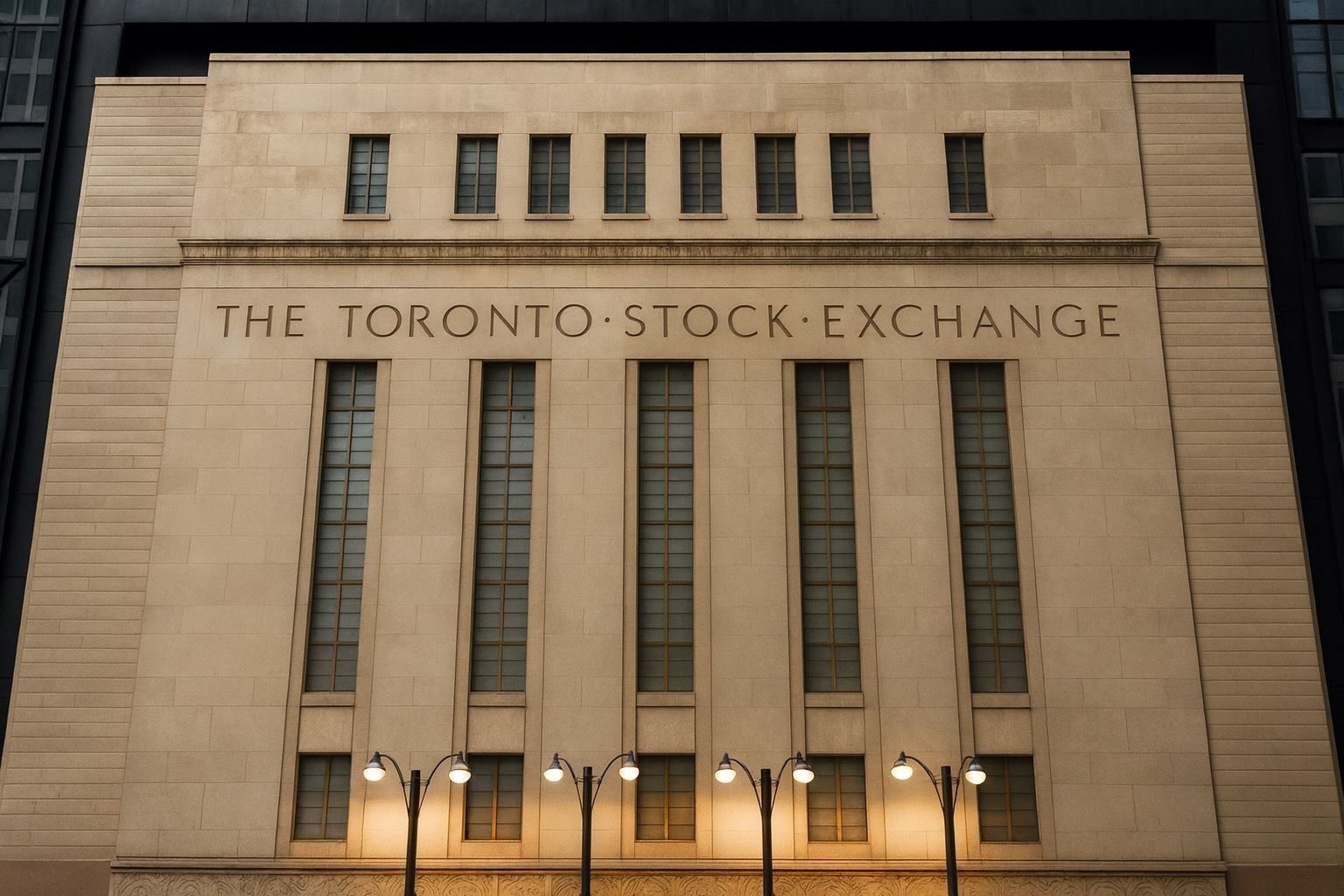
Canada’s stock market opened higher on Tuesday as investors rotated back into financials after a tech-led pullback, with Bank of Nova Scotia’s stronger‑than‑expected earnings and a C$1.9 billion takeover of Laurentian Bank setting the tone on Bay Street.
The S&P/TSX Composite Index was up about 0.2% at the open, trading near 31,165, after closing Monday’s session down 0.90% as technology, REITs and real estate stocks weighed on the benchmark.Reuters+1 Shortly after the bell, the index was still in positive territory around 31,120, modestly above Monday’s close of 31,101.78, with an intraday high just under 31,180.
Below is a full rundown of what’s moving Canada’s stock market today, plus fresh forecasts and strategy views that landed on December 2, 2025.
TSX Today: Modest Rebound After Monday’s Tech Selloff
On Monday, the S&P/TSX Composite fell 0.90%, snapping a powerful run that had recently carried the benchmark to record territory. Losses were led by information technology, REITs and broader real estate names.
- Top gainers yesterday: Bausch Health jumped more than 11%, while Curaleaf Holdings and fertilizer giant Nutrien also finished strongly higher.
- Top decliners: Celestica slid over 7%, Shopify sank more than 6%, and Bombardier fell more than 4%, highlighting how sensitive high‑multiple growth names remain to rate and sentiment swings.
Overnight, futures tracking the S&P/TSX Composite inched up about 0.1%, pointing to a cautious but positive start as traders looked ahead to Canadian bank earnings.Reuters That’s exactly what played out: at 9:30 a.m. ET the index opened 0.21% higher at 31,165.92, according to Reuters.
Real‑time quote data from Desjardins showed the TSX trading around 31,120 shortly after the open, up about 19 points (0.06%) from Monday’s close, with an early intraday high of 31,178.96 and a 52‑week high just above 31,400.
In other words: the Canadian market is trying to stabilise after Monday’s wobble, with financials and deal news offsetting lingering pressure on recent high‑flyers in tech and rate‑sensitive real estate.
Scotiabank Kicks Off Bank Earnings Season – and Lifts Financials
The biggest single catalyst for the TSX today is Bank of Nova Scotia (Scotiabank), the first of Canada’s Big Six banks to report fourth‑quarter results.
Earnings beat and restructuring charge
Scotiabank reported:
- Adjusted Q4 profit: about C$2.56 billion, up from C$2.12 billion a year earlier.
- Adjusted earnings per share: C$1.93, topping analyst expectations of C$1.84, according to LSEG data.
- Net interest income: roughly C$5.59 billion, up from C$4.92 billion, reflecting the benefit of higher rates and growth in interest‑earning assets.
- Provision for credit losses: rose to about C$1.11 billion, from C$1.03 billion a year ago, as the bank continued to build buffers against potential loan defaults.
The bank also booked a C$373 million restructuring charge, tied mainly to layoffs in its Canadian banking operations and in parts of Asia within its global banking and markets businesses.
At the same time, Scotiabank’s board declared a dividend on its outstanding shares, keeping its income profile intact for yield‑focused investors.
Why this matters for the TSX
Financials are one of the heaviest‑weighted sectors on the S&P/TSX Composite, so a solid start to bank earnings season can have an outsized impact on the broader index.
Reuters notes that Canada’s major banks have, on average, outperformed the TSX this year, helped by improved sentiment on domestic lenders and heightened demand for income stocks.Reuters+1 RBC Wealth Management estimates that financials have been one of the largest contributors to the index’s roughly 25% total return year‑to‑date, alongside materials and energy.
For investors watching Canada stock market today, the takeaways from Scotiabank’s report are:
- Fee‑driven businesses like wealth management and capital markets are helping offset slower loan growth.
- Credit costs are rising, but not yet alarmingly so, suggesting a still‑manageable credit cycle.
- Management remains focused on the North American trade corridor, trimming exposure to underperforming international markets while leaning into higher‑return segments.
With RBC, TD, BMO, CIBC and National Bank set to report over the coming days, investors will be watching to see whether Scotiabank’s mix of solid earnings and restructuring-related charges becomes a pattern across the sector.
Fairstone–Laurentian Deal Reshapes Quebec Banking
The other big headline on December 2 is a C$1.9 billion all‑cash takeover of Laurentian Bank of Canada by Fairstone Bank – a deal that will reshape parts of Quebec’s banking landscape and ripple through the TSX financials complex.
The deal at a glance
According to Reuters, Fairstone will acquire all outstanding Laurentian Bank shares for C$40.50 per share, representing about a 20% premium to Laurentian’s closing price on December 1.
Key points:
- The transaction values Laurentian at C$1.9 billion, with closing expected by late 2026, pending regulatory approvals.
- National Bank of Canada will purchase Laurentian’s retail and small‑ and medium‑enterprise (SME) banking portfolios, plus certain syndicated loans, bolstering its already strong franchise in Quebec.
- Laurentian’s board has simultaneously accelerated its shift to a specialty commercial bank, formally exiting retail and SME banking as outlined in its 2024 strategic plan.
For Laurentian shareholders, the deal locks in a price well above the bank’s recent 52‑week high just above C$34, as reported by MarketBeat.
Strategic implications
The transaction underscores several themes that matter for the Canada stock market outlook:
- Consolidation in regional and mid‑tier banks: Smaller institutions that struggled to attract buyers in earlier strategic reviews are now being re‑evaluated as assets that can help larger players bulk up in core markets.
- Focus on specialty strengths: Laurentian is leaning into higher‑margin specialty commercial lending, while National Bank deepens its consumer and SME footprint in Quebec.
- Deposit wars & funding costs: As competition for stable deposits intensifies, scale in retail banking can be an advantage – a factor likely to remain front‑and‑centre for TSX‑listed lenders through 2026.
On the TSX tape, the news is likely to be reflected in strong moves in Laurentian Bank shares, a spotlight on National Bank, and renewed investor interest in other regionals and niche lenders that could become future deal targets.
New TSX Income & Thematic Products: Banks, Gold and Copper
Beyond individual stocks, today also brings new income‑oriented tools for Canadian investors.
Evolve Big Six Canadian Banks UltraYield Index ETF (SIXY)
Evolve Funds Group launched the Evolve Big Six Canadian Banks UltraYield Index ETF on the TSX today under the ticker SIXY.
According to the issuer:
- SIXY offers modestly levered exposure to an equal‑weight portfolio of the Big Six banks: RBC, TD, BMO, Scotiabank, CIBC and National Bank.
- It overlays a covered call strategy to generate extra option income.
- Distributions are expected twice per month, with the first payout of C$0.21 per unit scheduled for December 22, 2025.
This product sits squarely in a trend highlighted by RBC Wealth Management’s 2026 outlook: investors are seeking quality, income‑generating equities as government bond yields reset higher but credit spreads remain tight.
Copper and gold plays linked to AI and resource demand
On the resources side:
- Global X Investments Canada today announced the launch of what it calls the world’s first copper covered call ETF, listed on the TSX, providing income‑oriented exposure to copper at a time when strategists expect AI‑related infrastructure to drive long‑term demand for the metal.
- Earlier this week, Snowline Gold graduated from the TSX Venture Exchange to a full TSX listing under the symbol SGD, a move expected to boost visibility and liquidity for the Yukon‑focused explorer.
Both developments fit neatly with a Reuters poll showing that strategists expect energy and materials – almost a third of the TSX by market capitalisation – to be key drivers of future gains as AI‑driven demand for metals and energy builds.
Corporate News Roundup on the TSX
Several other TSX‑listed names are generating headlines today:
- goeasy Ltd. (GSY): The non‑prime consumer lender announced that CEO Dan Rees will step down due to a personal health matter, with Patrick Ens slated to take over as CEO on January 1, 2026.goeasy Governance continuity and succession planning will be a focus for investors, particularly in a credit‑sensitive business.
- Curaleaf Holdings (CURA): Curaleaf unveiled an equity purchase agreement for the Virginia assets of The Cannabist Company, extending its U.S. footprint. The company trades on the TSX under ticker CURA.
- Arizona Sonoran Copper (ASCU): The copper developer closed an C$86.25 million bought‑deal private placement at C$3.35 per share, with TSX approval still pending, bolstering its balance sheet for project advancement.
- Propel Holdings (PRL): The fintech lender received regulatory approval to launch a new credit card program, reinforcing the emergence of alternative credit platforms within Canada’s financial ecosystem.
While none of these stories individually moves the entire index, together they underscore an active deal and capital‑raising environment that’s supportive of TSX liquidity and breadth.
Macro Backdrop: Rates, Commodities and the Canadian Outlook
Today’s moves on the Toronto Stock Exchange are unfolding against a nuanced global backdrop.
Global markets and commodities
A global markets update from Reuters describes a calmer tone after Monday’s bond and crypto volatility:
- Global government bonds stabilised after a sharp selloff driven by expectations of a coming rate hike in Japan.
- U.S. 10‑year Treasury yields hover near 4.11%, while German Bund yields sit around 2.77%.
- Bitcoin is down roughly 30% from its October peak, while gold trades just above US$4,200 per ounce, a few percent below its record high, and silver is slightly weaker.
- Brent crude is trading near US$63 a barrel, with U.S. WTI crude around US$59, after geopolitical tensions and supply concerns recently pushed prices higher.
Those levels continue to support Canada’s energy and mining sectors, key pillars of the TSX.
Bank of Canada and fiscal policy
RBC Wealth Management’s newly published 2026 Canada outlook paints a picture of:
- A Bank of Canada that has cut its policy rate to 2.25%, at the low end of its estimated neutral range, after delivering a total of 275 basis points of easing since the 2023–24 peak.
- A steeper yield curve, driven by higher long‑term bond yields, which RBC argues improves the case for adding duration through longer‑dated Government of Canada bonds rather than taking more credit risk in corporates.
- A federal budget proposing about C$280 billion in incremental spending and capital investment over five years, aimed at infrastructure, productivity, defence and housing – with the ambition of crowding in roughly C$1 trillion in total new capital.
On equities, RBC notes that the S&P/TSX Composite trades at roughly 15.9x earnings, a modest premium to its long‑term average of 14.7x but significantly below the S&P 500’s current multiple.RBC Wealth Management That leaves room for further gains, but also raises the bar for earnings to meet elevated expectations.
TSX Forecasts: Strategists See New Highs – But Expect a Bumpy Ride
If you’re searching for a Canada stock market forecast, the most recent consolidated view comes from a Reuters poll of equity strategists and portfolio managers released last week, which is now being digested alongside today’s RBC outlook.
The poll’s median view:
- Projects the S&P/TSX Composite to rise nearly 5% to 32,125 by the end of 2026, from around 30,600 in late November.
- Expects the index to climb further to 33,925 by mid‑2027, implying about an 11% gain from that November base.
Strategists highlight:
- Tailwinds from easing trade uncertainty and the expectation that both the Bank of Canada and U.S. Federal Reserve will keep shifting from restrictive to more accommodative policy, boosting liquidity.
- Structural demand for Canadian energy and minerals to supply AI‑related technologies, with energy and materials together accounting for about 32% of the TSX’s market cap.
- Risks from stretched valuations and fading momentum in gold, with 11 of 15 analysts in the survey saying a market correction in the next three months is likely or very likely.
Taken together, today’s data and analysis suggest that Canada’s stock market enters December 2025 from a position of relative strength, but with elevated expectations and narrower margins for error.
What Investors Should Watch Next
For traders and long‑term investors following Canada stock market today, here are the key storylines to monitor over the rest of the week:
- Big Six bank earnings roll‑out
- Whether other banks echo Scotiabank’s blend of stronger fee income, elevated provisions and restructuring costs will shape the near‑term path for financials‑heavy TSX indexes.
- Integration and reaction to the Fairstone–Laurentian deal
- How Laurentian shareholders respond to the premium, and how National Bank frames the acquired portfolios, will offer clues on future consolidation themes in Canadian banking.
- Flows into new income ETFs
- Early volumes and investor appetite for SIXY and copper covered‑call products will indicate just how hungry Canadian retail and advisory channels are for yield‑plus‑equity strategies in 2026.
- Commodities vs. AI narrative
- If gold holds near record levels and copper remains supported by AI infrastructure demand, resource names could continue to underpin the TSX, as both RBC and Reuters’ poll respondents anticipate.
As always, intraday market levels can shift quickly, but as of the morning of December 2, 2025, the Toronto Stock Exchange is signalling a market that remains risk‑on – just more selective, more income‑conscious, and increasingly shaped by banks, resources and policy rather than pure growth enthusiasm.
This article is for informational purposes only and does not constitute investment advice. Always do your own research or consult a licensed adviser before making investment decisions.