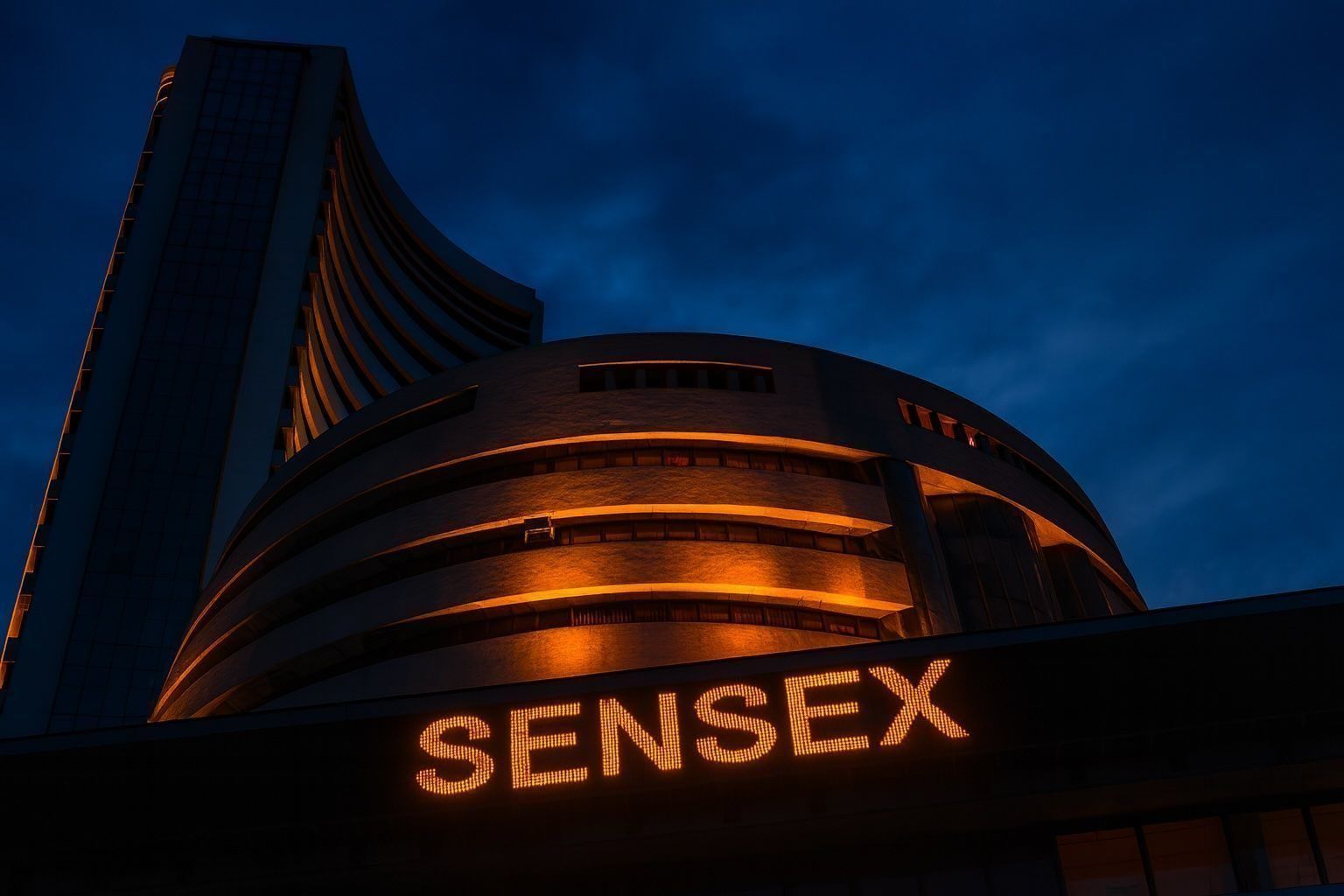

The Indian stock market extended its correction for a second straight session on Tuesday, 2 December 2025, as a record‑weak rupee, weak industrial data and persistent foreign investor selling triggered broad‑based profit‑booking near record highs.
At the close, the BSE Sensex slipped 503.63 points (‑0.59%) to 85,138.27, while the Nifty 50 fell 143.55 points (‑0.55%) to 26,032.20.Moneycontrol The sell‑off wiped out roughly ₹1.82 lakh crore in investor wealth, taking the total market capitalisation of BSE‑listed companies down to about ₹472.6 lakh crore.
The move came on a day when the rupee briefly plunged to an all‑time low of around 90.02 per US dollar, one of the weakest performances among major Asian currencies this year.
Headline recap: Indices, breadth and volatility
- Sensex: 85,138.27 (‑0.59%)
- Nifty 50: 26,032.20 (‑0.55%)
- Nifty Bank: ~59,274 (‑0.68%), dragged by heavyweights HDFC Bank, ICICI Bank and Axis Bank.
- Broader market: BSE Smallcap index fell about 0.49–0.6%, while the BSE Midcap index slipped roughly 0.14–0.2%, outperforming the benchmarks on a relative basis.
- Market breadth: On the NSE, about 2,000+ stocks declined versus ~1,080 gainers, underlining a clear negative breadth.
- Volatility: The India VIX cooled to near 11.2, down over 3% on the day, indicating that the correction is still relatively orderly rather than panic‑driven.
Despite the fall, both Sensex and Nifty remain not far below their all‑time highs scaled on Monday, when Nifty briefly touched 26,325 and Sensex moved above 86,150 intraday.
Why did the market fall today?
Today’s decline was less about a single shock and more about a cluster of headwinds hitting at once:
1. Rupee at record low near 90/USD
The most immediate trigger was the sharp weakening of the rupee, which touched an all‑time low of 90.02 per dollar in intraday trade.
Upstox and other market trackers highlight three big reasons:Upstox – Online Stock and Share Trading+1
- A record merchandise trade deficit of about $41.7 billion in October, driven by a jump in gold and silver imports.
- A double‑digit drop in exports (around 12%) and a 17% surge in imports, which has kept dollar demand high.
- Delay in finalising a US–India trade deal to counter steep tariffs imposed by the Trump administration, which is hurting exports and sentiment.
Layered on top of that are persistent FII outflows, making the rupee one of Asia’s worst‑performing currencies in 2025, with a depreciation of about 5% so far this year.
For equity investors, a rupee slide matters because it:
- Raises import costs (fuel, aviation, electronics, capital goods).
- Erodes dollar returns for foreign investors.
- Fuels worries that RBI may stay hawkish longer to anchor inflation expectations.
2. Weak industrial data vs strong GDP
Last week, India surprised with 8.2% GDP growth in Q2 FY26, the fastest in six quarters and well above consensus forecasts around 7.3%.Reuters+1 That has prompted several economists to upgrade FY26 growth forecasts to around 7.4%, calling the numbers “too hot to ignore.”The Indian Express
But hard industrial data is telling a softer story:
- Industrial output (IIP) growth in October 2025 slowed to just 0.4% year‑on‑year, down sharply from 4–4.6% in September.
- Manufacturing output growth cooled and both mining and electricity saw contractions, according to NSO data.
This divergence between “gangbuster” GDP and tepid factory output has sparked debate about how broad‑based the recovery really is, and that uncertainty fed into today’s profit‑taking.
3. Caution ahead of RBI’s December policy
The RBI Monetary Policy Committee (MPC) kicks off its three‑day meeting on 3 December, with the decision due on 5 December. Markets are wrestling with two opposing forces:The Times of India+1
- For a rate cut: Moderating inflation, a strong rupee‑adjusted export competitiveness need, and growth support arguments.
- Against a rate cut: Very strong GDP data, elevated core inflation risks, and concern that a cut could worsen rupee pressure.
Most mainstream economists now expect RBI to hold the repo rate, but the combination of rupee volatility and big macro surprises has made traders cautious in the run‑up.
4. Persistent FII selling and index rejig in financials
Foreign investors have been net sellers in Indian equities for five consecutive months, offloading over ₹1.4–1.5 lakh crore in 2025 even as the domestic economy has outperformed.
Today alone, FIIs:
- Bought equities worth about ₹15,234 crore,
- Sold about ₹18,876 crore,
- Ending with a net outflow of ₹3,642 crore in the cash segment.
Domestic institutional investors (DIIs) tried to cushion the blow, net buying ₹4,646 crore worth of shares, but that wasn’t enough to prevent index‑level declines.
On top of that, analysts point out that a NSE sectoral index overhaul triggered weight changes in key banking counters, adding pressure on the Nifty Bank and financials as large funds rebalanced.
5. Simple profit‑booking near record highs
The market had sprinted to fresh records just yesterday, with Nifty 50 briefly hitting 26,325.8 and Sensex topping 86,159 intraday before closing marginally lower.
Several commentators, including Dhan’s “Closing Bell” note, describe today’s move as classic profit‑taking after a strong run, amplified by weak data and a record‑low rupee rather than the start of a structural downtrend.Dhan+1
Sector and stock movers: Banks & metals drag, pharma outperforms
The pain was broad‑based:
- All major Nifty sectoral indices ended lower except pharma. Nifty Bank fell about 0.7%, while Nifty Financial Services dipped nearly 0.9%, making financials the worst‑hit pocket.
- Autos, IT, metals, realty and oil & gas all closed in the red, reflecting risk‑off sentiment across cyclicals.
- Nifty Pharma eked out a small gain (around +0.2%), helped by defensive buying and positive stock‑specific news.
Nifty 50 top losers
Across the Nifty 50, heavyweights led the decline:
- InterGlobe Aviation (IndiGo) was the top loser, dropping roughly 1.6% after disclosing a ₹117.5 crore GST penalty, which spooked investors as it came on top of a strong year‑to‑date rally.
- ICICI Bank, HDFC Bank and Axis Bank fell over 1% each, magnifying the drag from the financials basket.
- Reliance Industries also slipped more than 1%, partly on profit‑booking after strong gains and stock‑specific restructuring headlines.
Nifty 50 top gainers
Even in a weak tape, there were winners:
- Asian Paints surged over 3%, topping the Nifty gainers after an upgrade from UBS and optimism on margins as crude prices stabilise.
- Dr Reddy’s Laboratories, Maruti Suzuki, Bharti Airtel and SBI Life gained between 0.5% and 1%, with investors rotating into defensives and quality franchises.
Mid & small caps: pockets of froth and resilience
Mint’s market wrap flags that despite the weak index close, 8 NSE stocks jumped more than 10%, including Tips Films and Sun Pharma Advanced Research Company (SPARC), both locked near 20% upper circuits, while Easy Trip Planners also rallied almost 20%.
At the same time:
- 52 stocks hit fresh 52‑week highs, including names like Asian Paints, Bank of Baroda, AU Small Finance Bank, Federal Bank, Paytm, Union Bank and Vedanta.
- Around 180 stocks printed 52‑week lows, reflecting growing divergence under the index surface.
This mix of frothy movers and fresh lows suggests that while headline indices are near records, stock‑specific dispersion remains high—good for traders, but tricky for passive risk‑takers.
Rupee in free fall: why 90/USD is rattling Dalal Street
The rupee story is increasingly central to the equity narrative.
Upstox’s breakdown of the currency slide notes that:Upstox – Online Stock and Share Trading+1
- The trade deficit widened to a record $41.68 billion in October, driven by a surge in gold and silver imports.
- Exports fell nearly 12% while imports climbed ~17%, exacerbating dollar demand.
- US tariffs of around 50% on several Indian goods and delays in a US–India trade deal have hurt export momentum and confidence.
- The rupee has fallen about 5% against the dollar in 2025, ranking among Asia’s weakest performers.
Combined with record FPI equity outflows of over ₹1.4–1.5 lakh crore this year, the rupee’s slide has become a visible symbol of global risk‑off towards Indian assets, even as domestic growth numbers impress.
For equities, a persistently weak rupee raises questions about:
- Margin pressure for import‑heavy sectors (aviation, autos, oil marketing, chemicals).
- Valuation comfort for foreigners, whose dollar returns are eroded.
- RBI’s room to cut rates, as aggressive easing could worsen currency pressure.
Macro backdrop: 8.2% GDP vs 0.4% IIP and a big week for RBI
The backdrop to today’s trade is unusually complex:
- Q2 FY26 GDP grew 8.2% year‑on‑year, the strongest print in six quarters and well ahead of expectations, driven by a sharp jump in manufacturing GVA and robust government spending.
- Several economists have since raised FY26 growth forecasts to around 7.4%, arguing that India is emerging as one of the fastest‑growing large economies globally.
- Yet industrial production has slumped, with IIP up just 0.4% in October, manufacturing at 1.8% and contractions in mining and electricity raising doubts about the breadth of the recovery.
This “strong GDP, soft factories” combination has sharpened focus on the RBI meeting this week.
Times of India’s policy preview notes that experts are split: some see room for a symbolic rate cut to support growth, while others expect the MPC to hold the repo rate given strong GDP, sticky core inflation and rupee volatility.
Whatever the outcome on 5 December, the policy tone on:
- Inflation risks,
- Currency management, and
- Growth priorities
is likely to be the next major trigger for both bonds and equities.
Flows watch: FIIs sell ₹3,642 crore, DIIs absorb the hit
According to Moneycontrol’s FII–DII data:Moneycontrol+1
- Foreign Institutional Investors (FIIs/FPIs)
- Bought: ₹15,234 crore
- Sold: ₹18,876 crore
- Net: –₹3,642 crore
- Domestic Institutional Investors (DIIs)
- Bought: ₹15,195 crore
- Sold: ₹10,549 crore
- Net: +₹4,646 crore
For calendar 2025 so far, FIIs remain net sellers of about ₹2.62 lakh crore, while DIIs have net bought roughly ₹7.13 lakh crore, largely via mutual funds and insurance flows.
That tug‑of‑war has defined much of this year’s price action: global money trimming India on valuations and currency worries, while domestic money keeps averaging in on the growth story.
Technical view: Key Nifty and Bank Nifty levels after the fall
Pre‑market technical commentary for today had already suggested that Nifty was in a “pause, not panic” phase after Monday’s record high. NDTV Profit’s trade setup for 2 December flagged:NDTV Profit+1
- Immediate Nifty support:26,100–26,000
- Deeper structural support: Around 25,850, which acted as a breakout zone earlier.
- Near‑term resistance:26,300–26,325, the recent all‑time high area, with further resistance zones near 26,325–26,400.
- Upside technical targets (if trend resumes):26,500 and 26,800 over the coming weeks, assuming the index holds above the 26,000–25,800 band.
For Bank Nifty, the same note highlighted:NDTV Profit
- Support:59,400–59,000 (immediate), then 58,300–58,600 as a stronger confluence of recent lows and breakout levels.
- Resistance:60,000–60,300, with a potential move toward 61,000 on sustained strength.
Moneycontrol’s separate “trade setup” column also underlines 25,950–26,000 as the zone bulls must defend to keep the broader uptrend intact after three days of mild declines.Moneycontrol
In short, today’s correction has pushed Nifty back toward first support, but not yet into breakdown territory. Most technical houses still describe the trend as “positive with buy‑on‑dips bias”, albeit with rising short‑term volatility.
Medium‑ to long‑term forecasts: How strategists see Nifty from here
Even as the market digests today’s fall, brokerage forecasts released or highlighted on 2 December remain broadly constructive on India over a 1–2 year horizon.
Nomura: Nifty 29,300 by end‑2026
The Economic Times live blog cites a Nomura strategy note projecting Nifty 50 at 29,300 by end‑2026, about 12% above current levels, driven by:The Economic Times
- Cyclical recovery in growth,
- Strong corporate earnings momentum, and
- Supportive policy backdrop, including public capex and structural reforms.
Axis Securities: Base‑case 28,100, bull‑case 29,500 for December 2026
A detailed market outlook from Axis Securities, published this afternoon, lays out a spectrum of Nifty targets:Moneycontrol
- Base‑case target:28,100 by December 2026, implying roughly 8% upside from current levels.
- Bull‑case target:29,500 by December 2026, or more than 13% upside, assuming a “Goldilocks” global scenario with a US soft landing, lower volatility and easing tariff uncertainty.
Axis argues that:
- India is well‑positioned as a relative safe haven amid global volatility,
- Nifty earnings can grow about 13% CAGR over FY23–28, with financials as key contributors, and
- Risks revolve around trade policy, rupee depreciation and a delayed earnings revival if global conditions worsen.
Taken together, major foreign and domestic brokerages still see mid‑teens upside over the next 12–24 months, even from near‑record index levels—though they are increasingly vocal about risks from currency weakness, global tariffs and elevated valuations.
Important: These are third‑party projections, not guarantees. Markets can move very differently from any forecast, especially over shorter horizons.
Stock‑specific highlights from 2 December 2025
Beyond the indices, several individual stories stood out today:
- Vodafone Idea shares climbed around 4% intraday as investors bet on possible government relief on adjusted gross revenue (AGR) dues by year‑end, according to ET’s live blog.
- Bharat Dynamics gained over 2% after announcing additional orders worth about ₹2,462 crore from the Indian Army, boosting sentiment in defence names.
- SPARC (Sun Pharma Advanced Research Company) was locked at its 20% upper circuit after a favourable US court ruling, making it one of the day’s standout small‑cap movers.
- The renewable energy pack, including names like Adani Green and Suzlon, saw active trade as Upstox highlighted sector performance for the day, though moves were mixed after a strong year‑to‑date run.
These micro stories underscore that stock selection remains critical: even on a down day for the indices, catalysts like orders, regulatory relief or court decisions can drive double‑digit moves.
What to watch next
With today’s session done, traders and investors will be laser‑focused on a few key near‑term triggers:
- RBI MPC meeting (3–5 December)
- Tone on inflation, rupee and growth.
- Any change in policy stance or liquidity guidance.
- Global cues
- US data and the Federal Reserve’s rate‑cut signals, which will influence global risk appetite and flows into emerging markets.
- Developments on US–India trade talks, particularly around tariffs, given their impact on exports and the rupee.
- Flows & currency
- Whether FII selling slows or intensifies as December progresses.
- Whether the rupee stabilises below or above the 90/USD mark, which will be a key sentiment barometer.
- IPO pipeline and domestic positioning
- A busy primary market, with deals like Wakefit’s ₹1,289‑crore IPO from 8 December and approvals for ICICI Prudential AMC and others, will test domestic liquidity appetite.
Bottom line
- Today’s drop was meaningful but not catastrophic: Nifty is still above 26,000 and only a couple of percentage points off its record high.
- The weak rupee, soft industrial data and relentless FII selling are real headwinds and are now very much on the market’s radar.
- At the same time, domestic growth remains strong, DIIs are still buying aggressively, and major brokerages continue to project moderate upside over the next 1–2 years, albeit with rising risks.
As always, this article is for information and news purposes only. It is not investment advice. Anyone considering investing or trading should assess their own risk tolerance, time horizon and diversification, and consult a qualified financial adviser before acting on market moves—especially in a week as event‑heavy as this one.