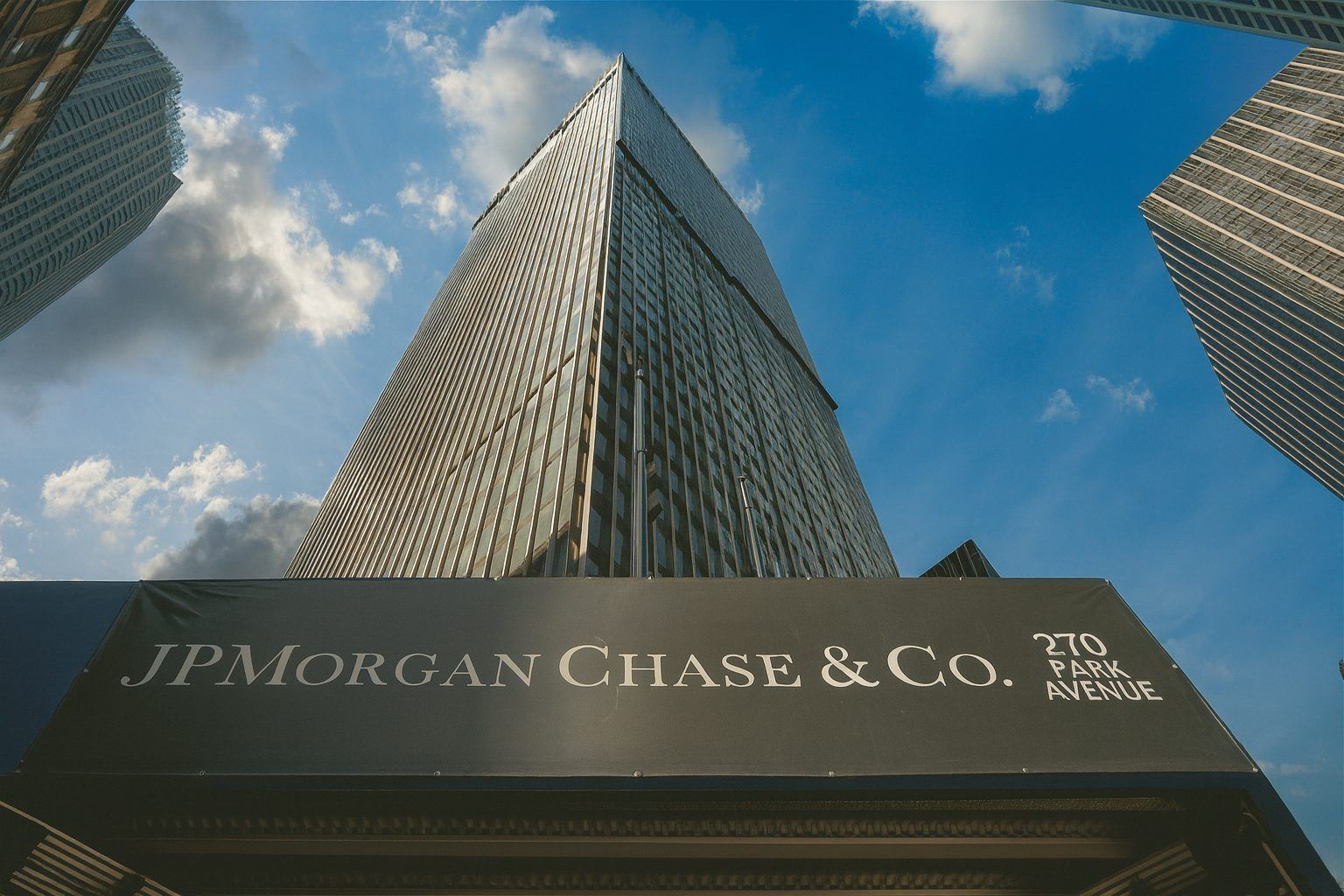

JPMorgan Chase & Co. NYSE:JPM continues to trade close to record levels as investors digest robust third‑quarter 2025 results, a massive $50 billion buyback program and a series of regulatory and macro headlines that could shape returns into 2026. As of December 3, 2025, JPMorgan’s share price hovers around $311 per share, after closing at $311.41 on Wednesday’s session.
This article summarizes all the key news, forecasts and analyses currently available as of 3 December 2025, and is intended for informational purposes only—not as personalized investment advice.
1. JPMorgan Chase stock snapshot as of December 3, 2025
Price and trading range
- Latest price (intraday, Dec 3, 2025): around $311–312 per share.
- Close on Dec 3, 2025: $311.41, after trading between $306.80 and $312.17 during the session.
- 52‑week range: roughly $202.16 (low) to $322.25 (high), placing today’s price close to the upper end of the band.
- All‑time high closing price: about $320.41 on November 12, 2025.
- Market capitalization: around $850–860 billion, based on recent data from Yahoo Finance and other providers.
Over the last year, JPMorgan stock has delivered roughly 27–28% total return, comfortably ahead of the broader U.S. equity market.
Valuation snapshot
- P/E ratio (trailing): ~15.2x, versus a 10‑year average P/E around 11.8x.
- Tangible book value per share (TBVPS): about $105.70 as of Q3 2025.
- Price‑to‑tangible book (P/TB): around 3.0–3.1x today—above both JPM’s long‑term average and the broader banks’ average near 3.0x.
At current levels, JPM trades at a premium to its own history and to many large‑bank peers, reflecting its dominant franchise, strong profitability and sizeable capital return program—but also raising questions about how much upside is left from here.
2. Fresh news as of December 3, 2025
2.1. December 3 flow: institutional moves and positioning
MarketBeat reports several new 13F‑style filings that show continued institutional activity in JPMorgan stock:
- Inceptionr LLC initiated or increased a position worth about $1.07 million in JPMorgan Chase & Co., according to a filing published December 3.
- Associated Banc Corp lists JPMorgan as its 5th‑largest holding, reinforcing the bank’s status as a core blue‑chip position for many institutional investors.
- Other recent filings (e.g., from Boston Partners and Country Trust Bank) show some managers trimming JPM holdings but still retaining meaningful exposure, while highlighting JPMorgan’s market cap near $838 billion, P/E around 15.25, beta near 1.1, and 52‑week high of $322.25.
Overall, institutional flows look balanced rather than one‑sided, consistent with a stock that is well‑owned and trading near fair value in many models.
2.2. Strategic expansion: Switzerland and national security themes
Two strategic initiatives stand out in late 2025:
- Swiss onshore private banking push
- A Zacks report on December 3 describes JPMorgan’s “Switzerland play”, highlighting a hiring spree and an ambition to double onshore Swiss private‑banking assets by 2030.Zacks+1
- JPM currently carries a Zacks Rank #3 (Hold), reflecting decent earnings momentum but a valuation that already prices in much of the good news.
- $10 billion national‑security investment initiative
- In November, JPMorgan announced a plan to commit up to $10 billion into sectors tied to U.S. national security and economic resilience—including energy independence, defense, frontier technologies (AI, quantum) and critical‑supply‑chain infrastructure.
- The initiative sits within a broader $1.5 trillion, 10‑year “Security and Resiliency Initiative”, with the bank hiring more bankers and setting up an advisory council to steer capital toward strategic industries.Barron’s
Both moves strengthen JPMorgan’s wealth‑management and strategic‑capital story, potentially supporting fee income and lending opportunities over the long run.
2.3. Regulatory overhang: record German AML fine
Regulation is the main negative headline around JPM at the moment:
- On November 6, 2025, Germany’s BaFin imposed a record €45 million fine (~$50 million) on JPMorgan SE, the Frankfurt unit, citing “serious deficiencies” in anti‑money‑laundering (AML) controls and delays in filing suspicious transaction reports between October 2021 and September 2022.Reuters+2PAN Finance+2
- JPMorgan acknowledged the shortcomings but emphasized that the late filings did not hinder official investigations and that remediation is under way.
Financially, the fine is immaterial compared with quarterly net income of over $14 billion. Reputationally, however, it reinforces ongoing regulatory risk—especially in Europe, where AML enforcement is tightening across the industry.
2.4. New lawsuits over prime‑rate and loan pricing
JPMorgan is also among several large U.S. banks named in new antitrust lawsuits:
- A Reuters report in October details a class action alleging that JPMorgan, Bank of America, Wells Fargo and others colluded to fix the U.S. prime rate for over 30 years, allegedly inflating borrowing costs for consumers and small businesses.
These cases may take years to resolve, but they add headline risk and could lead to settlements or increased compliance costs, even if damages ultimately prove manageable relative to JPMorgan’s earnings power.
3. Q3 2025 earnings: still the profit engine of Wall Street
JPMorgan’s third‑quarter 2025 results, released on 14 October, set the backdrop for the current share price. Key numbers from the firm’s SEC filing and earnings materials:
- Net income:$14.4 billion, up about 12% year‑on‑year.
- Earnings per share (EPS):$5.07, well above consensus around $4.84.
- Managed revenue: roughly $47.1 billion, up about 9% from a year earlier.
- Return on tangible common equity (ROTCE): about 20%, underscoring JPM’s industry‑leading profitability.
- Provision for credit losses: just $61 million, reflecting $300 million of net charge‑offs and a $239 million reserve release, a sign that credit quality remains benign.
Segment trends
- Markets & trading:
- Equities revenue surged around 33% to $3.3 billion.
- Fixed‑income revenue climbed roughly 21%, helped by strong activity in rates, credit and securitized products.
- Investment banking:
- Fees rose about 16% year‑on‑year, driven by a rebound in dealmaking and capital markets activity.
- Payments, wealth and asset management:
- J.P. Morgan Payments revenue grew 13% year‑over‑year to $4.9 billion, highlighting the strength of the bank’s transaction‑services franchise.
- Wealth management was singled out in some coverage as a key driver of growth, with higher fee income and new‑money inflows.
Guidance and outlook from Q3
- On the Q3 call and in follow‑up commentary, management lifted its net interest income (NII) forecast for 2025, reflecting the benefits of still‑elevated rates and solid loan balances.
- Executives also indicated that investment‑banking revenue should keep growing at a “low double‑digit” pace, while markets revenues were expected to grow in the high‑teens percentage range for Q3, guidance that was essentially met or exceeded.Reuters
Taken together, Q3 2025 confirmed JPMorgan’s status as the strongest earnings engine among global mega‑banks, which helps justify its premium valuation.
4. Capital strength, dividends and the $50 billion buyback
4.1. Stress tests and capital ratios
After the Federal Reserve’s 2025 stress tests, the largest U.S. banks—including JPMorgan—cleared the hurdles with room to spare, leading to a wave of dividend hikes and buyback announcements:
- Reuters reports that major banks’ average CET1 capital ratio under stress was about 11.6%, far above the 4.5% regulatory minimum, enabling larger capital returns.
- JPMorgan in particular used the results to underscore the resilience of its balance sheet and to justify a step‑up in shareholder distributions.
From the firm’s Q3 2025 earnings supplement:
- Book value per share: about $124.96.
- Tangible book value per share: about $105.70, up roughly 10% from a year earlier.
These figures reflect both retained earnings and the balance‑sheet impact of share repurchases.
4.2. Dividends: up twice in 2025
2025 has been a big dividend year for JPMorgan shareholders:
- In March, the board raised the quarterly dividend to $1.40 per share from $1.25, effective for the April 30 payment.
- In July, after stress‑test results, JPMorgan announced its intention to increase the quarterly dividend again to $1.50 per share starting in Q3 2025, a 7.1% hike from the prior level.
- The most recent dividend of $1.50 per share was paid on October 31, 2025, with an ex‑dividend date of October 6, 2025.
At today’s share price, the forward dividend yield is around 1.9–2.0%, with an estimated annual dividend of $6.00 per share and a payout ratio of about 27–28% of earnings.
4.3. $50 billion share repurchase program
The strongest support for JPM stock in 2025 has been the aggressive buyback plan:
- On July 1, 2025, JPMorgan announced a new $50 billion common‑share repurchase program, contingent on its strong stress‑test results.
- Media reports from Reuters, Barron’s and others highlight that this is one of the largest single buyback authorizations ever by a U.S. bank, and part of a broader move by big banks to ramp up shareholder payouts in a more benign regulatory environment.
Combined with the dividend, JPMorgan’s total shareholder yield (dividends plus buybacks) is estimated at around 5%.
5. Analyst ratings, price targets and stock‑price forecasts
5.1. Wall Street 12‑month price targets
Across major data providers, the consensus view on JPMorgan stock remains positive:
- StockAnalysis.com:
- 13 analysts cover JPM.
- Average 12‑month price target:$326.08, implying about 5.7% upside from current levels.
- Price‑target range: $285 (low) to $350 (high).
- Consensus rating:“Buy”.StockAnalysis
- ValueInvesting.io:
- Based on 30 analysts, the average price target is $331.37, ~7.3% above today’s price.
- Range: $252.50–$388.50.
- Consensus recommendation:Buy.
- MarketWatch analyst summary:
- Around 28 analysts tracked.
- Average target price: roughly $332.45, again pointing to mid‑single‑digit percentage upside over the next year.
- Public.com forecast page:
- Shows a target near $321.46, essentially in line with current prices, and emphasizes that estimates are regularly updated based on market conditions and earnings.
Taken together, recent forecasts cluster in the $320–335 range, suggesting that most of the easy gains may already be in the rear‑view mirror, but that analysts still generally expect modest positive returns from here.
5.2. Quantitative & technical reads
- Several trading and statistics platforms show JPM’s 50‑day moving average around $307, and the 200‑day moving average around $294, meaning the stock remains in a technically strong uptrend above both key support lines.
- Sites that track bank fundamentals note JPM’s P/E above its historical average and P/TB above 3x, often characterizing the shares as “premium to peers” rather than outright cheap.FullRatio+1
Some shorter‑term, purely technical services may flag overbought conditions or issue cautious signals based on moving‑average crossovers, but these are typically focused on trading horizons of days or weeks—not the multi‑year perspective that most long‑term investors use.
6. Macro backdrop and CEO commentary
Jamie Dimon’s public comments in 2025 have been notably cautious on the macro outlook, even as JPMorgan posts record profits:
- In September, he warned of a “cloudy” U.S. economic outlook, citing uncertainty around tariffs, geopolitics and the lagged effects of tighter policy.Reuters+1
- In November, Dimon argued that the U.S. risks “European‑style economic decline” if anti‑business policies and heavy regulation persist, highlighting divergent outcomes between business‑friendly states like Florida and Texas and more heavily taxed jurisdictions.The Economic Times
For JPMorgan shareholders, this stance matters because:
- It supports the bank’s conservative credit posture—provisions remain low, but management is clearly watching for any deterioration.
- It may constrain how aggressively JPM will grow risk‑weighted assets, even as it returns large amounts of capital to shareholders.
7. Key opportunities and risks for JPM stock from here
7.1. Bullish drivers
- Earnings power and ROTCE
- ROTCE of ~20% in Q3 places JPMorgan at the top of the global large‑bank league table.
- If that level of profitability is sustained, the bank can continue to grow tangible book value, support rising dividends and still have room for buybacks.
- Capital returns
- A $50 billion buyback plus a growing dividend (now $6 per share annually) delivers a high single‑digit shareholder yield when combined with organic earnings growth.
- Diversified growth engines
- Strong franchises in payments, prime services, investment banking, wealth management and consumer banking provide multiple avenues for revenue expansion, not solely dependent on U.S. rate policy.
- Strategic initiatives—like Swiss onshore expansion and the national‑security‑focused investment push—could support long‑term fee and lending growth.
7.2. Main risks to watch
- Valuation risk
- With P/E and P/TB both above long‑term averages, JPM stock is no longer obviously cheap. If earnings growth slows or macro risks materialize, the multiple could compress, even if profits remain high.
- Regulatory and legal pressure
- The BaFin €45 million AML fine is financially minor but highlights regulatory scrutiny that could lead to higher compliance costs or additional penalties.
- Antitrust and rate‑fixing lawsuits around the prime rate and loan pricing introduce uncertain legal overhang that could take years to resolve.
- Macro and credit cycle
- Dimon’s repeated warnings about geopolitics, tariffs and policy uncertainty suggest that JPMorgan itself is preparing for a more challenging macro backdrop.
- A sharp downturn would eventually push credit losses higher, potentially forcing the bank to scale back buybacks or slow dividend growth.
- Political and regulatory environment
- The easing of stress tests and capital requirements has enabled larger payouts now, but a change in political winds could reverse that trend and pressure future returns of capital.
8. Bottom line: how does JPM stock look as of December 3, 2025?
As of 3 December 2025, JPMorgan Chase stock represents a high‑quality, premium‑valued U.S. banking franchise with:
- Strong recent earnings momentum and 20%‑plus ROTCE.
- A growing dividend and a $50 billion buyback underpinning per‑share earnings and tangible book value growth.
- A consensus “Buy” rating and mid‑single‑digit 12‑month upside embedded in most analyst models, on top of a roughly 2% dividend yield.StockAnalysis+3StockAnalysis+3Value Investing+3
However, investors weighing JPM today must also recognize that:
- The stock trades near the top of its historical valuation ranges, especially on P/TB, leaving less margin of safety if macro conditions deteriorate.
- Regulatory and legal issues—from AML fines in Germany to U.S. antitrust lawsuits—remain a persistent backdrop risk.
- Management itself is openly cautious about the economic outlook, even while returning large amounts of capital to shareholders.
For readers and potential investors, JPMorgan Chase & Co. as of December 3, 2025 looks like a best‑in‑class bank priced as such: a compelling long‑term compounder for those comfortable with bank‑sector cycles and regulatory risk, but no longer the obvious bargain it was earlier in the rate‑hiking cycle.
If you intend to publish this on Google News or Discover, consider adding:
- A short disclosure box clarifying that the article is for information/education only and not investment advice.
- A timestamp (“Data as of December 3, 2025”) near the top, since bank‑stock metrics and price targets can change quickly.
Related articles: NYSE:JPM