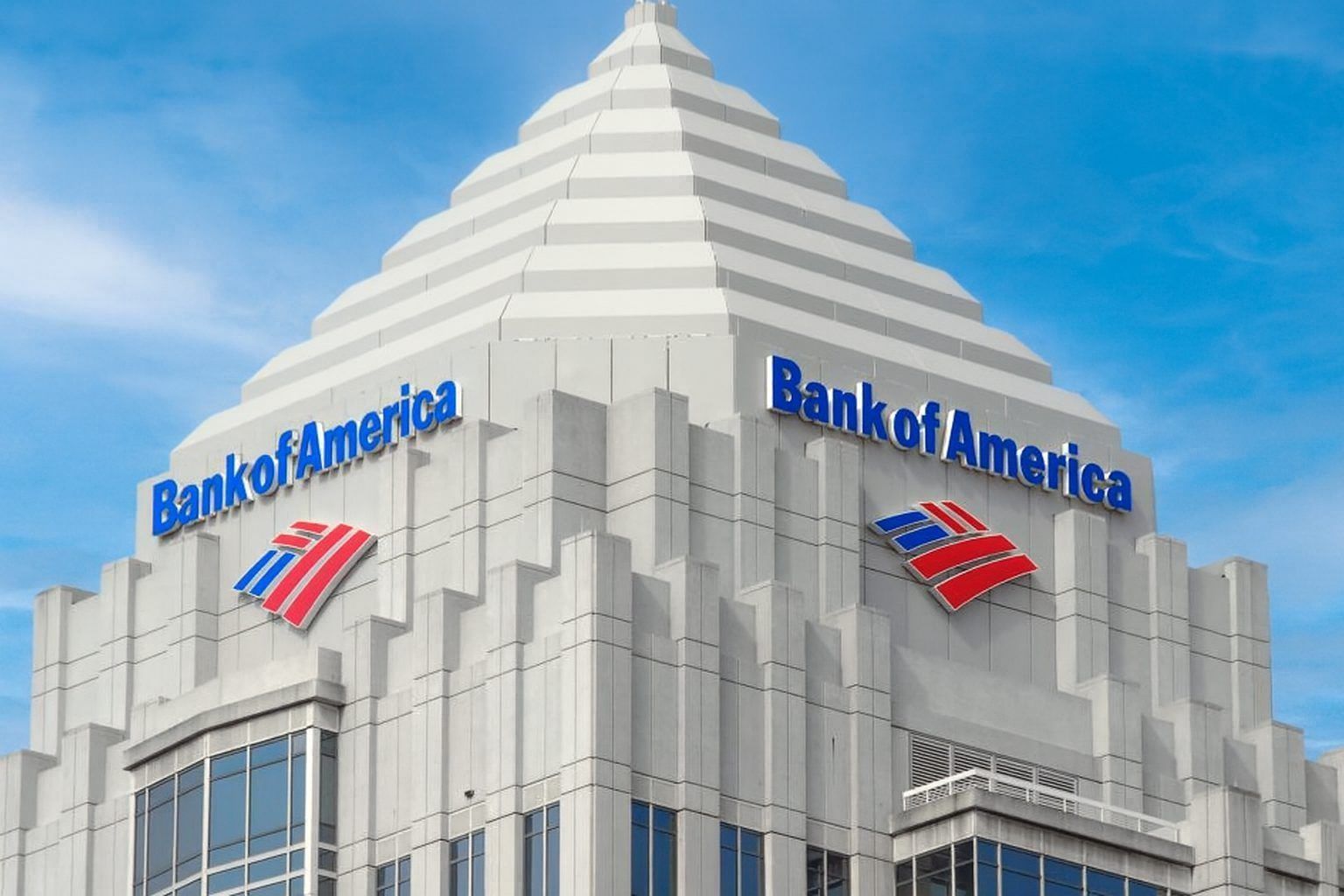

Bank of America Corporation NYSE:BAC heads into the final month of 2025 trading near multi‑year highs, backed by its strongest quarter in years, an aggressive digital and AI strategy, and a new push into Bitcoin ETFs — all while its most famous shareholder, Warren Buffett, keeps quietly trimming his stake.
Here’s a deep dive into where BAC stands today, December 3, 2025, and how Wall Street sees the stock into 2026 and beyond.
1. BAC stock today: hovering near record territory
As of Wednesday, December 3, 2025, Bank of America shares are trading around $54.10, up about 1.7% on the day and close to their recent 52‑week high in the low‑to‑mid $54 range.
Recent performance highlights:
- 1‑month: roughly flat to slightly positive.
- Year to date: about 20% gain in 2025, depending on the exact measurement date.
- 5‑year: Simply Wall St estimates 106%+ total return over the past five years, underscoring a powerful recovery from the post‑2022 banking slump.
In other words, BAC is no longer the classic “deep value” money‑center bank it was a few years ago — it trades like a high‑quality franchise at something close to fair value, with moderate, not explosive, upside expected.
2. Key news on December 3, 2025
Several fresh headlines are shaping the BAC story this week, particularly today:
2.1 CEO Brian Moynihan to present at Goldman Sachs conference
Bank of America announced this morning that Chair and CEO Brian Moynihan will speak at the Goldman Sachs Financial Services Conference on December 10, with a live webcast available via the bank’s investor relations site.
Investors will be watching for:
- Updated commentary on net interest income (NII) as the Fed approaches a widely expected December 2025 rate cut.
- Color on capital returns, including dividends and buybacks.
- Any incremental detail on BAC’s AI, wealth management and crypto strategy following Investor Day and recent research releases.
2.2 New India CEO approved
Reuters reports that India’s central bank has approved Vikram Sahu as CEO of Bank of America N.A. in India, replacing Kaku Nakhate after 15 years in the role.
While this isn’t a direct share‑price catalyst, it matters for:
- Governance and regulatory clarity in a key growth market.
- BAC’s broader Asia strategy, especially around corporate banking and capital markets in India.
2.3 Bitcoin advice and an expanded crypto push for 2026
A TradingView summary notes that Bank of America will, starting in January 2026, allow around 15,000 Merrill and Private Bank advisers to suggest 1–4% Bitcoin allocations for suitable clients, mostly via four spot Bitcoin ETFs, including BlackRock’s IBIT.
This is a major pivot:
- Previously, advisers had limited ability to proactively recommend crypto; clients had to initiate the conversation.
- The new framework brings BAC in line with peers like Morgan Stanley and BlackRock, and could:
- Deepen fee‑based wealth management revenues.
- Make the franchise more attractive to younger, digitally‑savvy investors.
- It also introduces regulatory and reputational risk if crypto markets become volatile again.
2.4 Macro views: stronger growth, muted index returns
In a December 2 press release, BofA Global Research forecast stronger‑than‑expected economic growth in 2026, led by AI‑driven capex, while also flagging higher volatility and only modest stock‑market gains: Bank of America+1
- US GDP growth in 2026: ~2.4% (4Q/4Q), above consensus.
- S&P 500: ~14% EPS growth but only 4–5% price upside, with a year‑end 2026 target of 7,100.
- Fed: expected 25 bp cut in December 2025 and two more cuts in 2026, with the 10‑year Treasury yield ending 2026 around 4–4.25%.
For BAC, this “strong growth, shallow equity upside” scenario is close to a Goldilocks backdrop:
- Rate cuts are gradual, so NII doesn’t collapse, yet credit losses remain manageable.
- Elevated volatility and lower index returns can be good for trading, hedging and wealth‑management activity.
3. Fundamentals after Q3 2025: “best quarter in years”
3.1 Headline numbers
Bank of America’s Q3 2025 results, released on October 15, were widely described as one of its strongest quarters in the past decade.
Key metrics (approximate):
- Revenue: about $28 billion, up ~11% year‑over‑year (YoY).
- Net income: roughly $8.5 billion vs. $6.9 billion a year earlier (~23% growth).
- Diluted EPS: $1.06, up from $0.81 in Q3 2024 and ahead of ~ $0.95 consensus.
- Net interest income (NII): record ~$15.2–$15.4 billion, up high‑single digits YoY.
- Investment banking fees: > $2 billion, up about 43% YoY as M&A and capital markets rebounded.
- Sales & Trading: ~8% YoY revenue growth, the 14th straight quarter of growth in this segment.
- Return on tangible common equity (ROTCE): around 15.4%.
- Efficiency ratio: below 62%, indicating revenue is growing faster than costs.
BofA also returned about $7.4 billion to shareholders in Q3 via dividends and buybacks, underscoring its capital strength and regulatory headroom.
3.2 Business segments
AlphaSense’s breakdown of the Q3 2025 earnings call shows broad‑based strength:AlphaSense
- Consumer Banking: ~$3.4 billion in after‑tax earnings, +28% YoY, helped by higher balances and strong card, home and auto loan demand.
- Global Wealth & Investment Management: nearly $1.3 billion in net income, +19% YoY.
- Global Banking: ~$2.1 billion in net income, +12% YoY, with about 17% return on allocated capital.
- Global Markets: ~$1.6 billion in net income, modestly higher YoY, supported by 10% growth in revenue (ex‑DVA), especially in sales & trading.
Put simply: BAC is firing on nearly all cylinders — lending, trading, wealth and investment banking are all contributing.
3.3 Guidance from Q3 and Investor Day
From management commentary and subsequent Investor Day coverage, several themes stand out:AlphaSense+2TS2 Tech+2
- Q4 2025 NII is expected at the upper end of the $15.5–$15.7 billion guidance range.
- For 2026, BofA expects NII growth of about 5–7%, similar to 2025 vs. 2024.
- At its November 5 Investor Day (first full one since 2011), BAC:
- Raised its medium‑term ROTCE target to 16–18%, up from “mid‑teens.”
- Signaled 5–7% annual NII growth over the next five years, assuming modest rate cuts and steady loan growth.
- Outlined branch expansion into six additional U.S. cities by 2028, aiming to add over $200 billion in potential deposits.
- Highlighted roughly $4 billion in incremental technology and AI spending in 2025, focused on automation, fraud prevention and personalized digital banking.
Analysts generally see these targets as ambitious but achievable, positioning Bank of America to close the profitability gap with top peers like JPMorgan — as long as the macro backdrop cooperates.
4. Valuation: still modestly undervalued, not a screaming bargain
4.1 Price vs. earnings and book value
Simply Wall St’s latest December 3 valuation piece notes:Simply Wall St+1
- BAC trades at a price‑to‑earnings (P/E) multiple of ~13.7–13.8x current earnings.
- That’s:
- Above the U.S. banks sector average (~11.4–11.5x),
- Slightly above a large‑bank peer average (~13.3–13.5x),
- Below their “fair” multiple estimate of about 16x.
On book value, they estimate:
- Book value per share ~ $37.95 and projected book value ~ $40.94.
- BAC therefore trades at roughly 1.3–1.4x book, versus the deep discount (around 0.3x–0.4x book) when Buffett first invested heavily back in 2011.
Their excess returns model yields an intrinsic value near $56.6 per share, implying the stock is only about 6% below fair value — “about right” rather than hugely cheap.
4.2 Fair value ranges from different models
Simply Wall St’s narrative and community models show a wide but reasonable fair‑value range:Simply Wall St+1
- “Most popular” fair value: ~$58.9, about 10% above recent prices.
- Bull case fair value: ~$58.9, ~9–10% upside.
- Bear case fair value: ~$43.3, implying 20%+ downside if growth and margins disappoint.
24/7 Wall St., in a separate long‑term forecast piece, cites:
- Wall Street median 12‑month target: $58.79 (about 11% upside at the time of writing).
- Their own internal 12‑month target: a more conservative $47.20 (roughly 11% downside from then‑current prices).
- A 2030 price target of $63.96, implying total upside of about 20–21% from current levels, plus dividends.
In short, most models see BAC as fairly valued to modestly undervalued today — with upside skewed to the mid‑to‑high $50s, not to $80+.
4.3 Street consensus and earnings forecasts
StockAnalysis aggregates 18 analysts and shows:StockAnalysis+2StockAnalysis+2
- Average 12‑month target price: $55.86, only ~3–5% upside vs. ~$54 today.
- Target range: $43.50 (low) to $70 (high).
- Consensus rating: “Buy”.
- Analysts expect:
- Revenue to grow from $96.1B (2024) to $111.1B in 2025 (~15.7% growth) and $118.0B in 2026 (~6.2% growth).
- EPS to rise from $3.21 (2024) to $3.86 in 2025 (+20.1%) and $4.39 in 2026 (+14%).
Other sources like TickerNerd quote slightly higher consensus targets in the $58 area based on a broader set of 30+ analysts, reinforcing the idea of single‑digit to low double‑digit upside over the next year rather than a moonshot.
5. Dividends, capital and stress tests
5.1 Dividend profile
Following this year’s Fed stress tests, Bank of America’s board approved a quarterly common dividend of $0.28 per share, an increase implemented earlier in 2025. Recent announcements and coverage indicate:Investing.com+2TS2 Tech+2
- Annualized dividend: $1.12 per share.
- Dividend yield: roughly 2.0–2.1% at today’s mid‑$50s price.
- Payout ratio: under 30% of earnings, leaving room for more increases if profit targets are met.
- The next common dividend payment is scheduled for December 26, 2025.
At the same time, BAC continues sizeable share repurchases, returning billions of dollars per quarter to shareholders.
5.2 Capital strength and regulatory buffers
TS2 Tech’s synthesis of BofA stress‑test disclosures notes that:TS2 Tech
- The Fed’s 2025 stress tests showed improved capital resilience, with modeled capital depletion improving by about 100 basis points.
- Bank of America’s Stress Capital Buffer (SCB) is set around 2.5%, putting its minimum CET1 requirement near 10%, versus an actual CET1 ratio around 11.8% earlier in 2025.
- BAC has been placed in G‑SIB bucket 3, requiring a 2% additional capital buffer and reflecting its status as a systemically important global bank.
Taken together, BAC appears comfortably capitalized, with enough flexibility to keep paying its dividend and buying back stock — but also under the stricter scrutiny that comes with being a top‑tier global institution.
6. Strategy shift: AI, digital, 401k Pay and Bitcoin ETFs
Beyond the headline numbers, much of the bull case for Bank of America stock revolves around technology and fee‑based businesses.
6.1 Digital and AI
According to Bank of America’s own disclosures, the bank now serves nearly 70 million consumer and small business clients through about 3,600 financial centers, 15,000 ATMs, and a rapidly growing digital franchise with around 59 million verified digital users.
Recent commentary from management and third‑party analyses highlight:
- Heavy investment in AI‑enabled virtual assistants (like Erica), fraud detection, and process automation.
- A push to use AI to improve customer acquisition, retention and cross‑selling in both consumer and commercial banking.
- Focus on leveraging digital channels to grow fee income (payments, wealth management, advisory) relative to traditional spread‑based lending.
6.2 Wealth management and ultra‑high‑net‑worth (UHNW)
In a recent Fortune piece, Moynihan emphasized a “huge opportunity” in U.S. wealth and ultra‑high‑net‑worth clients, positioning Merrill and the Private Bank as key growth engines.Fortune+1
This dovetails with:
- The crypto ETF initiative for 2026, allowing selected Merrill and Private Bank clients to allocate 1–4% to Bitcoin ETFs.
- Bank of America’s broader aim to be a “one‑stop shop” for banking, brokerage and advisory — a theme also stressed in 24/7 Wall St.’s long‑term forecast.24/7 Wall St.+1
6.3 New product: 401k Pay
On November 13, BAC announced “401k Pay”, a digital solution designed to streamline 401(k) contributions and payroll integration for employers, underscoring how the bank is using technology to deepen ties with both corporate clients and their employees.Yahoo Finance+1
Collectively, these moves show Bank of America trying to tilt its earnings mix toward recurring, fee‑based, tech‑enabled revenue — typically rewarded with higher valuation multiples than pure lending.
7. The Buffett overhang and institutional flows
7.1 Warren Buffett’s steady selling
Berkshire Hathaway remains one of Bank of America’s largest shareholders, but a flurry of Form 13F‑driven analysis shows Warren Buffett has been steadily reducing his BAC position:
- Nasdaq, via a Motley Fool article, estimates Berkshire sold about 427.6 million BAC shares between July 2024 and June 2025, equal to roughly 41% of its stake during that period.
- That selling came as BAC moved from trading at a 68% discount to book value in 2011 (when Berkshire first made its big investment) to around a 39% premium to book by late October 2025.
- A separate update notes Berkshire has continued trimming BAC and Apple while building a new ~$4.3 billion position in Alphabet, underlining a portfolio tilt toward AI‑linked tech.
Buffett’s motives appear to be a mix of:
- Valuation discipline (locking in gains at richer multiples).
- Tax planning ahead of potential corporate tax changes.
- Reallocation into other opportunities, not necessarily a vote of no confidence in BAC’s fundamentals.
Still, the optics of the “Oracle of Omaha” selling remain a psychological overhang for some investors.
7.2 Other institutional ownership
MarketBeat and related reporting suggest that roughly 70–71% of BAC’s float is held by institutional investors, with a mix of large asset managers and hedge funds. Some recent filings show:MarketBeat+1
- Stanley Capital Management trimming its BAC stake by about 6% in Q2 2025, to ~344,000 shares (about 2.7% of its portfolio).
- Other managers adding modestly, reflecting active but balanced institutional flows.
Net‑net, Bank of America remains a core large‑cap financial holding for many institutions rather than a speculative trade.
8. How 2026 is shaping up for BAC: bull vs. bear case
Putting the latest data together, here’s how many analysts and commentators are framing Bacon 2026.
8.1 Bull case: “quality compounder at a fair price”
The bullish narrative, reflected in Simply Wall St, StockAnalysis, TickerNerd and several TS2 and Zacks pieces, centers on:24/7 Wall St.+4AlphaSense+4Simply Wall St+4
- Earnings momentum: double‑digit revenue and EPS growth in 2025, with record NII and improving efficiency.
- Higher ROE targets: management now aiming for 16–18% ROTCE, closer to the sector’s best‑in‑class.
- Macro tailwinds: BofA’s own economists expect solid GDP growth, limited rate cuts and healthy demand — supportive for loan growth and credit quality.
- Tech and wealth‑led growth: AI, digital, wealth management, 401k Pay and crypto ETFs all helping diversify revenue and deepen customer relationships.
- Capital returns: a 2%+ dividend yield, a low payout ratio and active buybacks.
Under this view, BAC is a “quality compounder” that could deliver high‑single‑digit total returns annually (modest price gains plus dividend) if management hits its targets.
8.2 Bear case: “good bank, priced for perfection?”
The bear or cautious view, highlighted especially by 24/7 Wall St and some community narratives, raises several concerns:Bank of America+424/7 Wall St.+4Simply Wall St+4
- Valuation creep: with the stock at ~1.3–1.4x book and mid‑teens P/E, Buffett’s “plain‑as‑day bargain” argument no longer applies.
- Interest‑rate risk: BofA is one of the most rate‑sensitive big U.S. banks. If the Fed cuts faster than expected, NII could compress more sharply than management’s base case.
- Macro and consumer risk: BofA strategists themselves warn of an “AI air‑pocket” and a struggling consumer potentially becoming a “double whammy” for markets in 2026, even as earnings grow.MarketWatch+1
- Regulation and capital: higher G‑SIB buffers and evolving stress test rules could cap payout flexibility if conditions worsen.
- Execution risk: big bets on AI, digital platforms and crypto wealth offerings may take longer to pay off — or invite regulator pushback.
Under a more cautious scenario, BAC could trade sideways or even retrace to the high‑$40s if earnings or NII growth disappoint, even while remaining a fundamentally strong bank.
9. What this means for investors
For investors following Bank of America stock as of December 3, 2025, the picture looks something like this:
- Fundamentals: Among the strongest in years — double‑digit growth, record NII, improving efficiency and solid capital buffers.
- Valuation: No longer a deep discount, but most models see modest undervaluation with fair value in the mid‑to‑high $50s.
- Macro backdrop: BofA’s own research expects strong economic growth but limited index‑level equity upside, an environment that can actually favor large diversified banks.
- Strategic pivot: Heavy emphasis on AI, digital banking, wealth management, 401k solutions and now Bitcoin ETFs shows BAC leaning into high‑fee, recurring revenue lines.
- Risks: Faster rate cuts, a weaker consumer, higher capital requirements or missteps in crypto/AI execution could pressure both earnings and the multiple.
Whether BAC is a buy, hold or avoid ultimately depends on your risk tolerance, time horizon and macroeconomic view. This article is for informational purposes only and does not constitute investment advice. Before making any investment decisions, it’s wise to review Bank of America’s latest filings and consider speaking with a qualified financial adviser.
Related articles: NYSE:BAC