
Crofton, B.C. – December 4, 2025
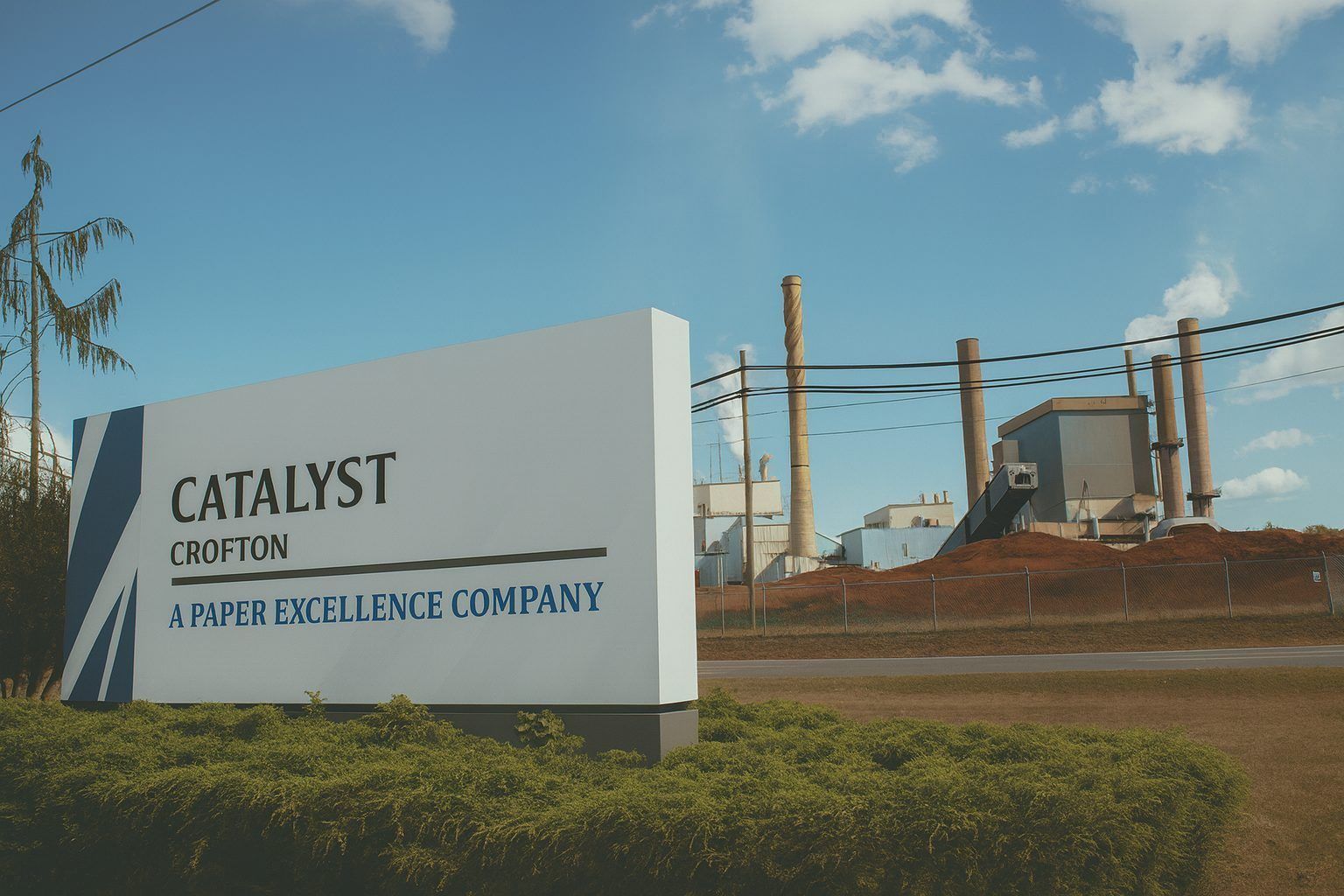
Domtar will permanently close its pulp mill in Crofton, on Vancouver Island, by mid‑December, eliminating about 350 jobs and deepening a crisis in British Columbia’s forest sector. The shutdown has triggered an emotional political fight over who is to blame, even as Premier David Eby rules out tapping old‑growth forests to keep the mill alive.
A 70‑year‑old mill reaches the end of the line
The Crofton mill has been a mainstay of the Cowichan Valley economy since the mid‑1950s, when British Columbia Forest Products opened it as a kraft pulp operation before adding newsprint capacity in the 1960s. Over the decades it expanded into a large integrated pulp and paper complex employing hundreds of workers and becoming one of North Cowichan’s largest taxpayers.
In a press release on December 2, Domtar announced it will permanently close operations at the Crofton facility, cutting roughly 380,000 tonnes a year of northern bleached softwood kraft (NBSK) pulp capacity from its portfolio and directly affecting about 350 employees. The company cited “continued poor pricing for pulp” and a lack of access to affordable fibre in B.C. as the central reasons for shutting the plant. Domtar Media+1
The mill is expected to cease production around December 15, 2025, though some workers will remain on site into early 2026 to manage decommissioning and transition work, according to regional media and industry summaries.
Crofton’s newsprint and paper lines had already been curtailed in 2024, when Paper Excellence — now rebranded under the Domtar name — halted paper production and laid off about 75 workers. Pulp operations continued until this latest decision, meaning the December closure effectively shutters the entire site.
“Devastating” news for workers and North Cowichan
For the small community of Crofton and the broader municipality of North Cowichan, the closure lands like an economic body‑blow. North Cowichan Mayor Rob Douglas called the announcement “devastating” and stressed that the mill has supported generations of local families, including his own. The municipality estimates the site has contributed roughly $5 million a year in taxes and utilities to local coffers. Global News+2Municipality of North Cowichan+2
Beyond the 350 direct mill jobs, the Truck Loggers Association (TLA) warns that local contractors, truckers and service businesses tied to the Crofton operation will be “hard hit,” describing the closure as a “major and far‑reaching loss” across the coastal forest supply chain. Truck Loggers Association+1
Industry and political opponents say the paycheques being erased are some of the best in the region. Internal estimates circulated by critics peg the average annual compensation for Crofton workers at around $100,000, meaning tens of millions of dollars in wages will disappear from the local economy each year.
Mayor Douglas says the municipality can absorb the immediate shock in its 2026 budget, but warns that future years will be more difficult once Crofton’s tax contributions disappear. The mill has long underpinned funding for core services and infrastructure in North Cowichan.
Why Domtar says it is shutting Crofton now
Domtar’s explanation for the closure closely tracks broader pressures on B.C.’s forest industry:
- Weak global pulp markets – Prices for softwood kraft pulp have struggled, compressing margins for high‑cost producers.
- Costly and constrained fibre supply – The company points to “lack of access to affordable fibre” in coastal B.C., as timber harvests have fallen and competition for residual chips has intensified. Domtar Media+2CityNews Halifax+2
- Regulatory and cost headwinds – Industry groups argue that B.C. has become one of the highest‑cost jurisdictions in North America due to complex permitting, conservation measures and rising operating costs.
- Trade disputes and tariffs – Both provincial and federal politicians point to U.S. duties on Canadian forest products as an added strain in an already weak market.
B.C. Forests Minister Ravi Parmar has described the Crofton announcement as “gut‑wrenching for workers”, saying that forestry communities are being hit by a combination of low pulp and lumber prices, shrinking timber supply, climate‑driven wildfires, conservation measures and American trade barriers. Global News+2CityNews Halifax+2
At the same time, Domtar insists it remains “committed to its remaining mills in B.C.” and says it will continue managing the Crofton site in compliance with environmental permits while it explores “a variety of possibilities” for the property’s future. Domtar Media+1
Eby rules out old‑growth logging to save the mill
The closure has immediately collided with one of the most contentious issues in B.C. politics: old‑growth logging.
Speaking in Victoria on December 3, Premier David Eby said his government is “looking for ways to help” Crofton workers and the community, but made it clear that cutting more old‑growth forest to feed the mill is off the table. CityNews Vancouver+2lethbridgeherald.com+2
Eby acknowledged that restrictions on harvesting ancient forests have contributed to higher fibre costs and reduced availability on Vancouver Island. But he framed those protections as a “necessary decision” to address biodiversity loss and climate concerns, arguing that sending old‑growth logs to the chipper would be, at best, a short‑term fix. CityNews Vancouver+1
Instead, the premier outlined a set of measures aimed at supporting workers and seeking new uses for the site:
- A team from the Ministry of Jobs is being dispatched to Crofton to map retraining options and alternative employment opportunities in and around the community of roughly 1,500 people.
- Eby is meeting with union leaders representing Domtar workers, as well as local mayors, to explore whether some jobs can be preserved through repurposing or partial re‑use of the mill site.
- The province is reviewing how previous funding commitments — including a joint federal‑provincial package worth about $18.8 million in 2023 to support a packaging conversion at Crofton — might be redirected or adapted now that the original project did not proceed.
Eby summed up the government’s position by saying B.C. is looking for “long‑term, sustainable solutions,” not a short extension of the mill’s life that would leave workers facing the same crisis again in a few years. CityNews Vancouver+1
Opposition and industry: “preventable” closure, policy failure
The Crofton announcement has quickly become a flashpoint in a much larger debate over B.C.’s forestry strategy.
Provincial opposition
In the legislature, B.C. Conservative MLA Ward Starmer labelled the closure a “five‑alarm dumpster fire”, accusing the NDP government of presiding over four mill closures in four weeks and failing to cut red tape, accelerate permits or ensure affordable fibre supplies. lethbridgeherald.com+2CityNews Halifax+2
Conservatives at the provincial level are calling for Minister Parmar’s resignation, arguing that government decisions on land use, old‑growth deferrals and permitting delays have helped trigger what they describe as a collapse of the coastal forest sector.
Federal Conservatives
Federally, three Conservative MPs representing Vancouver Island and the Interior issued a joint statement calling the Crofton mill “the lifeblood” of the community and estimating that the operation generated nearly $1 billion in regional economic impact over time. They argue that Ottawa’s failure to negotiate a new softwood lumber agreement with the United States — and the resulting escalation of tariffs — has deepened the financial problems facing B.C. mills. conservative.ca+2CityNews Halifax+2
Their statement links the Crofton shutdown to a string of recent closures and layoffs at sawmills in Chemainus and 100 Mile House, warning of mounting job losses across the province’s forestry towns.
Industry groups
Industry organizations are also using the Crofton news to demand faster policy change.
The BC Council of Forest Industries says Crofton is “further evidence” that the sector needs an urgent response from the province, highlighting two core priorities: more predictable, economically viable wood supply and a more efficient, competitive regulatory environment. The group wants quicker approvals for cutting permits and road building, lower operating costs, and stronger support for First Nations to co‑develop land‑use plans and process referrals. Global News+1
The Truck Loggers Association goes further, calling the closure “especially difficult” because, in its view, it was preventable. The TLA says labour, municipalities and contractors have spent months warning the province that more mills could shut down without concrete action, and argues that ongoing constraints on fibre access, an uncompetitive cost structure and regulatory uncertainty are putting contractors and their communities at risk. Truck Loggers Association+1
Part of a wider wave of B.C. mill closures
Crofton’s shutdown is the latest in a series of mill closures reshaping B.C.’s forest industry:
- West Fraser’s 100 Mile House mill is scheduled to close permanently by the end of 2025, cutting about 165 jobs as the company says it can no longer secure enough economically viable timber in the region.
- Powell River’s Catalyst Paper tiskʷat mill, once one of the largest pulp and paper mills in the world, was permanently curtailed in 2023 after years of intermittent shutdowns under Paper Excellence. The site is now the focus of community‑led redevelopment efforts.
- Earlier closures, such as the Elk Falls mill in Campbell River and other coastal facilities, already signalled a long‑term decline in traditional pulp and newsprint production in the province.
Analysts and commentators say these closures reflect a combination of factors: lower demand for some paper products, decades of overharvesting that reduced available timber, insect infestations and wildfires that damaged forests, plus policy choices aimed at protecting ecosystems and meeting climate goals. Crofton’s fate, in this reading, is tied to both global trends and uniquely B.C. decisions.
What happens next for Crofton’s workers and the mill site?
In the short term, Domtar says its priority is the “safety and well‑being” of employees as operations wind down. The company has indicated that some staff will stay on into early 2026 to handle mothballing and site management, and it is exploring options for the property, though no concrete proposals have been announced. Domtar Media+2Tree Frog creative+2
The B.C. government, meanwhile, is activating its standard “community transition” toolkit:
- Rapid response teams to coordinate retraining, employment insurance information and mental‑health supports.
- Engagement with local First Nations, municipal leaders and the union representing mill workers to look for new industrial or clean‑economy investments that could reuse existing infrastructure at the Crofton site.
- A broader review of how future fibre supplies, including second‑growth forests and manufactured wood products, can support jobs without reversing old‑growth protections.
For workers, the transition will be difficult. Many have built careers at the mill and have mortgages and families rooted in the Cowichan Valley. Local leaders are pressing both Victoria and Ottawa to ensure retraining grants, income supports and incentives for new investment are on the table quickly, not months or years from now.
The big question: can B.C. protect old growth and save mill towns?
The Crofton closure crystallizes a dilemma at the heart of B.C.’s forest policy:
- Conservationists argue that protecting remaining old‑growth ecosystems is an ecological necessity and that the industry must pivot to value‑added products, second‑growth harvesting and forest restoration.
- Industry and many rural communities counter that policy changes have moved faster than replacement opportunities, leaving mill towns to absorb layoffs while new investments and land‑use plans lag behind.
By refusing to open more old‑growth logging to feed Crofton, Premier Eby is staking out a position that climate and biodiversity commitments are non‑negotiable, even in the face of painful job losses. His government is betting that long‑term stability will come from transforming the sector rather than clinging to older business models.