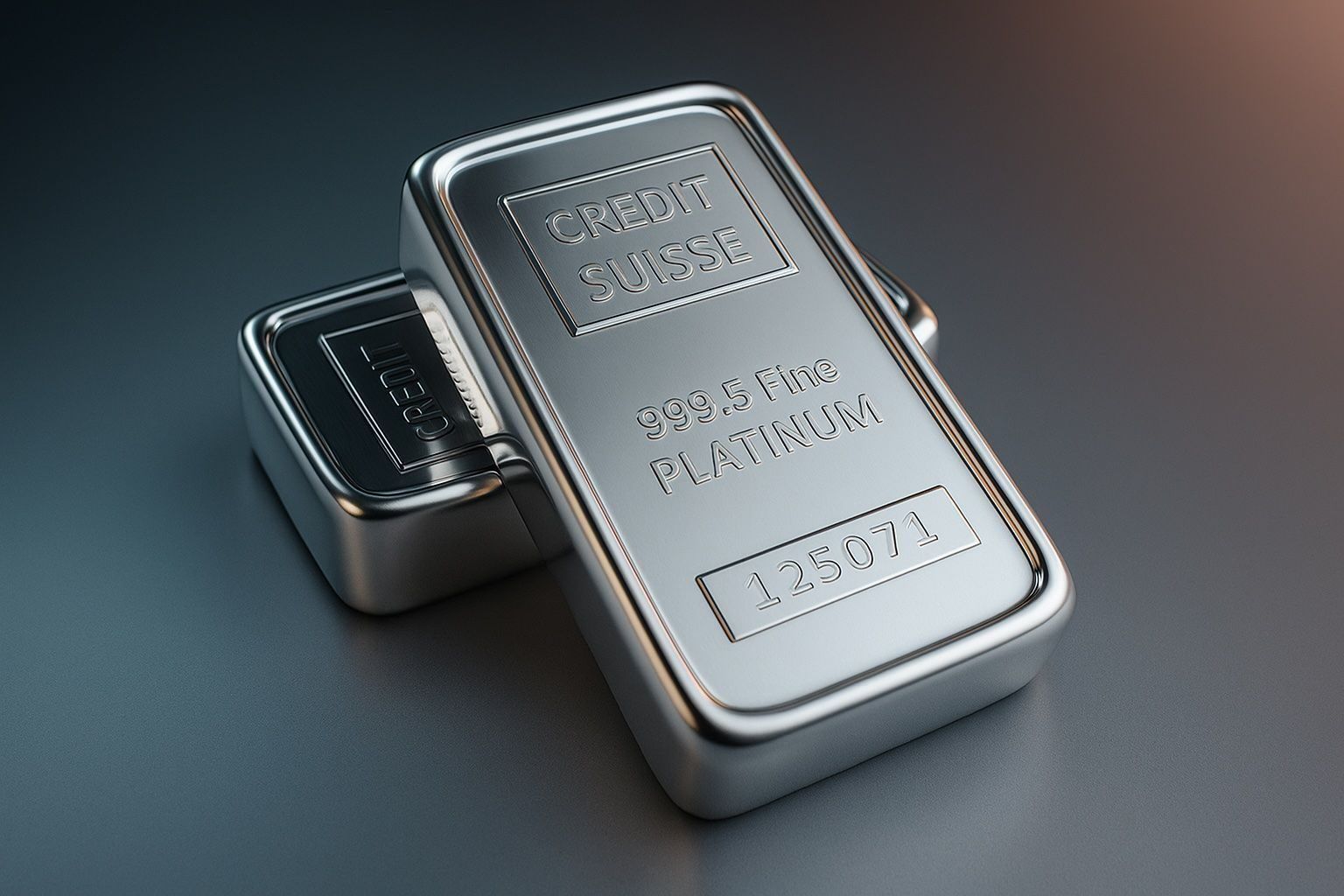

Spot platinum is trading around $1,650–$1,660 per troy ounce on Thursday, December 4, 2025, easing from recent highs as investors take profits ahead of a pivotal US Federal Reserve meeting. Live quotes from major bullion dealers show platinum near $1,656–$1,660/oz, roughly 1.7–2.1% lower than Wednesday’s levels.
Despite today’s pullback, platinum remains one of 2025’s standout performers. Data from commodities platforms suggest the metal is up around 70–75% year‑on‑year, after an explosive rally between April and October.
The softer tone in platinum fits a broader pause across precious metals. Gold is down about 0.5% to roughly $4,180/oztoday, while silver has slipped more than 2%, as traders lock in gains and reposition before next week’s Fed decision—pressure that has spilled over into platinum and palladium as well.
Platinum price today: key levels on 4 December 2025
While quotes vary slightly by venue and time of day, today’s platinum market can be summarized as follows:
- Spot platinum price per ounce: about $1,655–$1,660
- Price per gram: roughly $53.3–$53.4
- Price per kilogram: just above $53,000 APMEX+1
- Front‑month NYMEX platinum futures: around $1,656.5 for the December 2025 contract.
Closing data from earlier this week show platinum at $1,664.90/oz on December 1 and $1,636.50/oz on December 2, putting today’s trading in the middle of the recent $1,630–$1,670 band.
A separate snapshot from a London‑focused market note this morning put platinum at $1,641/oz, down from $1,653/oz in the prior session, underlining the modest but broad‑based consolidation in prices.
Meanwhile, TradingEconomics’ reference series shows platinum at $1,634.90/oz for December 4, down 2.11% on the day, but still up more than 70% over the past year.
Bottom line: even after today’s pullback, platinum is holding close to the upper end of its 2025 range and well above levels seen at the start of the year.
Why is platinum down today?
1. Profit‑taking after a huge rally
Between early April and mid‑October 2025, platinum and sister metal palladium soared by around 90%, outpacing even record‑breaking gains in gold and silver.
A Reuters survey in late October noted that spot platinum was up roughly 76% year‑to‑date, while palladium had risen about 56%, as investors rotated out of gold into the more thinly traded platinum‑group metals (PGMs) amid tight mine supply and tariff uncertainty.
After such a steep move, some cooling is natural. Recent articles from The Economic Times and other outlets have highlighted bouts of sharp profit‑taking across gold, silver, platinum and palladium, often triggered by short‑term dollar strength or shifting rate expectations.
Today’s soft tone looks like a continuation of that pattern: traders are banking profits from one of 2025’s strongest trades while they wait for fresh macro signals.
2. Fed uncertainty and the US dollar
Gold‑market coverage from Reuters today notes that investors have turned cautious ahead of the upcoming Fed meeting, with markets pricing in around an 89% chance of a 25‑basis‑point rate cut according to the CME FedWatch tool.
Lower rates are usually supportive for non‑yielding assets like platinum, but in the short term, a crowded “Fed cut” trade can see investors trim positions across all metals in response to:
- Position squaring before a major event
- Fluctuations in the US dollar, which directly affect dollar‑denominated metal prices
- Shifts in broader risk appetite and equity markets
Today, gold’s 0.5% slide and a drop of 2% in silver suggest macro‑driven selling in precious metals broadly, with platinum and palladium following suit.
3. Short‑term sentiment versus long‑term fundamentals
CME Group analysis points out that this year’s platinum rally has been driven by a mix of macro demand for “hard” assets—as investors seek assets central banks cannot print—and the perception that platinum had grown deeply undervalued relative to gold and silver after years of underperformance. CME Group
In other words, the long‑term story remains bullish, but after a 70%+ rise in less than a year, even small shifts in sentiment can produce outsized day‑to‑day moves, like today’s 2% dip.
2025 in review: from laggard to leader
For much of the last decade, platinum lagged both gold and palladium as diesel engines fell out of favor and automakers shifted to gasoline and then electric vehicles.
That changed dramatically in 2025:
- The World Platinum Investment Council (WPIC) estimates that the platinum market posted large deficits in 2023 and 2024, and is on track for yet another substantial shortfall in 2025, driven by strong investment demand and constrained mine supply.
- One November update summarised by newswires suggested the market could end 2025 with a deficit of around 692,000 ounces, before shifting toward a more balanced picture in 2026.
- A detailed Investing News Network review, drawing heavily on WPIC data, projects total platinum demand for 2025 at roughly 7.9 million ounces, versus supply closer to 7.0 million ounces, implying a deficit on the order of hundreds of thousands of ounces for a third straight year.
On the supply side, WPIC and INN both flag South Africa—which accounts for about two‑thirds of mined platinum—as a key bottleneck, citing power shortages, transport disruptions and muted investment in new capacity.
Demand has also stayed more resilient than many expected:
- Automotive demand is projected at around 3.0 million ounces in 2025. Automakers have gradually substituted platinum for more expensive palladium in gasoline catalytic converters, partially offsetting the drag from electric vehicle adoption.
- Jewellery demand is forecast to rise by double digits this year, led by strong growth in China, where platinum remains significantly cheaper than gold.
- Industrial uses—from glass to chemicals and electronics—have softened cyclically but remain a major pillar of demand.
- Emerging hydrogen technologies, including fuel‑cell vehicles and electrolyzers, still represent less than 1% of total platinum usage but are expected to grow nearly 20% in 2025 and could become a major demand driver by 2030–2040.
These overlapping forces have transformed platinum from a chronic underperformer into one of 2025’s strongest commodities, setting the stage for today’s debates about how much further the rally can run.
Fresh platinum forecasts released on 4 December 2025
Today brought a notable new piece of research: Deutsche Bank’s latest “Commodities Precious Special” report, which turned decisively more bullish on the entire precious‑metals complex.
Deutsche Bank: platinum seen at $1,735 in 2026
In an analysis published on December 4, Deutsche Bank:
- Raised its 2026 gold forecast to $4,450/oz,
- Projected silver at $55.10/oz, and
- Forecast platinum at $1,735/oz, citing what it calls a “persistent structural deficit” in the metal. The Financial Express
The bank expects the platinum market to remain undersupplied by roughly 13% of total supply in 2026, pointing to:
- Continued vulnerability of South African mine output,
- Limited flexibility in Russian supply,
- High lease rates that signal tight physical availability, and
- Policy changes in China—such as VAT reforms on platinum bars—that could channel more trading into formal markets and support bar‑and‑coin demand.
At today’s spot price near $1,650/oz, Deutsche Bank’s 2026 forecast implies modest additional upside rather than a completely new leg higher, but it reinforces the idea that current levels are not seen as unsustainably high by some large institutions.
Reuters poll: consensus closer to $1,550
By contrast, an October Reuters poll of around 30 analysts and traders found a median 2026 platinum forecast of $1,550/oz, up sharply from $1,272 in a previous survey and above an expected 2025 average of about $1,249.50.
That makes Deutsche Bank’s $1,735 call one of the more bullish numbers on the Street and underscores how much sentiment has shifted after this year’s rally.
WPIC: multi‑year deficits still the base case
In its longer‑term “2‑ to 5‑year view,” WPIC argues that the platinum market is likely to remain structurally undersupplied through at least 2029, with annual deficits averaging between roughly 620,000 and 730,000 ounces, or 8–9% of demand across the forecast period. Platinum Investment+1
A more recent update in June and September 2025 reiterated that even after this year’s price surge—WPIC estimated platinum prices were up over 50% year‑to‑date at one point—there is little sign of meaningful price‑driven demand destruction or a supply surge capable of closing the gap.
Other analyst views
Outside of large banks and industry bodies, smaller research shops and independent analysts generally expect elevated but volatile platinum prices through the end of 2025 and into 2026. One widely circulated market note this week suggested prices should “remain elevated through late 2025”, with moderate further upside as South African supply challenges and hydrogen‑related demand growth persist. LinkedIn
Collectively, current forecasts cluster in a $1,500–$1,750/oz range for 2026, though all emphasize that outcomes will depend heavily on macro conditions, EV adoption, and any new trade policies around critical minerals.
Macro backdrop: rates, tariffs and the energy transition
Several structural themes are likely to matter as much as day‑to‑day price action:
- Monetary policy – Precious metals have surged in 2025 against a backdrop of persistent inflation, large fiscal deficits and aggressive central‑bank easing. CME’s analysis links this environment directly to renewed investor interest in platinum and palladium as “hard” assets. CME Group
- Tariff and trade risks – Reuters notes that uncertainty over potential US tariffs on critical‑mineral imports, including PGMs, has been a key driver of this year’s rally, prompting inventory building and speculative positioning.
- Automotive transition – Electric vehicles now account for more than 20% of global new car sales, according to data cited by INN, reducing long‑term demand for exhaust‑treatment catalysts. But slower‑than‑expected EV adoption, plus substitution of platinum for palladium in gasoline engines, has made auto demand “resilient” in the short term. Investing News Network (INN)
- Hydrogen economy – WPIC sees platinum demand from hydrogen technologies growing quickly from a low base and potentially becoming the largest single demand segment by 2040, adding a structural layer to the long‑term story.
These factors help explain why, even when spot prices are weak on a given day, banks and industry bodies remain comfortable calling for tight markets and relatively high average prices over the next several years.
What today’s price means for investors
Compared with other metals:
- Gold is trading near $4,180/oz today.
- Silver is around $57/oz, after setting record highs above $58 earlier this week.
- Palladium is hovering in the $1,440–$1,470/oz area, according to recent market reports.
That leaves platinum still at a deep discount to gold—gold costs more than twice as much per ounce—and trading slightly above palladium, a reversal of the early‑2020s pattern when palladium commanded a huge premium.
Long‑run historical data show platinum’s all‑time high around $2,276/oz and an all‑time low near $330/oz, underlining how cyclical and volatile this market can be.
Equity markets are also reflecting the improved tone: Platinum Group Metals (TSE: PTM), a PGM‑focused miner, climbed above its 200‑day moving average today—often seen as a sign of a positive shift in medium‑term momentum.
For investors, today’s dip means:
- Short‑term traders may see two‑way volatility around Fed headlines and US data.
- Longer‑term investors who buy the structural deficit story are watching pullbacks like today’s for potential entry points, while remaining mindful that this is a small, thinly traded market where prices can reverse quickly.
As always, anyone considering platinum exposure should treat this as informational, not as a recommendation, and should check real‑time prices and consult a qualified adviser before making investment decisions.
Platinum price FAQs – December 4, 2025
Will platinum go up in 2026?
No one knows for sure, but current forecasts lean modestly bullish:
- A Reuters survey puts the median 2026 platinum forecast at $1,550/oz, up from an expected 2025 average of about $1,249.50.
- Deutsche Bank is more optimistic, projecting $1,735/oz in 2026 on the back of a structural deficit of roughly 13% of supply.
- WPIC expects multi‑year deficits averaging roughly 8–9% of demand through 2029, which, all else equal, would tend to support relatively high prices.
However, forecasts could be derailed by a deeper economic downturn, faster EV adoption, policy changes or a stronger‑than‑expected dollar.
Why is platinum cheaper than gold but so volatile?
Platinum’s market is far smaller and more industrial‑heavy than gold’s:
- A big portion of demand comes from the auto, industrial and jewellery sectors, with investment demand a smaller but fast‑growing slice.
- Supply is geographically concentrated, with South Africa and Russia dominating mine output, making platinum sensitive to local disruptions.
That mix makes platinum:
- Less of a pure monetary safe‑haven than gold
- More sensitive to business cycles, energy markets and regional politics
- Prone to sharper swings when investors crowd into or out of the market
What moves platinum prices day‑to‑day?
Key short‑term drivers include:
- US interest‑rate expectations and the dollar – lower real yields tend to support platinum, while a stronger dollar usually weighs on it.
- Risk sentiment – during bouts of market stress, investors can either flock to or flee from precious metals depending on the narrative.
- Auto‑sector data – changes in car production, especially for diesel and hybrid vehicles, directly affect catalyst demand.
- News on mine supply, tariffs or sanctions – for example, speculation about US tariffs on Russian PGMs or disruptions in South African operations.
How can investors get exposure to platinum?
According to investing guides and market overviews, the main routes are: Investing News Network (INN)+1
- Physical bullion – coins and bars from bullion dealers (requires secure storage and insurance).
- Exchange‑traded funds (ETFs) that hold physical platinum.
- Mining and PGM producer stocks, which can be more volatile than the metal itself.
- Futures and options on exchanges such as NYMEX—typically used by experienced traders due to leverage and complexity.
Each vehicle has distinct risk, cost and liquidity characteristics, so investors usually choose based on their time horizon, risk tolerance and access to markets.
Related articles: NASDAQ:CME