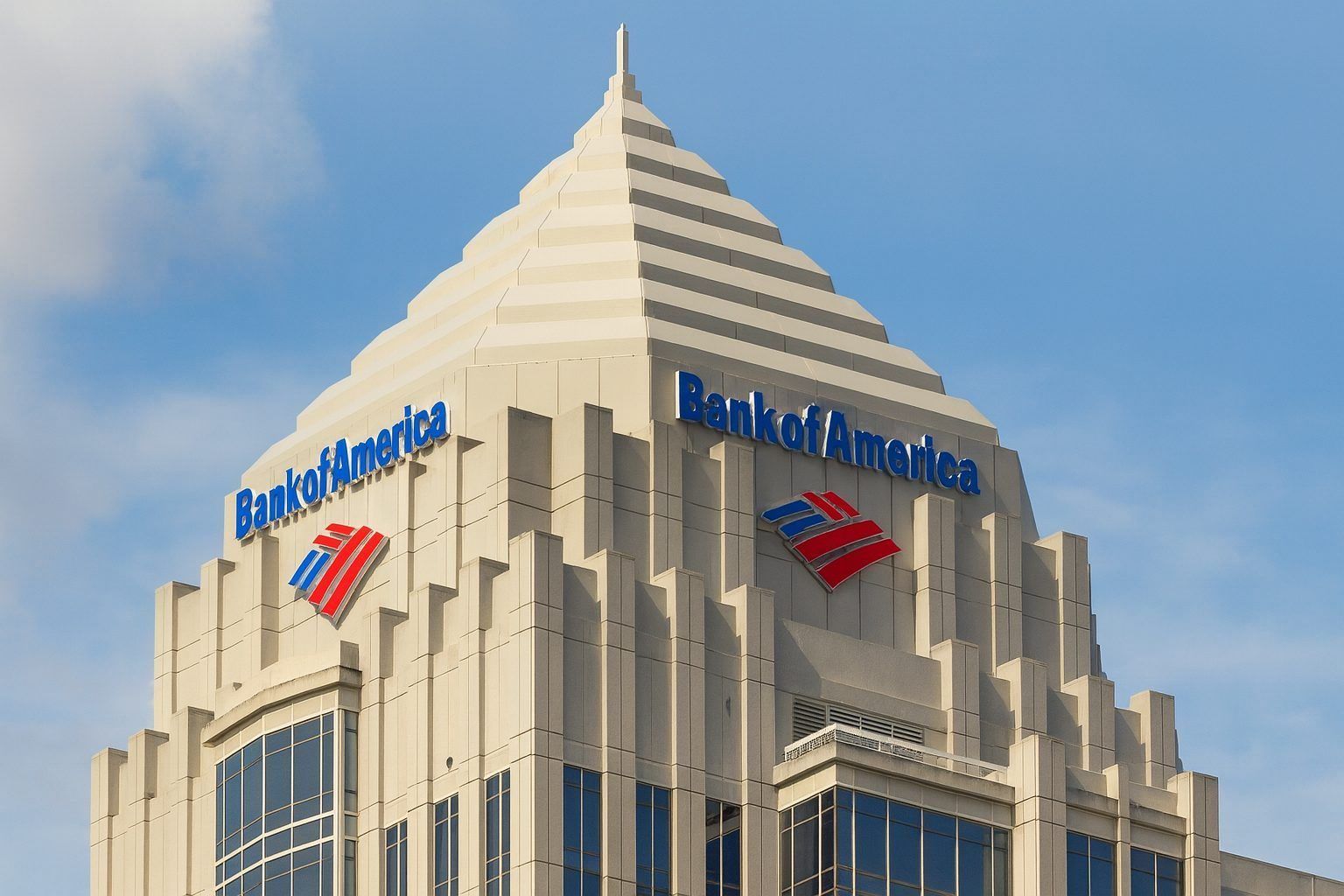
Bank of America Corporation NYSE:BAC is trading just below fresh 52‑week highs on Thursday as investors react to a new crypto strategy for wealth clients, a FIFA World Cup 2026™ credit‑card promotion, and a still‑bullish 2026 macro outlook from the bank’s own research team.
BAC share price and valuation on 4 December 2025
As of late‑morning U.S. trading on December 4, 2025, Bank of America shares are changing hands around $54.5–$54.6, up roughly 1% on the day and very close to the 12‑month high near $54.69.
Key snapshot metrics:
- Market capitalization: about $395–$400 billion.
- 52‑week range: roughly $33 to $55, placing the current price at the very top of the range.
- Valuation:
- Trailing P/E ~14.9 and forward P/E ~12.8.
- Price‑to‑book ~1.4 and price‑to‑tangible‑book just under 2x.
- Dividend: annualized $1.12 per share (quarterly $0.28), for a yield around 2.0–2.1% at current prices and a payout ratio under 30%.
- Performance: the stock is up mid‑teens over the last 12 months and close to 20% year‑to‑date, outpacing many peers and the broader market.
From a fundamentals standpoint, trailing 12‑month revenue is about $101 billion, with net income around $28 billion, implying robust profit margins near 29% and EPS of roughly $3.66.
Today’s biggest Bank of America headlines
1. Crypto enters the house view for wealth clients
The headline strategic move today is Bank of America’s decision to formally add crypto exposure to its managed‑portfolio toolkit for certain wealth clients starting in early 2026.
According to Zacks coverage (via TradingView/Finviz):
- Beginning January 2026, advisers at Merrill, Bank of America Private Bank and Merrill Edge will be able to recommend a 1–4% digital‑asset allocation for suitable clients.
- Implementation will focus on regulated spot Bitcoin ETFs rather than direct coin custody, including funds from Bitwise, Fidelity, Grayscale and BlackRock.
- The bank’s chief investment officer for the Private Bank, Chris Hyzy, frames crypto as a small, high‑volatility “satellite” allocation, not a core holding.
From a stock perspective, this is less about immediate profit and more about staying competitive in high‑net‑worth wealth management. Peers like Morgan Stanley and BlackRock already offer similar ETF access; Bank of America’s move:
- Aligns it with the emerging industry consensus on modest crypto allocations.
- Potentially makes BAC more attractive to younger, digitally focused clients who want crypto exposure in a traditional, advisor‑led wrapper.
Zacks also notes that consensus estimates for Bank of America’s EPS in 2025 and 2026 have been revised higher over the past month, to around $3.80 and $4.35 respectively, implying double‑digit earnings growth and supporting a Zacks Rank #2 (Buy).
2. FIFA World Cup 2026™ custom card design and ticket offer
On Thursday morning, Bank of America and Visa announced an exclusive FIFA World Cup 2026™‑branded credit‑card offer for new Cash Rewards customers:
- New applicants for Customized Cash Rewards and Unlimited Cash Rewards Visa cards can select one of two limited‑edition FIFA World Cup 2026™ designs, available from December 4, 2025 through July 2026.
- Customers who open a qualifying card between Dec. 4, 2025 and Jan. 5, 2026, and activate by Feb. 5, 2026, will receive a unique link to purchase up to two World Cup tickets during a special window in February 2026 (while supplies last).
- The promotion includes enhanced first‑year cash‑back bonuses and a $200 welcome bonus after a targeted spend threshold in the first 90 days.
Financially, this is a customer‑acquisition campaign rather than a needle‑moving profit driver by itself, but it has several implications for investors:
- It reinforces BAC’s global sports marketing push (including recent deals around endurance events and partnerships with high‑profile ambassadors).
- It demonstrates the bank’s willingness to trade short‑term promotional costs for deeper engagement in high‑spend categories like travel and entertainment.
- It could support card fee income and consumer spend into 2026 if uptake is strong.
3. Institutional investors add to Bank of America
A new MarketBeat report published December 4 highlights that Philadelphia Trust Co. increased its BAC position by 5.4% in Q2, bringing its holdings to about 189,800 shares worth nearly $9 million at the time of the filing.
The same report notes:
- Roughly 70–71% of BAC’s float is now owned by institutional investors and hedge funds.
- Several other managers, including CW Advisors, River Wealth Advisors and Beacon Pointe Advisors, have also been incremental net buyers of the stock.
While these are backward‑looking 13F data points, they confirm that BAC remains a core holding in institutional portfolios, not a niche or speculative name.
Earnings backdrop: one of BAC’s strongest quarters in years
The current share price is supported by an unusually strong earnings run.
In Q3 2025, Bank of America:
- Reported net income of $8.5 billion, up from $6.9 billion a year earlier.
- Delivered EPS of $1.06, beating Street estimates around $0.95.
- Posted record net interest income (NII) of roughly $15.2 billion, up about 9% year‑on‑year.
- Saw investment‑banking fees jump about 43% to $2 billion as global M&A and capital‑markets activity recovered.
- Guided Q4 NII to $15.6–$15.7 billion, roughly 8% above the prior‑year quarter, and reiterated expectations for record NII in full‑year 2025.
Reuters describes the quarter as a “well‑rounded beat,” with improved credit‑loss provisioning and strong consumer and commercial trends. Reuters
Looking at the last 12 months overall, StockAnalysis data show:
- Revenue: ~$101.5B
- Net income: ~$28.3B
- Operating margin: ~32%
- Return on equity: ~9.9%
These numbers are broadly consistent with a large, diversified, high‑quality franchise earning mid‑to‑high single‑digit returns on common equity, with room to improve if management hits newer targets.
Investor Day 2025: higher return targets and AI‑driven growth
At its first full Investor Day since 2011 on November 5, Bank of America laid out more ambitious medium‑term goals:
- ROTCE (return on tangible common equity): new target 16–18%, up from a vague “mid‑teens” previously and edging closer to JPMorgan’s 20%+ levels.
- Net interest income: management now expects 5–7% annual NII growth over the next five years, assuming modest rate cuts and steady loan growth.
- Investment banking & trading: plans to boost IB fee share by 50–100 basis points and lift trading market share from around 7.6% to 9% over 3–5 years.
- Wealth unit: targeting 4–5% net new asset growth in the medium term.
A key enabling pillar is heavy technology and AI spending:
- Bank of America spends roughly $13 billion per year on technology, and about $4 billion of that is earmarked for “new technology initiatives” in 2025, with AI at the center. Reuters+1
- According to Reuters, AI tools now allow some relationship bankers to manage up to 50 clients vs about 15 previously, by automating research and prep work.
- The bank’s digital assistant Erica has handled roughly 3 billion interactions, performing tasks equivalent to about 11,000 employees, while its 18,000 developers report major productivity gains from AI agents.
For BAC shareholders, the takeaway is that management is explicitly tying technology spending to higher revenue and lower unit costs. If those ROTCE and NII targets are met, today’s mid‑teens earnings multiple could prove conservative; if execution or the macro environment disappoint, the bar may now be harder to clear.
Capital strength, dividends and stress‑test results
On the capital and risk side, Bank of America’s balance sheet and regulatory metrics remain a support for the stock:
- The board approved an 8% dividend increase to $0.28 per share quarterly following the 2025 stress‑test cycle.
- The stock has now delivered 11 consecutive years of dividend growth, with a payout ratio under 30% and a shareholder yield (dividends plus buybacks) around 4–4.5%.
The Federal Reserve’s 2025 Dodd‑Frank stress test shows that under a severely adverse scenario, Bank of America’s minimum projected common equity Tier 1 (CET1) ratio would fall from 11.9% to about 10.2%, still well above regulatory minimums.
Bank of America’s own communications around the test indicate:
- Modeled capital depletion improved by roughly 100 basis points versus the prior year.
- Its Stress Capital Buffer (SCB) is set at 2.5%, implying a CET1 requirement of about 10%; proposed rules could nudge this a bit higher for 2026.
Together, these data points suggest ample capital to support dividends and share repurchases, though regulators are keeping the largest U.S. banks under tight scrutiny.
Macro and rate outlook: BofA’s own forecast for 2026
On December 2, BofA Global Research published its 2026 outlook, which has big implications for rate‑sensitive banks like BAC.
Key elements:
- U.S. GDP growth: forecast around 2.4% (4Q‑to‑4Q) in 2026, modestly above consensus.
- China: GDP growth forecast 4.7% in 2026 and 4.5% in 2027.
- S&P 500: expected 14% EPS growth, but only 4–5% price appreciation, with a year‑end 2026 target of 7,100, implying some multiple compression.
- Rates: BofA’s economists expect the Fed to cut 25 bps in December 2025 and twice more in 2026 (June and July), with the 10‑year U.S. Treasury yield ending 2026 around 4–4.25%.
Separately, U.S. Bank’s commentary on the late‑October FOMC meeting notes that the Fed has already cut rates to a 3.75–4.0% range and signaled additional easing is likely over the coming year.
For Bank of America, this backdrop is close to a “Goldilocks” outcome:
- Loan demand could benefit from lower rates and steady growth.
- Net interest margins might compress gradually rather than sharply, making the 5–7% NII growth target plausible.
- Modest single‑digit index returns and higher volatility could be constructive for trading, hedging and wealth‑management activity.
The risk, of course, is that the Fed cuts faster or further than expected if growth weakens, which would pressure margins more than BAC’s base case assumes.
Analyst ratings and Bank of America stock forecasts
Wall Street remains moderately bullish on BAC, but with more limited upside than in prior years.
Street consensus
- MarketBeat tallies 23 Buy and 5 Hold ratings, for an overall “Moderate Buy” consensus with an average 12‑month price target around $57–58, implying mid‑single to high‑single‑digit upside from current levels. MarketBeat+1
- StockAnalysis reports an average target near $55.9 from 18 analysts, only about 2–3% above today’s price, and also classifies the stock as a “Buy.” StockAnalysis
- Zacks assigns BAC a Rank #2 (Buy), supported by rising earnings estimates and strong price momentum.
Independent forecast and valuation work
Third‑party platforms highlight a range of fair‑value outcomes:
- 24/7 Wall St. combines Wall Street targets with its own models and notes that while consensus implies high single‑digit to low‑teens upside over 12 months, more conservative scenarios could see a pullback if valuation multiples compress, even though their longer‑term (2030) projections still place the stock meaningfully above today’s price.
- Simply Wall St finds BAC trading at about 13.7x earnings versus a U.S. banks average near 11.5x and suggests a “fair” multiple closer to 16x, implying modest undervaluation on P/E metrics. Their community narratives show bull‑case fair value around the high‑$50s and bear‑case fair value in the low‑$40s, underscoring that reasonable investors can disagree about upside/downside from here. Simply Wall St
Technical services such as StockInvest and ChartMill still flag BAC as being in a strong uptrend, trading above rising 50‑, 100‑ and 200‑day moving averages and sitting just below resistance in the mid‑$54s—conditions often associated with potential breakouts, though never guaranteed.
Overall, the consensus narrative is that Bank of America has moved from a “deep value” recovery story to a quality compounder at a fair price, with moderate near‑term upside and a lot riding on execution and the interest‑rate path.
Key upside drivers for BAC into 2026
Putting the pieces together, the positive drivers for Bank of America stock going into 2026 include:
- Earnings momentum and NII tailwind
- Double‑digit EPS and revenue growth, record net interest income, and positive operating leverage coming out of 2025.
- Management’s target of 5–7% annual NII growth over several years if the rate path cooperates.
- Higher return targets and cost discipline
- The new 16–18% ROTCE goal and wealth‑unit asset‑growth target signal management’s intent to close the gap with top‑tier peers.
- Tech and AI investment at scale
- Billions earmarked for AI and digital platforms, with concrete productivity gains already visible in banker coverage and developer workflows.
- Wealth, payments and card growth
- New initiatives such as the crypto allocation framework and FIFA World Cup 2026™ card promotion deepen client engagement and expand fee‑based revenue pools.
- Solid capital and dividends
- A comfortably above‑minimum CET1 position, improving stress‑test outcomes and an 11‑year dividend‑growth streak with room for future raises.
Main risks investors are watching
Counterbalancing the upside, several material risks and uncertainties could impact the BAC story:
- Interest‑rate path and NII pressure
If the Fed cuts faster or deeper than BofA’s base case of one cut this year and two next year, net interest margins could compress more than management anticipates, making the NII growth targets harder to achieve. - Credit cycle and macro shocks
The central forecast calls for steady growth and manageable credit losses, but a sharper slowdown, renewed inflation, or geopolitical events could quickly change that picture, leading to higher provisions and weaker loan growth. - Regulation and capital requirements
As a global systemically important bank (G‑SIB), BAC faces higher capital buffers and evolving rules on stress capital. Higher requirements can limit buybacks and pressure returns. - Valuation and Buffett’s selling
- The stock now trades well above its 2023 lows and roughly in line with or at a slight premium to large‑bank peers on some metrics.
- Berkshire Hathaway has trimmed a substantial portion of its BAC stake since mid‑2024, reallocating capital into other opportunities. While Berkshire remains a major shareholder, the ongoing selling is a psychological overhang for some investors.
- Execution risk around AI and new products
Big bets on AI, digital platforms and crypto‑related offerings could either boost profitability or prove more expensive and slower‑paying than hoped, especially if regulators tighten rules on digital assets or AI usage in finance.
Bottom line: how Bank of America stock looks after today’s news
As of December 4, 2025, Bank of America stock sits near its 52‑week high with:
- Strong recent earnings, record net interest income and improving efficiency.
- Higher medium‑term return and growth targets, backed by heavy AI and technology investment.
- A solid capital position and growing dividend, appealing to income‑oriented investors who still want exposure to growth.
- New, high‑profile initiatives in crypto, cards and sports partnerships that deepen its franchise and fee‑based revenue mix.
Against that, the stock is no longer cheap, analyst targets imply only modest upside from here, and the outlook depends heavily on how the Fed navigates 2026 and whether management can deliver on ambitious ROTCE and growth commitments.
For investors following BAC, the setup after today’s headlines looks like this: a high‑quality, systemically important bank priced at what many see as a reasonable multiple, with moderate short‑term upside and a portfolio of long‑term growth initiatives—but also meaningful macro, regulatory and execution risks.
This article is for informational purposes only and does not constitute investment advice or a recommendation to buy or sell any security. Consider your own objectives, risk tolerance and time horizon, and consult a licensed financial professional before making investment decisions.