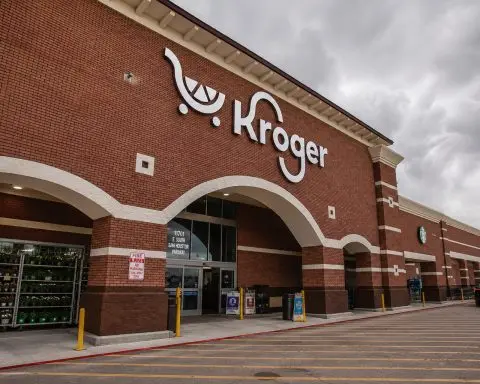

As of December 5, 2025, Kroger’s latest earnings, digital reset and analyst downgrades are reshaping the investment case for NYSE: KR.
Key Takeaways for Kroger (KR) Stock Today
- Q3 2025 headline loss, underlying profit: Kroger reported a net loss of $1.32 billion for Q3 2025, driven by a $2.6 billion impairment on its automated fulfillment network. On an adjusted basis, EPS came in at $1.05, slightly beating Wall Street estimates and up from $0.98 a year ago.
- Sales growth but revenue miss: Total Q3 sales rose to $33.9 billion from $33.6 billion, with identical sales ex-fuel up 2.6% and e‑commerce sales up 17%, but revenue fell short of analyst expectations around $34.2 billion.
- Digital strategy reset & Ocado payout: Kroger is closing three Ocado-powered robotic warehouses, cancelling a planned site in Charlotte, and shifting toward store-based fulfillment and third‑party delivery partners. Ocado will receive a one-off $350 million cash payment in January 2026; Kroger expects roughly $400 million in incremental e‑commerce operating profit in 2026 from the new hybrid model.
- Outlook tweaked, not torn up: Full‑year 2025 guidance nudged identical sales growth ex‑fuel to 2.8–3.0% (from 2.7–3.4%) and lifted the lower end of adjusted EPS guidance to $4.75–$4.80, while keeping operating profit and free‑cash‑flow targets intact.
- Stock under pressure but stabilizing: After a three‑day slide following earnings—Kroger fell about 4.6% on Thursday to close near $63.14—shares are trading around $63.26 today, in the lower half of their $57.69–$74.90 52‑week range.
- Analysts cut targets but still see upside: UBS, Evercore ISI, Wells Fargo and JPMorgan all trimmed KR price targets on December 5, yet most retain Buy or Neutral ratings. Street consensus now clusters around $73–$74, implying mid‑teens percentage upside from current levels.
Where Kroger Stock Stands on December 5, 2025
As of late trading on Friday, December 5, 2025, Kroger Co. NYSE:KR changes hands around $63.26 per share, up fractionally on the day after a sharp post‑earnings sell‑off.
According to MarketBeat’s snapshot, the stock’s 52‑week range runs from roughly $57.69 to $74.90, with a forward P/E near the mid‑teens and a dividend yield around 2.2%. MarketBeat That places Kroger firmly in the “steady value” camp: low‑growth, low‑margin, but with solid cash flow and shareholder returns.
TickerNerd estimates a market cap around $42 billion, with trailing‑twelve‑month revenue of about $147 billion, net margin ~1.9% and operating margin ~2.9%—typical of a mature grocery chain operating on razor‑thin spreads.
Q3 2025 Earnings: One Big Impairment Hides Better Underlying Trends
Headline numbers
Kroger’s fiscal Q3 2025 (quarter ended November 8) was all about the automation reset:
- Total sales: $33.9 billion, vs. $33.6 billion in Q3 2024.
- Identical sales ex‑fuel: +2.6%, modestly ahead of last year’s +2.3%.
- GAAP operating result:Operating loss of $1.541 billion and GAAP EPS of –$2.02.
- Driver: A $2.6 billion impairment and related charges, equivalent to about –$3.00 per share, tied to the automated fulfillment network (AFN).
- Adjusted results:
- Adjusted FIFO operating profit: $1.089 billion, up from $1.017 billion a year ago.
- Adjusted EPS: $1.05, vs. $0.98 in Q3 2024 and slightly above the ~$1.04 consensus.
Third‑party recaps from outlets such as AlphaSpread, Proactive Investors, Zacks and Retail Insight Network all highlight the same pattern: top‑line slightly light, bottom‑line better than feared once the one‑off charge is stripped out.
Margin and mix
Kroger’s gross margin improved to 22.8% of sales, up from 22.4% a year earlier, helped by the sale of Kroger Specialty Pharmacy, stronger “Our Brands” private‑label performance, and lower supply chain costs and shrink. Kroger Investor Relations
However, the OG&A expense rate (excluding fuel) ticked higher—partially due to higher wages, benefits and an accelerated multi‑employer pension contribution. Kroger Investor Relations This is the classic Kroger balancing act: squeeze efficiencies out of operations while continuing to invest in labor and price.
E‑commerce and “Our Brands” still doing the heavy lifting
Two bright spots:
- E‑commerce sales up 17% year over year, reinforcing that Kroger’s digital channels are gaining traction even as the company revisits how it fulfills online orders.
- Our Brands/private label continued to support margins, as customers trading down from national brands in an inflation‑weary environment often stay within Kroger’s ecosystem.
Zacks framed the quarter as “Q3 earnings beat estimates, e‑commerce sales jump 17%”, underscoring that the operating story is stronger than the headline GAAP loss suggests. Finviz+1
Strategy Reset: From Robots to a Hybrid E‑Commerce Model
The Ocado unwind
The most consequential strategic move, and the source of the impairment, is Kroger’s partial retreat from its Ocado‑powered robotics network.
Recent reporting from TradingView/Invezz and Grocery Dive, as well as Kroger’s own commentary, paints the following picture: TradingView+2Grocery Dive+2
- Kroger will close three of its eight U.S. Ocado customer fulfillment centers (CFCs)—reported as Frederick (Maryland), Pleasant Prairie (Wisconsin) and Groveland (Florida).
- It will cancel a planned CFC in Charlotte, North Carolina.
- Ocado will receive a one‑time $350 million cash payment in January 2026, compensating for early closure and the cancelled site.
- Kroger and Ocado will continue operating the remaining five CFCs, but Ocado expects around $50 million less in annual fee revenue in 2026 as a result.
Kroger’s Q3 press release confirms that the $2.6 billion impairment relates to this automated fulfillment network, while the earnings call notes that closing the centers and leaning more heavily on store‑based fulfillment plus third‑party delivery should deliver roughly $400 million in incremental e‑commerce operating profit in 2026.
Why Kroger is pivoting
Grocery Dive described Kroger as acknowledging that its “bet on robotics went too far,” reflecting how consumer behavior and delivery economics have evolved since the Ocado deal was first announced in 2018. Grocery Dive
Instead of centralized, capital‑heavy hubs, Kroger is:
- Expanding same‑day delivery and pickup out of stores.
- Deepening partnerships with Instacart, DoorDash and Uber, with Uber integration expected to expand in 2026 to encompass grocery delivery and loyalty programs.
In other words, Kroger is shifting from an “own the entire infrastructure” model to a more asset‑light, platform‑partnered approach, betting that flexible store‑based fulfillment plus third‑party logistics will deliver faster payback and higher returns on capital.
Guidance and Capital Allocation: Still Shareholder‑Friendly
2025 guidance tweak
In its updated 2025 outlook, Kroger now expects: Kroger Investor Relations+1
- Identical sales (ex‑fuel):2.8–3.0% growth (vs. 2.7–3.4% previously).
- Adjusted EPS:$4.75–$4.80 (raising the lower end from $4.70).
- Adjusted operating profit:$4.8–$4.9 billion (unchanged).
- Free cash flow:$2.8–$3.0 billion (unchanged).
- Capex:$3.6–$3.8 billion, still elevated as Kroger invests in stores, digital and supply chain.
Insider Monkey characterizes this as a “weak outlook” on sales, but notes that EPS guidance actually nudged higher, underscoring Kroger’s confidence in profitability despite slower like‑for‑like growth. Insider Monkey
Buybacks and dividend
Kroger continues to lean on capital returns as a key part of the equity story:
- The company completed a $5 billion accelerated share repurchase (ASR) as part of a $7.5 billion authorization, and is now buying back stock in the open market under the remaining $2.5 billion authorization, which it plans to finish by the end of fiscal 2025.
- Net debt to adjusted EBITDA stands at 1.73x, still comfortably below Kroger’s 2.3–2.5x target range, giving it room to fund buybacks and dividends while investing in the business.
- The dividend yields about 2.2%, with a payout ratio under 30% of expected earnings, and Kroger has raised its dividend for nearly 20 consecutive years, edging it toward eventual Dividend Aristocrat status if the streak continues.
MarketBeat’s December 5 analysis emphasizes that this combination of dividend growth and buybacks is a core pillar supporting the long‑term uptrend, even if short‑term headlines look messy.
Market Reaction: Short‑Term Pain After Q3
Thursday’s trading captured investor unease:
- According to Insider Monkey, Kroger shares fell 4.62% on Thursday, their third consecutive day of declines, closing at $63.14 after being down as much as 7.9% intraday.
- Finviz and other tickers similarly flagged Kroger as one of the day’s notable losers on Q3 results.
The key reasons cited across WSJ, Zacks, The Motley Fool and others:
- The headline net loss and impairment stirred concern about capital allocation and past strategic choices.
- Revenue missed consensus despite positive identical sales, suggesting some softness in fuel and certain categories.
- The Ocado pivot and warehouse closures, while potentially positive long term, added execution risk and near‑term uncertainty.
At the same time, more constructive coverage—such as MarketBeat’s “Kroger Stock Analysis: Digital Pivot, Dividend Safety & 2026 Growth Plans”—argues that the December pullback is unlikely to derail the longer‑term uptrend given stronger digital growth, improving adjusted margins and robust capital returns. MarketBeat
Analyst Moves on December 5: Target Cuts, But No Mass Downgrades
December 5 has been busy on the analyst front, with several firms updating their Kroger stock forecasts after Q3.
Fresh price target cuts today
Data compiled by GuruFocus and StockAnalysis shows multiple target reductions on December 5: StockAnalysis+3GuruFocus+3GuruFocus+3
- UBS – Michael Lasser
- Rating: Neutral/Hold
- Price target cut $74 → $70 (~11% upside from ~$63).
- Evercore ISI – Michael Montani
- Rating: Outperform/Buy
- Price target cut $80 → $77 (~22% upside).
- Wells Fargo – Edward Kelly
- Rating: Buy
- Price target cut $78 → $70.
- JPMorgan – Thomas Palmer
- Rating: Neutral/Hold
- Price target cut $73 → $71.
A Benzinga roundup captures the gist: forecasts are being “slashed” versus prior, but the Street is not abandoning the name—these are mostly downward tweaks within a still‑constructive range. Benzinga+1
Earlier in the week (December 1), Telsey Advisory Group maintained its Outperform rating and trimmed its target from $82 to $80, still implying mid‑20s upside at the time.
Street‑wide consensus
Zooming out:
- MarketBeat:
- Consensus rating: Moderate Buy (10 Buy, 9 Hold, 0 Sell).
- Average 12‑month price target:$73.61, with a range of $63–$85, implying about 16.6% upside from roughly $63.14.
- StockAnalysis:
- 14 analysts cover KR.
- Consensus rating: Buy.
- Average price target:$72.79 (low $63, high $82), ~15.3% upside vs current price.
- TickerNerd:
- Based on 32 Wall Street analysts, median target sits around $75.50 (range $65–$85), described as a “Buy” with roughly low‑teens upside from recent trading levels. Ticker Nerd+1
The bottom line: targets are drifting lower, but still sit a comfortable 10–20% above today’s price. There are no outright Sell calls in the major consensus datasets.
Forward‑Looking Fundamentals: What Analysts Expect
StockAnalysis provides a useful look at how Wall Street models Kroger’s revenue and EPS trajectory over the next few years: StockAnalysis
- Revenue 2025 (current fiscal year):
- Forecast: $153.19 billion, up 4.1% from ~$147.1 billion.
- Revenue 2026:
- Forecast: $157.49 billion, up 2.8% year over year.
- EPS 2025:
- Forecast: $4.95, up 34.8% from $3.67 (a figure depressed by earlier charges), and modestly above Kroger’s own $4.75–$4.80 guidance range.
- EPS 2026:
- Forecast: $5.45, implying ~10% growth on top of 2025.
TickerNerd’s snapshot reinforces that this growth sits on top of ROE around 25%, albeit with high headline leverage and thin margins.
In other words, the Street is betting that:
- The Ocado impairment is largely a one‑off.
- Digital and “Our Brands” continue to carry mix and margin.
- Buybacks magnify per‑share earnings growth, even if headline sales grow only low‑single‑digits.
Background: Life After the Failed Albertsons Merger
The current standalone strategy can’t be fully understood without the aborted merger with Albertsons.
- The proposed Kroger–Albertsons tie‑up was ultimately blocked by regulators and terminated in December 2024.
- In March 2025, Kroger filed a legal response and counterclaims against Albertsons, disputing blame and financial obligations related to the failed deal.
- Court filings and analysis from Grocery Dive portray a protracted legal and strategic tug‑of‑war involving Kroger, Albertsons, and C&S Wholesale, the proposed divestiture buyer.
With consolidation off the table—for now—Kroger has refocused on:
- Organic growth and margin expansion through digital, data/retail media and private label.
- Capital returns (buybacks, dividends) now that merger cash is not being deployed on M&A.
- Technology bets like Ocado—some of which, as Q3 shows, are being re‑evaluated.
Bull vs. Bear Case for Kroger Stock After Today’s News
The bull case
Supportive research today (including MarketBeat and several broker notes) tends to emphasize: MarketBeat+2MarketBeat+2
- Resilient core business: Grocery demand is defensive; Kroger’s scale and data give it bargaining power with suppliers and advertisers.
- Digital momentum: 17% e‑commerce growth, plus a pivot toward more flexible fulfillment models, positions Kroger to compete with Walmart and Amazon in online grocery.
- Margin improvement beneath the impairment: Adjusted margins and EPS are trending up, not down.
- Attractive valuation: A mid‑teens P/E for a business with high‑single‑digit EPS growth and a growing dividend can look appealing to dividend and quality‑value investors.
- Shareholder returns: A 2%+ yield plus substantial buybacks can drive double‑digit total returns if execution holds.
The bear case
More skeptical corners of Wall Street and platforms like Seeking Alpha raise valid concerns: www.alphaspread.com+2StockAnalysis+2
- Capital allocation missteps: The $2.6 billion impairment is a stark reminder that Kroger’s big tech bets don’t always pay off.
- Execution risk in the digital pivot: Closing facilities, shifting to a hybrid model, and weaving in third‑party partners is complex—and could lead to service issues or cost overruns.
- Intense competition: Walmart, Costco, Amazon and discounters all compete aggressively on price, convenience and private label.
- Legal overhang: Continuing litigation with Albertsons and C&S introduces uncertainty and potential costs.
- Thin margins + leverage: In a low‑margin sector, any misstep on pricing, wage costs or supply chain can quickly hit earnings—especially if leverage creeps higher due to buybacks.
In short, today’s news doesn’t break the Kroger story, but it sharpens the contrast between long‑term structural strengths and near‑term strategic and execution risk.
What to Watch Next
For investors and traders following KR into 2026, the key catalysts will likely include:
- Proof that the e‑commerce pivot works
- Can Kroger hit its stated goal of making its e‑commerce business profitable in 2026? Insider Monkey+1
- Do digital sales continue to grow high‑teens without eroding store profitability?
- Updated guidance in Q4 and 2026
- Any further updates to identical sales, EPS and free‑cash‑flow guidance.
- Management’s commentary on consumer behavior, inflation and promotions.
- Capital allocation signals
- Pace of buybacks under the remaining $2.5 billion authorization.
- Dividend growth heading into 2026.
- Legal developments in the Albertsons saga
- Outcomes of ongoing lawsuits and any settlement that might affect Kroger’s balance sheet or strategy.
- Further analyst revisions
- Whether Q4 commentary prompts more downgrades—or a stabilization of targets now that the impairment is out in the open.
Bottom Line
On December 5, 2025, Kroger stock sits at a crossroads rather than a cliff:
- The Q3 2025 loss is largely accounting‑driven, masking respectable adjusted growth in earnings, digital sales and margins.
- The Ocado pivot and impairment are painful but arguably necessary steps to align the business with where online grocery economics have moved.
- Wall Street’s tone is cautious but not bearish—targets are lower, yet the consensus still sees mid‑teens upside from today’s price and generally rates KR as a Buy/Moderate Buy.
For long‑term investors, the decision now hinges on whether you believe Kroger can execute on its hybrid e‑commerce model, keep leveraging data and private label, and sustain disciplined capital returns without repeating costly missteps.
This article is for informational purposes only and does not constitute financial or investment advice. Always do your own research or consult a licensed financial adviser before making investment decisions.
Related articles: NYSE:KR