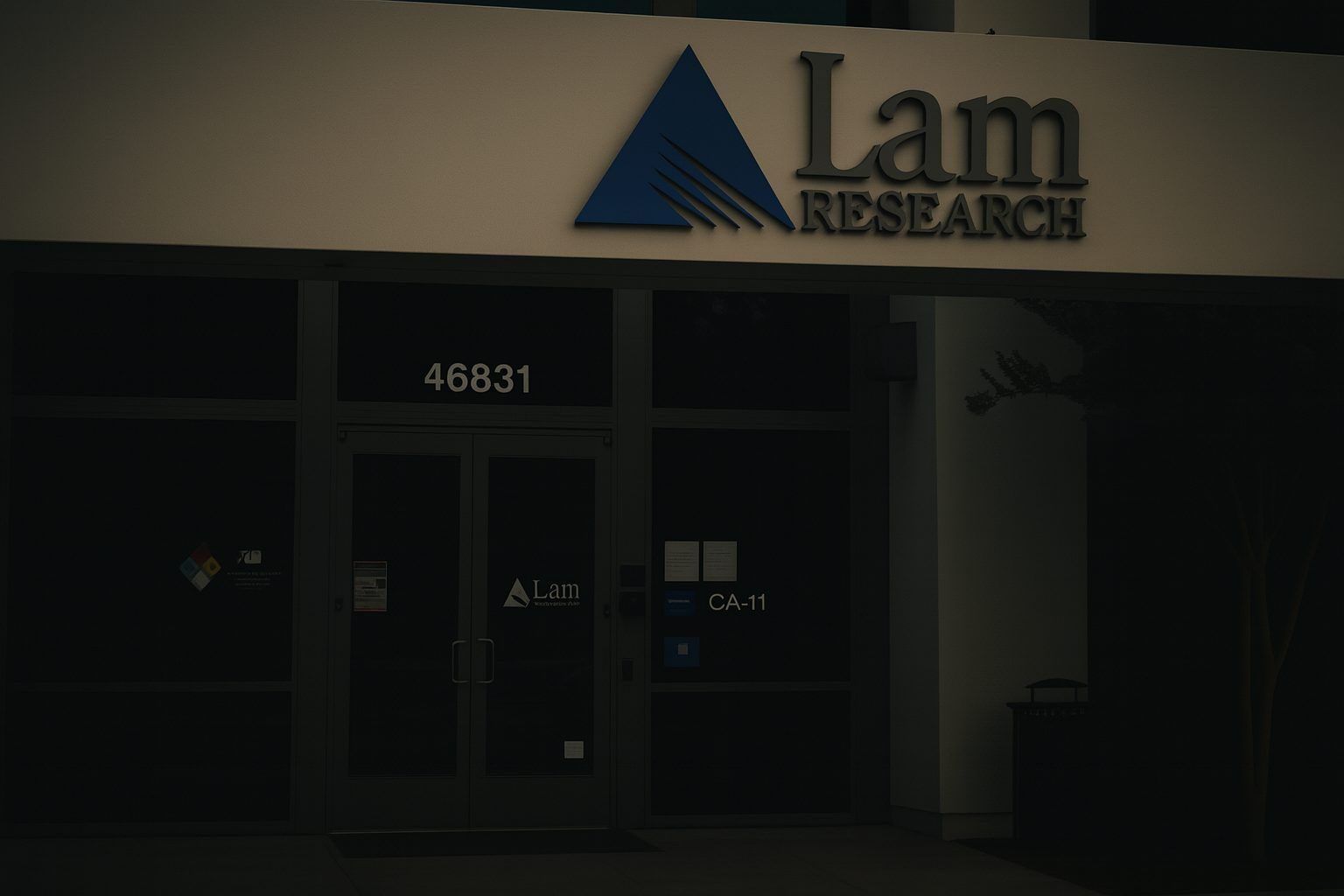

Lam Research Corporation NASDAQ:LRCX is back in the market spotlight as investors digest fresh institutional buying, record financial results and a wave of bullish AI-related forecasts going into 2026. On December 5, 2025, the stock is trading near all‑time highs after more than doubling this year, forcing the big question: is there still upside left in the Lam Research story, or has the AI wafer‑equipment trade run hot?
Below is a rundown of the latest price action, news, earnings, analyst forecasts and key risks that matter for Lam Research stock right now.
1. Lam Research Stock Price on December 5, 2025
In early afternoon U.S. trading on December 5, Lam Research shares change hands around $160–161, up roughly 2.3% on the day, giving the company a market capitalization of about $162 billion. The stock’s trailing price‑to‑earnings ratio sits just under 28x, based on the last twelve months of earnings.
That move comes after Lam closed Thursday, December 4 at $157.09, with an intraday high of $158.52, a low of $154.92, and heavy volume of roughly 8.8 million shares, according to the company’s historical quote page and third‑party data.
Different providers report slightly different performance figures, but they agree on one thing: 2025 has been a monster year for LRCX. One widely used source pegs the year‑to‑date total return at roughly 120–125% through December 5, far ahead of the S&P 500 over the same period.
In other words, Lam is no longer a “forgotten” semiconductor tools name – it’s one of the market’s clearest AI winners in 2025.
2. Fresh News on December 5: Big Money Moves Into (and Out of) LRCX
The most immediate catalysts on December 5, 2025 are a flurry of 13F‑based institutional ownership headlines. New filings show several large asset managers significantly adding to their Lam positions, even as a few others take profits:
- Marshall Wace LLP boosted its stake in Lam by 77.5% in Q2, now holding about 1.50 million shares, worth roughly $146 million, and representing about 0.12% of Lam’s outstanding stock.
- Baird Financial Group Inc. increased its stake by 28.6%, to 667,781 shares valued around $65 million.
- Epoch Investment Partners Inc. raised its position by 9.7%, to more than 2.05 million shares, making Lam its 20th‑largest holding at about 1% of its portfolio.
- 1832 Asset Management L.P. increased its holdings by a striking 574.6%, adding 271,901 shares to reach 319,218 shares worth just over $31 million.
At the same time, there is meaningful profit‑taking from other big players:
- Amundi trimmed its Lam position by 11.2%, selling approximately 1.36 million shares, but still owns over 10.7 million shares after the sale.
- Four Tree Island Advisory LLC reduced its Lam stake by 8.2% in Q2, yet the stock still represents an outsized 16.3% of its total portfolio, its single largest position.
Taken together, the December 5 filing wave paints a picture of a stock that is heavily owned by institutions, with net buying from several hedge funds and asset managers even at elevated price levels – but also enough profit‑taking to remind investors how far the stock has already run.
3. Morgan Stanley Upgrade and UBS AI Conference: Why the Stock is in Focus
Lam’s latest leg higher began earlier this week, when Morgan Stanley raised its price target to $158 from $137 on December 2, 2025, maintaining a positive view on the company amid the AI‑related wafer‑equipment boom.
That call landed just as Lam’s leadership – CEO Tim Archer and CFO Doug Bettinger – appeared at the UBS Global Technology & AI Conference on December 2. The company highlighted its positioning in etch and deposition tools critical for high‑bandwidth memory (HBM), advanced logic nodes and 3D NAND used in AI‑centric data centers.
According to a widely‑cited SWOT analysis and conference coverage:
- Management reiterated that every $100 billion of incremental AI data‑center spend can translate into roughly $8 billion of wafer‑fabrication‑equipment (WFE) demand, directly benefiting Lam and its peers.
- Lam expects the NAND WFE segment to be the fastest‑growing area over the next two years, with spending projected to grow at about 28% annually to roughly $14 billion by 2026, driven by high‑layer NAND and HBM demand.
Against this backdrop, the Morgan Stanley upgrade and the UBS conference reinforced the narrative that Lam is a core pick for investors wanting pure‑play exposure to the AI capex cycle.
4. Fundamentals: Record FY 2025 and Strong Q3 Results
Beneath the stock price and trading headlines, Lam’s fundamental story in 2025 has been undeniably strong.
Record FY 2025
Industry research notes that Lam’s FY 2025 revenue reached a record around $18.4 billion, driven by robust systems sales and a healthy installed base.
A multi‑year view from Trefis shows how dramatically the business has scaled:
- Last‑twelve‑months revenue climbed from about $15.6 billion (late 2024) to nearly $19.6 billion by late 2025, a roughly 26% increase.
- Net income margins expanded to roughly 29–30%, and Lam’s trailing P/E multiple re‑rated from the low‑20s to the mid‑30s over the past year as AI enthusiasm grew.
September 2025 Quarter (Lam’s Q1 FY 2026)
On October 22, 2025, Lam reported financial results for the quarter ended September 28, 2025:
- Revenue: $5.32 billion, up 3% quarter‑over‑quarter and about 28% year‑over‑year, beating analyst expectations of roughly $5.23 billion.
- GAAP gross margin: 50.4%; non‑GAAP gross margin: 50.6% – both record levels for the company.
- Non‑GAAP operating margin: 35.0%.
- Non‑GAAP EPS: $1.26, ahead of consensus near $1.21.
By segment and geography, Lam’s press release highlights:
- Systems revenue of about $3.55 billion, up from $3.44 billion in the prior quarter.
- Customer support & services revenue around $1.78 billion.
- China accounted for approximately 43% of quarterly revenue, followed by Taiwan (19%), Korea (15%), Japan (10%) and the U.S. (6%), illustrating both Lam’s global reach and its sensitivity to China policy.
Lam’s balance sheet has also strengthened:
- Cash, cash equivalents and restricted cash increased to about $6.7 billion at the end of the September quarter, up from $6.4 billion three months earlier.
- Deferred revenue climbed to $2.77 billion, signaling a solid backlog of future equipment and service deliveries.
5. Outlook and AI/WFE Spending: How Big is the Opportunity?
Company Guidance
For the December 2025 quarter, Lam’s official guidance calls for:
- Revenue of $5.20 billion ± $300 million
- Gross margin around 48.5% ± 1 percentage point
- Operating margin around 33% ± 1 percentage point
- GAAP and non‑GAAP EPS guidance centered around $1.15 ± $0.10 per diluted share.
Those figures imply a slight sequential step‑down in revenue and margin from the record September quarter, but still at levels above what many analysts had penciled in earlier in the year.
WFE Spending and AI
Recent analyses from Investing.com and others highlight a very favorable industry backdrop:
- Global wafer‑fabrication‑equipment (WFE) spending is projected to exceed $105 billion in 2025, with further growth expected in 2026 driven by AI and memory demand.
- Lam projects that AI data‑center investments could equate to roughly $240 billion of cumulative foundry equipment opportunity over time, with every $100 billion of AI capex translating into around $8 billion of WFE demand.
- In NAND, Lam expects revenue to grow by about $1.5 billion year‑over‑year, with its “share of wallet” rising from ~30% in 2024 to 40–45% in 2025, helped by high‑layer NAND and HBM‑related tools. Investing.com
- In foundry, Lam is targeting at least 30% revenue growth in 2025, largely tied to spending at leading‑edge customers like TSMC as the industry ramps 2nm Gate‑All‑Around (GAA) and advanced packaging technologies into 2026.
In short, the WFE cycle is very much AI‑driven, and Lam sits at the heart of that capex wave.
6. Dividend and Capital Returns
Lam isn’t just a growth story; it’s also leaning into shareholder returns.
On November 6, 2025, the company’s Board declared a quarterly cash dividend of $0.26 per share, payable on January 7, 2026 to shareholders of record as of December 3, 2025. This maintains the level set after a 13% hike from $0.23 to $0.26 announced in August.
Key points from that dividend announcement and related coverage:
- Lam has now increased its dividend for roughly 11 consecutive years, with a double‑digit growth rate over the last year.
- The payout remains conservative given Lam’s profitability and cash generation, leaving room for ongoing R&D investment, buybacks and capex.
For income‑oriented investors, Lam’s dividend yield is modest at today’s elevated share price, but the consistency and growth of the dividend reinforce the company’s message of confidence in its long‑term earnings power.
7. What Wall Street Analysts Are Forecasting for LRCX
Because Lam’s share price has moved so fast, it now sits above many earlier price targets – yet Street sentiment remains broadly positive.
Different aggregators provide slightly different snapshots, depending on their analyst universe:
- Benzinga’s analyst‑ratings page shows Lam with an overall “Buy” consensus, a highest target of $200, lowest of $85, and a consensus price target around $144. Benzinga
- MarketBeat tracks a consensus target near $153, with a high of $200 and low around $90, implying modest downside from the current price but still a “Moderate Buy” rating overall. MarketBeat
- StockAnalysis.com lists an average 12‑month target of roughly $148, again with a $200 high and $90 low, and categorizes the stock as a “Strong Buy” based on its analyst mix. StockAnalysis
- StocksGuide is more bullish, citing an average target of about $168.30 (high $210, low ~$117), with 28 Buy and 10 Hold ratings out of 38 covering analysts.
- A TickerNerd summary of 43 analysts pegs the median target around $165, with a $200 high and $84 low, again describing Lam as a “Strong Buy” on average. Ticker Nerd
Individual research pieces add more color:
- A Seeking Alpha note titled “Lam Research: AI Foundry Growth Keeps The Upside Case Alive” rates the stock Buy, with a price target of $178, citing 28% revenue growth and 47% EPS growth in the latest quarter and record margins as justification for further upside. StockInvest
- Another SA article, “Lam Research: Fundamentals Remain Solid and I Remain Bullish,” underscores the company’s strong execution but also flags heavy China exposure as a key risk. StockInvest+1
- Investing.com’s SWOT analysis lists updated targets from Mizuho ($170, Outperform), Bank of America ($165, Buy), and Barclays ($142, Equal Weight) following the October 23 earnings release.
Bottom line on forecasts:
The Street generally expects mid‑ to high‑single‑digit percentage upside from current levels over the next 12 months, with bull cases up near $180–200 and bear cases closer to $90–100 – a wide range that reflects both Lam’s cyclical risk and its AI‑driven potential.
8. Valuation: Has LRCX Run Too Far?
After more than doubling in 2025, Lam is no longer obviously “cheap.”
- Trefis data suggests Lam’s stock price rose about 103% from December 4, 2024 to December 4, 2025, while revenue grew roughly 26% and net margins improved, meaning a large part of the move came from multiple expansion (P/E re‑rating from ~25x to the mid‑30s).
- At around $160–161 per share and a trailing P/E near 28x, Lam trades at a premium to its own historical average and at a full valuation relative to the broader semiconductor equipment group, though still below some AI‑software and GPU names.
Several independent valuation models – including fair‑value estimates in Morningstar‑style and Trefis‑style frameworks – place intrinsic value roughly in the mid‑150s to mid‑160s, implying Lam now trades around or modestly above many fair‑value estimates, depending on growth assumptions.
That’s why some recent analyses frame Lam as a “premium‑valued AI winner” rather than a classic value play: investors are paying up for its strategic position in AI, HBM and advanced packaging, not for a bargain multiple.
9. Key Risks: China, Cycles and WFE Normalization
Despite the bullish AI narrative, recent research and Lam’s own SEC filings stress several material risks:
- China export restrictions
- Lam has already flagged an estimated $200 million revenue impact from recent U.S. restrictions on selling certain tools into China.
- China represented roughly 40%+ of revenue in the latest quarter, so further escalation in export controls could meaningfully affect growth.
- Cyclical WFE and memory spending
- Industry forecasts see WFE surpassing $105 billion in 2025, but several analysts warn of potential deceleration after this cycle peaks.
- Lam itself has guided for lower revenue in the second half of calendar 2025 vs. the first half, hinting at a more normalized spending environment on the horizon.
- Concentration and geopolitical risk
- Lam’s customer base includes major foundries and memory makers in Taiwan, Korea and China, making it sensitive to geopolitical tensions, tariffs and supply‑chain disruptions.
- Valuation compression risk
- Because a large part of the recent share‑price gain came from multiple expansion, any wobble in AI spending expectations or WFE forecasts could drive sharp pullbacks, even if fundamentals remain solid.
Put simply, Lam is well‑positioned – but not risk‑free.
10. Takeaways for Investors
For readers scanning Google News or Discover on December 5, 2025, here’s the distilled picture of Lam Research stock today:
- The AI wave is real for Lam. Record revenue, 50%+ gross margins and robust demand in NAND, DRAM and advanced logic all point to Lam being a core enabler of AI infrastructure, not just a bystander.
- Institutional money is still coming in. Multiple 13F filings out today show major funds increasing positions – even as some long‑time holders lock in profits – reinforcing Lam’s status as an institutional favorite.
- Analysts remain bullish but more selective. Most coverage calls Lam a Buy/Strong Buy, with average targets clustering between the mid‑140s and high‑160s, and bull cases stretching to $178–200.
- The stock is priced for success. After a roughly 120%+ YTD run, Lam now trades at a premium multiple, leaving less room for error if WFE spending or AI capex grows more slowly than expected.
- Risks are concentrated in China exposure and cycle timing. Export controls, geopolitical tension and post‑2025 WFE normalization are the main watch‑items for 2026.
As always, this article is for information and news purposes only and does not constitute investment advice. Anyone considering Lam Research stock should weigh their risk tolerance, time horizon and portfolio diversification, and review the company’s own filings and risk factors before making decisions.