
Overview – A choppy but positive week for German equities
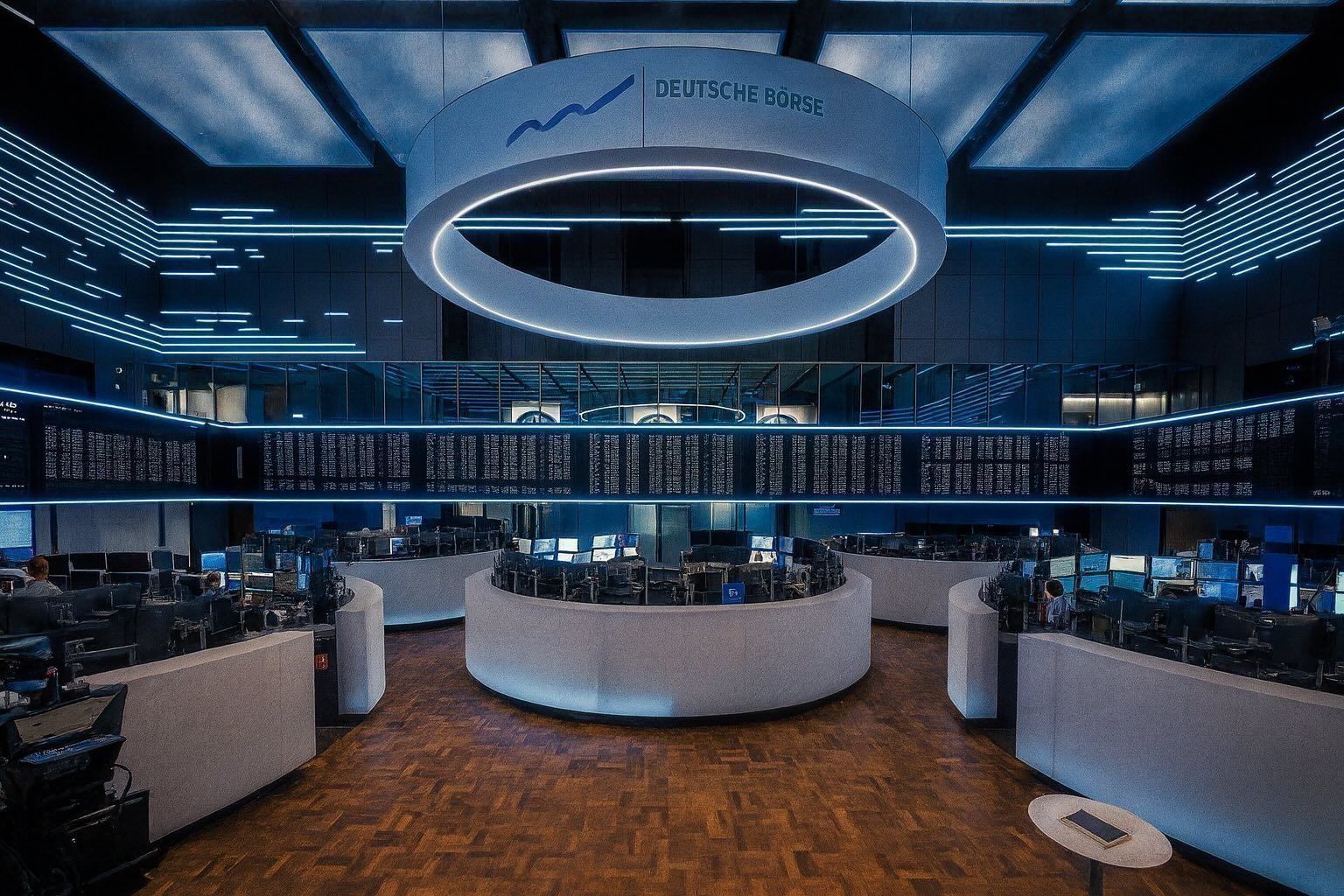
The German stock market ended the first week of December with a cautiously upbeat tone. The DAX 40 index finished Friday, 5 December, at 24,028.14 points, around 0.8% higher week-on-week and marking its second consecutive weekly gain.
After a sharp drop on Monday, the index clawed back losses on the back of:
- Stronger‑than‑expected German factory orders for October,
- Growing confidence in a Federal Reserve rate cut next week,
- Political relief after Chancellor Friedrich Merz pushed a contentious pensions bill through parliament, and
- Ongoing expectations that eurozone inflation will stay near the European Central Bank’s (ECB) 2% target.
Mid‑caps and tech names participated in the rebound: on Friday alone, the MDAX added about 0.3% and the TecDAX roughly 0.6%, while the main DAX 40 gained around 0.7%.
DAX 40 Weekly Performance: Weak Monday, Strong Finish
Day‑by‑day moves on the Frankfurt Stock Exchange
Based on exchange data, the DAX 40 traded as follows between Monday 1 December and Friday 5 December:Investing.com
- Monday, 1 Dec – 23,589.44 (‑1.04%)
- The DAX started December on the back foot as investors took profits after strong gains in late November. European indices opened the month lower, with cyclicals and defence names under pressure.
- Tuesday, 2 Dec – 23,710.86 (+0.51%)
- The index stabilised and moved modestly higher, tracking a broadly flat pan‑European session. Investors stayed cautious ahead of key U.S. inflation data and eurozone releases, but selective buying returned in large caps.
- Wednesday, 3 Dec – 23,693.71 (‑0.07%)
- A classic consolidation day. The DAX drifted sideways with a slight loss as markets waited for new macro catalysts and clarity on the Fed’s next move.
- Thursday, 4 Dec – 23,882.03 (+0.79%)
- German equities broke higher, with the DAX closing at a three‑week high near 23,900. Trading Economics and Dow Jones data show a gain of about 0.8% on the day, helped by a rally in autos and industrials as global risk appetite improved.
- Friday, 5 Dec – 24,028.14 (+0.61%)
- The index pushed back above the psychologically important 24,000 mark, briefly crossing 24,100 intraday – a level last seen in mid‑November – before settling near 24,028.
- According to Dow Jones and Investing.com, this left the DAX around 0.8% higher for the week, confirming a second weekly advance.
European equities overall logged modest gains, with the STOXX 600 up roughly 0.4% week‑on‑week, as markets priced in a high probability of a 25 bps Fed rate cut next week.
Macro Backdrop: Mixed German Data, but Factory Orders Surprise on the Upside
PMI shows manufacturing still in contraction
The week began with sobering news on the real economy. The HCOB Germany Manufacturing PMI for November fell to 48.2 from 49.6 in October, a nine‑month low and firmly below the 50 threshold that separates expansion from contraction.
Key details from the survey:Reuters
- New orders declined at the fastest pace in ten months,
- Export demand weakened across Asia, Europe and North America,
- Manufacturing employment continued to fall, and
- Business confidence improved only marginally and remained below its long‑term average.
In short, Germany’s industrial engine is still far from firing on all cylinders.
Industrial orders: one bright spot with caveats
Later in the week, October industrial orders offered a rare positive surprise:
- Orders rose 1.5% month‑on‑month, beating expectations for a 0.4% increase.
- The jump was driven by an 87% surge in “other transport equipment” orders, a category that includes aircraft, ships, trains and military hardware.Reuters
- Domestic orders rose 9.9%, which economists linked partly to Berlin’s “investment booster” programme and increased defence spending.Reuters
- By contrast, foreign orders fell 4%, and a three‑month comparison showed total orders still 0.5% lower than in the previous three‑month period – evidence that the sector is stabilising rather than clearly recovering.
For equity markets, the message was nuanced: Germany’s industry is no longer in free fall, but any upturn is fragile and heavily dependent on lumpy big‑ticket contracts and fiscal support.
Growth, jobs and the broader outlook
Recent official data suggest the German labour market has softened but not collapsed: unemployment is hovering around 6.3%, with just under 3 million people out of work, and employment levels broadly flat.
Medium‑term projections paint a picture of sluggish, not booming, growth:
- The European Commission’s autumn 2025 forecast expects German GDP growth to hover near 0.2% in 2025, before improving to about 1.3% in 2026, helped by easing inflation and recovery in export markets.
- The German Economic Institute (IW) is more pessimistic, seeing GDP up just 0.1% in 2025 and 0.9% in 2026, warning that weak global trade and high tax and social contributions (projected at a record 41.5% of GDP) could keep the recovery muted.
Equity traders largely looked through these weak structural numbers this week, focusing instead on near‑term support from monetary policy and seasonal factors.
Inflation, ECB Signals and Rate Expectations
Eurozone inflation near target
Eurostat’s flash estimate showed euro area inflation at 2.2% year‑on‑year in November, only slightly above October’s 2.1% and effectively back at the ECB’s 2% target after the double‑digit peak of 2022. Core inflation remains moderate.
This relatively benign inflation backdrop is one reason markets have priced in further ECB easing in 2025, complementing the Fed cut expectations that underpinned risk appetite this week.
ECB policymakers: “full optionality” on future moves
Two ECB officials spoke over 5–6 December and their comments were closely watched in Frankfurt:
- Olli Rehn stressed that eurozone inflation has “stabilised around the ECB’s symmetric 2% target” and that the central bank’s latest projections actually see inflation slightly below 2% over the forecast horizon, highlighting downside risks to price growth.Reuters
- François Villeroy de Galhau argued that upside and downside inflation risks now “cut both ways”, and insisted the ECB must keep “full optionality” at upcoming meetings rather than commit to a specific terminal rate path. He also flagged German fiscal expansion and supply‑chain fragmentation as potential upside risks, while a stronger euro and cheaper Chinese imports pull in the opposite direction.Reuters
For the German stock market, this combination – inflation near target, but central bankers unwilling to rule out further easing – reinforces a supportive medium‑term rate environment without triggering fears of runaway prices.
Politics Enters the Frame: Merz’s Pensions Bill and Market Relief
Domestic politics briefly took centre stage on Friday.
According to Reuters, German stocks outperformed broader European markets, with the DAX up around 0.7%, after Chancellor Friedrich Merz secured an absolute majority in parliament for a pensions reform bill, avoiding a potential government crisis.
The bill, a key element of the governing coalition’s agenda, had faced a rebellion within parts of Merz’s own party. Its passage reassured investors that Germany’s fiscal and reform programme would not be derailed in the near term, supporting sentiment in domestically focused sectors and financials.
Sector and Stock Movers in Frankfurt
Autos and industrials lead the rebound
Cyclical sectors with heavy weight in the DAX were among the biggest winners:
- Across Europe, autos and parts were the top‑performing sector this week, rising about 5.6% on the STOXX 600. A major driver was a U.S. proposal to reverse tighter fuel economy rules, which would favour traditional combustion‑engine vehicle sales and benefit German manufacturers.
- On Thursday’s rally, Mercedes‑Benz, Porsche and Daimler Truck posted outsized gains, helping lift the DAX nearly 0.8% on the day.
On Friday’s close:
- BMW hit a new 52‑week high, gaining about 3.5%,
- Infineon Technologies rose roughly 2.8%, and
- BASF advanced a little over 2%, according to exchange data cited by Investing.com.
These moves underline investor preference for:
- Export‑oriented industrials and automakers, which benefit from global demand and a softer rate outlook,
- Selected technology hardware names that gain from structural themes like AI‑driven automation, and
- Chemicals, which are sensitive to energy prices and industrial capex.
Lagging sectors: utilities and some defensives
Not every corner of the market joined the party:
- German utilities such as RWE and E.ON lagged on Friday, slipping around 1%, as investors rotated away from defensive yield plays toward growth and cyclicals.
- Some healthcare and staples names underperformed earlier in the week as risk appetite improved and bond yields eased.
Forecasts and Analysis: What Comes Next for the DAX?
Strategists: cautiously optimistic on European and German equities
Several fresh outlooks published in late November and early December are shaping expectations:
- Citigroup set a 2026 year‑end target of 640 for the STOXX 600, implying more than 10% upside from current levels, citing fiscal expansion (including in Germany) and accommodative monetary policy as key tailwinds. The bank upgraded autos, industrials, chemicals and basic resources to “overweight” and turned more cautious on richly valued European tech.Reuters+1
- An IG 2026 DAX 40 outlook highlights three pillars supporting the German market:
- Resilient earnings at large industrial exporters,
- Low eurozone interest rates as inflation settles near 2%, and
- Stable global demand despite U.S. tariffs.
IG notes that the DAX has traded largely sideways since mid‑2025 but argues that disciplined cost control, restructuring and gradual AI‑driven efficiency gains have helped many DAX constituents maintain margins.
- A detailed DAX 40 forecast study from NAGA, updated in November, points out that the German benchmark has already delivered a strong rally in 2025, with some forecasts from banks and AI‑driven models calling for ranges between 22,500 and 30,000 points into 2026. One AI‑based model (MunafaSutra) sees short‑term targets in the 24,300–24,800 zone and medium‑term potential up to around 24,900.
These projections are not guarantees and often assume continued disinflation, moderate global growth and no severe escalation in trade tensions. But they explain why pullbacks in the DAX this year have tended to attract dip‑buyers.
“Santa rally” statistics support seasonal bulls
Seasonality is another talking point in Frankfurt right now.
An analysis of historical data highlighted by Euronews and Seasonax shows that over the past 40 years:euronews+1
- The DAX has delivered an average December return of about 2.18%, finishing the month higher 73% of the time,
- From 15 December to year‑end, the index has historically gained around 1.87% on average, again with a roughly 73% “win rate”, and
- So‑called “Santa rally” dynamics are often linked to fund‑manager window‑dressing and performance‑chasing late in the year.
Given that the DAX has been in a sideways range since mid‑2025, seasonal statisticians argue that a breakout later in December is statistically more likely than a breakdown – though, as always, past performance is no guide to future returns.
Technical Picture: Key DAX Levels to Watch
Price data and futures quotes suggest several important zones for traders:Investing.com+1
- Immediate resistance:
- The area between 24,100 and 24,300 – tested intraday on Friday – is the first hurdle. A sustained break above it would open the door toward late‑July highs around 24,600–24,700.
- Support levels:
- 23,900: Thursday’s breakout area and now first short‑term support.
- 23,700–23,600: Cluster of this week’s earlier closes and a key range low; a drop back below would suggest the latest rally was a false breakout.
- 23,400: Highlighted in some medium‑term technical analyses as an important line in the sand; breaking it would raise the risk of a deeper correction back toward the 22,000–23,000 zone.
Overall, momentum has turned positive again, but the index is still trading within a broader 23,000–24,700 band that has contained prices for much of the second half of 2025.
What This Week Means for Investors
For investors following the German stock market and the DAX 40:
- Short term, the market has shrugged off weak PMI data thanks to upbeat factory orders, improving global risk sentiment and a relatively dovish backdrop from both the Fed and ECB.
- Sector leadership remains firmly with autos, industrials, cyclicals and select tech hardware, while traditional defensives lag.
- Macro fundamentals in Germany remain soft: growth is tepid, industry is stabilising rather than booming, and structural issues such as high taxes, energy costs and weak external demand haven’t gone away.
- Medium‑term outlooks from major banks and brokers are cautiously constructive, but they emphasise the likelihood of volatile, range‑bound trading rather than a straight‑line rally.
For now, the path of least resistance in early December looks gently higher, supported by seasonal patterns and lower‑for‑longer rates – but any disappointment in U.S. or eurozone data, renewed trade tensions, or signs of a sharper slowdown in global manufacturing could quickly test the lower end of the current DAX trading range.
Looking Ahead: Key Events for the Coming Days
Investors in German equities will be watching closely for:
- The Federal Reserve’s rate decision and updated projections, which could reinforce or undermine the current “soft‑landing and cuts” narrative.Reuters
- Further eurozone and German data releases (business sentiment surveys, industrial production) to see whether October’s encouraging orders data was a one‑off or the start of a trend.
- Any new signals from ECB officials on the timing and pace of future rate moves, particularly if inflation data continue to hover near or below 2%.
As always, this article is for information and analysis only and does not constitute investment advice. Investors should consider their own risk tolerance and, where appropriate, seek professional guidance before making portfolio decisions.
Related articles: Stock Market