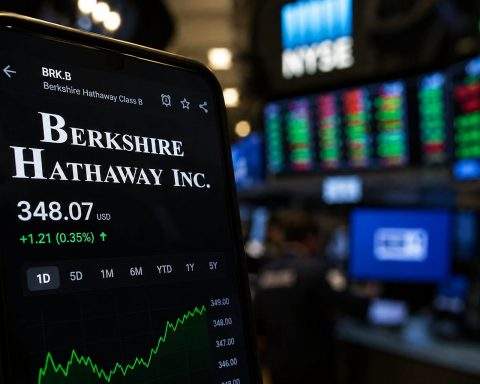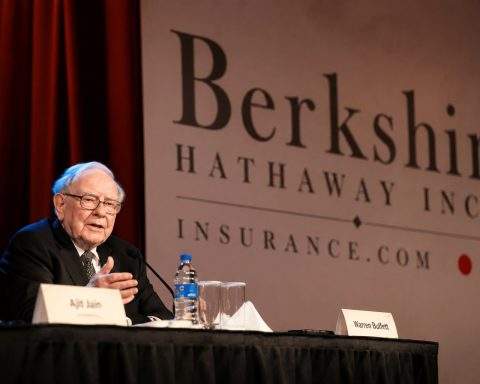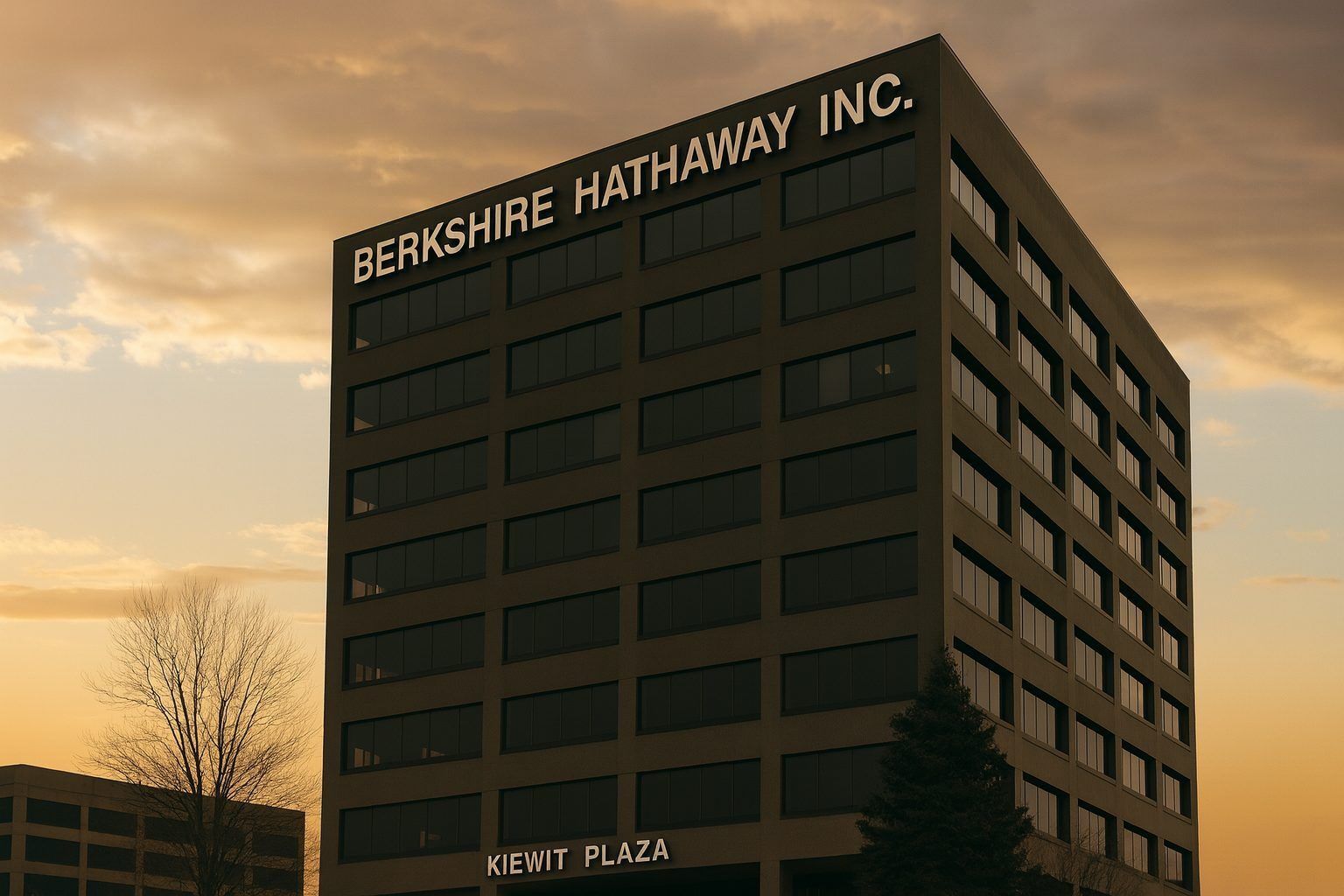

Berkshire Hathaway stock is entering one of the most important turning points in its history: a record cash pile, a looming CEO change from Warren Buffett to Greg Abel, and sharply divided Wall Street forecasts – all as the conglomerate joins the elite club of trillion‑dollar companies.
As of the close on Friday, December 5, 2025, Berkshire Hathaway Class B shares (BRK.B) finished at $504.34, up 0.22% on the day and about 7% below their 52‑week high of $542.07 set in May. Over the last 12 months, BRK.B is up roughly 7%, with a year‑to‑date gain of about 11%, and a 5‑year total shareholder return of around 121%.
With an estimated market capitalization of about $1.09 trillion, Berkshire is now one of only 11 companies globally above the trillion‑dollar mark – and the first financial firm to reach that level.
Below is a deep dive into the latest news, forecasts and analysis as of December 6, 2025.
1. Berkshire Hathaway Stock Today: Price, Performance and Valuation
Stable, slow‑grind price action
Recent trading in BRK.B has been calm but constructive:
- Last close (Dec 5, 2025): $504.34
- 30‑day performance: +3.2%
- 12‑month performance: +7.2%
- YTD 2025 performance: +11.3%
- 52‑week range: $440.10 – $542.07 (current price is ~7% below the high and ~15% above the low) FinanceCharts
Berkshire’s Class A shares (BRK.A) closed Friday at $755,800, a modest gain on the day and almost perfectly aligned with long‑term historical price data.
Valuation snapshot
Fundamental analysts at Simply Wall St estimate that Berkshire trades on a price‑to‑earnings (P/E) multiple of about 16.2x, slightly above the broader U.S. diversified financials industry (~13.7x), but below many large‑cap peers at around 25x.
On their numbers:
- P/E: 16.2x (versus an internal “fair” P/E of ~16.9x – described as “about right”).
- A discounted cash‑flow (DCF) model pegs fair value near $764.90 per BRK.B share, implying ~34% upside versus recent prices around $503–505.
Not everyone agrees. FinanceCharts’ internal “fair value” metric sits much lower, at $187.76, implying the stock could be significantly overvalued on that particular model. FinanceCharts
In short: valuation depends heavily on the model you trust.
2. Q3 2025 Earnings: Operating Power Under the Hood
Berkshire released its third‑quarter 2025 earnings on November 1. The headline numbers were strong: berkshirehathaway.com
- Net earnings attributable to shareholders:
- Q3 2025: $30.8 billion
- Q3 2024: $26.3 billion
- Operating earnings (Buffett’s preferred metric):
- Q3 2025: $13.5 billion
- Q3 2024: $10.1 billion
That’s roughly a 34% jump in operating income, driven by: berkshirehathaway.com+1
- Insurance underwriting profit rising sharply to $2.37 billion in Q3 2025 (vs ~$750 million a year earlier).
- Solid earnings from BNSF Railway (~$1.45 billion) and Berkshire Hathaway Energy (~$1.49 billion).
- Growing profits across manufacturing, service and retailing, including housing‑related operations like Clayton Homes.
Berkshire also reported its vaunted insurance float at around $176 billion as of September 30, 2025, up about $5 billion since year‑end 2024, reinforcing the conglomerate’s capacity to invest large, low‑cost capital over long horizons.
3. Record Cash Hoard and Buffett’s $184 Billion “Warning”
One of the biggest stories around Berkshire today is its massive cash position and what that says about Warren Buffett’s view of the market.
Cash and short‑term investments at historic highs
According to Morningstar’s November coverage, Berkshire ended Q3 2025 with a record $358 billion in cash and cash equivalents, up from about $344 billion at the end of Q2.
A separate analysis from The Motley Fool (re‑published by Nasdaq) notes that if you include short‑term investments, Berkshire’s cash pile reaches roughly $381 billion, highlighting how much dry powder Buffett has allowed to accumulate.
Net sellers for 12 straight quarters
That Motley Fool piece highlights a striking datapoint:
- Over the last 12 consecutive quarters, Berkshire has been a net seller of equities, with net stock sales totaling about $184 billion.
The article frames this as a “$184 billion warning” from Buffett, suggesting he is uneasy with overall stock market valuations. It points to a high Shiller CAPE ratio for the S&P 500 and notes that historically, such lofty valuations have often preceded significant drawdowns. Nasdaq
For Berkshire shareholders, the combination of record cash and ongoing net selling reinforces the idea that:
- Buffett and his team are finding fewer large, attractively priced opportunities.
- The company is positioning itself conservatively ahead of potential market volatility.
4. Portfolio Shifts: Alphabet, Homebuilders and the Housing Bet
Big tech: Berkshire quietly builds Alphabet stake
Berkshire’s Q3 2025 13F filing confirms an expanding position in Alphabet (GOOGL). Independent portfolio trackers estimate Berkshire now owns roughly 17.8 million Alphabet shares, worth more than $4.3 billion as of mid‑November.
A recent report notes Berkshire purchased nearly 18 million Alphabet shares in Q3, and since Berkshire disclosed the stake on November 1, Alphabet shares have rallied by around 13%, underscoring the continued “Buffett effect” in tech. Yahoo Finance+1
Meanwhile, Berkshire’s long‑standing top five equity holdings remain familiar names: Valuesider
- Apple (AAPL) – ~22.7% of the equity portfolio
- American Express (AXP) – ~18.8%
- Bank of America (BAC) – ~11.0%
- Coca‑Cola (KO) – ~9.9%
- Chevron (CVX) – ~7.1%
Even though Berkshire has trimmed Apple and Bank of America over recent quarters, these positions still dominate the portfolio.
Housing & homebuilders: A rare “rule‑breaking” trade
Today’s freshest Berkshire‑related story (dated December 6, 2025) comes from Fast Company, highlighting how unusual this housing market cycle has been – and how Berkshire has traded it.
Key points:
- Berkshire bought U.S. homebuilders D.R. Horton, Lennar and NVR in 2023, then sold most of the D.R. Horton stake in 2024.
- In Q2 2025, Berkshire jumped back into homebuilders, acquiring around 1.5 million D.R. Horton shares and boosting its Lennar position to more than 7 million shares.
- By late 2025, Berkshire had completely exited D.R. Horton again, while retaining its Lennar and NVR positions.
The article notes that this rapid in‑and‑out trading in a cyclical sector contrasts with Buffett’s famous 1996 line: “If you aren’t willing to own a stock for 10 years, don’t even think about owning it for 10 minutes.” Fast Company+1
The most reasonable interpretation:
- Berkshire is treating homebuilders as tactical opportunities tied to the unique post‑pandemic housing cycle, rather than permanent “forever” holdings.
- Its willingness to sell D.R. Horton after a strong rebound while holding Lennar and NVR suggests a nuanced, valuation‑sensitive view rather than a broad housing bull or bear call.
5. Leadership Transition: From Warren Buffett to Greg Abel
The single biggest structural change for Berkshire shareholders is the planned CEO transition at the end of 2025.
Buffett stepping down as CEO
At Berkshire’s 2025 annual meeting, Warren Buffett, now 95, announced he intends to step down as CEO at year‑end 2025 and request that the board appoint Greg Abel as his successor.
Since then:
- Berkshire’s board has unanimously approved Abel as president and CEO, effective January 1, 2026, with Buffett staying on as chairman.
- The announcement initially triggered about a 2% drop in BRK.B in pre‑market trading as investors digested the end of an era.
Who is Greg Abel?
Recent coverage from Investopedia and others paints a consistent picture: Investopedia+2Investopedia+2
- Abel is a 25‑year Berkshire veteran and CEO of Berkshire Hathaway Energy, known for hands‑on operational excellence.
- He has been vice‑chairman of non‑insurance operations since 2018 and has been explicitly identified as Buffett’s successor since 2021.
- Buffett and the late Charlie Munger have repeatedly said Abel “understands capital allocation as well as I do” and will maintain Berkshire’s culture.
Still, analysts warn that the “Buffett premium” embedded in Berkshire’s valuation could fade as the market tests whether Abel can command the same level of investor trust. One recent analysis notes that Berkshire shares fell about 5% following the formal retirement announcement, underscoring skepticism despite Abel’s strong credentials. Investopedia
6. Wall Street and Quant Models: A Mixed and Sometimes Conflicting Outlook
As of December 6, 2025, forecasts for Berkshire Hathaway stock are unusually split, depending on whether you look at traditional analysts, quant models or technical services.
6.1 Traditional analyst price targets
UBS / MarketBeat / StockAnalysis
- MarketBeat aggregates 1 recent Wall Street rating and shows a consensus “Buy” rating with a 12‑month price target of $585 for BRK.B – about 16% upside from $504.34. MarketBeat
- StockAnalysis, drawing on the same UBS coverage, lists a single target of $595, implying ~18% upside, and labels the current consensus as “Strong Buy.” StockAnalysis
Benzinga multi‑analyst view
Benzinga compiles a broader set of 38 analyst ratings, with a surprising twist: Benzinga
- Average price target: $567.61
- Highest target: $597
- Lowest target: $325
- Consensus rating:Sell, reflecting a sizable group of cautious or bearish analysts, despite a target that still sits ~12.5% above current levels.
The same piece also presents long‑term algorithmic projections (via CoinCodex), which estimate:
- For the rest of 2025, an average BRK.B price around $499, essentially flat versus today.
- For 2030, a band of $860–$900, with a central forecast near $880, implying an annualized return of about 12% from current levels in that model.
StocksGuide: Slight downside, majority “Sell”
StocksGuide provides yet another angle: StocksGuide
- Average 2026 target price: $490.34, about 2.8% below the current $504.34.
- Range: from $468.03 (downside ~7%) up to $625.01 (upside ~24%).
- Analyst recommendation mix (10 analysts):
- 1 Buy
- 3 Hold
- 6 Sell
Taken together, traditional analyst opinions are all over the map, spanning Strong Buy to majority Sell, with most price targets clustering between flat and roughly 20% upside.
6.2 Fundamental valuation services
As noted earlier:
- Simply Wall St DCF model: Fair value near $764.90, implying ~34% upside at ~$503.60, and labeling Berkshire “undervalued” on a cash‑flow basis. Simply Wall St
- A separate “Excess Returns” valuation, cited in recent Yahoo Finance analysis, suggests Berkshire could be 33–34% undervalued, reaching similar conclusions from a different model. Yahoo Finance+1
- FinanceCharts’ fair‑value figure of $187.76, by contrast, implies significant overvaluation and highlights how sensitive outcomes are to assumptions.
Fundamental models therefore range from “deeply undervalued” to “significantly overvalued”, depending on methodology.
6.3 Technical and quantitative forecasts
Intellectia, a quantitative and technical research platform, offers a short‑ to medium‑term forecast: Intellectia
- Current technical rating:Buy, with 4 bullish and 1 bearish signal (MACD, momentum and oscillators are positive).
- Moving averages:
- Short and mid‑term (SMA 5, 20, 60) show a mixed but generally bullish configuration.
- Longer‑term trend (SMA 60 vs 200) leans bearish, suggesting the broader uptrend is less robust.
- Near‑term (next month) projection: about –1.9% expected move, based on high correlation (99.8%) with BRK.A historical patterns.
- 2026 forecast: average price around $431 by December 2026, below today’s level.
- 2030 forecast: average price near $529, only modestly above current levels.
According to Intellectia, BRK.B remains a technically sound, slow‑growing compounder, but its multi‑year risk‑reward profile is not obviously explosive from here.
7. Trillion‑Dollar Status and Market Role
Investor’s Business Daily recently updated its list of trillion‑dollar companies and noted that the club now counts 11 members. Berkshire Hathaway stands out as the first financial company to cross the threshold, sharing the stage with big tech names like Nvidia, Apple, Alphabet, Microsoft and Amazon, and more recently Eli Lilly.
Given its diversified exposures – insurance, railroads, utilities, industrials, consumer, energy and a massive equity portfolio – many investors still view Berkshire as a proxy for the broader U.S. economy and a relatively defensive “all‑weather” compounder.
8. Is Berkshire Hathaway Stock a Buy Right Now?
This is the question many investors are asking heading into 2026 – especially with Warren Buffett stepping down as CEO.
Bullish arguments
Supporters of the stock point to:
- Strong operating earnings growth, with Q3 2025 operating income up roughly 34% year‑over‑year.
- Record cash and float, giving Berkshire unparalleled firepower to deploy into bargains if markets correct.
- Model‑based valuations (Simply Wall St, “Excess Returns”) suggesting 30%+ upside from current levels. Simply Wall St+1
- A proven culture and succession plan, with Greg Abel positioned to continue Berkshire’s long‑term, conservative capital allocation philosophy.
From this angle, BRK.B looks like a steady, high‑quality compounder trading at a reasonable price, with “optionality” if markets reprice and Berkshire can put its record cash to work.
Bearish arguments
On the other side:
- Several multi‑analyst compilations (Benzinga, StocksGuide) show a consensus Sell and muted or even slightly negative upside on a 1‑ to 2‑year view.
- Some fair‑value models (such as FinanceCharts) flag Berkshire as meaningfully overvalued relative to long‑term fundamentals.
- Buffett’s own behavior – net stock selling for 12 straight quarters and allowing the cash pile to hit record highs – can be interpreted as a vote of caution on overall market valuations.
- The CEO transition introduces leadership risk: while Abel is widely respected, he does not yet command Buffett’s iconic status, and any stumble could compress the valuation multiple.
From this perspective, Berkshire looks like a great company at a fair‑to‑full price, with the risk that the market, post‑Buffett, assigns it a lower premium.
9. Key Takeaways for December 6, 2025
For readers tracking Berkshire Hathaway stock today, here are the main points:
- Stock level: BRK.B trades around $504, about 7% below its 52‑week high and up roughly 11% year‑to‑date, with a five‑year total return above 120%.
- Fundamentals: Q3 2025 showed strong operating earnings, robust contributions from insurance, BNSF and energy, and a growing float of $176 billion.
- Balance sheet strength: Berkshire holds record levels of cash and short‑term investments, estimated between $358–381 billion, giving it unmatched flexibility for future deals or buybacks.
- Capital allocation stance: Berkshire has been a net seller of stocks for 12 straight quarters, a potential signal that management sees limited bargains at current market valuations.
- Leadership transition: Warren Buffett will step down as CEO at the end of 2025, with Greg Abel officially taking over on January 1, 2026, while Buffett remains chairman.
- Latest news (Dec 6): New reporting highlights Berkshire’s tactical trading in homebuilders–exiting D.R. Horton while keeping Lennar and NVR–as a rare example of “rule‑breaking” behavior in a unique housing cycle. Fast Company
- Forecasts: Price targets and ratings are sharply divided, ranging from Strong Buy with ~18% upside (UBS) to majority Sell with limited or negative expected returns (Benzinga/StocksGuide), while some DCF models still see 30%+ undervaluation.
10. Final Word (and a Quick Disclaimer)
Berkshire Hathaway today is not just a Buffett story – it’s a global, trillion‑dollar conglomerate with resilient operating businesses, a massive cash hoard and a carefully planned succession.
Whether Berkshire Hathaway stock is right for you depends on:
- Your view of market valuations and the probability of a future correction.
- Your confidence in Greg Abel and the broader Berkshire team to allocate capital in a post‑Buffett world.
- Your time horizon and risk tolerance: Berkshire is built for long‑term compounding, not fast‑trading excitement.
This article is for informational and educational purposes only and is not financial advice. Always do your own research and, if needed, consult a licensed financial adviser before making investment decisions.
Related articles: NYSE:BRK.B