
Updated December 6, 2025
NuScale Power Corp. NYSE:SMR has turned into one of 2025’s wildest AI-adjacent trades. After rocketing above $57 earlier this year and then crashing back to about $21.39 at the close on December 5, the stock now sits roughly 63% below its 52‑week high, with a market cap of about $6.5 billion and a 52‑week range of $11.08–$57.42.
At the same time, Wall Street’s 12‑month price targets cluster near $36–$38 per share, implying hefty upside from here — but most analysts rate the stock only a Hold or even Reduce.
Here’s a deep dive into the latest news, forecasts and analysis around NuScale Power stock as of December 6, 2025 — with a particular focus on what changed in Q4 2025 and what investors will be watching into 2026.
1. NuScale Power at a Glance
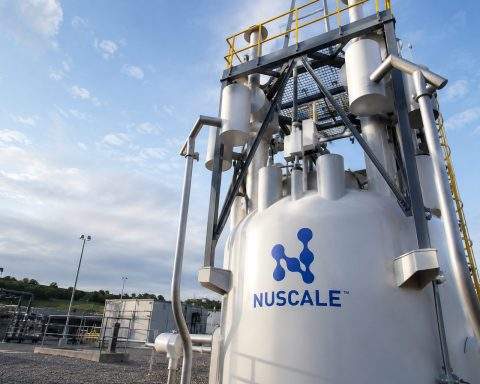
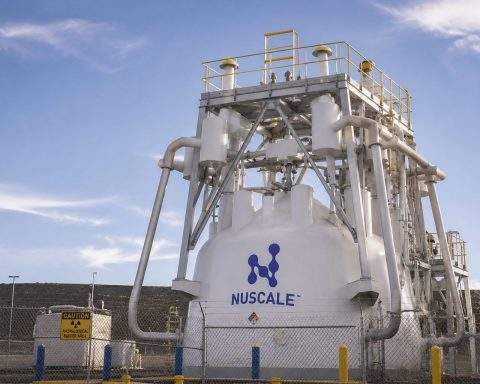
NuScale Power develops small modular reactor (SMR) technology. Its flagship NuScale Power Module is a 77‑megawatt electric (MWe) pressurized water reactor that can be combined in 12‑unit “VOYGR” plants up to 924 MWe. StockAnalysis+1
Key current snapshot:
- Ticker: SMR (NYSE)
- Share price (Dec 5 close): $21.39
- Market cap: ≈ $6.48 billion
- Shares outstanding: ≈ 302.7 million
- TTM revenue: ~$63.9 million
- TTM net loss: ~–$380 million
- 52‑week range: $11.08 – $57.42
- Analyst consensus rating: “Hold” (StockAnalysis) / “Reduce” (MarketBeat) StockAnalysis+1
NuScale is still pre‑commercial: it has no operating plants, no final investment decisions (FIDs) yet on a VOYGR project, and it relies heavily on equity issuance and government cost‑sharing for funding.
2. Q3 2025: Ugly GAAP Numbers, Fortress Balance Sheet
NuScale’s Q3 2025 results, released November 6, sparked a wave of headlines — and a lot of confusion.
Headline numbers (Q3 2025): NuScale Power+1
- Revenue: ~$7.8 million, up sharply from about $0.5 million in Q3 2024, largely from engineering work on the Romanian RoPower Doicești SMR project (FEED Phase 2).
- GAAP EPS: about –$1.85 vs. consensus around –$0.14, a massive “miss” driven by accounting, not operations. TradingView+1
- G&A expense: jumped by roughly $502 million, mainly from a one‑time $495 million “milestone contribution” under NuScale’s Partnership Milestones Agreement with ENTRA1 Energy. Renewable Energy Industry+1
- Cash & investments: about $753.8 million as of September 30, 2025.
- Debt: essentially zero, leaving NuScale in a net cash position.
That $495 million milestone payment is central to the story. NuScale is effectively paying its development partner ENTRA1 upfront to accelerate project work and secure the Tennessee Valley Authority (TVA) SMR program (more on that below). MarketBeat and other bullish commentators argue this is “a messy quarter that actually strengthened the company,” because it both funded ENTRA1 and left NuScale with a large, debt‑free cash pile. MarketBeat
Critics, however, see the opposite: minimal revenue, enormous non‑recurring expenses and heavy dependence on issuing new stock.
3. The TVA/ENTRA1 6‑GW Framework: Big Vision, Not Yet a Contract
The core commercial pillar of the NuScale bull case is its partnership with ENTRA1 Energy and the TVA framework agreement.
In September 2025, ENTRA1 announced a landmark program with TVA to explore deploying up to 6 gigawatts (GW) of SMR capacity in TVA’s service territory — described as the largest SMR program yet announced in the U.S.
Key points:
- The TVA–ENTRA1 framework is currently a memorandum of understanding (MoU), not a binding construction contract.
- NuScale’s role is as the reactor technology provider to ENTRA1, which would develop, own and/or operate the plants. NuScale “sells the Intel‑like chip inside,” not the electrons. Utility Dive+1
- A U.S.–Japan framework agreement also names ENTRA1 as the sole developer eligible for a portion of up to $25 billion of capital aimed at AI‑related power infrastructure, which would include projects using NuScale technology.
If even a fraction of that 6‑GW program turns into binding power purchase agreements (PPAs) with hyperscale data‑center customers in the TVA region, NuScale’s licensing and royalty model could be highly lucrative. But no “hard contracts” are in place yet, and management has been telling investors since mid‑2025 that it aims to land two or three such contracts by year‑end. Utility Dive+1
As of December 6, 2025, the market is still betting on future conversions, not signed PPAs.
4. Romania’s Doicești SMR: Europe’s First NuScale Plant?
NuScale’s other flagship project is the Doicești SMR plant in Romania, led by RoPower Nuclear (a JV of Nuclearelectrica and Nova Power & Gas) with engineering support from Fluor and NuScale.
Where things stand:
- The project envisions six 77‑MWe NuScale modules (≈462 MWe) plus an 80‑MW solar park on the site of a former coal plant at Doicești.
- The project is currently in FEED Phase 2; NuScale’s engineering work under Fluor’s FEED contract is what generated Q3’s $7.8 million in revenue.
- NucNet and NuScale’s CEO have suggested the final investment decision (FID) could slip into late 2026 or early 2027, underscoring how long and complex the path to construction remains.
- Reuters reported in November that Romania is aiming for a preliminary decision in 2025 to move ahead with the plant by 2029, backed by up to $4 billion in U.S. financing (EXIM Bank and DFC).
Bottom line: Romania is probably NuScale’s most advanced concrete project, but it is still at the design and financing stage, not yet under construction.
5. Regulatory Moat: NRC Approval for the 77‑MW Design
NuScale’s biggest strategic asset remains regulatory:
- In May 2025, the U.S. Nuclear Regulatory Commission (NRC) approved NuScale’s upgraded 77‑MW SMR design, superseding the earlier 50‑MW version.
- NuScale is currently the only U.S. SMR developer with an NRC‑certified design, which its CFO has described as putting the company “in a class by itself” among advanced nuclear rivals. Utility Dive+1
That design approval is already boosting customer interest — management says it is now “inundated” with inquiries — but as Utility Dive pointed out in August, interest has not yet translated into binding deals. Utility Dive+1
Investors should also remember that NuScale canceled its earlier flagship project in Idaho (the Carbon Free Power Project) in 2023 due to escalating costs, despite $1.35 billion of federal support — a reminder that SMR economics are not yet fully proven.
6. December 2025 Macro Tailwind: DOE’s $800 Million SMR Push
The nuclear sector got a fresh jolt on December 2, 2025, when the U.S. Department of Energy announced up to $800 million in funding for small modular reactors: up to $400 million for a GE Vernova/Hitachi BWRX‑300 project with TVA, and up to $400 million for Holtec’s Palisades SMR project in Michigan.
While none of that money goes directly to NuScale, the DOE move is widely seen as a validation of the SMR concept and a sign that U.S. policymakers are serious about getting at least a few SMR plants built by the early 2030s. MarketBeat’s recent “nuclear revival” piece explicitly highlighted NuScale and Oklo as key public beneficiaries of the AI‑driven power crunch and the new DOE support. MarketBeat+1
The combination of:
- surging U.S. power demand (data centers, EVs, crypto), and
- direct DOE backing for SMRs
is a powerful narrative tailwind for SMR stocks — NuScale included.
7. AI Hype: Jensen Huang, Joe Rogan and the December Pop
Another December catalyst came from an unlikely place: The Joe Rogan Experience.
On a recent episode, NVIDIA CEO Jensen Huang argued that nuclear power will be essential to meet the gargantuan energy needs of AI data centers. His comments triggered a sharp rebound in nuclear names after a bruising November, with Benzinga specifically calling out NuScale (SMR) and Oklo (OKLO) as stocks “ready to roar back.” Benzinga+1
The Motley Fool’s piece “Why NuScale Power Stock Is Soaring Today” similarly linked the move to Huang’s endorsement of nuclear as an AI power solution. StockAnalysis+1
This AI‑nuclear narrative has been central to NuScale’s 2025 price action:
- Bank of America notes that NuScale’s shares were up more than 100% year‑to‑date by late September, largely on investors treating SMRs as a critical AI‑enabling technology.
- Later in the year, heavy profit‑taking and analyst downgrades triggered a “nuclear meltdown” correction across SMR stocks before Huang’s remarks helped spark the latest bounce. StockAnalysis+1
The takeaway: NuScale has become an AI proxy trade, and that cuts both ways — it can rally hard on sentiment, and it can crash just as fast.
8. Dilution Overhang: Doubling Authorized Shares and a $750M ATM
The single biggest overhang on SMR in late 2025 is dilution risk.
Special meeting on December 16, 2025
NuScale has called a special shareholder meeting for December 16, 2025 to vote on a major change to its capital structure.
The company is asking investors to approve an amendment that would:
- Increase authorized Class A common stock from 332 million to 662 million shares,
- Raise the total authorized capital stock from 512 million to 842 million shares, while leaving Class B and preferred authorizations unchanged.
As of November 17, all 332 million Class A shares were already issued or reserved, including nearly 19.9 million for Class B exchanges, ~7.7 million for equity plans and ~18.9 million for its existing at‑the‑market (ATM) equity program. That leaves essentially no spare authorization under the current cap.
The proxy statement is unusually blunt:
- Management states that without fresh authorization, NuScale’s ability to raise equity would be so constrained that it “may create substantial doubt” about the company’s ability to continue as a going concern. Stock Titan
- It warns explicitly that any new Class A issuance will significantly dilute existing holders’ ownership, voting power and book value per share, and could have anti‑takeover effects by allowing the board to issue stock in ways that make changes of control more difficult.
On top of that, Simply Wall St and others note that NuScale has filed for a new $750 million follow‑on ATM program, giving it the flexibility to drip additional stock into the market if the authorization is approved.
Fluor’s orderly exit
At the same time, majority shareholder Fluor Corporation agreed in November to convert its remaining Class B units into Class A shares and monetize its stake gradually by Q2 2026, under volume limits designed to avoid crashing NuScale’s stock. Fluor also agreed to vote in favor of the share‑authorization increase and to reduce some of its economic rights under a tax receivable agreement.
That removes one source of uncertainty (a surprise block sale by Fluor), but it also means more NuScale shares will eventually hit the market.
9. Analyst Ratings and SMR Stock Forecasts
Despite the drama, Wall Street is still constructively cautious on NuScale.
Consensus targets
Depending on the data provider:
- MarketBeat: 16 analysts over the last 12 months, consensus rating “Reduce”, average 12‑month price target $36.12 (range $20–$60). MarketBeat
- StockAnalysis: 8 analysts, consensus “Hold”, average target $38.50, implying about 80% upside from the current price. StockAnalysis+1
- TradingView: aggregates 16 recent analyst ratings, categorizing the consensus as neutral, with a price target of $38.35 (range $15–$60).
With the stock around $21–$22, the street is essentially saying: “We see meaningful upside if NuScale executes, but risk is high and timing is uncertain.”
Recent rating actions
Recent moves highlight how divided analysts are:
- UBS maintained a Hold but slashed its price target from $38 to $20 on November 25.
- RBC Capital kept a Hold while trimming its target from $35 to $32 on November 10.
- Cantor Fitzgerald initiated coverage with a Buy and a $55 target in October, signaling that some houses still see large upside if TVA and Romania convert to real orders.
- Goldman Sachs and others cut targets in November after the Q3 miss and post‑earnings sell‑off.
Meanwhile, Bank of America’s Dimple Gosai downgraded NuScale to Underperform on September 30, arguing that valuations were based on “unrealistic” assumptions about SMR deployment. At that time BofA estimated NuScale was trading at about 11.9× expected 2032 EBITDA with an implied discount rate of just 6.2%, lower than typical for the sector, leaving “little room for error.” MarketWatch
10. Finances: Cash Rich, Revenue Poor, Equity Dependent
NuScale today looks like a classic high‑capex tech platform pre‑revenue:
- The company generated just $37 million in revenue in 2024, up 62% year‑over‑year, but still tiny relative to its market cap.
- Trailing 12‑month (TTM) revenue is about $63.9 million, against a TTM net loss near –$380 million.
- Thanks to its $475 million ATM raise and milestone structures, NuScale sits on around $754 million of cash and investments, equal to roughly 12% of its market cap, and carries no debt.
But the proxy statement is clear: the company expects to continue generating losses in the near to medium term, and has primarily funded operations through stock sales. Without approval to issue more Class A shares, management warns that its ability to execute its business plan would be severely constrained.
For shareholders, that boils down to a simple tension:
NuScale has a long cash runway — but it’s built on equity markets that the company must keep tapping.
11. How the Market is Interpreting Q3 and the New SMR Cycle
Recent commentary splits into two camps.
The bullish read
Bullish analysts and commentators (MarketBeat, some Motley Fool and Seeking Alpha pieces) emphasize: MarketBeat+2StockAnalysis+2
- Regulatory moat: the only SMR developer with an NRC‑certified design.
- TVA/ENTRA1 framework: 6 GW of potential deployments in a region with roughly 11 GW of data‑center load requests.
- Government tailwinds: DOE’s $800 million SMR program plus a U.S.–Japan framework that could funnel up to $25 billion into ENTRA1‑led AI power projects using NuScale technology.
- Balance sheet strength: ~$754 million cash, no debt, and a financial structure designed to front‑load ENTRA1’s project pipeline.
From this perspective, the Q3 loss is a one‑off strategic investment to lock in a generational opportunity: becoming the default SMR supplier for AI data centers and new-build nuclear in both the U.S. and Europe.
The bearish read
More cautious voices (Bank of America, several Seeking Alpha and Simply Wall St pieces) focus on: MarketWatch+2Stock Titan+2
- No binding contracts yet despite years of marketing and multiple MoUs.
- Heavy reliance on equity issuance, including a proposed doubling of authorized shares and a fresh $750 million ATM.
- High valuation vs. distant, uncertain cash flows, with EBITDA estimates pushed well into the 2030s.
- Execution risk after the cancellation of the Idaho Carbon Free Power Project and delays on Romania’s FID.
For these skeptics, NuScale still looks like a “show me” story: the company must prove that SMRs can be built on time and on budget, with competitive power prices, before today’s valuation is justified.
12. Key Risks for NuScale Power Stock
If you’re following SMR, here are the main risks analysts keep returning to:
- Commercialization risk
- No SMR plant using NuScale technology is under construction yet; all major projects remain at FEED, MoU or preliminary decision stages.
- Dilution and capital‑market risk
- The business model assumes ongoing equity raises to fund years of losses and milestone payments. If the share price weakens or the December 16 authorization vote fails, NuScale’s flexibility could be sharply reduced.
- Cost and schedule risk
- The Idaho project cancellation and ongoing debates about whether SMRs can deliver cheap power highlight the danger that costs may come in higher, or timelines longer, than the market currently assumes.
- Competition
- DOE’s new $800 million program is backing GE‑Hitachi and Holtec, not NuScale, even as Oklo and other advanced nuclear players attract significant capital and attention.
- Regulatory and political shifts
- NuScale benefits today from strong U.S. and Romanian political support, but nuclear policy can change with administrations and public sentiment.
13. The Bull Case: Why Some Investors Still Love SMR
Despite these risks, the bull case is straightforward:
- Massive structural demand for 24/7 clean power as AI, cloud, and electrification drive U.S. and global electricity use higher.
- Unique regulatory position as the only SMR technology with NRC certification, plus growing international recognition.
- Two marquee project pathways — TVA/ENTRA1 in the U.S. and RoPower in Romania — that could lead to NuScale’s first full‑scale deployments if FIDs are reached.
- Strong cash and no debt, which gives NuScale time to convert MoUs into firm contracts, provided equity investors stay onboard.
For long‑term, risk‑tolerant investors, NuScale is essentially a leveraged bet on a nuclear “renaissance” built around AI‑driven power demand.
14. What to Watch Next (From December 6, 2025 Onward)
If you’re tracking NuScale Power stock, the next 12–18 months revolve around a handful of events:
- December 16, 2025 special meeting
- Does the share‑authorization increase pass? If yes, NuScale gets more runway but dilution risk becomes concrete. If no, the going‑concern language in the proxy suggests serious funding constraints.
- Any “hard contracts” out of TVA/ENTRA1
- Watch for announcements that TVA or large data‑center customers (hyperscalers) have signed binding PPAs or construction agreements tied to the 6‑GW framework.
- Romania FID progress
- Signals that the Doicești SMR is moving from FEED to final investment decision — including updated cost and schedule estimates — will be critical proof points.
- Further DOE or international support for SMRs
- Additional grants, guarantees or tax incentives could improve project economics and de‑risk financing across the sector.
- Cash burn and ATM usage
- Quarterly updates on cash, ATM issuance and the timing of Fluor’s stake monetization will tell you how fast dilution is actually happening.
15. Conclusion: High‑Risk Nuclear Pure Play in an AI World
NuScale Power stock sits at the intersection of three big narratives:
- the AI energy boom,
- a potential nuclear renaissance, and
- the reality that building first‑of‑a‑kind power plants is slow, expensive and politically sensitive.
As of December 6, 2025, SMR shares trade around $21 after a year of spectacular rallies and gut‑wrenching sell‑offs. The company has real assets — NRC design approval, advanced projects in Romania and the TVA region, a large cash war chest — but it also faces real challenges, from dilution and execution risk to intense competition and still‑unproven SMR economics.
For now, Wall Street’s message is: “Interesting, but show us the contracts.” Whether NuScale can turn MoUs and political support into steel, concrete and long‑term cash flow will determine if today’s price is a bargain entry point — or just another stop on a very volatile journey.
Disclaimer: This article is for informational and educational purposes only and does not constitute financial advice, investment recommendation, or an offer to buy or sell any security. Always do your own research and consider speaking with a licensed financial adviser before making investment decisions.
Related articles: NYSE:SMR