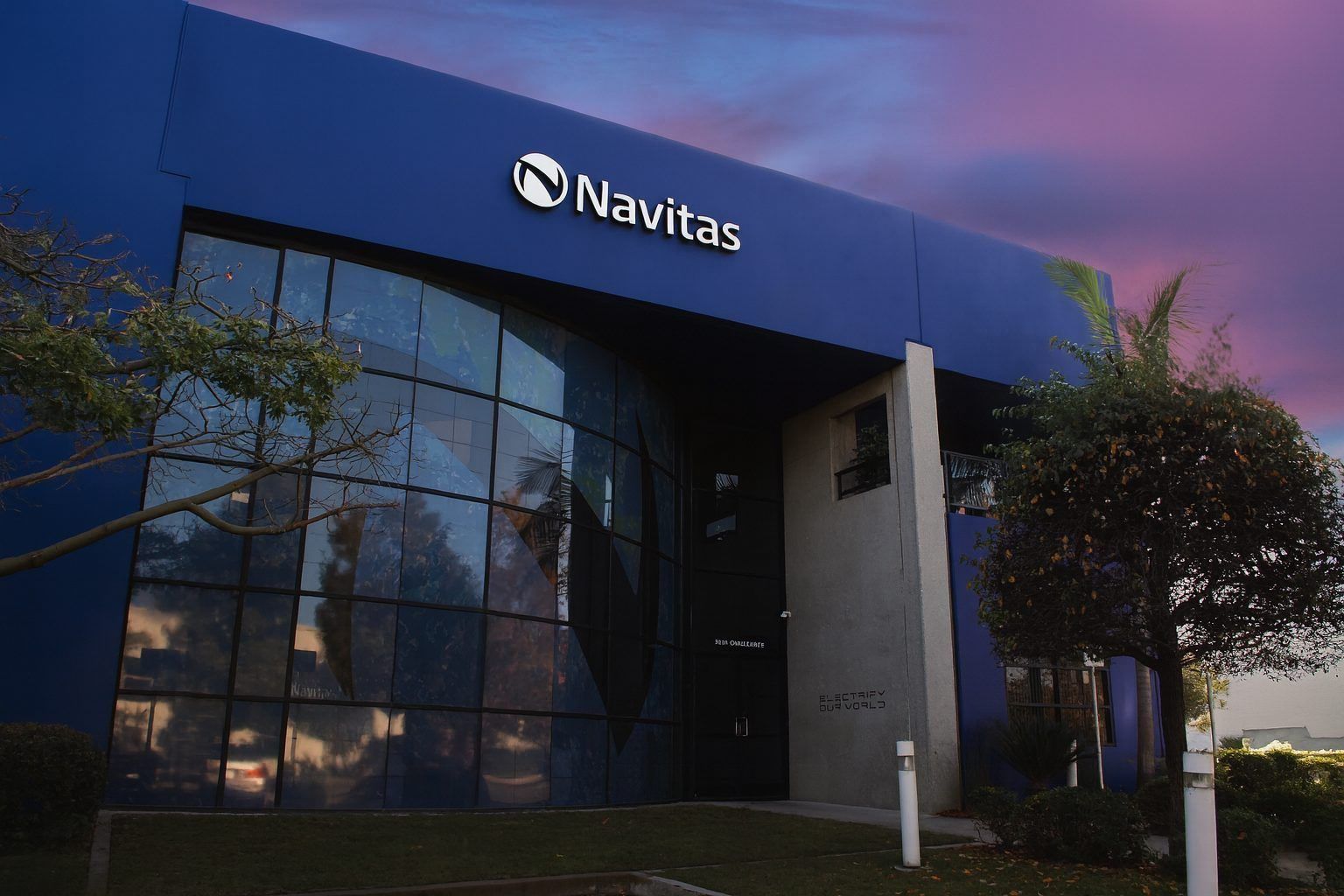

Navitas Semiconductor Corp. NASDAQ:NVTS ended Friday, December 5, 2025 around $9.48 per share, leaving the high‑beta power‑chip stock roughly 47% below its 52‑week high of $17.79 and more than 500% above its April low of $1.52.MarketBeat+1 That extreme range, combined with fresh research, AI trading signals and institutional filings published since 6 December 2025, has kept Navitas squarely on the radar of momentum traders and long‑term semiconductor investors alike.
At the same time, management’s “Navitas 2.0” strategy — a pivot away from low‑power mobile chargers toward high‑power gallium nitride (GaN) and silicon carbide (SiC) solutions for AI data centers, grid and energy infrastructure, and industrial electrification — is reshaping both the company’s fundamentals and its risk profile.Navitas Semiconductor+1 Below is a structured look at the latest news, forecasts and analyses around Navitas stock from 6 December 2025 onward, and how they fit into the broader story.
Navitas Semiconductor Stock Snapshot: Price, Performance and Volatility
- Last close: $9.48 (Dec 5, 2025, Nasdaq close).
- 52‑week range: $1.52 (Apr 4, 2025) to $17.79 (Oct 20, 2025).
- Distance from extremes: ~46.7% below the high and ~523.7% above the low.
- Market cap & risk: Around $2.2 billion market value, with a beta of ~3.1, underlining high volatility versus the broader market.
Despite a brutal 35% slide in November, Navitas shares remain up sharply for 2025; recent coverage notes the stock is up roughly 165% year‑to‑date, thanks largely to enthusiasm around its role in the AI and power‑electronics transition.
What Changed From 6 December 2025: Fresh Coverage and Signals
1. November’s Sell‑Off Under the Microscope
On 6 December 2025, new commentary focused on explaining why such a high‑flyer suffered a 35.1% drop in November, even as AI‑linked chip names stayed strong.
While full articles are partially paywalled, their headlines and summaries, combined with Navitas’ own Q3 numbers, point to a few key factors:
- Sharp revenue contraction: Q3 2025 revenue fell to $10.1 million, down from $21.7 million a year earlier and from $14.5 million in Q2, as Navitas actively deprioritized lower‑margin mobile and consumer business to pursue high‑power markets.
- Ongoing losses: GAAP operating loss for Q3 was $19.4 million, with non‑GAAP loss from operations at $11.5 million, underscoring that the growth pivot is still in the investment phase.
- Guidance reset: Management guided Q4 2025 revenue down further to about $7.0 million, plus or minus $0.25 million, while targeting improved non‑GAAP gross margins around 38.5%.
- Dilution worries: A $100 million private placement announced on November 7 added ~14.8 million new shares at $6.75, increasing the share count and heightening concerns about dilution.
Put together, investors are grappling with a classic “transition trough”: revenue is shrinking as old markets are deprioritized, while the high‑power AI and infrastructure businesses have yet to fully show up in the top line.
2. “Should You Buy Navitas Before 2026?” – The Fresh Bull Case
Also on December 6, a widely shared long‑form piece asked whether investors should buy Navitas Semiconductor stock before 2026, arguing that the company “could be about to experience incredible growth in the next five years” and highlighting how the stock has “skyrocketed in 2025.”The Motley Fool+2The Motley Fool+2
While the full text is behind a paywall, the bullish narrative lines up with other recent coverage:
- Articles syndicated across financial portals emphasize Navitas as a pure‑play on GaN and SiC, two wide‑bandgap technologies critical for next‑generation AI data centers, EVs, solar and industrial power.
- Navitas’ collaboration with NVIDIA is a centerpiece: the company is supplying 100 V and 650 V GaN devices and high‑voltage SiC products tailored to NVIDIA’s new 800 VDC AI factory power architecture, designed to move power efficiently “from the grid to the GPU.”Navitas Semiconductor+1
- Bulls argue that if Navitas can translate its design wins and partnerships into sustained revenue growth, the current revenue slump could be temporary, while the total addressable market in high‑power AI and energy is large.
In short, post‑December‑6 bullish commentaries frame NVTS as a high‑risk/high‑reward AI‑infrastructure power play, not a mature cash‑cow semiconductor.
3. AI & Quant Systems: Strong Short‑Term Momentum, Mixed Timeframes
Several quant and AI‑driven services updated their Navitas Semiconductor stock views on or around December 6:
- StockTradersDaily “Trading Systems Reacting to (NVTS) Volatility”:
- Near‑term (1–5 days): Strong bullish signal, with support around $8.52 and resistance in the $9.22 area.
- Mid‑term (5–20 days): Neutral, indicating possible consolidation.
- Long‑term (20+ days): Strong bullish signal, with resistance levels projected up toward the low‑teens.
- Danelfin AI rating (Dec 6 update):
- Assigns NVTS an AI Score of 7/10 (Buy), ranking it #34 of 107 in the semiconductor group and indicating relatively favorable combined fundamentals, technicals and sentiment.
- Investing.com technicals (Dec 6):
- A basket of indicators (RSI, MACD, CCI and others) collectively classify NVTS as a “Strong Buy” on the daily timeframe, with RSI(14) ~63 and multiple momentum indicators in “Buy” territory, although Williams %R shows the stock in overbought conditions.Investing.com
- CoinCodex short‑term price model (Dec 6):
- Algorithmic forecasts point to a flat to slightly negative short‑term outlook, with a near‑unchanged projection for “tomorrow” and a mild drop over the next week.CoinCodex
These models are not fundamental research, but they highlight an important nuance: technicals and AI scoring remain constructive even as many human analysts now see the stock as fully valued or ahead of its fundamentals.
Institutional Buying vs. Insider Selling
One of the most notable pieces of December 6 news was a MarketBeat report on institutional ownership:
- Cetera Investment Advisers increased its Navitas position by 662% in Q2, to 132,004 shares worth about $865,000, contributing to institutional ownership of roughly 46.1% of the float. Several other institutional holders, including Creative Planning and Geode Capital, also added to their positions.
At the same time, insiders have been net sellers:
- Navitas’ CFO Todd Glickman sold 96,313 shares at an average price of $10.56 in early November, a ~9.8% reduction in his holdings.
- Director Brian Long has sold a string of blocks, including 48,165 shares at $8.50 on December 3, and roughly 3.9 million shares over recent months, totaling about $27.6 million in proceeds.
- In the past 90 days, insiders have sold about 4.0 million shares worth approximately $28.6 million, though insiders still own just under 30% of the company.
For investors, this creates a mixed signal: institutional money is building positions, but key insiders are cashing out a meaningful amount of stock at prices below the 52‑week high but above the recent capital‑raise price.
Product and Strategic News: Building the High‑Power Portfolio
1. New 3.3 kV and 2.3 kV SiC Portfolio (Dec 1–2, 2025)
Just days before the latest stock commentary, Navitas announced sample availability of 3,300 V and 2,300 V ultra‑high‑voltage SiC devices based on its 4th‑generation GeneSiC Trench‑Assisted Planar (TAP) MOSFET technology.
Key points from the December 1 company release and December 2 trade‑press coverage:
- Devices are offered as power modules, discrete devices and known‑good die (KGD), targeting AI data center solid‑state transformers, utility‑scale energy storage, renewable generation and megawatt‑class fast‑charging.
- The TAP architecture uses a multi‑step electric‑field management profile to reduce voltage stress, improve blocking capability and boost avalanche ruggedness versus conventional trench or planar MOSFETs.
- New SiCPAK G+ power modules combine advanced potting techniques, AlN DBC substrates and high‑current press‑fit pins, with trade‑press tests suggesting >60% improvement in power‑cycling lifetime and >10× thermal‑shock reliability versus traditional modules.
- Navitas also introduced AEC‑Plus, an extended qualification benchmark that goes beyond standard AEC‑Q101 and JEDEC requirements, positioning these devices for mission‑critical grid and energy‑infrastructure lifetimes.
Simply Wall St’s December 5 article, “Does Navitas Have a Durable Edge With Its New AEC‑Plus SiC Strategy?”, argues that these launches reinforce the long‑term investment narrative — high‑reliability SiC for AI and energy infrastructure — but don’t eliminate near‑term risks from ongoing losses and potential dilution.Simply Wall St
2. Distribution and Manufacturing: WT Microelectronics and GlobalFoundries
Two November press releases are central to the “Navitas 2.0” story and are heavily referenced in December analyses:
- WT Microelectronics partnership (Nov 27, 2025):
- Navitas consolidated its Asian distributor base and expanded its deal with WT Microelectronics, which will now lead customer engagement and design‑in activity in Asia for high‑power GaN and SiC devices, backed by regional logistics and technical support.
- Management describes this as part of a “massive consolidation” of distribution focused on AI data centers, energy infrastructure and industrial electrification customers.Navitas Semiconductor
- GlobalFoundries GaN partnership (Nov 20, 2025):
- Navitas and GlobalFoundries (GF) announced a long‑term strategic partnership to strengthen U.S. GaN technology and manufacturing. Production on advanced GaN‑on‑Si processes is planned at GF’s Burlington, Vermont fab, with development in early 2026 and production later in the year.
- The collaboration targets AI data centers, performance computing, grid infrastructure and industrial electrification, explicitly tying into U.S. supply‑chain and national‑security objectives.
Recent trading commentary on December 4 notes that Navitas shares were up nearly 7% intraday as markets reacted to these strategic moves plus the private placement, while also highlighting improved liquidity (quick ratio ~7.1) but deeply negative EBIT and net margins.
3. NVIDIA’s 800 VDC AI Factory Architecture
The October 13 press release, frequently referenced in December research, details how Navitas supplies new 100 V GaN FETs, high‑power 650 V GaN devices and high‑voltage SiC products for NVIDIA’s 800 VDC “AI factory” power architecture.Navitas Semiconductor+1
The architecture:
- Enables direct conversion from 13.8 kVAC utility to 800 VDC using solid‑state transformers and high‑efficiency rectifiers, then two high‑efficiency DC‑DC stages down to GPU voltages.
- Targets multi‑megawatt rack power in next‑generation AI data centers, where efficiency and power density are critical.
For investors, this NVIDIA alignment underpins many of the optimistic 2025 articles describing Navitas as a leveraged pick‑and‑shovel play on AI compute buildout.
Financial Performance: A Deep Transition Trough
Q3 2025 Results and Q4 Outlook
Navitas’ Q3 2025 earnings release (Nov 3) frames the current year as a deliberate reset:
- Revenue: $10.1 million (vs. $21.7 million in Q3 2024 and $14.5 million in Q2 2025).
- GAAP loss from operations: $19.4 million, improved from a $29.0 million loss a year earlier.
- Non‑GAAP loss from operations: $11.5 million, slightly improved vs. Q3 2024 but worse than Q2 2025.
- Cash: $150.6 million on the balance sheet as of September 30, before the November $100 million raise.
- Q4 guide: revenue around $7.0 million, with improved non‑GAAP gross margin (~38.5%) and operating expenses near $15 million as the company shrinks its low‑power mobile exposure and streamlines distribution.
The earlier Q2 2025 release (August 4) already signaled this pivot: revenue was $14.5 million, down from $20.5 million a year earlier, and management announced an increased focus on AI data centers and energy infrastructure, a $100 million capital raise and a new low‑cost 8‑inch GaN foundry partner.
Third‑party commentary after December 6 emphasizes that, over the last three years, revenue is up nearly 20% but profitability remains deeply negative, with recent articles citing a 24.2% gross margin, EBIT margin of around –136% and net margin near –183%.
Analyst Forecasts: Consensus Sees Downside From Current Levels
Multiple forecast aggregators updated their Navitas Semiconductor stock views around December 6–7, 2025. While methodologies differ, a consistent pattern emerges: targets are generally below the current share price.
1. MarketBeat (Dec 6)
- Coverage: 9 Wall Street analysts.
- Consensus rating:Hold (2 Sell, 5 Hold, 2 Buy).
- Average 12‑month price target:$6.48, implying about 32% downside from $9.48.
- Target range:$3.50 to $13.00.
2. ValueInvesting.io
- Coverage: 15 analysts.
- Consensus recommendation:HOLD.
- Average target:$8.44 (about –11% implied downside).
- Range:$4.24–$13.65, with community and analyst “fair value” estimates clustering around $8–$8.3 per share.ValueInvesting+1
- Forecasts also call for revenue to drop to ~$46.5 million in 2025, down more than 40% from 2024, with a further dip modeled for 2026 before recovery, and EPS remaining negative through at least next year.
3. TickerNerd
- Coverage: 11 analysts.
- Consensus:Neutral, with 2 Buy, 5 Hold, 1 Sell (some ratings overlapping in methodology).
- Median target:$8.00 (range $4.20–$13.00), implying around –15.6% downside from $9.48.
4. Public.com (Retail‑Focused Aggregator)
- Coverage: 5 analysts (as of Dec 7, 2025).
- Consensus rating:Hold.
- Average price target:$6.50, again below the current share price.
5. StockAnalysis.com
Curiously, StockAnalysis shows a more positive rating but still low targets:
- Coverage: 6 analysts.
- Consensus rating:“Buy”, implying expectations of market outperformance.
- Average target:$5.92, which actually implies about –37.6% downside from $9.48 (target range $1.50–$13.00).
Across these sources, the blended message is:
Analysts like the long‑term technology story but believe the stock price is ahead of near‑term fundamentals.
Most Wall Street models embed continued losses, one to two years of revenue pressure, and only gradual improvement in EPS, which leads to target prices in the mid‑single‑ to high‑single‑digit range, versus a current price near $9.50.
Independent Valuation Narratives
Simply Wall St’s December 5 narrative piece on Navitas’ new SiC strategy provides a useful consolidated view:
- Their long‑term model projects revenue rising to about $129.8 million and earnings to $18.3 million by 2028, implying ~24% annual revenue growth and a swing of more than $140 million from current losses.
- Based on those assumptions, they highlight an implied “fair value” around $8.28 per share, roughly 12% below current levels.Simply Wall St
- The article stresses that to justify today’s price, investors must believe Navitas can:
- Turn current design wins in AI data centers, EVs and grid infrastructure into sustained, higher‑margin revenue, and
- Avoid excessive shareholder dilution while funding that growth.
This mirrors the broader market debate: if Navitas executes, the upside could be substantial — but a lot of optimism is already priced in.
Technical Picture and Risk Profile
Recent datapoints paint Navitas as a high‑momentum but high‑risk equity:
- 52‑week move: from $1.52 to $17.79, now settled in the mid‑$9 range.
- Volatility & beta: beta around 3.14, implying moves roughly three times more volatile than the broader market.
- Technical scorecards: multiple indicator sets (RSI, MACD, oscillators) currently read “Buy” or “Strong Buy” on daily timeframes.Investing.com+2Danelfin AI+2
Traders are effectively betting that Navitas’ AI and SiC story is strong enough to sustain momentum, while fundamental analysts remain more cautious.
Bull vs. Bear Case for Navitas Semiconductor Stock (Late 2025)
Bull Case – Why Optimists Like NVTS
- Pure‑play on wide‑bandgap power: Navitas is focused on GaN and SiC, the two technologies widely seen as critical for high‑efficiency power conversion in AI data centers, EVs, renewables and industrial systems.
- NVIDIA and AI factory leverage: Being recognized as a power semiconductor partner for NVIDIA’s 800 VDC AI factory architecture gives Navitas both credibility and a potential growth runway if AI compute build‑outs continue.
- Ultra‑high‑voltage SiC portfolio: The new 3.3 kV and 2.3 kV SiC modules, plus AEC‑Plus qualification and SiCPAK G+ packaging, position Navitas for mission‑critical grid, storage and energy applications where reliability and lifetime performance are paramount.
- Strengthened ecosystem: Partnerships with GlobalFoundries (U.S. GaN manufacturing) and WT Microelectronics (Asian distribution), combined with a $100 million cash infusion, aim to secure capacity, supply chain and go‑to‑market for high‑power growth.
Bear Case – Why Skeptics Urge Caution
- Steep revenue decline: Forecasts from multiple data providers expect 2025 revenue to fall 40–45% vs. 2024, with only modest growth modeled for 2026.
- Persistent losses: Even optimistic forecasts keep EPS negative through at least 2026, and Q3 showed large GAAP and non‑GAAP operating losses despite cost‑cutting.
- Dilution and insider selling: The $100 million private placement at $6.75 per share, plus heavy insider selling over the past 90 days, raises questions about shareholder dilution and management’s confidence at current prices.
- Valuation vs. targets: Almost every major forecast aggregator shows average price targets below the current share price, often by double‑digit percentages, even when the formal rating is “Buy” or “Hold.”StockAnalysis+4MarketBeat+4ValueInvesting+4
In other words, Navitas has a compelling technology story but an execution and valuation challenge.
Key Things NVTS Investors Are Watching Heading Into 2026
Based on the latest research since 6 December 2025, several catalysts stand out:
- Q4 2025 and FY 2025 Results
- Whether revenue bottomed around the guided $7 million and how quickly the company can grow again in 2026 will be critical for re‑rating the stock.
- Design‑Win Traction in AI Data Centers and Grid Infrastructure
- Investors are looking for concrete evidence that NVIDIA‑related and other high‑power design wins are translating into order backlog and revenue, not just press releases.
- SiC Portfolio Adoption
- How quickly customers in energy storage, renewables, fast charging and utility‑scale infrastructure adopt the new 3.3 kV/2.3 kV SiC modules — and at what margins — will shape medium‑term financials.
- Capital Allocation and Dilution
- After the $100 million private placement, the market will be sensitive to any further equity raises and to how efficiently Navitas deploys this capital to drive profitable growth.
- Institutional vs. Insider Flows
- Ongoing 13F filings and insider‑trading reports will be watched closely to see whether institutional accumulation continues and whether insider selling slows.
Quick FAQ for SEO (Not Investment Advice)
Is Navitas Semiconductor (NVTS) stock a buy right now?
Analyst consensus across several platforms leans between Hold and cautious Buy, with average price targets in the $6–$8.50 range, below the current ~$9.50 share price.StockAnalysis+4MarketBeat+4ValueInvesting+4 Bullish theses focus on AI data centers and ultra‑high‑voltage SiC, while bearish views emphasize revenue decline, ongoing losses, dilution and insider selling.
Why did Navitas Semiconductor stock crash in November 2025?
Coverage on December 6 links the roughly 35% November drop to a combination of disappointing revenue trends, cautious Q4 guidance and the dilutive $100 million share offering, all coming after a huge year‑to‑date rally.
What kind of stock is NVTS: growth, value or speculative?
Based on current fundamentals and forecasts — negative earnings, shrinking near‑term revenue, significant dilution but large long‑term AI and energy opportunities — Navitas is best described as a speculative growth stock in a strategic niche of the semiconductor market.
Bottom line:
Since 6 December 2025, new research, AI‑driven models and institutional‑flow data have sharpened the market’s view of Navitas Semiconductor stock. The technology and strategic positioning look stronger than ever, but Wall Street’s models and insider behavior suggest that much of this optimism may already be reflected in the share price. Anyone considering NVTS should weigh the high volatility and execution risk against the potential payoff if Navitas’ GaN and SiC roadmap successfully powers the next generation of AI and energy infrastructure.
This article is for informational purposes only and does not constitute financial or investment advice.
Related articles: NASDAQ:NVTS