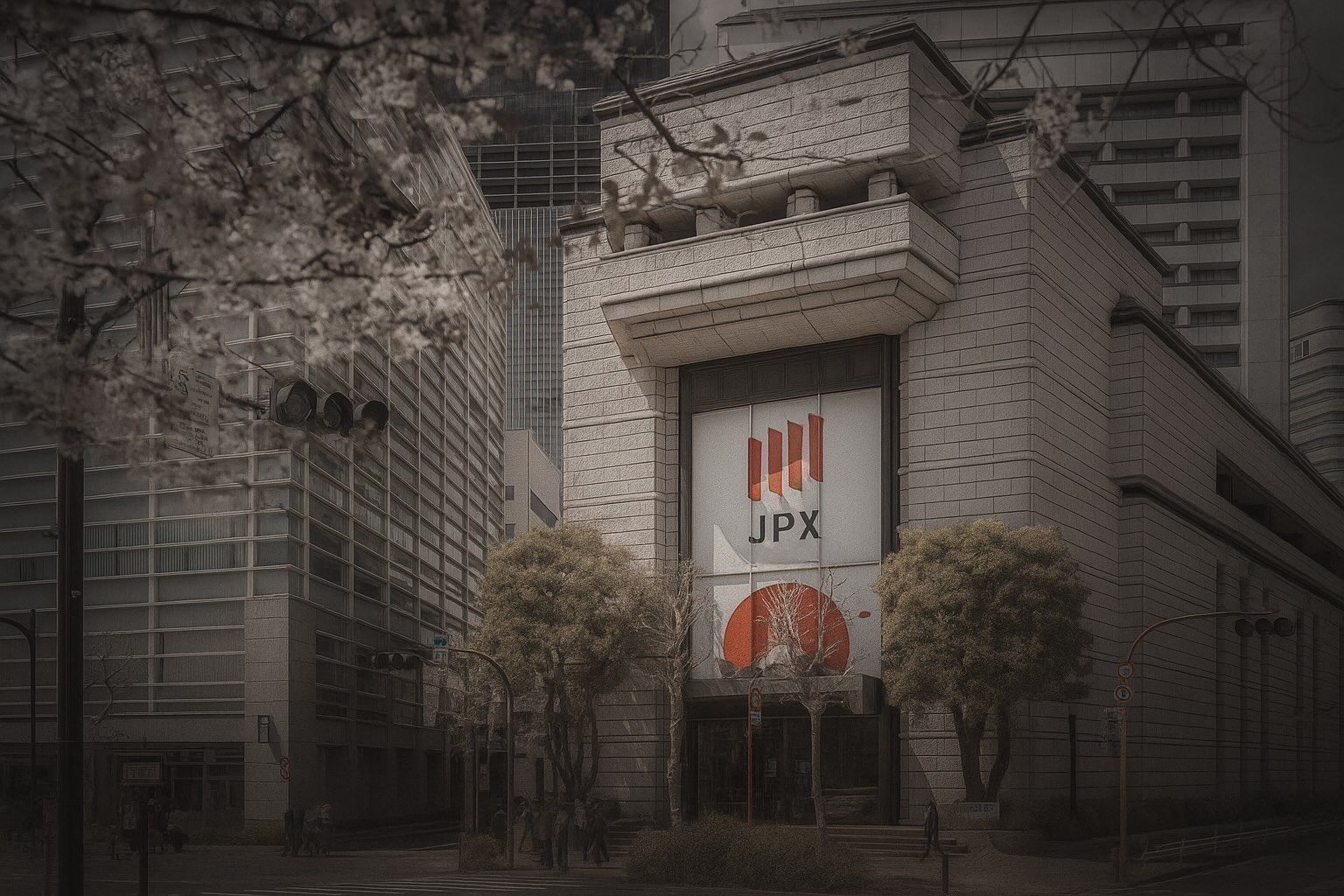
Japan’s stock market is ending 2025 on a high‑wire act.
The Nikkei 225 closed today at 50,581.94 points, up 0.18%, keeping the index close to record territory after breaking above the old bubble‑era peak earlier this year. Nikkei Indexes+1 Yet beneath the headline, leadership is shifting: big tech and chip names are wobbling on valuation worries, while real‑estate and infrastructure plays are quietly taking the lead. Fujikura jumped about 5–6% and Fuji Electric over 4% today, helping make real estate the best‑performing TSE sector even as heavyweight growth stocks slipped.
At the same time, Japan’s Q3 GDP was revised to a sharp annualised contraction of –2.3%, the worst since 2023, largely on weaker capital expenditure. Yet economists still expect the Bank of Japan (BOJ) to move ahead with another rate hike, likely in December or early 2026. Reuters+2AP News+2 That mix—cyclical slowdown plus policy normalisation—makes stock selection on the Tokyo Stock Exchange (TSE) more important than ever.
Below is a news‑driven, SEO‑optimised look at 10 Tokyo‑listed stocks many investors are watching as potential buys today, based on developments and data available on December 8, 2025.
Important: This article is for information and education only, not personalized investment advice. All prices, yields and returns are approximate and based on intraday or recent data as of December 8, 2025, and may change quickly. Always do your own research or consult a licensed adviser before investing.
1. Fujikura (5803.T) – Cables and Fiber for the AI Data‑Center Boom
Theme: AI infrastructure, power & communications
Profile: Fujikura makes power cables, optical fiber, and wiring harnesses used in data centers, renewable energy and autos.
- Fujikura has been one of the standout performers on the TSE in 2025, with Reuters noting that its shares have surged around 160% year‑to‑date on the back of AI data‑center and high‑voltage grid demand.
- Today, the stock rose another ~5–6%, while the real‑estate sector led gains and big chip names sagged.
- Over the last 12 months, Fujikura’s share price has swung in a huge 52‑week range from roughly ¥3,600 to above ¥21,000, underlining both the growth story and the volatility.
Fundamentally, Fujikura’s restructuring and a pivot to high‑margin data‑center and grid projects have driven revenue and profit growth; investor blogs tracking Japanese dividends note that EPS and cash flow have improved markedly in 2024–2025 as legacy businesses were cleaned up.
Why investors like it now
- Direct play on AI and electrification: High‑voltage cables, optical fiber and interconnects are mission‑critical for hyperscale data centers and renewable energy grids—two capex areas still growing even as other industrial demand softens.
- Turnaround story: Improved margins and balance‑sheet repair have turned Fujikura into a credible growth story rather than a deep‑value recovery bet.
Key risks
- After a ~160% run, the valuation and expectations are elevated; any slowdown in AI or grid spending could trigger a sharp pullback.
- Highly cyclical end markets and Japan’s macro slowdown add uncertainty.
2. Fuji Electric (6504.T) – Powering Data Centers and Semiconductor Fabs
Theme: Power electronics, energy infrastructure, semiconductors
Profile: Fuji Electric sells power semiconductors and equipment used in data centers, factories and utilities.
- Today Fuji Electric’s shares climbed around 4%, making it one of the day’s top performers on the Nikkei as investors rotated into infrastructure‑linked names.
- The stock now trades near ¥11,300, close to its 52‑week high of ¥11,690 and well above its low around ¥4,620. It has gained roughly 25% over the past year.
- Fuji Electric’s latest financials show revenue above ¥1.1 trillion and earnings up more than 20% year‑on‑year, with a forward P/E around the high teens and a dividend yield near 1.6–1.7%.
Company presentations highlight sustained demand for data‑center power equipment, power conditioning systems for renewable energy, and equipment for semiconductor fabs, positioning the firm at the intersection of multiple structural growth themes.
Why investors like it now
- Leverage to AI and electrification: As data centers and chip plants proliferate, Fuji Electric’s power electronics are seeing strong order momentum.
- Solid, not extreme, valuation: A P/E near the high‑teens is a premium to the Topix average but more moderate than some high‑flying chip stocks.
Key risks
- Exposure to global capex cycles means earnings could fall if data‑center and fab investment slows.
- Recent price strength leaves less margin of safety if Japan’s economy stays weak.
3. Tokyo Electron (8035.T) – Core Nikkei Chip Giant With High Expectations
Theme: Semiconductor equipment, AI & HPC manufacturing
Profile: Tokyo Electron is Japan’s flagship maker of wafer‑fab equipment used by leading chipmakers worldwide.
- Today, Tokyo Electron closed around ¥33,160, only slightly higher on the day but up almost 10% over the past two weeks.
- Technical analysis service StockInvest.us currently classifies 8035.T as a short‑term “buy candidate”, projecting that, based on recent trends, the stock could gain roughly 35% over the next three months, albeit with notable volatility. StockInvest
- On the other hand, one fundamental model (Peter‑Lynch‑style fair value) estimates fair value at about ¥28,700 versus today’s price above ¥33,000, implying the shares trade at a roughly 13% premium to that metric.
Tokyo Electron sits at the heart of the global AI and advanced‑logic build‑out, and the Nikkei Semiconductor Stock Index is up strongly this year, reflecting massive investor enthusiasm for chip equipment.
Why investors like it now
- Pure‑play on global chip capex: If AI server and advanced process spending stay strong into 2026–27, Tokyo Electron stands to benefit directly.
- Strong momentum: The stock has rebounded from earlier volatility and is trending higher into year‑end.
Key risks
- Multiple news pieces highlight “valuation worries” around Japan’s high‑growth tech names, and Tokyo Electron is a prime example—premium valuations could compress if earnings disappoint or global growth slows. mint+2Kitco+2
- Highly cyclical; historically, chip‑equipment names can fall sharply when orders turn.
For many investors, Tokyo Electron looks like a high‑quality but not obviously cheap way to play the AI cycle—more suited to those comfortable with volatility.
4. Renesas Electronics (6723.T) – Auto Chips, AI and Portfolio Reshaping
Theme: Automotive & industrial semiconductors, portfolio optimisation
Profile: Renesas is a major global supplier of microcontrollers and power management ICs, especially for autos and industrial equipment.
- Today’s share price is around ¥2,108, with a day range of roughly ¥2,032–2,116 and a 52‑week range of ¥1,320–2,750.
- The stock has delivered mid‑single‑digit percentage gains over the last year, a modest return compared with some other chip plays.
- Renesas recently announced a ¥28 per‑share dividend to be paid in March 2026, equating to a forward yield around 1.3–1.5% at current prices with an ex‑dividend date late December 2025.
Strategically, the company is exploring a sale of its timing‑chip division for about $2 billion, in order to free capital and refocus on core auto and industrial markets that management sees as higher priority.
Renesas has also absorbed a one‑off loss of roughly ¥235 billion related to funds deposited with Wolfspeed, which entered Chapter 11 restructuring—one reason current reported earnings and P/E metrics look distorted.
Why investors like it now
- Leveraged to auto electrification and industrial automation, both structural growth stories even if the broader economy wobbles.
- Portfolio cleanup (timing‑unit sale) could surface value and simplify the equity story.
Key risks
- Short‑term earnings are clouded by restructuring charges and the Wolfspeed‑related loss.
- Demand for some chip categories remains cyclical; Renesas has already announced plans to cut several hundred jobs amid weak demand earlier in 2025.
Renesas can make sense for investors who want exposure to auto and industrial chips but are willing to tolerate restructuring noise.
5. Sumitomo Mitsui Financial Group (8316.T) – Rate‑Hike Winner at Reasonable Valuation
Theme: Japanese banking, rising interest rates, shareholder returns
Profile: SMFG is one of Japan’s three “megabanks,” with global corporate, retail and investment banking operations.
- Since early 2024, SMFG’s share price has risen about 80%, while MUFG is up ~90% and Mizuho around 105%, versus roughly 39% for the Topix index, reflecting a powerful re‑rating as Japan exited negative rates.
- As of early December, SMFG trades on a trailing P/E around 13–14 and offers a forward dividend yield around 2.7–2.8%, with solid recent dividend growth.
- Analysts and S&P Global note that SMFG and peers have raised full‑year profit forecasts to record levels, expecting BOJ policy rates to rise from 0.5% to around 0.75% in the current fiscal year.
Why investors like it now
- Direct beneficiary of higher interest rates: After nearly two decades of zero or negative rates, even modest hikes materially lift banks’ net interest margins.
- Still not “bubble‑priced”: Despite big share‑price gains, megabanks are trading around or just above book value, cheaper than many US and European peers on price‑to‑book and P/E metrics. Morningstar+1
Key risks
- A deeper or prolonged GDP slump could pressure loan growth and credit quality, offsetting the benefit of higher rates.
- Policy risk: if the BOJ tightens more slowly than markets expect, rate‑hike optimism could unwind.
For income‑oriented investors, SMFG is often seen as a relatively straightforward way to play Japan’s shift away from ultra‑easy money.
6. Mitsubishi UFJ Financial Group (8306.T / MUFG) – Japan’s Banking Flagship
Theme: Global banking, buybacks and record profits
Profile: MUFG is Japan’s largest financial group, with a huge domestic franchise and significant overseas operations.
- MUFG has raised its profit forecast to about ¥2.1 trillion for the year ending March 2026, a record level, and has stepped up share buybacks and dividends.
- Its Tokyo‑listed shares recently traded around ¥2,530, while the New York–listed ADR (MUFG) changes hands near $16.30 with a forward dividend yield of roughly 3.3%.
- The group is also undergoing leadership transition, with Mitsubishi UFJ Bank president Junichi Hanzawa slated to become MUFG group president next spring, signalling continuity in strategy.
Why investors like it now
- Scale and diversification: MUFG’s global footprint and fee businesses offer more levers than domestic‑only banks.
- Capital returns: Management has shown willingness to return capital via buybacks and dividends as profitability improves.
Key risks
- Global credit and market risk: MUFG’s overseas operations mean it’s exposed to US and Asian credit cycles as well as Japan’s.
- As with SMFG, a policy mis‑step by the BOJ or a sharper domestic downturn could hit earnings.
Many international investors treat MUFG as the core “blue‑chip” bank holding in Japan, pairing it with one of the other megabanks for diversification.
7. Mitsui Fudosan (8801.T) – Blue‑Chip Developer in a Reflating Property Market
Theme: Japanese real estate, reflation, moderate yield
Profile: Mitsui Fudosan is one of Japan’s top property developers, active in offices, retail, logistics and mixed‑use complexes.
- As of December 8, 2025, Mitsui Fudosan sports a dividend yield around 1.9–2.0%, with an annual dividend of ¥34 per share and a relatively low payout ratio near 28%.
- YTD returns are strong—over 45% according to Yahoo’s trailing figures—reflecting both rising real‑estate values and investor enthusiasm for reflation.
- Market research from Morningstar and others notes that Japanese commercial property looks supported by tight vacancy rates, long leases and gradual rent increases, even as global property markets elsewhere remain shaky.
Why investors like it now
- Reflation & rate‑hike hedge: Moderate inflation and rising wages help landlords, and many analysts expect Japanese real estate to be a long‑term winner of the post‑deflation regime, especially in prime Tokyo locations.
- Balance between growth and income: Yield is not high, but dividend growth and asset values offer total‑return potential.
Key risks
- Higher interest rates increase funding costs and could eventually pressure capitalisation rates.
- A more prolonged GDP downturn or renewed remote‑work trend could hurt office demand.
8. Mitsubishi Estate (8802.T) – Defensive Developer with Buybacks
Theme: High‑quality office & mixed‑use real estate, capital returns
Profile: Mitsubishi Estate owns and develops many marquee office and commercial properties in central Tokyo and overseas.
- The stock currently offers a dividend yield around 1.25–1.30%, with a ¥46 annual dividend and a payout ratio around 27%.
- In 2025 Mitsubishi Estate announced multiple share‑buyback programs, including one for about 4.8% of shares worth ¥100 billion, underlining management’s focus on shareholder returns.
- Like Mitsui Fudosan, it is a key beneficiary of Tokyo’s resilient office market and large redevelopment pipeline.
Why investors like it now
- Quality assets in prime locations tend to hold value even in downturns.
- Combination of steady dividends and buybacks can support per‑share earnings and net asset value over time.
Key risks
- Yields are modest compared with REITs, so a lot of the thesis depends on continued NAV growth and successful projects.
- As with all property developers, more aggressive rate hikes could pressure valuations.
9. Listed Index Fund J‑REIT (1345.T) – High‑Yield Access to Japanese REITs
Theme: Income‑oriented real‑estate exposure via ETF
Profile: 1345.T is an ETF that tracks the Tokyo Stock Exchange REIT Index, holding a diversified basket of Japanese real‑estate investment trusts.
- Over the past year, the ETF has returned about 20–24%, with YTD returns near 22%, outpacing many global REIT markets.
- The fund currently offers a dividend yield around 4%, with quarterly distributions and an expense ratio around 0.36%.
- Research on the TSE REIT index notes that rental income growth and still‑modest long‑term rates have supported stable performance despite global property jitters.
Why investors like it now
- Simple, diversified way to play Japanese property without having to pick individual REITs or developers.
- Attractive yield vs Japanese government bonds, which still offer relatively low nominal returns even after rate hikes.
Key risks
- Sensitive to interest‑rate expectations; a faster BOJ tightening cycle could pressure REIT valuations.
- Hotel and retail‑heavy REITs remain vulnerable if domestic consumption weakens or tourism slows.
10. Japan Tobacco (2914.T) – High Dividend at (Near) All‑Time Highs
Theme: High‑yield dividend, consumer staples, controversial ESG profile
Profile: Japan Tobacco (JT) is a global tobacco and nicotine‑products company, also active in pharmaceuticals and processed foods.
- JT’s stock recently hit an all‑time high around ¥5,916 and is now trading only a couple of percent below that, around ¥5,800–5,900.
- Over the last month, the stock is up around 10–11%, and year‑to‑date it has gained roughly 30%+, slightly ahead of the Nikkei 225.
- Various data providers put JT’s dividend yield in the 3.4–4.5% range, with the next ex‑dividend date on December 29, 2025 and semi‑annual payments.
Fundamentally, JT reported a 9.7% increase in annual adjusted operating profit in its tobacco division and expects core revenue up around 6.9% and operating profit up over 8% in 2025, driven by price increases and acquisitions despite slowly declining cigarette volumes.
Recent commentary also notes that analyst price targets have drifted higher and that the stock has delivered a roughly 20% gain over the past three months, supported by solid return on equity.
Why investors like it now
- High, relatively stable dividend yield in a low‑rate country.
- Pricing power and strong brands help offset declining volumes; management is investing in reduced‑risk products to extend the franchise.
Key risks
- Significant regulatory and ESG risks: tobacco faces tightening rules globally, and many institutional investors avoid the sector entirely.
- At or near all‑time highs, any earnings disappointment could trigger a sharp correction.
For investors comfortable with the ethical and regulatory profile, JT is often seen as a core high‑yield income stock in Japan—but it’s not suitable for everyone.
Market Backdrop: Why Japan Still Looks Interesting into 2026
Despite today’s GDP downgrade, several medium‑term forces continue to support the case for Japanese equities:
- Corporate governance and shareholder‑return reforms
- The Tokyo Stock Exchange has pushed companies with chronically low price‑to‑book ratios to improve capital efficiency, spurring buybacks and higher dividends.
- Analysts note that Japan’s average valuations remain below US levels despite the Nikkei’s record highs.
- Reflation and BOJ normalisation
- After years of deflation, wages and prices are finally rising, creating a more normal interest‑rate environment that tends to favour banks, insurers and quality income stocks.
- Sector leadership rotation
- Recent sessions show big tech and some chip names under pressure on valuations, while real estate, infrastructure and value‑oriented financials outperform, especially on days like today when Fujikura and Fuji Electric lead the market.
For investors building a Tokyo‑focused portfolio, that suggests balancing high‑growth AI and semiconductor stories with more reasonably valued banks, developers and high‑yield names.
How to Use This List (and What to Watch Next)
- Match ideas to your risk profile
- High‑beta growth: Fujikura, Tokyo Electron, Lasertec (noted but very expensive) and Renesas all sit in the volatile tech/AI bucket.
- Cyclical value & rate plays: SMFG and MUFG benefit from higher interest rates and corporate lending.
- Property & income: Mitsui Fudosan, Mitsubishi Estate, 1345.T (J‑REIT ETF) and Japan Tobacco lean more toward real assets and dividends.
- Monitor key catalysts into early 2026
- BOJ meetings and wage negotiations (shuntō) will shape the pace of rate hikes—critical for banks and REITs.
- US Federal Reserve decisions and global AI‑chip demand will drive sentiment around Tokyo Electron, Renesas and related names.
- Earnings updates and guidance revisions from megabanks, developers and JT will show whether 2025’s profit boom is sustainable.
- Diversify, don’t bet the farm on one theme
Even within Japan, 2025 has shown how quickly leadership can shift—from exporters to banks, from chipmakers to real estate. A blend of sectors and styles is usually safer than a single concentrated bet.
If you tell me your risk tolerance (conservative / balanced / aggressive) and investment horizon, I can help you turn these 10 names into a sample watchlist or model allocation—while staying strictly informational, not advisory.