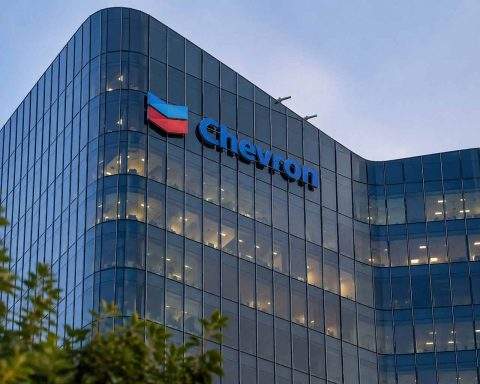

Chevron Corporation NYSE:CVX enters the second week of December trading around $150 per share, giving the oil major a market capitalization of roughly $300 billion and a dividend yield close to 4.6%.TradingView+1 At the same time, oil prices have slipped back toward the low $60s, and Chevron has just rolled out a 2026 spending plan, new international projects and fresh long‑term cash‑flow guidance that together frame the stock’s risk–reward profile going into 2026.
Below is a detailed look at Chevron’s latest stock performance, news, forecasts and analysis as of December 8, 2025.
Chevron stock today: price, performance and valuation
Real‑time quotes show Chevron stock trading at about $149–150 on Monday, December 8, 2025. TradingView pegs the latest price at $149.85, down about 1.5% over the past 24 hours, while StockAnalysis shows $149.47 as of 10:11 a.m. EST.
Key snapshot metrics:
- Market cap: about $302 billionTradingView
- Trailing P/E: ~21–24x, depending on source and time of quoteTradingView+1
- Dividend yield (trailing):4.56–4.58%TradingView+1
- 52‑week range: roughly $132 to $169 per shareInvesting.com
- 1‑year performance: about ‑5–6%, while the last six months are modestly positive.
Technical indicators on TradingView currently flash a “sell” to “strong sell” rating on daily and one‑month timeframes, reflecting the recent pullback and weak near‑term momentum despite a still‑elevated valuation versus sector peers.TradingView+1
Simply Wall St’s latest valuation piece (Dec. 7) estimates a fair value near $173 per share, implying the stock is about 13% undervalued, but also notes that Chevron’s P/E around 23.7x screens expensive relative to the broader U.S. oil and gas group at 13.8x.
Macro backdrop: oil prices slide as markets eye Fed cut and Ukraine talks
Chevron’s stock continues to trade against a softer commodity backdrop:
- On December 8, Brent crude trades near $63.18 per barrel and WTI around $59.51, both down roughly 1% on the day.
- The move comes as investors watch Ukraine peace talks and price in a high probability of a U.S. Federal Reserve rate cut this week, which could influence global growth and energy demand.
- Analysts quoted by Reuters warn that a ceasefire in Ukraine could ultimately increase Russian exports and push oil gradually toward $60 per barrel through 2026, highlighting oversupply risk.
At the same time, Chevron’s own messaging is more constructive: management has repeatedly argued there is a “need for significant investment” to avoid a structural supply gap, and plans to grow oil and gas output 2–3% annually through 2030 even at moderate oil prices.Reuters+1
Q3 2025 earnings: record production and solid cash flow
Chevron’s Q3 2025 report, released on October 31, set the stage for the latest investor debate:
- Reported earnings:$3.5 billion (GAAP) or $1.82 per diluted share
- Adjusted earnings:$3.6 billion, or $1.85 per share, beating the Street’s ~$1.68 consensus.
- Production: a record 4.1 million barrels of oil equivalent per day (boe/d), up 21% year‑on‑year, largely due to the $55 billion Hess acquisition, which brought a 30% stake in Guyana’s prolific Stabroek block and Bakken shale assets.
- Cash flow from operations: about $9.4–9.9 billion, with adjusted free cash flow roughly $7 billion for the quarter.
- Segment trends: upstream earnings fell about 28% on lower oil prices, while downstream profit jumped roughly 91% on stronger refining margins and lower operating costs.
- Shareholder returns: roughly $3.4 billion in dividends and $2.6 billion in share buybacks during the quarter.
Chevron will next report earnings around January 30, 2026, with consensus EPS estimates near $1.58 for Q4.
2026 capex plan and long‑term cash‑flow guidance
The biggest strategic news for Chevron investors heading into 2026 is the company’s updated spending and growth roadmap.
Capex: $18–19 billion in 2026, at the low end of guidance
On December 3, Chevron announced an organic capital expenditure budget of $18–19 billion for 2026, plus $1.3–1.7 billion of affiliate capex — placing total planned investment at the low end of its previously guided $18–21 billion annual range through 2030.
Reuters and Nasdaq summaries highlight how that capital is allocated:Reuters+1
- About $17 billion will go to upstream
- Roughly $9–10.5 billion earmarked for the United States, including nearly $6 billion for shale and tight oil in the Permian, DJ and Bakken plays
- Roughly $7 billion for offshore growth in Guyana, the Eastern Mediterranean and the U.S. Gulf of Mexico
- Only about $1 billion is slated for downstream (refining and chemicals), slightly lower than 2025 levels
Management describes this as a “highest‑return opportunities” program focused on low‑cost barrels while maintaining capital discipline.
Investor day: targeting >10% annual FCF and EPS growth to 2030
At its Investor Day on November 12, Chevron laid out an aggressive long‑term plan:Stock Titan+3Reuters+3chevron.com+3
- Adjusted free cash flow (FCF) growth >10% annually through 2030 at $70 Brent
- EPS growth also >10% per year at the same oil price assumption
- Capex guidance cut to $18–21 billion per year, from a prior $19–22 billion range
- A breakeven below $50 Brent through 2030
- Continued $10–20 billion per year in share buybacks over 2026–2030
These targets rely on Hess synergies, new production from Guyana and U.S. shale, cost reductions, and large projects such as Gorgon Stage 3 (Australia) and various Gulf of Mexico developments.
A fresh analysis on Nasdaq/Motley Fool argues that, assuming $70 Brent, Chevron expects legacy operations to add around $10 billion in incremental free cash flow in 2026, with the Hess acquisition contributing another $2.5 billion, setting up “a big year” for cash returns via dividends and buybacks.Nasdaq+1
New growth drivers: Nigeria expansion and Gorgon LNG Stage 3
Nigeria: re‑entering the licensing game
In one of the week’s most important operational headlines, Chevron confirmed it will join Nigeria’s 2025 offshore oil licensing round and plans to deploy a drilling rig in late 2026.
Key points from Reuters’ coverage:
- Chevron aims to expand its footprint in Africa’s top oil producer, citing improved regulatory clarity under Nigeria’s Petroleum Industry Act (PIA).
- The 2025 licensing round will auction 50 fields through a digital platform as Nigeria tries to revive investment and output after years of underinvestment.
- Chevron has agreed to acquire a 40% stake in two offshore exploration licences, PPL 2000 and PPL 2001, from TotalEnergies and is seeking regulatory approval.
- The company reports no oil theft or sabotage in its Nigerian operations over the past year, highlighting improved security.
For Chevron stockholders, Nigeria’s licensing round adds another long‑dated exploration and production option alongside Guyana, Gorgon and U.S. shale.
Australia: $2–3 billion Gorgon Stage 3 LNG expansion
Within the last few days, Chevron and its partners have also taken final investment decision (FID) on Gorgon Stage 3, a major LNG backfill project off Western Australia’s coast:
- Reuters reports an A$3 billion (≈US$1.98–2.0 billion) investment approved by the Gorgon joint venture to connect the Geryon and Eurytion gas fields to existing infrastructure on Barrow Island via subsea tie‑backs and six new wells.
- ABC News and other local outlets note that Stage 3 will help maintain 15.6 million tonnes per year of LNG capacity and up to 300 terajoules per day of domestic gas supply, while creating about 800 jobs during construction and commissioning.
- Oilprice.com and industry reports emphasise Stage 3 as the first in a series of subsea tie‑backs designed to extend Gorgon’s field life into the 2070s.
Combined with Chevron’s Wheatstone LNG project and Guyana assets, Gorgon Stage 3 reinforces Chevron’s long‑term exposure to global LNG demand, especially in Asia.
Governance and leadership tweaks
On the corporate side, Chevron has announced several leadership changes in recent months:
- Amit R. Ghai will become Controller of Chevron effective March 1, 2026, succeeding Alana K. Knowles, who plans to retire after 38 years at the company.
- Kevin McLachlan, previously a senior exploration executive at TotalEnergies, has been appointed Vice President of Exploration, effective November 1, 2025, taking over from long‑time executive Liz Schwarze, who will retire in early 2026.
These moves are part of a broader effort to refresh senior leadership as Chevron leans into large, technically complex upstream projects.
Dividends: a cornerstone of the Chevron investment case
Chevron remains one of the highest‑yielding dividend stocks in the Dow:
- Current annual dividend:$6.84 per share, paid quarterly
- Dividend yield: about 4.6% at today’s share price
- Last ex‑dividend date:November 18, 2025 (most recent quarterly payout of $1.71 per share)StockAnalysis
- Consecutive years of dividend growth:38StockAnalysis+2Dividend.com+2
Dividend.com and Macrotrends data show Chevron’s forward yield around 4.5–4.6%, above its long‑term average and above the S&P 500’s yield, making it attractive to income‑focused investors.
Chevron also combines dividends with substantial share repurchases; management has reiterated a $10–20 billion annual buyback target heading into 2026.
Institutional flows and insider activity
Recent regulatory filings highlight active institutional positioning in Chevron:
- SVB Wealth LLC disclosed a new stake of about 62,066 shares in Q2 2025, valued near $8.9 million.
- Natixis increased its holdings, while 1832 Asset Management sharply reduced its position, selling over 735,000 shares and retaining only a small stake.
- Insider activity includes sales by John B. Hess, reflecting ongoing integration of Hess into Chevron’s shareholder base.
Overall, MarketBeat estimates that over 70% of Chevron’s float is held by institutions and hedge funds, underlining its role as a core holding in energy and dividend strategies.
Analyst ratings and 12‑month price targets
Across major data providers, Wall Street remains broadly positive on Chevron stock, though there is some divergence on how much upside remains.
Consensus overview
- StockAnalysis: 16 analysts, “Buy” consensus, average price target $172.13, implying about 15% upside from current levels; target range $124–204.StockAnalysis
- Investing.com: 24 analysts, “Buy” consensus, average target $172.67, also pointing to roughly 15–16% upside; 15 buys, 10 holds, 1 sell.Investing.com
- TipRanks: 17 Wall Street analysts, “Strong Buy” consensus with average target $177, implying about 18% upside; high target $204, low $158.TipRanks+1
- MarketBeat: 23 analysts, “Hold” consensus, average target $166.16, implying around 11% upside; distribution currently skewed toward holds with a few sell ratings.MarketBeat+1
- ValueInvesting.io: 32 analysts, “Buy” consensus, average target $176.29 (≈17.5% upside), with a forecast range from about $125 to $214.Value Investing
Independent AI‑ and narrative‑driven platforms echo that bullish skew:
- A Grok‑based “Best Energy Stocks to Buy Now” list from CoinCentral names Chevron as one of five top energy plays, citing a ~4.5% dividend yield, strong Guyana and Permian assets, and an average price target around $172 with a “Strong Buy” analyst breakdown.CoinCentral
- Simply Wall St’s narrative tags Chevron as roughly 13% undervalued, with an intrinsic fair value estimate around $172.92, though it flags execution and energy‑transition risks.
Taken together, most mainstream forecasts cluster in the mid‑$170s, suggesting low‑teens to high‑teens percentage upside over 12 months if management delivers on its plan and oil prices broadly cooperate.
Short‑term models and technical forecasts
Short‑term, more quantitative and technical models are less enthusiastic than traditional analysts:
- TradingView’s technical summary currently shows “sell” signals across several timeframes, suggesting the recent pullback could continue or consolidate before any move higher.TradingView
- CoinCodex’s algorithmic forecast for December implies a narrow trading range between roughly $143 and $150, with minimal expected short‑term return from here, underscoring the idea that Chevron may be in a consolidation phase after recent news.
These tools tend to react quickly to price momentum and volatility rather than fundamental developments, so they are best viewed as complementary to the longer‑term analyst and cash‑flow based models.
Valuation and risk: what the bears are saying
Not everyone is convinced Chevron shares are cheap:
- A Seeking Alpha piece (cited in search results) argues that high valuations and near‑term commodity headwinds could limit upside, with oil price softness potentially offsetting production growth into 2026.
- Simply Wall St notes that Chevron’s P/E multiple is materially above the sector average, raising the question of whether investors are already paying up for quality and future growth.
- Macro risk is significant: the International Energy Agency projects a possible 4 million barrels per day oversupply next year, around 4% of global demand, which could put further pressure on oil prices if realized.
- Energy‑transition policies, regulatory uncertainty in regions like Nigeria and Venezuela, and the execution risks of large projects like Gorgon Stage 3 also loom in the background.
For income investors, the payout ratio is another watchpoint: StockAnalysis shows a trailing payout near 96% of EPS, which is manageable if Chevron hits its FCF targets but leaves less room for error if oil prices stay at the low end of management’s assumptions.
Key catalysts to watch next
Looking beyond today, several upcoming events and themes are likely to drive Chevron stock:
- Q4 2025 and 2026 earnings
- Next earnings report is expected around January 30, 2026, with the Street looking for EPS of about $1.58.
- Revisions to 2025 and 2026 EPS estimates have already started to tick higher following the Q3 beat and guidance update.
- Execution on 2026 capex and Gorgon Stage 3
- Investors will track whether Chevron can deliver higher free cash flow while holding capex at the low end of guidance and executing Gorgon Stage 3 on time and budget.
- Nigeria licensing and new exploration wells
- Progress on the 2025 Nigeria bid round, regulatory approvals for PPL 2000/2001, and the planned 2026 rig arrival will be a key signal on Chevron’s Africa growth pipeline.
- Oil and LNG price dynamics
- Any resolution or escalation in Ukraine, updates from OPEC+, and changes in U.S. Federal Reserve policy could quickly shift the oil price path that underpins Chevron’s 2030 guidance.
Bottom line
As of December 8, 2025, Chevron offers:
- A high dividend yield around 4.6% with nearly four decades of annual increases
- Record production and strong free‑cash‑flow generation, boosted by the Hess acquisition
- A disciplined 2026 capex plan, focused on U.S. shale, Guyana and offshore growth
- New long‑term growth projects in Nigeria and Gorgon Stage 3 LNG
- A generally bullish Wall Street stance, with most 12‑month price targets in the $166–$177 range, implying double‑digit percentage upside from current levels
Against that, investors must weigh valuation, commodity‑cycle risk, and execution risk on multi‑billion‑dollar projects.
Related articles: NYSE:CVX