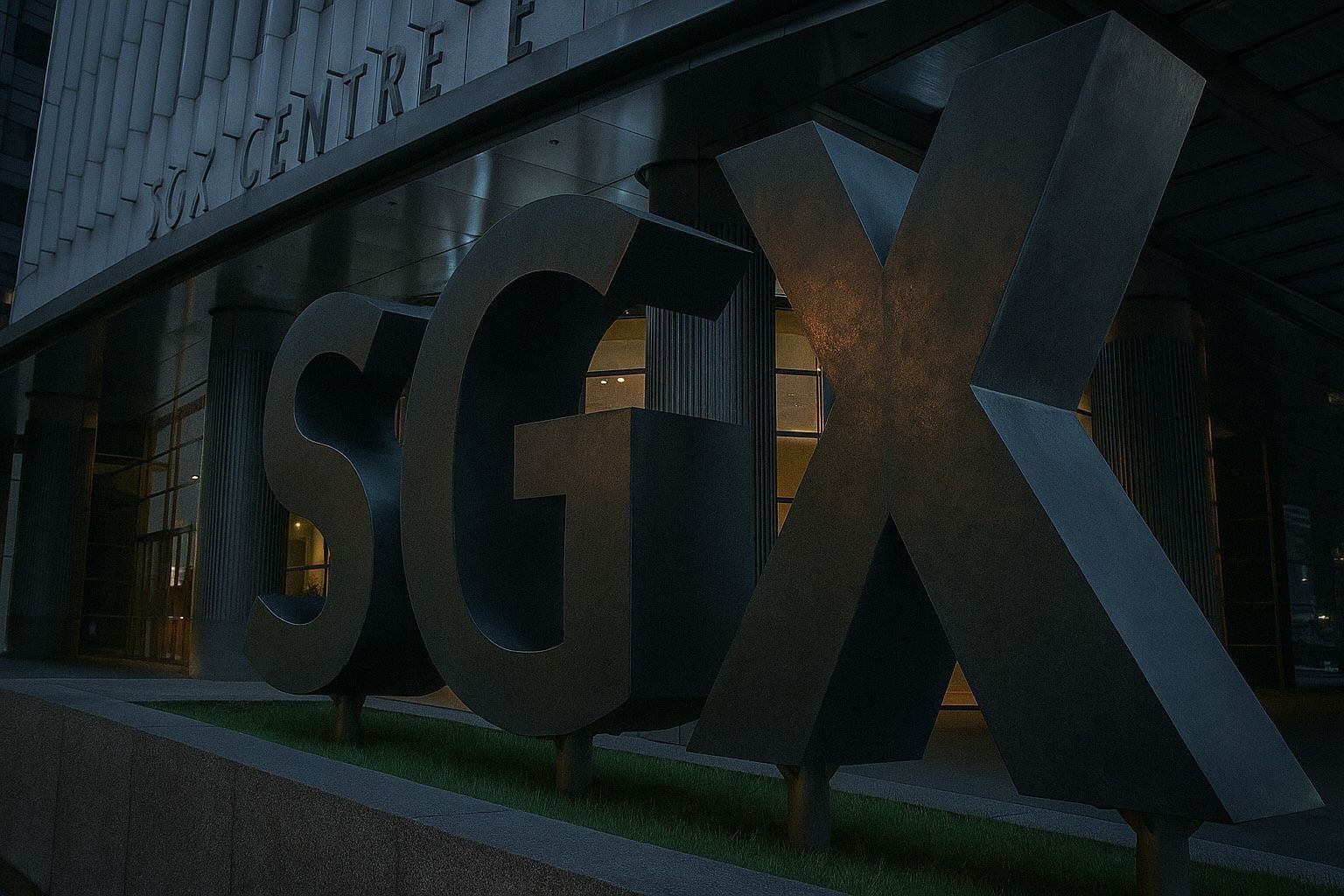

Singapore’s stock market is treading carefully today as investors sit on their hands ahead of a closely watched US Federal Reserve rate decision. After a small rebound on Tuesday, the Straits Times Index (STI) is slipping back in late-morning trade, with fund-raising moves by Temasek-backed SeaTown and Olam Group adding color to an otherwise cautious session.
STI edges lower after Tuesday’s rebound
On Tuesday, Singapore shares finally broke a three‑day losing streak. The STI rose about 0.1%, adding 6.16 points to close at 4,513.24 , even as the broader market saw slightly more losers than gainers and turnover hovered around S$1.1 billion.
Blue-chip moves on Tuesday were modest but telling:
- DFI Retail Group was the top STI gainer, climbing about 1.5%.
- UOL Group was the biggest loser, falling nearly 1.8%.
- The three local banks finished mixed: DBS and OCBC ticked up around 0.3%, while UOB slipped about 0.5%.
Even that gentle rise came with a big asterisk. Both local and regional reports highlighted that traders were already fixed on the Fed’s upcoming decision, with market economist Jose Torres noting that stubborn inflation and rising bond yields were tempering optimism despite Singapore’s approach to record levels.
Today, the tone has turned softer again. Real‑time world‑index data shows the STI trading around 4,497 points in late morning, down roughly 0.3–0.4% , pulling it back below Tuesday’s close and leaving it still not far from historic highs.
RTTNews summed up the mood neatly in a morning note: after Tuesday’s gain, the index “sits just above the 4,510-point plateau” and may be “stuck in neutral” on Wednesday as traders await the Fed.RTTNews+ 1
Asia follows Wall Street lower as the Fed meets
Today’s softness in Singapore mirrors moves across the region. A pan-Asian market update from Hong Kong reported that most major indices were in the red on Wednesday , including Tokyo, Hong Kong, Shanghai, Sydney, Singapore, Wellington, Jakarta and Manila, as investors “retreated” ahead of the Fed decision and a round of big-tech earnings.The Business Times+ 1
Overnight in the US:
- The S&P 500 and Dow edged lower, while the Nasdaq was little changed as bond yields climbed again.
- Traders now price in roughly an 85–90% chance of a 25‑basis‑point rate cut at the Fed’s meeting, but expect a hawkish tone and intense scrutiny of the Fed’s “dot plot” projections.The Straits Times+ 1
Commentary cited by Singapore papers stresses that markets are less worried about whether the Fed cuts today and more about how many cuts are coming in 2026 . Several analysts warn that if policymakers signal slower‑than‑expected easing, the current rally in risk assets could wobble.
Locally, a weekly review by Beansprout and the Securities Investors Association (Singapore) noted that expectations of a December Fed cut had already helped push the STI to around 4,531 points last week , with rate‑cut odds rising from below 50% to the mid‑80s over just two weeks – a key driver of November and early‑December strength in both US and Singapore equities.
Key Singapore movers and themes
Banks and defensives still anchor the index
The STI remains dominated by the three local banks and high‑yield defensive counters like REITs and consumer staples. On Tuesday:
- DBS closed around S$54.12.
- OCBC at about S$18.79,
- UOB at S$34.28,
with the trio again doing much of the heavy lifting for the index.
Across the broader market, property names such as UOL , industrials like ST Engineering , and yield plays such as CapitaLand Integrated Commercial Trust showed mixed performances, echoing a market that is near record highs but increasingly sensitive to every nuance in Fed messaging.
New attention on future incoming indexes
One local catalyst today comes from Singapore Exchange’s iEdge Singapore Next 50 Index , where Golden Agri‑Resources, YZJ Maritime and Centurion Accommodation REIT are being added later this month, replacing Samudera Shipping, Nanofilm Technologies and Aztech Global .
The Business Times flagged these names in its “stocks to watch” list this morning, noting that:
- Golden Agri‑Resources last traded at S$0.275 ,
- YZJ Maritime at S$0.705 , and
- Centurion Accommodation REIT at S$1.07 on Tuesday’s close.
Index changes of this sort often attract short‑term flows from quantitative and index‑tracking funds, potentially increasing both trading volume and volatility in the affected counters as rebalancing nears.
SeaTown’s US$900m second close highlights demand for Asian private credit
One of today’s most notable corporate headlines doesn’t involve a listed company, but it speaks volumes about Singapore’s role as a regional capital hub.
Temasek‑backed SeaTown Holdings announced that its Private Credit Fund III has secured about US$900 million (S$1.17 billion) in commitments at its second close , on top of the US$612 million raised at first close in August. The fund is targeting a final size similar to its first two vintages (roughly US$1.2–1.3 billion).
Key points from SeaTown’s comments to Reuters and local media:
- Investor demand comes from the Middle East, Japan, Taiwan and Singapore , with institutional clients still “anchoring” the fund and rising participation from private wealth.
- Asia’s private‑credit market is projected to grow from US$59 billion in 2024 to US$92 billion by 2027 , outpacing global averages.
- SeaTown continues to target mid‑teens net returns with double‑digit distribution yields , citing “healthy” spreads across its core markets.The Straits Times
SeaTown also warned of risks – including refinancing pressure in specific sectors and geopolitical uncertainty – but overall expects Asia-Pacific private credit to offer an attractive risk-reward profile over the next 12–24 months.
For Singapore’s listed space, the SeaTown story reinforces a familiar theme: strong regional demand for yield and private‑market exposure , which tend to support valuations for local banks, REITs and asset‑management groups listed on SGX.
Olam’s ofi secures US$1.12b loan ahead of dual listing
Another big corporate development today comes from Olam Group . The agribusiness giant said its unit olam food ingredients (ofi) has locked in a US$1.12 billion multi‑tranche dual‑currency term loan facility .
According to the company’s Wednesday announcement:
- The facility includes two US-dollar tranches totaling US$775 million and a 2.42-billion-yuan (about S$444 million) tranche .
- The loan will be transferred to ofi following its planned IPO and demerger , aligning the capital structure with its future standalone status.
- Olam still aims to list ofi on the premium segment of the London Stock Exchange , with a secondary listing in Singapore , although precise timing has not been confirmed.
- Ofi contributed nearly 40% of Olam’s total revenue in FY2024 and generated about S$14.7 billion in sales in the first half of 2025 , underlining its importance to the group.
If the dual‑listing goes ahead as planned, ofi could be one of the largest new names to hit SGX’s boards in recent years – a potential boost to market depth, daily turnover and index‑level liquidity.
AI and regional tech: SK Hynix’s possible New York listing
Today’s global tech news also matters for Singapore investors. South Korean memory‑chip heavyweight SK Hynix confirmed that it is reviewing a possible New York listing via American depositary receipts (ADRs), using a portion of its treasury shares.
Regulatory filings and media reports say the company is considering listing about 2.4% of outstanding shares (roughly 17.4 million shares) as ADRs, with analysts arguing that this could help close a valuation gap with US peers like Micron and TSMC by tapping into passive and ETF demand in the US market.
SK Hynix shares have surged more than 200% in 2025 , fueled by booming demand for high‑bandwidth memory chips used in artificial‑intelligence workloads.
For Singapore, the news is another reminder that:
- The AI hardware cycle remains a central driver of global risk sentiment.
- Local plays leveraged to AI – from data‑centre REITs to semiconductor‑related firms listed on SGX – will likely continue to trade in tandem with swings in global AI sentiment.
Technical picture: STI near highs but range‑bound
From a technical perspective, the STI is still in enviable territory.
A recent analysis from Beansprout’s Weekly Market Review notes that:
- The index has been trading around its 20‑day moving average near 4,520–4,530 ,
- Key resistance is clustered close to the all‑time high around 4,575 , and
- Important support lies near 4,450 , around the 50‑day moving average and lower Bollinger Band, implying a trading range of roughly 4,450–4,575 .
Momentum indicators such as MACD and RSI are described as neutral rather than overheated , suggesting fading upside momentum but no strong signs of an imminent breakdown.
Today’s intraday level around 4,497 sits squarely within that range and only slightly below the mid‑point, consistent with a consolidation phase rather than a trend reversal .
Medium‑term drivers: rates, reforms and the green transition
A market that has already run hard
Back in July, a detailed Straits Times feature pointed out that the STI had already gained more than 10% year‑to‑date and over 20% over the preceding 12 months , having broken above 4,000 in March and 4,200 in July.
This article flagged two opposing camps:
- Cautious houses , such as Goldman Sachs, argued that valuations were getting rich relative to modest projected earnings growth of around 5% for 2025–2026, justifying a downgrade of Singapore equities to “market weight”.
- Bullish strategists , including teams at JPMorgan and Morgan Stanley, countered that Singapore’s high dividend yields, governance standards and policy support – especially market-revitalization efforts – could sustain outperformance.
Those debates matter even more now that the STI is hovering within striking distance of fresh records.
Equity‑market reforms and SGX’s appeal
Singapore’s Equity Market Development Program (EQDP) – a S$5 billion initiative to boost research coverage, liquidity and institutional participation – continues to feature in strategist reports as a key pillar of the market’s medium‑term story. The program has already appointed several asset managers and disbursed its first wave of mandates, with expectations that flows will primarily benefit liquid large‑caps before trickling into quality mid‑caps and small‑caps.
The December FTSE Straits Times Index quarterly review , meanwhile, left the STI’s 30 constituents unchanged, reinforcing stability at the top of the market while index changes are concentrated in mid‑cap and thematic indices such as the iEdge series.
Singapore as a green and sustainable hub
On the sustainability front, analysis from FTSE Russell (part of LSEG) highlights that:
- All 11 real‑estate companies in the STI generate some portion of “green revenues” , mostly tied to green‑certified buildings.
- Singapore’s Green Building Masterplan aims for 80% of buildings to be green by 2030 and 80% of new developments to be “super low energy”.
- SGX rules will incorporate IFRS‑aligned climate‑disclosure standards from 2025 , pushing disclosure of climate indicators above already‑solid current levels.
For long‑term investors, this strengthens the case for Singapore as a regional hub for sustainable and income‑oriented equity strategies , combining high dividends with improving ESG transparency.
What investors are watching next
Over the next 24–48 hours, three flashpoints will dominate trading decisions in Singapore:
- Fed decision and dot plot
- A widely expected 25‑basis‑point cut is unlikely to shock markets. The focus is on how many additional cuts policymakers pencil in for 2026 and how hawkish the tone of the statement and press conference proves to be.
- US bond yields and bank guidance
- Recent gains in the US 10‑year yield have already weighed on Wall Street. Any spike renewed could cap risk appetite globally, even as higher rates tend to help bank margins. JP Morgan’s recent warning of higher 2026 expenses shows how sensitive financials are to forward‑guidance nuance.
- Big-tech and AI sentiment
- Earnings from Oracle and Broadcom , along with ongoing headlines around AI chip exports and new listings like SK Hynix’s potential ADRs, will feed directly into sentiment toward tech‑linked counters and data‑centre plays listed on SGX.
In Singapore specifically, investors will also be tracked:
- Progress towards ofi’s proposed London–Singapore IPO ,
- Further fund‑raising milestones for SeaTown’s Private Credit Fund III , and
- Any additional corporate actions stemming from the EQDP and SGX’s ongoing efforts to deepen the local equity ecosystem.
Bottom line
As of early afternoon on 10 December 2025 , the Singapore stock market is easing modestly , with the STI drifting lower from Tuesday’s close in sympathy with a cautious Asia-Pacific region. Yet the index remains close to all‑time highs, supported by strong banks, resilient dividend names and a steady pipeline of fund‑raising and listing activity highlighted by SeaTown and Olam.
Near term, everything hinges on the Fed’s tone: a “hawkish cut” could keep the STI range-bound or trigger a mild pull-back, while a more dovish-than-expected stance might refresh the rally in yield plays and growth sectors alike. Over the medium term, Singapore’s combination of high yields, reform momentum and growing ESG credentials continues to underpin the case for the city-state as one of Asia’s most resilient equity markets.Beansprout+ 2The Straits Times+ 2