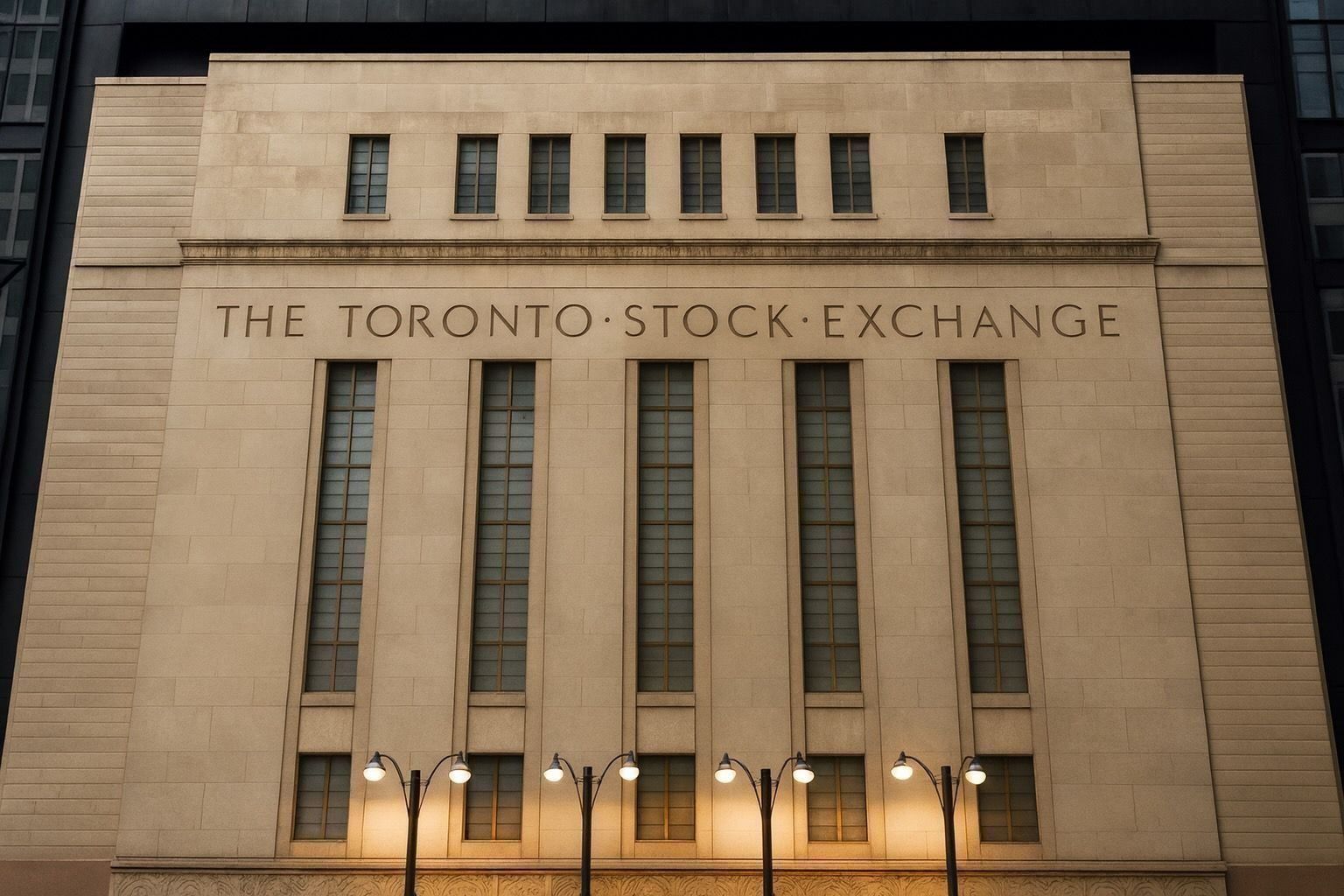

As of late morning Eastern time on Wednesday, December 10, 2025, the Canadian stock market is catching its breath. The S&P/TSX Composite Index is hovering around 31,200, edging slightly lower after Tuesday’s record close near 31,244, when the benchmark gained about 0.24% (up 74 points).
Fresh off the Bank of Canada’s final interest‑rate decision of the year, where policymakers left the key overnight rate unchanged at 2.25%, investors are weighing a resilient domestic economy against ongoing global trade tensions and an already “blockbuster” year for Canadian equities. Bank of Canada+2Reuters+2
Below is a detailed look at how the Canada stock market today is trading, which sectors and stocks are moving the TSX, and what leading strategists are forecasting for 2026.
1. Market snapshot: TSX slightly softer after record high
On Tuesday, December 9, the S&P/TSX Composite closed around 31,244 points, up 74 points or roughly 0.24%, trimming its month‑to‑date loss to under half a percent and marking yet another record close for the benchmark Canadian index.
Today, December 10, intraday data show the TSX easing marginally to roughly 31,227 points, a dip of about 0.05%from that record, as investors digest central‑bank headlines and await the U.S. Federal Reserve’s own decision.
Despite the small pullback, context matters:
- Over the past month, Canada’s main stock index has pushed to new highs, extending the strong rebound that began mid‑year.
- Strategists at AGF Investments describe 2025 as a “blockbuster” year for Canadian equities, noting that the S&P/TSX Composite has outperformed the S&P 500 through the first 11 months of the year. agf.com
In other words, today’s action looks more like consolidation than a trend reversal.
2. Bank of Canada holds at 2.25% – and sets the backdrop for 2026
The big macro story for the Canadian stock market today is the Bank of Canada (BoC). At its December 10 policy meeting, the BoC:
- Kept the policy rate at 2.25%, matching market expectations.
- Left the rate unchanged after a quarter‑point cut in October, which followed earlier easing as trade tensions and slower growth weighed on the outlook.
According to official communications and media coverage:
- The central bank cited a “resilient” Canadian economy, with Q3 GDP growing at about 2.6% annualized and roughly 181,000 jobs added from September to November. Reuters+1
- Headline inflation has eased to just above 2%, close to target, but core inflation measures remain near 3%, suggesting price pressures haven’t fully disappeared.
- Policymakers expect growth to slow in Q4 and into early 2026, but not enough to justify renewed rate cuts right now.
Several major institutions weighed in quickly:
- TD Economics notes that the BoC is likely finished cutting rates for this cycle and could keep the policy rate at 2.25% through 2026, assuming inflation continues to drift towards 2%.
- Market commentary from FX analysts suggests the BoC may sit on the sidelines while the U.S. Federal Reserve continues to cut, which could support a modestly stronger Canadian dollar over time.
What it means for the TSX
For Canadian equities, today’s hold reinforces a “goldilocks‑ish” backdrop:
- No immediate rate hikes to undermine valuations or bank profitability.
- No fresh cuts, which could have signalled deeper concern about growth.
- A policy stance that, for now, supports steady – but not spectacular – economic expansion into 2026.
That combination helps explain why the TSX is trading close to its highs rather than reacting violently to the decision.
3. Sector performance: banks and growth names up, miners under pressure
Today’s intraday market internals on the Toronto Stock Exchange show a classic push‑and‑pull between interest‑rate sensitive financials, growth stocks, and resource names.
Financials and blue‑chip cyclicals offer support
Real‑time “Top % Gainers” data for the TSX (around 11:26 a.m. ET) highlight a strong showing from banks and select blue chips: InvestCom
- Canadian Banc Corp (BK) – up about 4–5%, benefiting from news of an upcoming Class A share split (more on that below).
- Lightspeed Commerce (LSPD) – higher by more than 4%, adding to renewed interest in Canadian tech and e‑commerce names.
- Canadian Pacific Kansas City (CP) – up roughly 1–1.5%, reflecting ongoing optimism about rail volumes and cross‑border trade.
- The big banks are quietly stronger:
- Toronto‑Dominion (TD), Bank of Montreal (BMO), CIBC (CM) and Manulife (MFC) are all up close to 1% intraday.
- Bank of Nova Scotia (BNS) and National Bank (NA) are also trading higher, extending gains linked to recent earnings and capital‑management moves.
This pattern aligns with the central‑bank backdrop: a steady policy rate and a “resilient overall” economy are broadly supportive for banks and credit providers. Mortgage Rates & Broker News+1
Growth and small‑caps are bouncing
Investor appetite for higher‑beta names is showing up in the top of the leaderboard:
- PyroGenesis Canada (PYR) is one of the session’s standout winners, up more than 30%.
- Xtract One Technologies (XTRA) and Global Education Communities (GEC) are also posting solid single‑digit to high‑single‑digit percentage gains.
These are smaller stocks, but their moves fit the theme of renewed risk‑taking after a strong year for the broader Canadian market.
Resource and uranium stocks drag the TSX
On the flip side, the “Top % Losers” list is dominated by miners and energy names, particularly uranium and precious metals: InvestCom
- Energy Fuels (EFR), NexGen Energy (NXE), Denison Mines (DML) and Mega Uranium (MGA) are all down roughly 4–7% intraday.
- Cameco (CCO), one of the world’s largest uranium producers, is off nearly 4%.
- Gold and silver producers such as Agnico Eagle (AEM), First Majestic Silver (AG), GoGold Resources (GGD)and Endeavour Silver (EDR) are also weaker.
- Vermilion Energy (VET) is lower, adding to pressure on the broader energy complex.
This weakness is consistent with commentary that gold prices have eased today while oil trades in a range, tilting the day’s balance away from materials and energy, even as they remain massive drivers of the TSX over 2025 as a whole.
Cryptocurrency‑linked and high‑beta financial names are also under pressure, with Galaxy Digital (GLXY) and Bitfarms (BITF) among notable decliners.
4. Stock‑specific news shaping Canadian markets today
Beyond index levels and sector moves, news flow from individual Canadian companies is giving traders plenty to watch on December 10.
Bank of Nova Scotia: capital discipline and dividend strength
A detailed analysis from Kalkine Media highlights how Bank of Nova Scotia (BNS) is helping to drive momentum within the S&P/TSX Composite today.
Key themes from the piece:
- The bank reported stronger quarterly progress in lending and core operations.
- It reaffirmed its dividend payout, signalling confidence in its capital position despite softer domestic mortgage growth and international credit risks.
- BNS executed a significant cancellation of common equity and issued a long‑dated note, moves aimed at optimizing its long‑term funding structure.
Together, these actions reinforce the Canadian bank sector’s reputation for conservative balance‑sheet management– a key reason banks remain anchor holdings in many TSX‑focused portfolios.
Lithium Americas: heading into the TSX big leagues
On the commodity and growth side, Lithium Americas Corp. is set to join the S&P/TSX Composite Index later this month, as part of S&P Dow Jones Indices’ quarterly review of Canadian benchmarks.
Index inclusion typically matters because:
- It forces index‑tracking funds and ETFs to buy the stock.
- It can meaningfully increase liquidity and visibility, often tightening spreads and attracting more institutional research coverage.
For a sector like lithium, which sits at the intersection of energy transition and industrial demand, this move underscores the TSX’s growing exposure to battery‑metals themes.
Canadian Banc Corp: share split and a strong intraday rally
Canadian Banc Corp (BK) announced plans to complete a split of its Class A shares, a structural move that often makes units appear cheaper on a per‑share basis and can broaden retail interest.
Investors seem to approve: BK is among today’s top percentage gainers on the TSX, up nearly 5% intraday alongside the broader strength in bank‑linked investment products such as Financial 15 Split (FTN).
VersaBank: dividend stability
In London, Ontario‑based VersaBank (VBNK), which trades on both the TSX and Nasdaq, declared cash dividendstoday on its listed shares.
While the yield details are aimed at income‑focused investors, the headline reinforces a wider message: Canadian financials continue to return capital to shareholders at a time when central‑bank policy has stabilized and credit conditions remain manageable.
Constellation Software: governance update at a market darling
Tech and software investors will note that Constellation Software Inc. (CSU) announced the appointment of Mark Miller to its Board of Directors.
Though such board moves don’t always prompt large price swings, Constellation is a major TSX heavyweight with a long track record of acquisition‑driven growth. Governance and leadership updates at a company of this size can influence institutional sentiment across the broader Canadian tech complex.
5. Forecasts and analyses: what strategists see for the TSX in 2026
With just weeks left in 2025, a range of major firms have published outlooks for Canada’s stock market in 2026. Today’s BoC decision slots into that bigger picture.
After a “blockbuster” 2025, more room to run – but with caveats
AGF Investments’ “Outlook 2026 – Canada Equities” (dated December 2, 2025) makes several key points: agf.com
- Banks, commodity companies, industrials and technology remain the core drivers of Canadian equity performance.
- The S&P/TSX has actually outpaced the S&P 500 through most of 2025, thanks in large part to outperformance from these sectors.
- AGF believes Canadian equities “look poised for growth” again in 2026, supported by a combination of solid earnings growth, potential fiscal stimulus, and a possible trade‑deal renewal with the U.S. But returns are unlikely to repeat 2025’s 20%‑plus pace.
ClearBridge Investments’ Canadian Equity Outlook similarly warns that while the TSX has enjoyed strong gains, performance has become concentrated: clearbridge.com
- The materials sector (especially metals and mining) is up more than 70% year‑to‑date.
- The gold sub‑industry has more than doubled and now accounts for over 12% of the S&P/TSX Composite.
That concentration means that a reversal in gold or commodity prices could have an outsized impact on the broader index, a risk investors should keep in mind even on seemingly quiet days like today.
Valuations, resilience and the “quality” theme
RBC Wealth Management’s Global Insight 2026 – Canada notes that Canadian equities are trading at a modest valuation premium relative to some global peers but argues this could provide insulation if equity markets experience a broader pullback. The firm continues to favour companies with strong balance sheets, durable earnings and management teams that have navigated past volatility successfully.
Edward Jones’ 2025 annual outlook frames the period ahead as one of “solid fundamentals amid policy uncertainty.”The firm expects: Edward Jones
- Modest but positive GDP growth in Canada.
- A continuation of the current equity expansion, albeit with cooler returns and more frequent bouts of volatility.
Taken together, these perspectives suggest that while 2026 may not repeat 2025’s fireworks, the consensus still leans toward moderately positive returns for the TSX rather than a deep downturn.
Macro and sector themes to watch
A few cross‑cutting themes emerge from these forecasts and from today’s BoC decision:
- Moderate growth, not a boom: Several outlooks see Canada’s economy growing a bit faster in 2026 than in 2025, but still below its long‑term trend, as both monetary and fiscal support remain in play.
- Range‑bound energy, contrarian opportunity: AGF notes that oil prices have been largely range‑bound in 2025 and expects this to continue into at least the first half of 2026. Energy is described as one of the most avoided sectors, which could set up a contrarian entry point for patient investors.
- Trade and tariffs as wildcards: ClearBridge and Edward Jones both highlight U.S. trade policy and tariffs as major sources of uncertainty for Canadian exports and corporate investment decisions.
Overlay today’s BoC message – a steady 2.25% policy rate, a resilient but slowing economy, and inflation hovering near target – and the picture that emerges for the Canadian stock market is one of “steady‑as‑she‑goes” rather than dramatic repositioning.
6. What the Canada stock market today means for investors
For investors watching the Canada stock market live on December 10, 2025, the combination of a flat TSX, a BoC rate hold and mixed sector moves sends a few clear messages:
- The rally is intact, but leadership is shifting.
- Financials and select growth names (like Lightspeed and smaller tech firms) are leading today.
- Materials and uranium miners, which powered much of 2025’s gains, are experiencing a normal bout of profit‑taking.
- Policy risk has eased—for now.
- Markets had already priced in today’s BoC hold, and the decision largely validates the current TSX valuation backdrop.
- Concentration risk is real.
- With gold and materials such a large share of the index, investors who track the TSX closely may want to review whether their portfolios are over‑exposed to a single theme, especially after a year of out‑sized gains in that space.
- Quality and diversification remain the watchwords for 2026.
- Strategy pieces from RBC, AGF, ClearBridge and others all lean toward quality – strong balance sheets, sustainable earnings, and diversified revenue streams – over aggressive speculation in the year ahead.
7. Key events to watch next for the TSX
Looking ahead from today’s session, several catalysts could sway the Canada stock market in the short term:
- U.S. Federal Reserve decision and press conference, which could affect global risk appetite, bond yields and the Canadian dollar.
- Index rebalancing later in December, including Lithium Americas’ addition to the S&P/TSX Composite, which may spark repositioning among Canadian ETFs and index‑tracking funds.
- Upcoming earnings and dividend announcements from Canadian banks and resource companies, which remain the backbone of the TSX.
For now, though, December 10, 2025 is shaping up as a quiet but telling day: the Canadian stock market is resting near all‑time highs, digesting a steady hand from the Bank of Canada, and gently re‑shuffling sector leadership as investors start to position for 2026.
This article is for informational purposes only and does not constitute financial or investment advice. Always conduct your own research or consult a licensed professional before making investment decisions.
Related articles: TSX