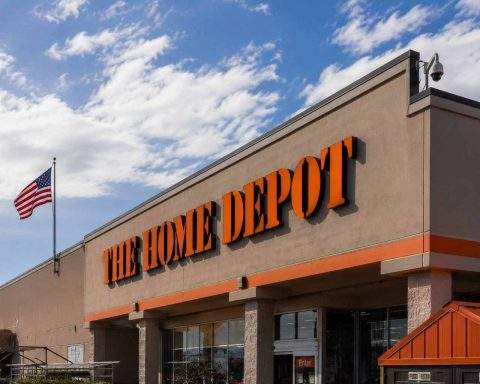

Home Depot, Inc. NYSE:HD quietly turned into one of the blue‑chip winners on Thursday as investors rotated out of big tech and into more traditional Dow names.
By the closing bell on December 11, 2025, Home Depot stock had climbed 1.8% to $357.46, after trading between roughly $354 and $363 on the day with volume just over 5.8 million shares. Investing.com+1 After the bell, quote services showed only modest after‑hours moves, with HD ticking slightly higher around $357–358.
The move came against a powerful backdrop: the Dow Jones Industrial Average jumped about 1.3% (nearly 650 points) to a record close, as investors piled into non‑tech blue chips like Visa, Home Depot and UnitedHealth, while the Nasdaq slipped 0.3% on Oracle‑driven AI jitters.
Heading into Friday, December 12, here’s what Thursday’s trading, the latest company news, and fresh analyst research are telling us about Home Depot — and what to watch before the opening bell.
1. How Home Depot Stock Traded After the Bell on December 11
Price action & volume
- Close (Dec. 11, 2025): $357.46, up 1.80% on the day Investing.com+1
- Intraday range: roughly $353.94 – $362.72 Investing.com
- Volume: about 5.9 million shares, roughly in line with the stock’s average daily volume near 5.9–6.0 million Investing.com+1
- After‑hours indications: quotes around $357–358, showing only minor follow‑through once regular trading ended StockAnalysis
From a bigger‑picture standpoint, HD now trades roughly 17–18% below its 52‑week high of about $426.75, but comfortably above its 52‑week low near $326.31.
Relative to the market
Thursday’s move was part of a wider rotation:
- Dow: +1.3%, record close
- S&P 500: +0.2%, also notching a record
- Nasdaq: –0.3%, pressured by a sharp drop in Oracle and other AI‑linked names Investopedia+1
In other words, HD outperformed the S&P 500, roughly matched the Dow’s percentage gain, and moved opposite the sagging tech complex. That’s exactly what you’d expect if investors are leaning toward rate‑sensitive, real‑economy blue chips over high‑multiple growth.
2. Catalysts Behind Thursday’s Move: Product Buzz, Creator Portal and Analyst Support
Several overlapping storylines helped support Home Depot’s advance into the close.
2.1 Product launch and intraday momentum
A widely‑shared note from AInvest highlighted that Home Depot shares were up about 2.9% intraday at one point on Thursday, with the stock touching roughly $362.31 before paring gains.
According to that report, traders were reacting to a blend of:
- A new Home Depot product designed to tackle “industry challenges” and ease pain points in home improvement demand. AInvest+1
- A reiterated Buy rating from Jefferies with a $424 price target, implying mid‑teens upside from current levels.
- Ongoing buzz around Home Depot’s use of AI‑driven tools (such as its “Magic Apron” concept) to deepen customer engagement and support professional contractors. AInvest+1
The exact financial impact of the new product isn’t yet clear, but the market clearly liked the story: it helped power HD’s intraday spike and signaled that investors are still willing to reward innovation in a slow housing environment.
2.2 New “Creator Portal” ramps up digital marketing
On December 10, Home Depot announced the launch of The Home Depot Creator Portal, a dedicated platform connecting digital content creators and influencers with the retailer.
Key details:
- The portal is a central hub where creators can:
- Access campaign opportunities and content inspiration
- Build shoppable content around DIY projects, décor, and pro‑grade projects
- Earn commissions via trackable links and gain storefront‑style visibility
- Thousands of creators are already enrolled, and applications are open to the public.
- Home Depot is launching the program with a “Starting Lineup” of high‑profile creators and athletes — including Dude Perfect and USWNT star Trinity Rodman — ahead of a major global soccer event next year. The Home Depot
For investors, this matters because:
- It’s a high‑margin, asset‑light way to drive traffic and sales, especially online.
- It leans into creator‑driven commerce, which has become a major customer‑acquisition channel in retail.
- It reinforces management’s narrative that Home Depot can keep gaining share even when the overall home improvement market is barely growing.
While the portal won’t suddenly transform 2025 earnings, it adds another lever for long‑term growth and brand engagement.
2.3 Investor Day: guidance reaffirmed, 2026 outlook and “market recovery” scenarios
At its Investor & Analyst Conference on December 9, Home Depot delivered a dense strategic update and reaffirmed detailed guidance.
For fiscal 2025, management reiterated:
- Total sales growth: ~3%
- Comparable sales: “slightly positive” over the comparable 52‑week period
- Operating margin: ~12.6% (about 13.0% on an adjusted basis)
- Net interest expense: ~$2.3 billion
- Diluted EPS: expected to decline ~6% vs. fiscal 2024
- Adjusted EPS: expected to decline ~5% vs. fiscal 2024 The Home Depot+1
For 2026, the company introduced a preliminary outlook:
- Home improvement market assumed at –1% to +1%
- Comparable sales growth: roughly flat to +2%
- Total sales growth:2.5% to 4.5%
- Operating margin:12.4%–12.6% (12.8%–13.0% adjusted)
- EPS growth: roughly flat to +4% (both GAAP and adjusted) The Home Depot+1
And in a “Market Recovery Case” built on stronger housing turnover:
- Sales growth: 5–6%
- Comparable sales: 4–5%
- EPS growth: mid‑ to high‑single digits, with profit growing faster than sales The Home Depot
The market’s reaction has been mixed:
- Bulls see these numbers as conservative baselines, leaving room for upside if housing recovers faster.
- Bears note that, even with modest growth, EPS is still under pressure in 2025 and only stabilizes in 2026, suggesting limited near‑term earnings momentum.
2.4 Legal overhang: Pomerantz LLP investigation
The AInvest piece also flagged that Pomerantz LLP is investigating potential securities‑law claims on behalf of Home Depot investors.
According to the original Pomerantz press release, the firm is looking into whether Home Depot or certain officers engaged in securities fraud or other unlawful business practices after financial results and guidance cuts triggered a roughly 6% one‑day share price drop earlier in November.
Important context:
- This is only an investigation, not a concluded lawsuit or finding of wrongdoing.
- Such investigations are relatively common when a large‑cap stock sells off sharply after earnings.
- Still, it adds a layer of headline risk that investors will monitor for any escalation.
3. Fundamentals: Housing and Pro Weakness Still Cloud the Outlook
Even as the stock bounced on Thursday, the latest fundamental research paints a more cautious picture.
3.1 Sluggish comps and pressured margins
A detailed Zacks analysis (syndicated via TradingView and Nasdaq) highlights that Home Depot is battling a soft demand environment, especially in discretionary and large‑ticket projects: TradingView+1
Key points from recent quarters:
- Q3 comparable sales: +0.2% overall; U.S. comps up only 0.1%, vs. 1.0% and 1.4% increases in the prior two quarters.
- October U.S. comps: down 1.7%, following modest gains in August and September, showing momentum faded into the fall.
- Ticket vs. traffic: average ticket rose about 1.8%, but transactions fell 1.6%, signaling fewer shopping trips and some reliance on price/mix rather than true volume growth.
- Margins: operating margin dropped from 13.5% to 12.9% year‑on‑year in the most recent quarter (adjusted: 13.8% → 13.3%), as costs outpaced slow sales.
Zacks also notes:
- Return on invested capital (ROIC) slid from 31.5% to 26.3% over the last 12 months.
- Inventory climbed to about $26.2 billion, up $2.3 billion year‑over‑year, with turnover slipping from 4.8x to 4.5x.
- Net interest expense is projected around $2.3 billion in fiscal 2025, up from ~ $2.1 billion, reflecting a heavier debt load and higher funding costs.
Taken together, these metrics confirm what management itself has acknowledged: housing turnover remains near multi‑decade lows, and the expected second‑half demand recovery in 2025 has been weaker than hoped.
3.2 Pro segment and SRS integration
The Pro customer — contractors, remodelers, and trades — is essential to the Home Depot story. Recent commentary from Zacks and Nasdaq underscores that: TradingView+1
- Pro backlogs are shrinking, especially for larger projects, hinting at more cautious capital spending by builders.
- Home Depot’s SRS Distribution acquisition, designed to deepen its reach into roofing and building materials, is growing slower than originally expected due to unusually light storm activity in 2025. Growth expectations have been revised down from mid‑single‑digit to low single‑digit for the year.
That said, long‑term‑oriented research (including Morningstar’s December 11 note) still characterizes Home Depot as a wide‑moat leader, expecting it to generate around $160–170 billion in revenue in 2025 and continue to invest heavily in its Pro ecosystem to gain share in a difficult market.
4. How Wall Street Rates Home Depot Going Into December 12
Despite near‑term headwinds, most analysts remain positive on HD — but the tone is more nuanced than the price action alone suggests.
4.1 Consensus ratings and price targets
According to StockAnalysis, based on 24 covering analysts: StockAnalysis
- Consensus rating:“Buy”
- Average 12‑month price target:$421.33
- Implied upside vs. Thursday’s close (~$357.46): about 18%
- Target range:
- Low: $350
- High: $497
MarketBeat, using a somewhat broader set of research, finds: MarketBeat
- 21 Buy, 11 Hold, 2 Sell ratings
- Overall rating: “Moderate Buy”
- Average target: about $401.47, implying high‑single‑ to low‑double‑digit upside from current levels.
4.2 Recent analyst moves
Recent days have seen a flurry of post‑Investor‑Day revisions:
- Bernstein: “Market Perform” (neutral) with a $362 target, arguing that Home Depot’s Pro‑focused roadmap is sensible but that housing and margin risks justify a more cautious stance and a preference for rival Lowe’s, which they view as cheaper. Investing.com
- Jefferies: Buy, $424 target, pointing to a modest 2026 recovery and long‑term opportunity in Pro and AI‑driven tools.
- DA Davidson, Wells Fargo, Piper Sandler, UBS, RBC: all updated targets on or around December 10, trimming numbers but mostly reaffirming Buy or Strong Buy ratings, with targets ranging roughly from the mid‑$360s to mid‑$440s.
At the same time, Zacks currently rates HD a “Sell” (Rank #4), arguing that downside risks from sluggish demand, margin pressure and elevated valuation outweigh near‑term upside, and recommending that new investors wait for a more attractive entry point or clearer sign of recovery. TradingView
4.3 Valuation snapshot
Per Zacks’ breakdown: TradingView+1
- HD trades at a forward price‑to‑sales (P/S) near 2.0x, above the industry average around 1.4x, even after its correction.
- The stock is also only slightly below its own 12‑month median P/S, suggesting the pullback hasn’t materially “de‑risked” the multiple.
- StockAnalysis data imply forward EPS just under $15 with a forward P/E in the low‑ to mid‑20s, which is not cheap for a business with flat to slightly negative EPS growth in 2025.
The upshot: Wall Street broadly likes Home Depot, but enthusiasm is tempered by the reality that earnings are still drifting lower before they improve.
5. Macro Backdrop: Fed Cuts, Jobless Claims and a Record‑Setting Dow
Home Depot’s Thursday move also can’t be separated from the macro narrative driving the entire Dow.
5.1 Fed’s third rate cut and talk of a pause
This week the Federal Reserve cut its policy rate by 25 basis points for the third consecutive meeting, bringing the target range to roughly 3.50%–3.75%.
However:
- The Fed signaled it may pause further cuts, worried about persistent inflation and distorted data following a lengthy government shutdown.
- Markets, by contrast, still price in more easing in 2026, with many brokerages expecting at least another 50 basis points of cuts down the road.
Lower rates are generally good news for highly interest‑rate‑sensitive sectors like housing and home improvement, but Fed caution means the path is likely to be bumpy rather than a straight line down.
5.2 Jobless claims spike, but economists urge caution
On Thursday, the Labor Department reported that weekly jobless claims jumped by 44,000 to 236,000, the biggest weekly increase in nearly 4½ years.
Economists largely attribute the spike to seasonal adjustment quirks around the holidays rather than a sudden collapse in the labor market:
- The four‑week moving average remains near 216,750, still historically low.
- Continued claims actually fell to about 1.84 million, although expirations of benefits may be part of that story.
For Home Depot, the key takeaway is that the macro backdrop is mixed but not recessionary: job growth is slowing but not collapsing, while lower rates and a narrower trade deficit could support growth into 2026.
6. What to Watch Before the Market Opens on December 12, 2025
With Thursday’s session in the books and futures markets digesting the latest data and Fed guidance, here’s a checklist for Home Depot shareholders heading into Friday’s open.
6.1 Market mood: does the rotation into Dow names persist?
- Thursday’s rally was led by non‑tech blue chips, including Home Depot, while tech‑heavy indices lagged.
- Overnight commentary suggests traders are watching whether that rotation away from AI‑heavy tech and into value/cyclical names continues on Friday, especially with Oracle’s sell‑off and AI valuation worries still front‑of‑mind.
If that trade persists, Dow components like HD could see continued support, even without company‑specific headlines.
6.2 Economic calendar and Fed‑speak
Friday’s global calendar isn’t packed with blockbuster U.S. releases, but a few items could influence risk appetite:
- Further commentary from Fed officials, including Chicago Fed President Austan Goolsbee, as markets look for clues about how long the central bank’s pause may last.
- Routine releases like rig‑count data and updates on speculative positioning in commodities, which affect broader risk sentiment and inflation expectations.
For Home Depot, none of these are direct catalysts — but they may nudge bond yields, consumer confidence, and the market’s overall risk‑on/risk‑off tone, which influence HD’s multiple.
6.3 Company‑specific storylines
Between now and the open, investors will be watching:
- Follow‑up commentary on the new product launch
- Any sell‑side notes offering more detail on the product’s category, pricing and expected margin profile could shape how durable Thursday’s enthusiasm really is.
- Creator Portal engagement metrics
- Early adoption data or anecdotal reports from creators might help investors gauge whether the portal can meaningfully boost e‑commerce and brand engagement into 2026’s soccer‑driven marketing push.
- Updates on legal and regulatory matters
- Any new filings or statements related to the ongoing Pomerantz LLP investigation would likely attract attention, even if they don’t immediately affect fundamentals.
- Technical levels from Thursday’s range
- Short‑term traders will watch whether HD holds above the low‑$350s, which roughly corresponds to Thursday’s intraday low, and whether it can retest or break Thursday’s high near the low‑$360s.
7. Bottom Line: A Quality Franchise in a Tough Cycle
Putting it all together:
- Price action: Home Depot stock advanced solidly on Thursday, closing near the top of its intraday range and modestly higher after hours, supported by rotation into Dow components and specific positive headlines.
- Fundamentals: The core business is still navigating a slow housing market, soft discretionary demand, and compressed margins, with management itself guiding to mid‑single‑digit EPS declines in 2025 before a possible stabilization or mild recovery in 2026.
- Strategy: Management is trying to grow through the cycle by investing in the Pro ecosystem, acquisitions like SRS, AI tools for contractors, and new digital channels such as the Creator Portal.
- Street view: Consensus remains constructive, with most analysts rating HD a Buy and price targets clustered well above the current share price — but notable voices (like Zacks and Bernstein) are urging caution, citing valuation and cyclical risk.
For investors watching the stock into Friday’s open, the key questions are:
- Does the “value rotation” into names like HD continue, or does leadership snap back to tech?
- Do we see any fresh information on the product launch, Pro business, or legal matters that changes the risk‑reward narrative?
- How long will earnings be under pressure before the housing market — and Home Depot’s own “Market Recovery Case” — begin to play out?
Related articles: NYSE:HD