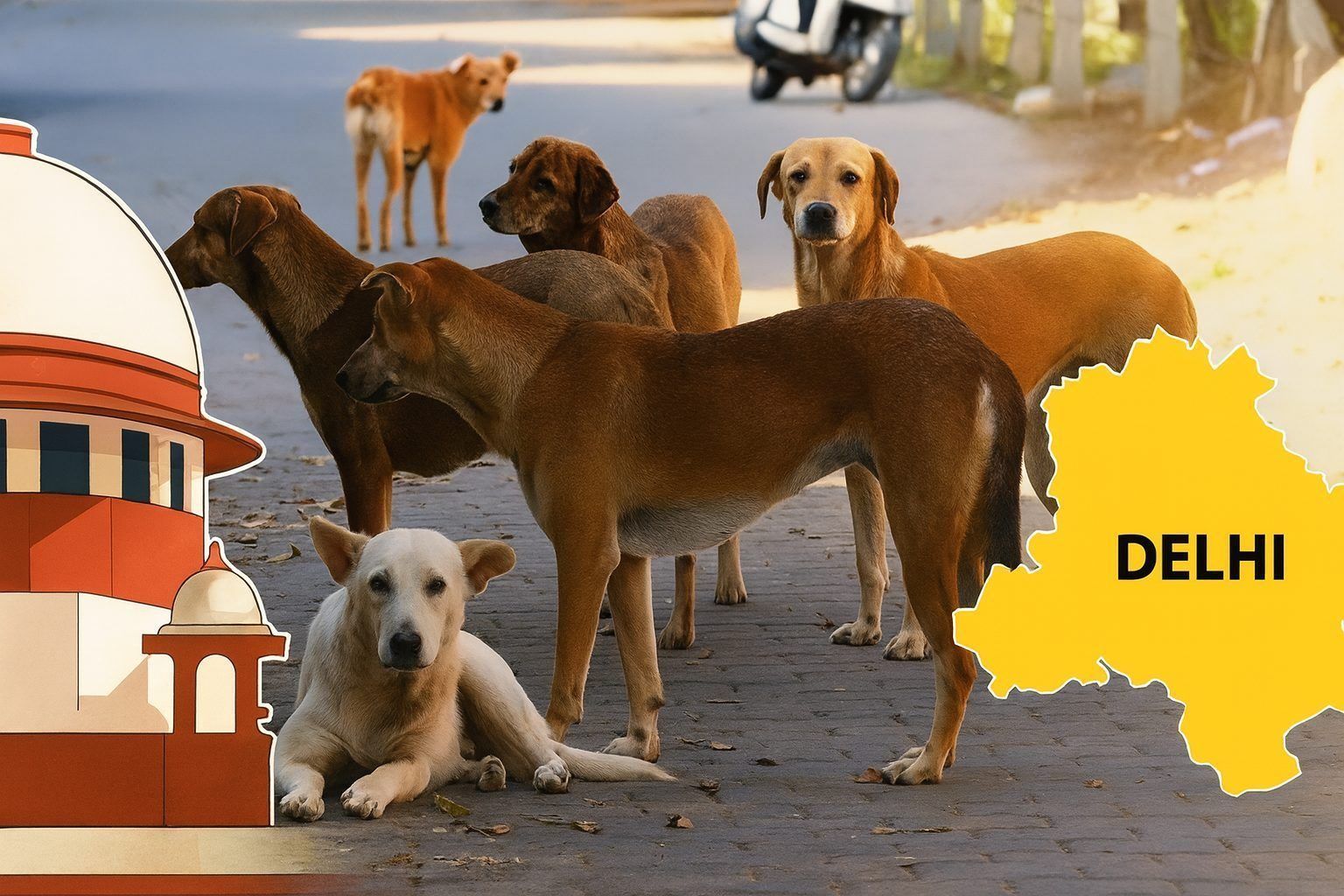

India’s policy conversation today is being shaped by two very different—but equally high-stakes—questions of scale and capacity: Can the country build banks big enough to finance its next decade of growth? And can cities and states build systems strong enough to curb stray dog attacks while staying humane and legally compliant?
On Friday, December 12, 2025, fresh reporting and commentary put both issues back in the spotlight—one from the world of banking consolidation and M&A finance, and the other from the urgent, street-level reality of dog-bite incidents and animal birth control (ABC) programmes.
The big picture on December 12: What changed today
Here are the developments driving the conversation:
- A Moneycontrol opinion column argues India needs multiple “SBI-scale” banks—not just one dominant lender—if it wants global-sized financial firepower. Moneycontrol+1
- Indian lenders are pushing the RBI to loosen a key limit on merger-and-acquisition financing, seeking to double the cap as dealmaking rises—an effort to compete more directly with global banks.
- Across India, local governments are scrambling to respond to the Supreme Court’s November 7 directive on keeping stray dogs out of sensitive public spaces—while also facing infrastructure constraints, public anger after attacks, and pushback from animal welfare groups.
India banking consolidation 2025: Why “one SBI” is being called insufficient
A Moneycontrol commentary published today makes a blunt argument: India’s economy is chasing global rank, but its banks aren’t built at global scale yet—and that gap matters for long-term growth.
The global comparison driving the debate: China’s “banking muscle”
The column points to the world’s largest banks list dominated by Chinese lenders—ICBC, Agricultural Bank of China, China Construction Bank, and Bank of China—and notes how far even the biggest Indian banks sit from the top tier.
S&P Global Market Intelligence’s latest ranking of the world’s largest banks by assets reinforces that picture: China’s “top four” hold the leading positions, while State Bank of India is placed far lower (43rd) in that global league table. S&P Global
The core argument: scale absorbs shocks—and funds ambition
The “big-bank” case is not just about prestige rankings. It’s about shock absorption and capacity.
Moneycontrol’s argument is that large banks can absorb meaningful slippages or credit events without destabilising confidence, and that scale helps banks stay attractive and resilient even when asset-quality pressure rises. It also contends that as India targets higher growth trajectories, banks need to be structurally capable of “heavy-lifting” credit expansion. Moneycontrol
But there’s a warning too: monopoly risk
The opinion doesn’t advocate “one mega-bank runs the show.” It warns that a single dominant player can distort pricing power and competition, and suggests India needs more than one SBI-sized institution to preserve healthy competitive tension—especially when the credit cycle turns more aggressive. Moneycontrol
RBI and M&A funding: Banks push to double merger financing cap as deals grow
Alongside the consolidation debate, deal financing has become today’s concrete “policy lever” story.
A Bloomberg-reported item published by The Economic Times on December 12 says Indian lenders—led by large banks—have asked the regulator to raise the cap on merger lending to at least 20% of a bank’s core capital, up from 10%.
Why this matters: a shift in who funds corporate India’s big deals
The report notes that the RBI recently opened the door (in October) for local banks to finance mergers and acquisitions—an arena historically dominated by foreign banks—while final guidelines are still expected after feedback.
If the cap is loosened, it could:
- allow domestic banks to underwrite larger acquisitions without hitting internal regulatory ceilings too quickly,
- reduce dependence on offshore lenders for certain deal structures, and
- deepen India’s corporate finance toolkit as M&A volumes rise.
The context: dealmaking has been rising
The same report cites data indicating India’s announced M&A volume in 2025 has reached about $69 billion so far, up more than 18% versus the comparable period last year.
A global cautionary tale: China’s bank mergers show scale alone can carry risks
While India debates building bigger banks, a Reuters analysis published December 12 offers an important counterpoint from China: consolidation can reduce the number of weak institutions without eliminating weak assets—and can sometimes spread risk into the surviving entities.
Reuters reports that China has aggressively consolidated parts of its small banking sector, including hundreds of license cancellations in 2025, but that absorbing banks can see profits drop and capital ratios weaken after taking on troubled balance sheets. The analysis flags the dangers of “diluting” bad debt rather than resolving it, and the risk of moral hazard if rescues become expected. Reuters
Takeaway for India: If consolidation returns, the policy question won’t just be “how big?” but also “how clean, how governed, and how well-capitalised after the merger?” Reuters
Kerala stray dog attacks: ABC programme gets fresh push amid legal confusion and rising fear
On the ground, Kerala’s immediate crisis is about public safety—and specifically dog-bite incidents—while navigating the operational fallout of the Supreme Court’s stray-dog directive.
A New Indian Express report (published Dec 11, still driving the Dec 12 conversation) says the Kerala government issued fresh instructions to restart or continue the Animal Birth Control (ABC) programme, clarifying that the lack of shelters should not be used as a reason to halt sterilisation and vaccination drives.
What the Kerala instructions clarify
According to the report, local bodies had suspended ABC activity after the Supreme Court’s November 7 direction, largely because of uncertainty about where sterilised dogs could be kept if they couldn’t be released back. The state’s updated message: ABC can continue, but dogs picked up from “sensitive public spaces” should not be released back in those exact locations. The New Indian Express
The numbers Kerala is dealing with are massive
Kerala Kaumudi reported that, based on data available up to October 2025, 249,860 people were bitten by stray dogs in the last ten months, and 17 people died due to rabies. It also reported that a previous survey (2019–20) estimated around 7 lakh stray dogs in the state, and suggested the figure could be around 9 lakh by 2025.
The same Kerala Kaumudi report says 52,995 dogs were sterilised under the ABC programme between November 1, 2024 and September 30, 2025, with district-level variation (Kollam reported highest numbers; Kasaragod among the lowest in the cited data).
Portable ABC units and political friction: why implementation keeps stalling
Kerala’s ABC push is also colliding with operational capacity and local resistance—not just policy intent.
New Indian Express reports that Kerala has 19 ABC centres and cites state data up to September 30 showing 9,737 dogs sterilised and 53,401 vaccinated in the current financial year (as reported). It also highlights a pilot portable ABC unit launched in the Nedumangad municipality area from December 5, intended to reduce resistance associated with fixed centres.
At the same time, the report describes a practical roadblock: even when sterilisation and vaccination happen, local opposition can erupt when authorities try to return dogs to the same location—creating a political and administrative “dead end” for municipal teams. The New Indian Express
December 12 updates nationwide: J&K and Hyderabad show the same “shelter capacity” crunch
Kerala is not alone. Today’s news flow shows the same tension—court-driven urgency vs. infrastructure reality—playing out across other states and cities.
J&K issues a compliance-style directive focused on institutions
Hindustan Times reported on December 12 that the Jammu & Kashmir housing and urban development department directed urban local bodies to map schools, hospitals, stadiums, and transport hubs within two weeks and secure them against stray dog ingress. The report also mentions compliance reporting timelines, inspection requirements, and directions aligned with humane ABC-based action.
Hyderabad says enforcement is “hard” with limited facilities
A Times of India report dated December 12 says Hyderabad’s municipal officials cite inadequate infrastructure: the city has five designated Animal Care Centres with a combined capacity of about 3,300 dogs, much of it already occupied, while the number of unsterilised stray dogs is estimated at around 50,000. The report describes planned capacity expansion, but also the reality that large open campuses and porous boundaries allow new dogs to enter quickly even after drives.
Mumbai’s fresh flashpoint on December 12: a school attack video and renewed calls for action
Mumbai added a sharp, viral edge to the national conversation today.
Free Press Journal reported (updated December 12) on a CCTV-captured attack at a Goregaon school where a stray dog lunged and bit a security guard on December 11, intensifying public concern. The report also notes animal welfare activists preparing a mobilisation on December 14 opposing relocation-focused approaches and calling for humane, scientific population management.
This is the core national friction in one frame:
- citizens see bite videos and demand safety,
- courts demand action in sensitive public spaces, and
- animal welfare groups warn that indiscriminate relocation can worsen outcomes if sterilisation, vaccination, and stable community-dog dynamics are disrupted.
Why the ABC programme is at the center of India’s stray dog policy fight
ABC (Animal Birth Control) programmes sit at the crossroads of three competing imperatives:
- Public safety: preventing bites and rabies-linked deaths (and reducing fear around schools, hospitals, and transit hubs).
- Legal compliance: implementing court directions and administrative timelines without collapsing local governance capacity.
- Animal welfare realism: ensuring that population control is humane and sustainable—something that requires trained catchers, vets, facilities, funding, and community cooperation, not just orders on paper.
Kerala’s dilemma—sterilise and vaccinate, but where do the dogs go when shelters are limited and residents oppose releases?—is now the national dilemma.
What’s next: timelines to watch in banking and stray dog management
Banking: policy signals matter as much as merger rumours
India’s “big bank” debate is now being fuelled by two parallel forces:
- the strategic narrative that India needs world-class banks to fund growth and compete globally, and
- practical regulatory moves that could expand banks’ role in corporate finance (like M&A funding).
The next market-moving question is whether the RBI moves closer to finalising M&A financing rules—and whether New Delhi revisits consolidation in a way that balances scale with competition and risk controls.
Kerala: shelters, portable centres, and court review pressures
Kerala Kaumudi earlier reported that the state has been directing local bodies to identify shelter options and continue ABC surgeries, while planning to increase portable ABC capacity and take stock after local body elections—along with a note that the matter would come up again before the Supreme Court on January 13 (as reported).
In practical terms, Kerala’s near-term success will likely hinge on:
- whether ABC operations resume at scale across districts,
- whether municipalities can build or repurpose shelter space fast enough, and
- whether enforcement focuses on truly high-risk institutional zones without freezing the broader sterilisation-vaccination pipeline.
The common thread: India’s capacity challenge
These stories—PSU bank consolidation and stray dog control—may feel unrelated, but the underlying policy tension is the same:
India is trying to build systems that are big enough to matter—whether that’s banks capable of financing trillion-rupee ambitions, or municipal frameworks capable of preventing dog-bite crises without collapsing into chaos.