
London shares ended higher on Friday, 12 December 2025, with the FTSE 100 supported by a risk-on global backdrop after this week’s US Federal Reserve cut, and by renewed expectations that the Bank of England will start easing again as UK growth data disappointed. But the day’s tape also underlined a more complicated reality for investors: softer macro data can lift rate-cut hopes even as it raises questions about underlying demand—particularly for UK-facing retailers.
UK market snapshot: FTSE 100 and FTSE 250 close higher
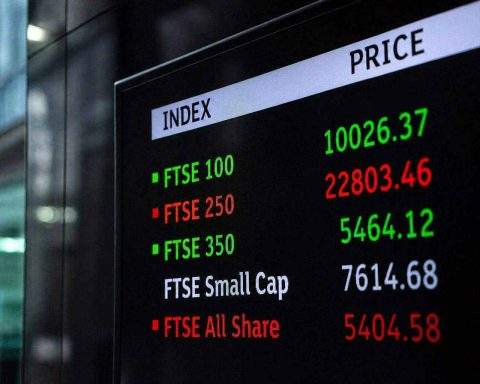
The UK’s blue-chip FTSE 100 closed up about 0.46% at 9,747.87, building on the prior session’s gains and remaining within reach of recent highs.
The domestically focused FTSE 250 also traded higher on the day (around the 0.5% mark in quoted data), reflecting a modest improvement in risk appetite even as investors digested weaker UK activity figures.
In early European trade, broader regional markets were firmer too—another tailwind for London—after Wall Street’s record close overnight helped set a constructive tone into the end of the week.
The big driver: UK GDP weakens again, markets lean into a December BoE cut
The key domestic catalyst on 12 December was the latest UK GDP reading. Data showed the UK economy unexpectedly remained in contraction in October, reinforcing the narrative of a soft patch that has persisted through the autumn.
That matters for markets because it feeds directly into the next major macro event on the calendar: the Bank of England’s 18 December policy decision. Traders have already been leaning toward a cut, and Friday’s growth disappointment added weight to the view that the BoE will prioritise protecting activity as inflation gradually cools.
Economists surveyed by Reuters this week expected the BoE to cut Bank Rate by 25 basis points to 3.75% on 18 December, though views on how far and how fast the easing cycle could run in 2026 were notably less settled—an important nuance for equity investors trying to price the medium-term outlook for earnings and valuations.
Why weak GDP can be “equity-positive” (at least initially)
For equities, especially rate-sensitive segments of the market, the mechanism is straightforward:
- Softer growth increases the probability of lower borrowing costs.
- Lower expected rates can support valuation multiples and reduce financing pressure.
- A slightly weaker pound can benefit the FTSE 100’s internationally exposed earners.
But there’s a trade-off: if growth weakness is persistent, it can cap earnings expectations—particularly for UK domestic cyclicals that don’t have foreign-currency buffers.
Sterling and rates: the pound softens as rate-cut probabilities rise
Sterling eased after the GDP surprise, reflecting the market’s growing conviction that UK rates have room to fall. In currency terms, that softness can provide a marginal tailwind to large-cap UK multinationals (whose overseas revenues translate into more pounds), even if it complicates the inflation picture for import-heavy sectors.
In parallel, investors continued to watch the global rates complex after the Federal Reserve’s quarter-point cut this week. While the Fed’s message suggested it may not rush into further near-term easing without clearer labour-market signals, markets broadly interpreted the tone as less hawkish than feared—helping maintain risk appetite into Friday.
UK stock movers and company news: retailers diverge, while deals and energy support pockets of the market
Friday’s session wasn’t only about macro. A cluster of UK corporate updates shaped sector leadership and stock-specific volatility—exactly the type of mix that tends to perform well on Google Discover when investors are scanning for “what moved, and why” before the weekend.
Card Factory plunges on profit warning as footfall bites
Card Factory was one of the standout negative movers after warning on profits, pointing to weaker high-street footfall during a critical trading period and ongoing pressure on consumer confidence and shopping behaviour. The company guided for adjusted profit before tax of £55 million to £60 million for the full year—below prior expectations—and shares fell sharply on the day.
The takeaway for UK equity investors: even if rate-cut hopes are building, the consumer is still highly sensitive to confidence shocks, and discretionary spending remains uneven heading into the final stretch of the Christmas period.
Capita sticks to profit guidance despite revenue pressure in parts of the business
Outsourcer Capita issued a trading update for the first 11 months of its financial year, acknowledging weaker revenue performance in some divisions but keeping full-year profit guidance unchanged. It also detailed a transition agreement related to its remaining closed book Life & Pensions contracts—an update investors have been watching given Capita’s restructuring and cash-flow focus.
WH Smith delays results again as accounting review continues
WH Smith pushed back publication of its preliminary results again, extending uncertainty tied to an ongoing accounting review of its North American operations. Delays of this kind can weigh on sentiment because they raise the perceived risk premium—especially in retail, where investors are already cautious about margins and demand into 2026.
Aberdeen expands in the US with closed-end fund acquisition
Asset manager Aberdeen said it will acquire the management of nine US-based closed-end funds with assets totalling £1.5 billion (about $2 billion), buying them from MFS and combining them into larger vehicles that will invest across areas including bonds and private credit. The deal sits within Aberdeen’s longer-running push to grow scale in the US market and consolidate assets where it sees room for expansion.
Harbour Energy deal lifts energy sentiment
In the energy space, Harbour Energy announced an agreement to acquire the subsidiaries of Waldorf Energy Partners and Waldorf Production—UK North Sea assets currently in administration—for $170 million. The deal increases Harbour’s interest in the operated Catcher field to 90% and adds a 29.5% non-operated interest in the Kraken field, with completion expected in Q2 2026. Shares in Harbour rose sharply on the news, and the update also included details involving Capricorn Energy’s claims and settlement structure.
SolGold in focus after Jiangxi Copper raises takeover offer
Deal activity also hit the metals space. China’s Jiangxi Copper raised its takeover bid for SolGold to 28 pence per share, valuing the Ecuador-focused miner at roughly £842 million (about $1.13 billion). SolGold’s board said it would be minded to recommend the proposal if Jiangxi proceeds with a formal offer on those terms—keeping M&A firmly in the narrative for UK-listed miners as commodity and safe-haven dynamics stay in play.
Retail and consumers: a split-screen picture heading into Christmas
A major reason UK markets can feel “two-speed” right now is that top-down forecasts and bottom-up trading updates don’t always align.
On the optimistic side, PwC forecast UK Christmas spending could rise 3.5% year-on-year to £24.6 billion, even as it flagged that the increase may be driven more by prices than by volumes—an important distinction for retailer margin expectations.
On the cautious side, company updates like Card Factory’s profit warning highlight the continued fragility of footfall-driven retail models. In other words: the aggregate spend number may hold up, but where and how people spend still matters a lot for share prices.
Financials watch: regulatory headlines add fresh uncertainty for lenders
Beyond growth and retail, UK financial stocks had plenty to watch on 12 December:
- The Financial Conduct Authority fined Nationwide Building Society £44 million for failures to properly monitor financial crime risks among customers over a multi-year period.
- Separately, a Reuters report said the FCA’s proposed motor finance redress plan could end up costing more than originally estimated, with industry sources suggesting a total closer to £18–£20 billion rather than the FCA’s earlier £11 billion estimate—raising the stakes for lenders and finance providers and potentially setting up a prolonged dispute over methodology and implementation.
For equity markets, this matters because regulatory costs can hit profitability directly, while uncertainty around final payout structures can suppress valuations even if rate cuts are supportive in theory.
Global backdrop: Fed cut optimism collides with tech volatility and a commodities bid
While UK data drove sterling and BoE expectations, global risk appetite still did heavy lifting for equities.
European shares opened higher on Friday, following Wall Street’s record close, with banks leading gains across the region. Markets continued to process the Fed’s rate cut and the tone around 2026 easing prospects.
At the same time, investors remained wary about expensive pockets of the tech sector after Oracle’s sharp decline earlier in the week revived questions about the near-term profitability of AI-linked spending—one reason global equity sentiment, while positive, has not been uniformly “risk-on.” Reuters
In commodities, copper hitting record highs in Shanghai and broader metals strength helped keep miners in focus globally—an important input for London given the FTSE’s heavyweight exposure to diversified mining names.
UK stock market outlook: what investors will watch next week
With Friday’s session setting the table, here are the most market-moving items for UK equities as the calendar turns toward the second half of December:
- Bank of England decision (18 December): After the GDP disappointment, the market will focus less on whether the BoE cuts and more on voting splits, guidance, and how policymakers describe the inflation-versus-growth trade-off.
- UK inflation data: Any upside surprise could complicate the “December cut” narrative and quickly feed through to gilt yields, sterling, and rate-sensitive equity valuations. Investing.com
- UK consumer and retail signals: PwC’s spending forecast points to resilience in headline numbers, but profit warnings show retailers remain vulnerable to shifts in footfall and confidence.
- Regulatory overhang for financials: The scale and timetable of motor finance redress—and how lenders respond—could remain a source of volatility for UK bank and specialty finance shares into 2026.
- Global rates and “AI trade” sentiment: The Fed may have cut, but global markets are still sensitive to tech earnings revisions and to any signals that 2026 will be more volatile than the post-cut rally implies. Reuters+1
Bottom line for 12 December 2025
The United Kingdom stock market’s message today was clear: the FTSE can climb even on disappointing economic news when that news increases confidence in rate cuts—especially with global equities buoyed by a friendlier US rates backdrop.
But the distribution of winners and losers remains highly stock-specific. Deal activity (Harbour Energy, SolGold) and strategic expansion (Aberdeen) offered bright spots, while UK-facing retail stress (Card Factory) and accounting uncertainty (WH Smith) reminded investors that “lower rates” doesn’t automatically translate into stronger near-term earnings for every sector. Financial Times+4Reuters+4Reuters+4
Related articles: FTSE 100