
Updated: Friday, December 12, 2025 (London close) — 3:30 PM EST / 8:30 PM UK time
The UK stock market ended the week on a cautious note after a volatile Friday session saw London stocks erase early gains. A surprise UK GDP contraction intensified expectations for a Bank of England (BoE) rate cut next week, while a late-day shift to “risk-off” positioning—sparked by renewed AI-valuation concerns on Wall Street—pulled European equities lower into the close. Reuters+2Sharecast+2
FTSE 100 and FTSE 250 close: UK shares give up morning rally
By the closing bell in London:
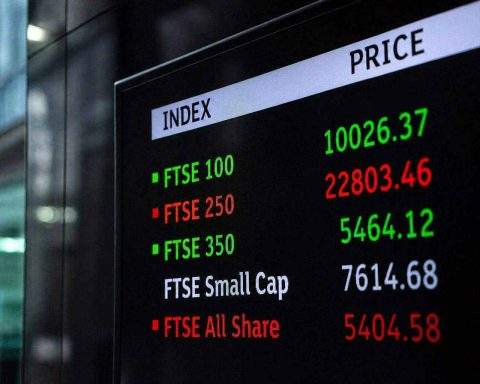
- FTSE 100 finished down 0.6% at 9,649.03 after touching an intraday high of 9,761.47 earlier in the session.
- FTSE 250 ended up 0.11% at 21,876.55, outperforming the blue-chip index on the day even as the broader weekly tone stayed subdued.
- Both the FTSE 100 and FTSE 250 logged a second consecutive weekly decline, underscoring that rate-cut optimism has not fully offset growth concerns.
The intra-day story mattered: investors initially leaned into the “lower rates ahead” narrative, but by afternoon the global mood deteriorated—dragging the UK benchmark into negative territory.
What moved the UK stock market today: growth worries meet global risk-off
Friday’s UK trading was pulled in two directions:
1) UK GDP shock boosts BoE cut expectations
New data showed Britain’s economy lost momentum ahead of the late-November Budget, reinforcing expectations that the BoE may need to support demand. Reuters reported the economy shrank 0.1% in the three months to October, and October GDP also fell 0.1%—a softer outcome than economists had expected.
Those numbers fed directly into rate expectations: markets were pricing roughly a 90% chance of a 25bp BoE cut at next week’s meeting.
2) Wall Street “AI angst” undercuts European risk appetite
Late in the session, London’s mood turned with the US open. A tech-led wobble in the US—tied to concerns about the durability of AI-related returns—hit sentiment across Europe and helped pull the FTSE 100 off its highs.
Reuters linked the downturn in US risk appetite to fresh worries about an AI bubble, with Broadcom a focal point of the selloff.
The macro backdrop: what today’s UK data is telling investors
UK growth: “no growth since June”
Beyond the headline contraction, Reuters noted that—based on the official figures—the economy hasn’t grown since June, highlighting the fragility of the UK recovery narrative into year-end.
That matters for equities because it changes the market’s central question from “how fast can the UK grow?” to “how quickly does policy need to ease to prevent a deeper slowdown?”
UK trade: deficit widened in the latest three-month window
The latest UK trade release added another layer to the growth puzzle. The total goods and services trade deficit widened by £4.0 billion to £6.7 billion in the three months to October 2025, according to the Office for National Statistics.
Widening external deficits don’t automatically drive stock prices day-to-day, but they contribute to a broader narrative of soft demand and uneven momentum heading into winter.
Bank of England outlook: market pricing vs. economist forecasts
With the BoE decision on Thursday, December 18 now the dominant near-term catalyst for UK assets, today’s coverage delivered a key takeaway: a cut is widely expected, but the path after that is debated.
Markets: heavily priced for near-term easing
Between weak GDP, cooling inflation signals, and softer labor indicators referenced in today’s reports, investors increasingly see the BoE moving soon—and then staying open to more cuts into 2026.
MUFG: “a cut for Christmas,” then more in 2026
In a Dec. 12 preview, MUFG said the path looks clear for the BoE to cut to 3.75% next week, with risks largely skewed toward the cut going ahead unless upcoming CPI/jobs data surprise sharply. MUFG also flagged the possibility of a tight vote split and projected further easing into 2026 to a terminal rate around 3.25%.
CBI: growth upgrades—but a more cautious rate-cut path
In contrast, the CBI upgraded its growth forecasts (raising the 2026 view to 1.3% and 2025 to 1.4%) but warned of persistent structural issues—and suggested inflation could stay sticky enough that the BoE may only have room for two further cuts (to 3.5% from 4%).
Bottom line for investors: Friday’s UK market action reflects a tug-of-war between “lower rates should help equities” and “weak growth may hit earnings first”—especially for UK-exposed companies.
Pound and rates: sterling softens after GDP surprise
In FX, the pound edged lower after the GDP data, with Reuters citing sterling down around 0.1% to $1.3375, though still near a multi-week high reached Thursday.
For UK equities, sterling moves matter because the FTSE 100 earns a large share of revenues overseas. A softer pound can support multinationals’ translated earnings—yet today the global “risk-off” impulse and growth worries were more influential than currency tailwinds.
Sector watch: precious-metal miners surge, but gains fade
One of the clearest themes in today’s London session was the strength in precious metals:
- Reuters said the FTSE 350 precious metal miners index jumped 5% to a record high before paring back to close up 0.8%.
In the close report, Sharecast also highlighted strength in names tied to gold, including Fresnillo and Hochschild, while noting that other heavyweight miners ended lower on the day.
This split is important: it shows investors were not simply “buying miners,” but favoring specific commodity exposures(notably gold/silver) as macro uncertainty rose.
Top UK stock news today: winners, losers, and the headlines driving moves
Friday’s biggest single-stock stories combined classic “rate-cut” positioning with very company-specific newsflow.
Notable risers: upgrades and selective risk-taking
- InterContinental Hotels Group (IHG) rose after an analyst upgrade, according to Reuters and Sharecast.
- Sharecast’s leaders list showed gains in several heavyweight names including Burberry, Flutter, Ashtead, and BT Group.
Notable fallers: retail pain and defensive pressure
- Card Factory plunged after issuing a profit warning tied to weak store sales and footfall expectations. Reuters said shares fell as much as 27%, and the company guided to an adjusted pretax profit range of £55m–£60m for the year ending January 2026 (below prior expectations).
- WH Smith fell after delaying annual results again, Reuters reported. Sharecast added background about the delay following an accounting issue at the firm’s North American arm.
- Sharecast’s fallers list included declines in British American Tobacco, Imperial Brands, and St James’s Place, among others—showing the selloff wasn’t confined to one sector.
M&A / energy: Harbour Energy in focus
- Reuters said Harbour Energy rose after agreeing to acquire subsidiaries of Waldorf Energy Partners and Waldorf Production for $170 million.
Consumer spending outlook: mixed signals heading into Christmas
Retail is in the spotlight because it is where “macro” hits earnings fastest. One reason Card Factory’s warning resonated is that it landed alongside a broader debate about the UK consumer’s resilience.
A Reuters report citing a PwC survey said UK Christmas spending is expected to rise 3.5% to £24.6 billion, but that this is effectively flat in volume terms given inflation. The same report referenced weaker November card spending data from Barclays and slower retail growth tracked by the British Retail Consortium.
Taken together, today’s signals suggest consumers may still spend—but are highly value-sensitive, and retailers with weaker footfall exposure may struggle to convert seasonal demand into profits.
What’s next for the UK stock market: the week ahead
With Friday’s close in the books, the UK market’s near-term focus tightens around a few catalysts:
1) Bank of England decision (Dec 18)
Sharecast summarized the market consensus: a 25bp cut is widely expected, and Friday’s GDP print “cemented” that view in many analysts’ minds. Sharecast+1
2) UK inflation and labor data before the BoE
Both MUFG and Sharecast emphasized that upcoming CPI and labor market releases are key “last hurdles” that could influence the vote split and messaging—even if the cut itself is strongly anticipated. MUFG Research+1
3) Inflation psychology: expectations still above target
A BoE-linked survey showed the public’s median expectation for inflation over the next year eased slightly to 3.5% (from 3.6%), still well above the BoE’s 2% target—data policymakers watch for signs inflation expectations are becoming entrenched.
4) Global risk appetite (especially US tech)
As Friday proved, the FTSE 100 can rally on domestic rate-cut hopes—and still reverse sharply if US equity leadership falters. The AI/tech narrative (and how markets reprice it) remains a key driver into year-end.
UK stock market takeaway for Dec 12, 2025
The UK stock market today delivered a clear message: rate cuts may be coming—but growth is slowing first.
The FTSE 100’s retreat from near 9,761 to a close around 9,649 captured investors’ dilemma in real time: optimism on easier policy collided with evidence of a softening economy and a late-session global risk-off swing.
Into next week, the market’s base case is increasingly straightforward—a BoE cut is likely—but the bigger debate is just beginning: how far and how fast can the BoE ease without re-igniting inflation pressure, and will earnings hold up long enough for lower rates to help? MUFG Research+2Reuters+2
This article is for informational purposes and is not financial advice.
Related articles: FTSE 100