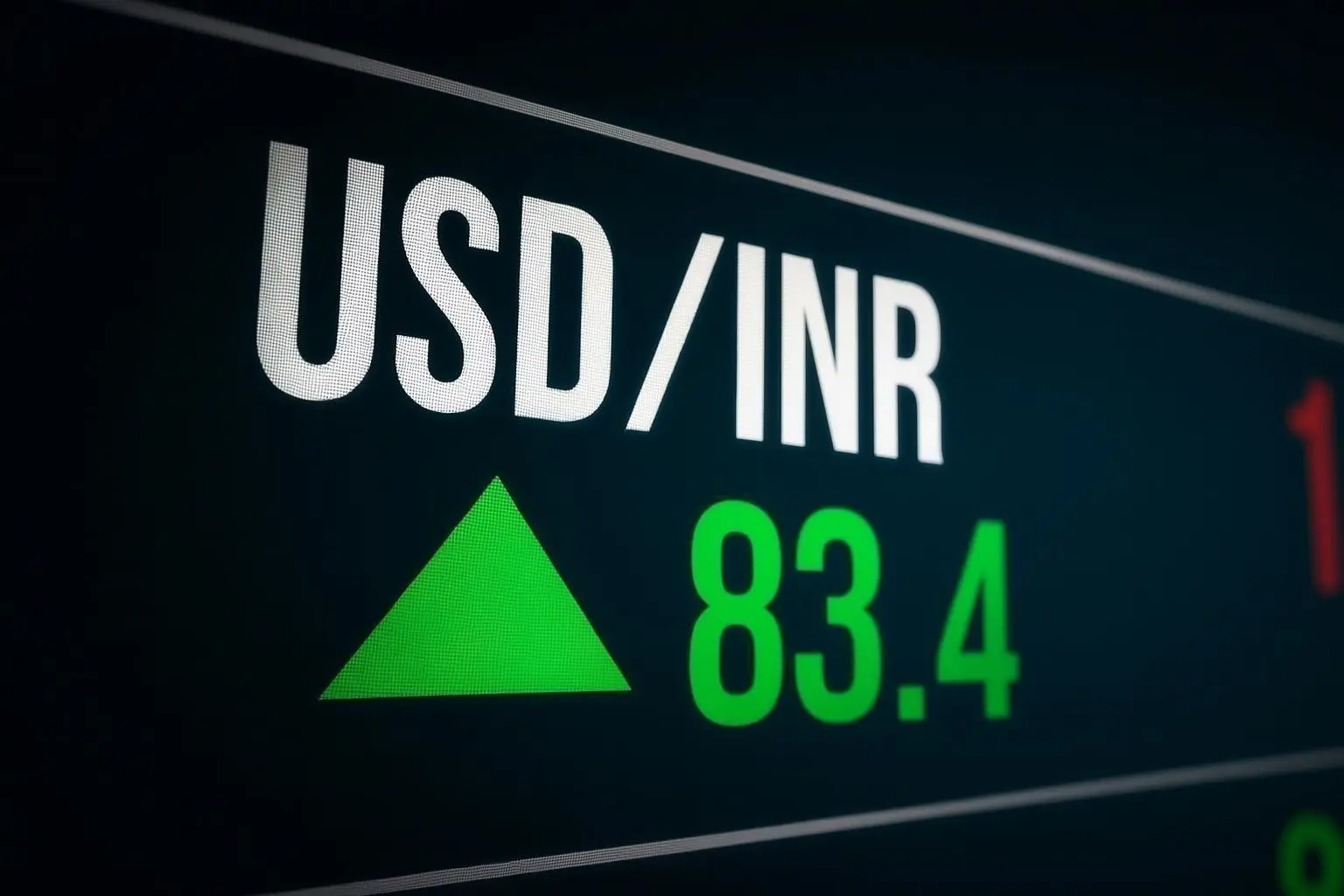
The Indian rupee fell to fresh record lows against the US dollar on December 15, pushing the INR/USD price to roughly $0.0110 per ₹1 (about 1.10 US cents) and taking USD/INR into the ₹90.7–₹90.8 per $1 zone—a level that has become the market’s new focal point.
While the US dollar has broadly softened in recent weeks, the rupee hasn’t enjoyed the usual relief. Instead, a mix of trade-policy uncertainty, persistent foreign outflows, hedging demand from importers, and a “managed” approach to volatility from the Reserve Bank of India (RBI) has kept USD/INR biased higher. Reuters+1
INR/USD price today: where the rupee stands on Dec. 15
In onshore trade, the rupee slid to new record lows beyond the previous trough set late last week. Reuters reported the rupee fell to around ₹90.785 per $1 and later closed near ₹90.73, after earlier hitting successive all-time lows.
Independent mid-market trackers also showed USD/INR around ₹90.74 on Dec. 15, reinforcing how close the market has been to the day’s extremes.
Indian financial media, citing market moves during the session, also flagged the rupee touching fresh record levels near ₹90.75 and warned that ₹91 is now the next psychological threshold many traders are discussing.
Why USD/INR is rising: trade deal limbo, tariffs and capital outflows
1) The US–India trade narrative is still the big swing factor
A central driver remains the prolonged uncertainty around US–India trade negotiations. Reuters linked the rupee’s fresh record lows to a “deadlock”/stalemate dynamic that has weighed on sentiment and capital flows. Reuters+1
That uncertainty matters because the market is trying to price two very different worlds:
- A deal pathway that could reduce tariff pressure, improve confidence, and encourage foreign inflows back into Indian assets.
- A no-deal / delayed-deal pathway that keeps risk premia elevated and encourages importers and investors to keep buying dollars on dips.
2) Year-to-date damage is adding to caution
By mid-December, Reuters described the rupee as down nearly 6% year-to-date, making it one of the weakest performers in Asia in 2025.
Foreign portfolio flows have been a key pressure point: Reuters reported foreign investors had sold more than $18 billion of Indian stocks in 2025, with additional net selling in bonds during December.
3) Flow mechanics: importers hedge, exporters hold back
Even when headline risk is quiet, USD/INR can rise simply because the day-to-day supply/demand balance is skewed.
Reuters noted that importers have been stepping up hedging as the rupee weakens, while exporters have been reluctant to sell dollars, tightening USD supply in the local market.
That combination often creates a feedback loop: the more USD/INR rises, the more urgent hedging becomes for some corporate buyers—especially into year-end when liquidity can thin out.
Trade deficit surprise: a better November number, but not a clear turning point yet
One potentially supportive development arrived in India’s November trade data: Reuters reported the merchandise trade deficit narrowed to $24.53 billion (a five‑month low), improving sharply from October’s record deficit as imports (including gold/oil/coal) fell.
Exports also improved in the same release, with merchandise exports around $38.13 billion and imports around $62.66 billion in November, per Reuters.
There was also a notable rebound in shipments to the US: Reuters reported exports to the US rose over 21% year-on-year to about $6.92 billion in November.
Why hasn’t that translated into rupee strength (yet)? Because currency markets typically need more than one month of better data to reprice a trend—especially when the bigger overhang (trade negotiations and tariffs) remains unresolved.
RBI watch: intervention signals, reserves, and a major USD/INR swap auction
RBI intervention: smoothing volatility, not defending a single line
Traders widely believe the RBI has been present to limit disorderly moves. Reuters reported the rupee avoided steeper losses amid likely central bank intervention, but also emphasized the view that the RBI is managing volatility rather than targeting a precise level.
A market participant quoted by Reuters framed a key technical area: support around ₹90.80 per $1, with the risk of a move into ₹91–₹92 if that gives way.
FX reserves have eased from recent highs
Rupee defense is never just about spot USD/INR—it’s also about how much pressure intervention places on reserves.
Reuters reported India’s foreign exchange reserves were about $687.3 billion (as of Dec. 5), down from a peak near $703 billion in early September.
A $5 billion, 36‑month USD/INR buy/sell swap is next
The RBI’s next liquidity and FX-management signal comes via a long-tenor swap operation.
- Reuters highlighted that the market’s focus is shifting to a 3‑year dollar-rupee buy/sell swap auction scheduled for Tuesday.
- NDTV, citing an RBI release, reported the RBI will conduct a 36‑month swap auction of $5 billion on Dec. 16, with the near leg dated Dec. 18, 2025 and unwind on Dec. 18, 2028.
- Informist added market color that participation could be strong given ample dollar liquidity with banks, and noted expectations around where swap pricing could clear versus prevailing forward premiums.
For USD/INR, these operations matter because they can influence rupee liquidity conditions, forward premia, and (indirectly) hedging costs for corporates.
What the derivatives market is implying
For near-term expectations, Reuters pointed to the 1‑month non-deliverable forward (NDF) suggesting a ₹90.46–₹90.52 range at one point—an indication of where offshore markets were pricing near-term USD/INR levels.
Reuters also reported that traders were bracing for USD/INR to hover in a broad ₹89.80–₹90.80 band this week, with the risk of higher volatility into year-end as liquidity thins.
The global backdrop: softer dollar, but INR is swimming against the current
The rupee’s slide is happening during a period when many emerging-market currencies have been more resilient.
Reuters reported that EM FX has drawn increased investor interest in 2025, helped by a weaker dollar trend—but also noted that India’s rupee has not been lifted by that tide, citing “anaemic” trade and investment flows pushing INR to record lows. Reuters
In other words: even if the global USD cycle is less supportive than it was earlier in the year, India-specific factors are dominating INR/USD pricing right now.
USD/INR forecasts: where major outlooks cluster for 2026
Forecasts diverge—because they embed different assumptions about trade policy, capital flows, and how tightly the RBI manages INR volatility. Here’s what a few widely followed outlooks indicate:
- Reuters poll (Dec 1–3 survey of 37 analysts): median forecast saw USD/INR improving to ~₹88.91 by end‑Feb 2026 and ~₹88.83 by end‑May 2026 (i.e., rupee strengthening from early-December levels).
- RBC Capital Markets (spot forecast table): USD/INR around ₹89.25 in Q1 2026, drifting to ₹90.00 by Q4 2026.
- MUFG (Dec 2025 monthly FX outlook table): USD/INR ₹89.45 (Q1 2026), ₹89.50 (Q2 2026), moving to ₹90.20 (Q3 2026) and ₹90.80 (Q4 2026).
- MUFG (IndiaPulse note): explicitly targets USD/INR 90.80 by the September 2026 quarter, arguing balance-of-payments pressures and import needs keep INR vulnerable even with RBI intervention.
- Citi Research (via Reuters): expects the rupee around ₹91 per $1 in fiscal 2027 as part of a broader macro/flows outlook tied to an improving balance of payments.
- Kotak Securities (quoted in Financial Express): expects a broad spot trading range of ~₹89.50–₹91.00, emphasizing FPI outflows and global yield dynamics as key drivers.
Why forecasts disagree
The spread between “back to 88s” and “up to 90.8/91” comes down to three variables:
- Trade policy path: a credible framework deal can change risk appetite quickly, but delays keep USD demand elevated.
- Capital flows: if equity and bond inflows return, they can overpower importer hedging; if outflows persist, the rupee struggles even with a softer dollar.
- RBI reaction function: intervention can slow the move, but the RBI may tolerate gradual depreciation—especially if reserves management and liquidity objectives pull in different directions.
Key things to watch next for INR/USD and USD/INR
The rupee’s next move is likely to be driven by a mix of macro releases, policy events, and headline risk:
- India macro data: Reuters flagged India’s WPI inflation (Dec. 15), HSBC flash PMI (Dec. 16), and RBI policy meeting minutes (Dec. 19) as near-term events.
- US macro and central banks: Reuters highlighted a data-heavy week including US releases (payrolls, retail sales, CPI) and key central bank decisions globally, all of which can move the dollar and risk sentiment.
- RBI’s $5bn swap auction (Dec. 16): pricing/participation could influence forward premia and hedging behavior—important for USD/INR’s tone into year-end.
- Trade headlines: any credible progress (or fresh friction) in US–India talks can move USD/INR quickly because positioning is already cautious.
Bottom line
As of Dec. 15, 2025, the rupee is trading at record-weak levels near ₹90.7–₹90.8 per $1, pulling the INR/USD price to about $0.011 per rupee. The immediate drivers are not just global dollar direction, but India-specific pressures: trade-policy uncertainty, uneven FX flows (importer hedging vs exporter reluctance), and persistent foreign outflows—partly cushioned by RBI smoothing operations and upcoming liquidity tools like the long-tenor swap auction.
For 2026, published forecasts span a wide band—from high‑₹88s (if a deal and flows stabilize) to ₹90.8/₹91 (if balance-of-payments pressures and risk premia persist).