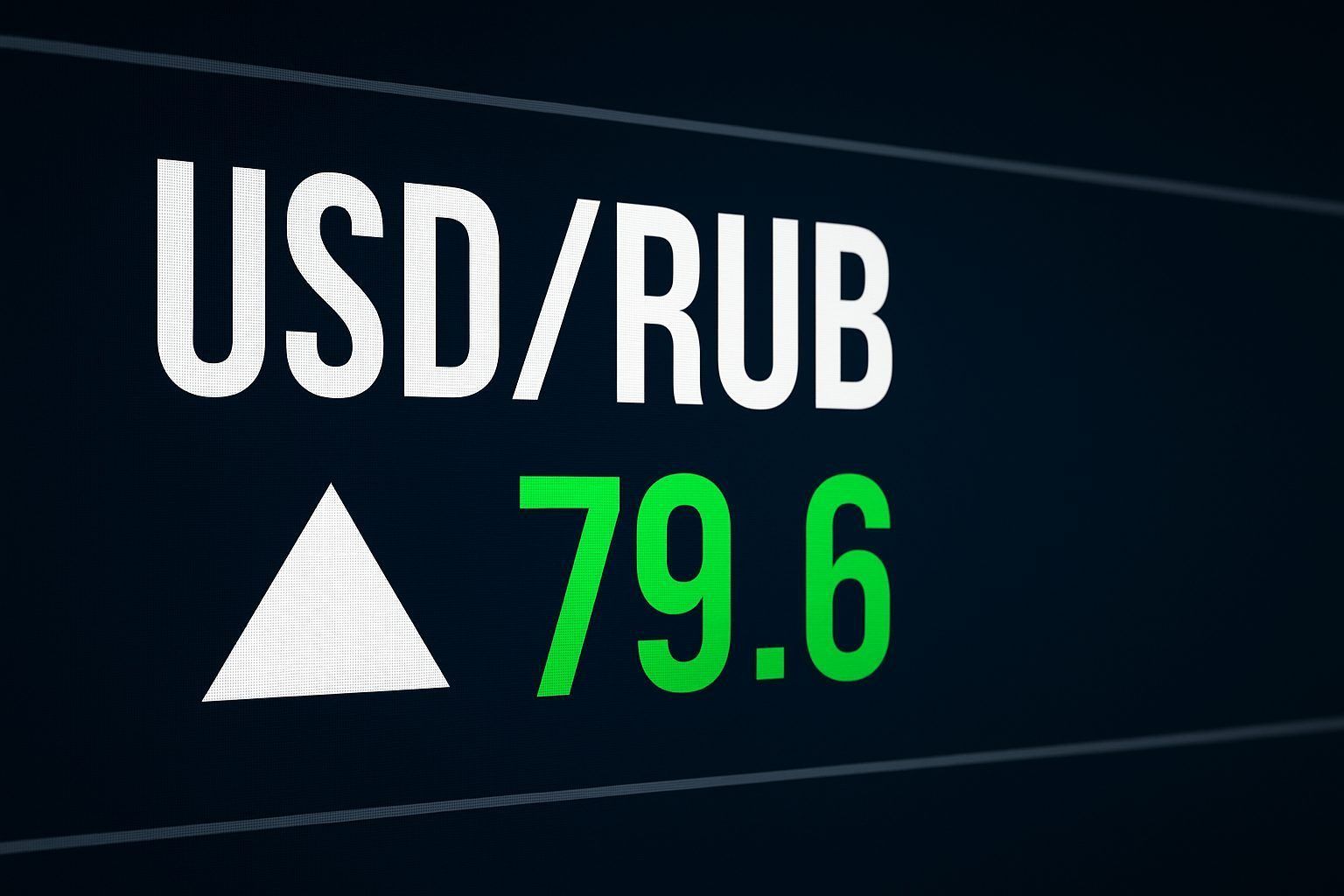
The Russian ruble is starting the week on firm footing against the U.S. dollar, with USD/RUB hovering in the 79–80 area on Monday, December 15, 2025. In RUB/USD terms, that’s roughly $0.0125–$0.0126 per ruble—about 1.25–1.26 U.S. cents.
While day-to-day moves in RUB/USD can look deceptively calm, today’s backdrop is anything but: legal escalation over frozen Russian sovereign assets in Europe, a still-soft oil market, and expectations for the Bank of Russia’s next policy step are all influencing how traders and analysts frame the ruble’s next move.
RUB/USD price today: where the exchange rate stands
Because the ruble is often discussed as “rubles per dollar,” here are the key reference points for Dec. 15, 2025:
- Market context (Reuters reference in today’s reporting): Reuters cited $1 = 79.3500 rubles in its Dec. 15 coverage tied to the Euroclear dispute.
- Bank of Russia official rate (latest posted set “from 13.12.2025”): 1 USD = 79.7296 RUB on the Bank of Russia’s official exchange-rate page. (Official rates can remain in effect across non-business days and until the next posting.) Central Bank of Russia
- Data aggregators (session framing): TradingEconomics reported USD/RUB at 79.4100 on Dec. 15, describing it as down on the session.
Put simply: the ruble is still strong versus the dollar, even after the volatility earlier this month when USD/RUB flirted with the mid-to-high 70s.
The biggest RUB/USD headlines driving today’s narrative
1) Russia’s central bank moves against Euroclear as the EU locks in the asset freeze
A major ruble-adjacent headline on Dec. 15 is legal and geopolitical: Russia’s central bank filed a claim in Moscow seeking damages from Euroclear—the Belgian securities depository that holds much of the Russian sovereign assets frozen in Europe. Reuters reports the claim amount as 18.2 trillion rubles (about $230 billion) and links it directly to the EU’s plans around immobilized Russian reserves.
Why FX markets care: Anything that raises uncertainty over cross-border settlement, asset custody, or retaliation risk can affect risk premia, capital-flow expectations, and the perceived stability of a currency regime—especially one already operating under extensive sanctions constraints.
2) Oil is higher today—but budget pressure remains a ruble theme
Oil prices were modestly higher on Monday, according to Reuters, but the bigger macro issue for RUB/USD is the ongoing tension between a strong ruble and Russia’s fiscal math, especially when crude prices are not booming.
Reuters calculations published Dec. 12 said Russia’s monthly oil and gas revenue in December is poised to fall sharply(to about 410 billion rubles, the lowest since August 2020), driven by lower crude prices and a stronger ruble.
3) Emerging-market FX is in vogue—helped by a softer dollar narrative
A separate Reuters feature on Dec. 15 highlights investor attention on emerging-market currencies amid broader FX volatility and expectations of continued dollar weakness into 2026. While not Russia-specific, this matters because it sets the broader “risk-on / carry” context in which high-yielding or idiosyncratic EM currencies can outperform. Reuters
Why RUB/USD is so sensitive to policy and trade flows in late 2025
The ruble’s “strength problem”: great for inflation, painful for exporters and the budget
Russia’s own officials have acknowledged the downside of a strong currency for an export-heavy economy. In early December, Reuters reported senior officials warning that the rouble will be stronger than previously expected, creating challenges for exporters and large export-oriented projects.
This is not an abstract issue: Russia’s fiscal revenues are heavily linked to commodity exports, and when the ruble strengthens, each dollar of export revenue converts into fewer rubles—a key reason the oil-and-gas revenue debate has become intertwined with the USD/RUB level.
A high-rate ruble vs. the next cut: the Dec. 19 Bank of Russia decision looms
Interest-rate differentials matter in FX, and the ruble has been supported by tight monetary policy. Reuters polling ahead of the Dec. 19, 2025 Bank of Russia meeting suggested analysts expected a 50 bp rate cut (to 16%) in response to easing inflation, and the same Reuters report pointed to expectations of a weaker ruble over time.
For RUB/USD, this is a key pivot:
- Cuts can reduce carry appeal (less incentive to hold rubles for yield).
- But if inflation stays under control and capital outflows remain constrained, the ruble can remain resilient even as rates edge down.
De-dollarisation and ruble invoicing are changing FX demand
Reuters reported comments from Russia’s central bank governor indicating the ruble share in payments for exports reached 57% in 2025, while the ruble share in import payments was 55%.
That shift matters because it can reduce structural demand for dollars inside the domestic economy, making USD/RUB more dependent on episodic factors like energy receipts timing, sanctions shocks, and policy changes.
Sanctions, settlement constraints, and “where the market is made”
Reuters has also described how USD/RUB pricing has become more opaque, with the rate determined through over-the-counter trade rather than a fully open, deep on-exchange market.
That microstructure reality helps explain why:
- different platforms can show slightly different “spot” rates at the same time, and
- headlines that would normally trigger a smooth price reaction can instead show up as wider spreads or delayed repricing.
RUB/USD forecasts: what major outlooks suggest after Dec. 15
Forecasting ruble moves is notoriously difficult—especially with sanctions, oil volatility, and policy intervention risks in play. Still, several widely cited outlooks help frame the consensus range.
Bank of Russia macro survey: gradual weakening path in 2026–2028
The Bank of Russia’s macroeconomic survey (published earlier in December) summarized analyst expectations for USD/RUB averages:
- 2025: 83.8
- 2026: 90.3
- 2027: 97.6
- 2028: 102.0
That survey also implies an average around 81.0 per dollar in December 2025—broadly consistent with the ruble staying relatively strong into year-end versus older “100+” narratives. Central Bank of Russia
Government thinking: officials argue the economy must adapt to a stronger ruble
In Reuters reporting on Dec. 2, Economy Minister Maxim Reshetnikov argued that structurally the exchange rate will be stronger than it appeared one or two years ago, and Reuters noted the government had shifted its 2026 average forecast to 92.2 per dollar (as of September).
That stance matters for RUB/USD because it signals policy tolerance: not every ruble rally is automatically “too strong” to be allowed, at least rhetorically.
Global bank-style forecasts: a more moderate 2026 range
MUFG’s December FX outlook projected USD/RUB levels around:
- 77.274 (Q1 2026) gradually moving to
- 83.030 (Q4 2026)
This is a notably stronger-ruble path than the longer-horizon averages in the Bank of Russia survey—and it illustrates how divergent assumptions (oil, sanctions enforcement, capital flows, domestic policy) can produce very different ruble trajectories.
Reuters poll framing: weaker within 12 months in one scenario set
Reuters’ Dec. 3 polling around the central bank meeting suggested the ruble could weaken to around 95.75 per dollar within a year, tying currency expectations to a broader macro view of easing policy and shifting fundamentals.
Taken together, the “big picture” is this:
- Near term (weeks): USD/RUB anchored near the high-70s to low-80s barring a shock.
- 2026 base cases: many forecasts still point to some weakening, but with wide dispersion depending on oil and sanctions.
A practical scenario map for RUB/USD into early 2026
Scenario A: Ruble stays strong (USD/RUB stays near ~75–82)
This scenario is more plausible if:
- domestic FX demand stays structurally low (imports constrained, de-dollarisation continues),
- the Bank of Russia cuts slowly and keeps real rates relatively attractive,
- oil avoids a sharp downside shock.
Scenario B: Controlled weakening (USD/RUB drifts toward ~85–95)
This scenario fits many “mainstream” forecasts if:
- rate cuts accelerate, trimming carry support,
- fiscal pressures intensify and policy leans toward a weaker ruble to support budget ruble revenues,
- sanctions or enforcement tighten in ways that reduce hard-currency inflows.
Scenario C: Volatility spike (gap moves above ~95–100)
This is the “tail risk” path—more likely after a sudden geopolitical escalation, a major oil-price drawdown, or a disruptive sanctions development affecting settlement channels. The Euroclear legal escalation and the EU’s longer-term freeze decision underline that legal and geopolitical risk remains a live variable. Reuters+1
What to watch next for RUB/USD (key dates after Dec. 15)
- Dec. 18 (EU summit focus): EU leaders were expected to finalize details around the Ukraine loan framework tied to immobilized Russian assets, keeping the “frozen reserves” story in the headlines. Reuters
- Dec. 19 (Bank of Russia rate decision): markets are watching whether the central bank cuts as expected and, crucially, how it communicates the path for 2026.
- Oil market direction into year-end: even modest oil moves can matter because budget expectations and ruble liquidity dynamics remain closely linked to export revenues.
Bottom line: RUB/USD remains strong, but the story is shifting from “rally” to “sustainability”
On Dec. 15, 2025, RUB/USD is best described as stable-to-strong, with USD/RUB near the 79 handle—supported by the legacy of tight policy and structurally reduced FX demand, yet increasingly overshadowed by a new set of questions: how Russia balances a strong ruble against fiscal needs, how far rate cuts go in 2026, and whether the EU–Russia legal confrontation over immobilized reserves spills into broader financial channels.
This article is for informational purposes only and does not constitute investment advice.