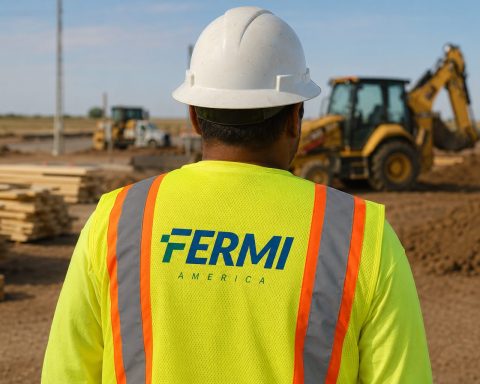

Fermi Inc. stock NASDAQ:FRMI is back in the spotlight on Monday, December 15, 2025, after the company confirmed that its first prospective tenant terminated a $150 million “Advance in Aid of Construction Agreement” (AICA) connected to the company’s flagship Project Matador development in Texas. The update has amplified what investors love and fear about Fermi in equal measure: gigantic ambition, huge addressable demand for AI power, and a business model where early customer commitments matter a lot when you’re still in the “prove it” phase. SEC+1
As of Dec. 15, FRMI shares were trading around $8.58 (down $1.51 from the prior close), extending the turbulence that began late last week when the tenant’s withdrawal first hit headlines.
What happened to Fermi (FRMI) stock: the AICA termination, explained
In a Form 8‑K filed with the SEC (dated December 12, 2025), Fermi laid out a tight timeline:
- Sept. 19, 2025: Fermi signed a non-binding letter of intent (LOI) with an investment grade-rated “First Tenant” to potentially lease part of the Project Matador Site, subject to negotiating a definitive lease.
- Nov. 3, 2025: Fermi and the First Tenant entered the AICA, under which the tenant could advance up to $150 million toward construction costs (subject to conditions).
- Dec. 9, 2025 (midnight): The LOI’s exclusivity period expired.
- Dec. 11, 2025: The First Tenant notified Fermi it is terminating the AICA. Fermi said no funds were ever drawn under the agreement, and that lease negotiations continue.
Two lines in the filing are doing most of the emotional heavy lifting for investors:
- With exclusivity over, Fermi says it has begun discussions with several other potential tenants for 2026 power delivery at Project Matador.
- Fermi says it remains confident it can meet its expected schedule because “behind-the-meter” AI power demand remains robust. SEC+1
(“Behind-the-meter,” in plain English: power delivered more directly and controllably to a customer, often designed to reduce reliance on congested grids—catnip for hyperscale AI compute.)
Why the market reacted so violently
Fermi is a newly public, pre-revenue infrastructure story where customer concentration risk isn’t a footnote—it’s the whole first chapter. When a first “anchor” tenant wobbles, the market immediately stress-tests everything: pricing power, credibility, financing, and how real the pipeline is.
Reuters captured that dynamic bluntly. On Friday, FRMI plunged about 34% after the tenant backed out of the funding deal, and the stock was trading around $10.04, roughly half the IPO price. Reuters also quoted investors warning that with smaller/newer firms, “key client risk” can bite hard, and that Fermi is still in a “‘show me’ stage.” Reuters+1
Layer on a broader market anxiety that keeps resurfacing in 2025: whether the AI data-center boom risks an overbuild before profits catch up. Reuters quoted a CIO warning that when a major (potential) tenant cancels a nine‑figure deal at a company that hasn’t shown profits, “investor concern skyrockets,” especially amid overbuild worries. Reuters
The “damage report” as of Dec. 15, 2025: price action and context
Here’s the weird reality of FRMI right now:
- The company’s disclosure emphasizes no cash left the building (no AICA funds were drawn).
- The stock, however, trades like the market just watched oxygen leave the room—because in early-stage infrastructure, confidence and counterparties can be as valuable as cash.
As of Dec. 15, FRMI traded near $8.58, still far below the $21 IPO price reported by Reuters when Fermi raised roughly $682.5 million in its September 2025 IPO (with the shares expected to trade on Nasdaq and the London Stock Exchange under “FRMI”). Reuters
Today’s analysis: was this a negotiation blow-up, or a business model flaw?
One of the more interesting threads in the coverage is that the breakdown may reflect pricing friction, not necessarily a lack of demand.
DataCenterDynamics reported that Cantor Fitzgerald’s clean-energy analyst Derek Soderberg characterized the episode as a sign of pricing discipline—arguing Fermi didn’t want to concede on pricing in a way that could weaken future gigawatt-scale deals.
That’s the bull-case framing: a tough negotiation now avoids “poisoning the well” later.
The bear-case framing: if your first marquee customer won’t sign on your terms, your “pricing discipline” might just be “pricing fantasy,” and the next tenants will know it.
Neither interpretation is proven yet, which is why FRMI is behaving like a seismograph during a stampede.
Forecasts and analyst targets for FRMI stock on Dec. 15
Despite the obvious uncertainty, the sell-side isn’t uniformly abandoning ship—at least not yet.
Analyst ratings mentioned in today’s coverage
An Investing.com roundup published this morning said UBS maintained a Buy rating with a $30 price target, while acknowledging that delays converting the LOI into a definitive lease have been the core overhang on the stock. The same piece said analyst targets cited in coverage range from $20 to $37.
Separately, Investing.com reported Evercore ISI cut its price target to $20 from $37 while maintaining an Outperform rating, calling the termination a “clear negative” and saying it increases uncertainty around the previously disclosed LOI. Investing.com
A third-party distribution note (Moomoo/TipRanks data) also said Stifel maintained a Buy with a $29 target.
Consensus “stock forecast” numbers being cited
MarketBeat’s consensus page for FRMI (as of today) lists an average 12‑month price target of $31.56, with a cited range from $27 to $37.
A big, neon caution sign belongs here: price targets can lag reality. The market is telling you it wants a signed lease, not a spreadsheet.
The other big December development investors are weighing: the Xcel/SPS power agreement
Fermi’s December narrative isn’t only bad news.
On Dec. 5, 2025, Fermi America (the brand used in company communications) announced a definitive Electric Service Agreement with Southwestern Public Service Company (SPS), a subsidiary of Xcel Energy, for up to 200 MW of electrical capacity for Project Matador—starting with 86 MW in January 2026 and ramping to 200 MW.
This matters because it’s a concrete, dated milestone (power delivery starting January 2026) in a story otherwise dominated by long-horizon nuclear and giga-scale buildouts. It doesn’t solve the “anchor tenant” question, but it does support the argument that Fermi is assembling pieces of a real infrastructure stack. PR Newswire
What is Project Matador—and why investors keep coming back to it
Fermi is trying to build what Reuters described as a massive energy-and-data campus concept—sometimes framed as a “hypergrid”—near Amarillo, Texas, combining nuclear, natural gas, and solar (and in some reports, other sources) to deliver huge volumes of power suited to AI data centers. Reuters reported the campus could eventually deliver up to 11 GW, with 1 GW expected online by late 2026 (per company statements reported at the time). Reuters+1
Reuters also reported that in nuclear regulatory documents the company referred to the nuclear complex as the Donald J. Trump Generating Plant, and that Fermi said it has been in talks with large data managers (“hyperscalers”) on preliminary documents like LOIs and term sheets. Reuters+1
That’s the structural reason FRMI trades like a sci‑fi option: if Fermi becomes the “power bottleneck solver” for hyperscale AI, the upside narrative is enormous. If it can’t lock in tenants and financing, the equity story can compress brutally.
The company’s message today: “tenant one” isn’t gone, and competition for capacity may be starting
Local coverage in Texas included CEO Toby Neugebauer’s statement that Fermi remains in active conversation with the first tenant, and that the exclusivity clause expiring allows other potential tenants to begin bidding—framing the moment as a pivot toward broader demand rather than a dead end.
This is the tension at the heart of the stock:
- The market reads “tenant terminated funding agreement” as “trust breach / deal risk.”
- The company reads “exclusivity ended” as “we can finally run a competitive process.”
Both can be true. Markets are annoying like that.
What to watch next for Fermi (FRMI) stock
For anyone tracking FRMI into year-end 2025, the next catalysts are less about vibes and more about paperwork:
- A definitive lease agreement (not an LOI) with the first tenant or another named anchor tenant. The current filing makes clear the LOI is non-binding and negotiations are ongoing.
- Any new SEC filings clarifying the tenant situation, construction financing, or revised timelines.
- Evidence that the company can convert “demand is robust” into signed contracts—especially for the 2026 power delivery window that management highlighted. SEC+1
- Execution on nearer-term infrastructure steps, like the SPS/Xcel power deliveries starting January 2026.
- Any meaningful updates on the nuclear pathway and financing structure described in prior Reuters reporting (because nuclear timelines and costs have a long history of… let’s call it “creative optimism”). Reuters+1
Bottom line: FRMI is trading on counterparty confidence
As of Dec. 15, 2025, the “headline fact” is simple: a prospective tenant ended a $150 million construction funding agreement tied to Project Matador, though lease talks continue and Fermi says it is now speaking with other potential tenants. SEC+1
The investable question is harder: does this episode become a footnote in a competitive tenant process—or the first crack in a story priced for near-flawless execution?
Either way, this is not a sleepy REIT ticker right now. It’s a referendum on whether the AI power bottleneck is about to mint new infrastructure giants… or new cautionary tales.