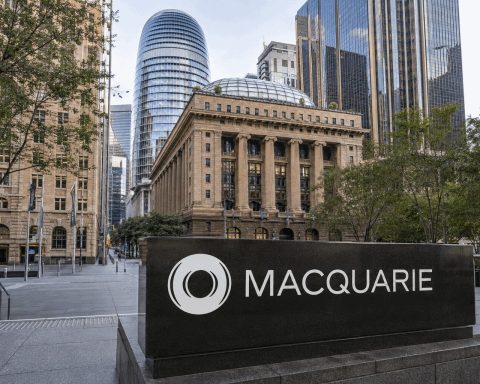

Macquarie Group Ltd ASX:MQG shares hovered around the psychologically important A$200 level on Tuesday, 16 December 2025, as investors weighed a near-term income catalyst (the interim dividend payment due 17 December) against mixed technical signals and a still-active debate on how quickly earnings can re-accelerate in FY26.
For market watchers, the story today is less about a single headline and more about the setup: a globally diversified financial group with meaningful exposure to market conditions, sitting just ahead of a dividend payment and still digesting the implications of its latest half-year results and capital management settings.
Where MQG traded on 16 December 2025
According to Stock Analysis price history data, MQG traded between A$200.20 and A$202.02 during the 16 December session, and was indicated around A$200.83 near 3:59pm AEST. The same data set shows an end-of-day close of A$201.13 for 16 December (with 15 December closing at A$200.31).
That range matters because A$200 has acted as a key “line in the sand” for traders and longer-term holders alike—especially in the weeks after MQG’s post-results volatility in November and the stock’s choppy consolidation since then. StockAnalysis+1
Today’s notable MQG-focused coverage (16 December 2025)
While there wasn’t a flood of major company-specific breaking news about Macquarie’s ordinary shares today, two MQG-related items stood out across market coverage and filings-focused newswires:
1) Technical analysis: “seller exhaustion” and the A$200 breakout narrative
A technical note published today by FNArena (via Fairmont Equities’ Michael Gable) argues MQG’s move through prior resistance near A$200 suggests “seller exhaustion,” potentially clearing the way for a recovery phase—after weeks of sideways trading designed to “absorb” supply around that level. FNArena.com
Importantly for readers: this is third-party technical opinion, not company guidance. Still, it helps explain why A$200 has become such a heavily watched zone for MQG price action going into year-end.
2) Capital notes distribution update (not the ordinary share dividend)
TipRanks’ auto-generated announcements feed reported a new distribution for Macquarie Group’s quoted hybrid security MQGPG, with a stated distribution amount of AUD 1.3793, record date 27 February 2026, and payment date 16 March 2026.
This is separate from MQG ordinary shares. However, distributions on Macquarie-issued listed hybrids can still show up on investor radars because they touch on the group’s broader funding stack and income-product investor base (even if they don’t directly change ordinary share earnings).
Dividend countdown: what matters for MQG shareholders this week
The near-term calendar driver is Macquarie’s 1H26 interim dividend of A$2.80 per ordinary share (35% franked), with payment scheduled for Wednesday, 17 December 2025.
Three practical points for investors:
- The stock already went ex-dividend on 17 November 2025, with a record date of 18 November 2025—so buying MQG on 16 December does not entitle a new buyer to this payment.
- Macquarie has stated that shares will be acquired on-market to satisfy the Dividend Reinvestment Plan (DRP) for this interim dividend. That structure can matter at the margin because it avoids issuing new shares directly (dilution), though it can create incremental on-market buying demand during the DRP acquisition window.
- At the time of the half-year release, Macquarie described the interim dividend as representing a 64% payout ratio (within its stated annual payout policy range).
For income-focused readers, the key takeaway is simple: the cash is about to hit accounts, but the market impact is typically felt around the ex-dividend period—not the payment date itself.
What the business is doing: the most relevant fundamentals behind MQG stock
Macquarie is not a traditional “plain vanilla” bank. It’s a diversified global financial services group spanning:
- asset management (including private markets exposure),
- banking and financial services (lending and deposits),
- commodities and global markets (trading and risk management), and
- investment banking/advisory and principal-style activity through Macquarie Capital.
In its 1H26 result for the half year ended 30 September 2025, Macquarie reported:
- net profit of A$1,655 million,
- assets under management of A$959.1 billion (at 30 September 2025),
- and an annualised ROE of 9.6% (versus 11.2% in FY25).
The group also highlighted that its financial position “comfortably exceeds” regulatory minimums, providing flexibility for capital management—including buybacks. Macquarie
Buyback as a supporting factor
Macquarie’s board approved an extension of an up to A$2 billion on-market share buyback for a further 12 months at the half-year update, noting the buyback can be varied, paused, or terminated depending on conditions and capital needs.
As of 6 November 2025, Macquarie said it had acquired A$1,013 million of ordinary shares on-market at an average price of A$189.80.
For MQG stockholders, buybacks matter in two ways:
- they can mechanically support earnings per share (fewer shares outstanding), and
- they can act as a sentiment anchor when valuations fall into ranges management considers attractive—though execution is always conditional on capital, markets, and opportunities elsewhere in the business.
Analyst forecasts and price targets for MQG: what the market is implying on 16 December 2025
Across major forecast aggregators, the “center of gravity” for Macquarie targets currently sits in the low-to-mid A$220s—but with meaningful dispersion.
Consensus targets cluster around ~A$222–A$224
- Investing.com shows a consensus rating of “Buy” and an average 12‑month target of 224.48 (high 255, low 200) based on 13 analysts. Investing.com
- MarketScreener reports a mean consensus of “Outperform”, with 12 analysts and an average target price of 224.48 AUD against a last close around 200.31 AUD. MarketScreener
- TipRanks shows an average price target of AU$222.61 (high AU$255.90, low AU$200.70) based on 8 analysts in the past 3 months, implying roughly ~10% upside from its referenced last price.
Some services publish higher averages
Fintel lists an average one-year price target of $233.91, with forecasts ranging from $202.57 to $267.75 (as of a 6 December 2025 record/projection set).
What this means in plain English: the Street is generally not pricing MQG as “broken,” but neither is it pricing in a straight-line return to prior highs. Targets imply moderate upside from today’s levels—conditional on Macquarie delivering steadier earnings momentum and/or improved market conditions. StockAnalysis+3Investing.com+3MarketScreener+3
Technical signals are mixed — and that’s the point
One reason MQG has become an active discussion stock into late 2025 is that different timeframes tell different stories.
- Investing.com’s technical dashboard shows shorter-term strength (e.g., “5 Hours: Strong Buy”) while also flagging a Weekly: Strong Sell view, alongside a broader summary that sits closer to Neutral/Buy depending on timeframe. Investing.com Australia
- StockInvest similarly notes a short-term moving average buy signal, but also says the long-term average still implies a more negative/“sell” backdrop because the long-term line sits above the short-term line. StockInvest
- FNArena’s technical column specifically frames the A$200 break as the clearing of resistance and an indicator that prior supply may have been absorbed.
This kind of mixed tape is common in large-cap financials during transitions: the stock can look constructive over days/weeks while still working through a larger trend that has not fully reset.
Growth outlook: what forecast models expect (and what can derail it)
Forecast models cited by Simply Wall St (last updated 9 December 2025) indicate Macquarie is expected to grow:
- earnings by ~9.7% per year,
- revenue by ~5.5% per year, and
- reach a forecast ROE of ~12.8% in 3 years.
That’s a meaningful improvement versus the 9.6% annualised ROE Macquarie reported for the 1H26 half-year, and it underscores what bullish investors are betting on: an upswing in conditions that drive performance fees, advisory volumes, trading/risk management demand, and credit-related income—without a major spike in losses or regulatory costs.
Risks Macquarie itself highlights
In its 1H26 outlook commentary, Macquarie explicitly points to factors that can swing near-term performance, including:
- global economic conditions, inflation and interest rates, and volatility events,
- geopolitical impacts,
- completion timing of transactions and period-end reviews,
- FX and geographic mix of income,
- and potential tax/regulatory changes and uncertainties.
For MQG stock, these risks matter more than they might for simpler domestic lenders—because Macquarie’s earnings are often more market-condition sensitive and can be “lumpy” across halves.
The wider Macquarie deal narrative investors are still watching
Even though it’s not a 16 December headline, Macquarie’s deal activity continues to form part of the stock’s backdrop—particularly via Macquarie Asset Management.
Reuters has reported on Macquarie Asset Management’s buyout proposal for Qube Holdings (announced in late November 2025), which—if it progresses—would reinforce the idea that Macquarie remains an active infrastructure/real assets dealmaker despite a mixed year for large Australian M&A.
Separately, Reuters noted Nomura’s ambitions to build out alternatives and referenced its earlier 2025 acquisition of Macquarie’s U.S. and European public asset management units—context that matters for how investors think about the evolving shape of Macquarie’s asset management earnings base.
What to watch next for Macquarie stock
For readers tracking MQG into year-end and early 2026, the most actionable watchlist items are:
- Post-dividend trading behaviour (17–20 December): not because the dividend payment changes value by itself, but because it can influence positioning and liquidity.
- A$200 as a technical “battle zone”: multiple technical commentaries place emphasis on MQG holding above prior resistance. FNArena.com+1
- Buyback pace and market conditions: buybacks are explicitly discretionary; stronger market opportunities or capital needs can slow them, while weaker prices can sometimes accelerate value arguments (without guaranteeing action).
- Macro signals (rates and volatility): Macquarie itself flags market conditions, interest rates, and volatility events as key swing factors.
- Any updates on major transactions or private market realizations: Macquarie’s earnings can be sensitive to timing in asset sales, performance fees, and deal flow.
Bottom line on 16 December 2025
As of 16 December 2025, Macquarie Group Ltd ASX:MQG is trading in a tightly watched price band around A$200–A$201, with attention split between:
- a near-term dividend payment (cash arriving 17 December, but the stock has long been ex-dividend), Macquarie+2Macquarie+2
- a technical narrative that the A$200 resistance level may be giving way, FNArena.com+1
- and a consensus valuation framework that clusters in the low A$220s, implying mid‑single to low‑double‑digit upside if Macquarie can deliver on improving earnings expectations.
For long-term investors, the essential question remains whether Macquarie’s diversified machine—asset management, banking, commodities/risk management, and advisory—can translate stabilising conditions into more consistent returns on equity, while managing the real-world constraints it lists (rates, volatility, regulation, and transaction timing).