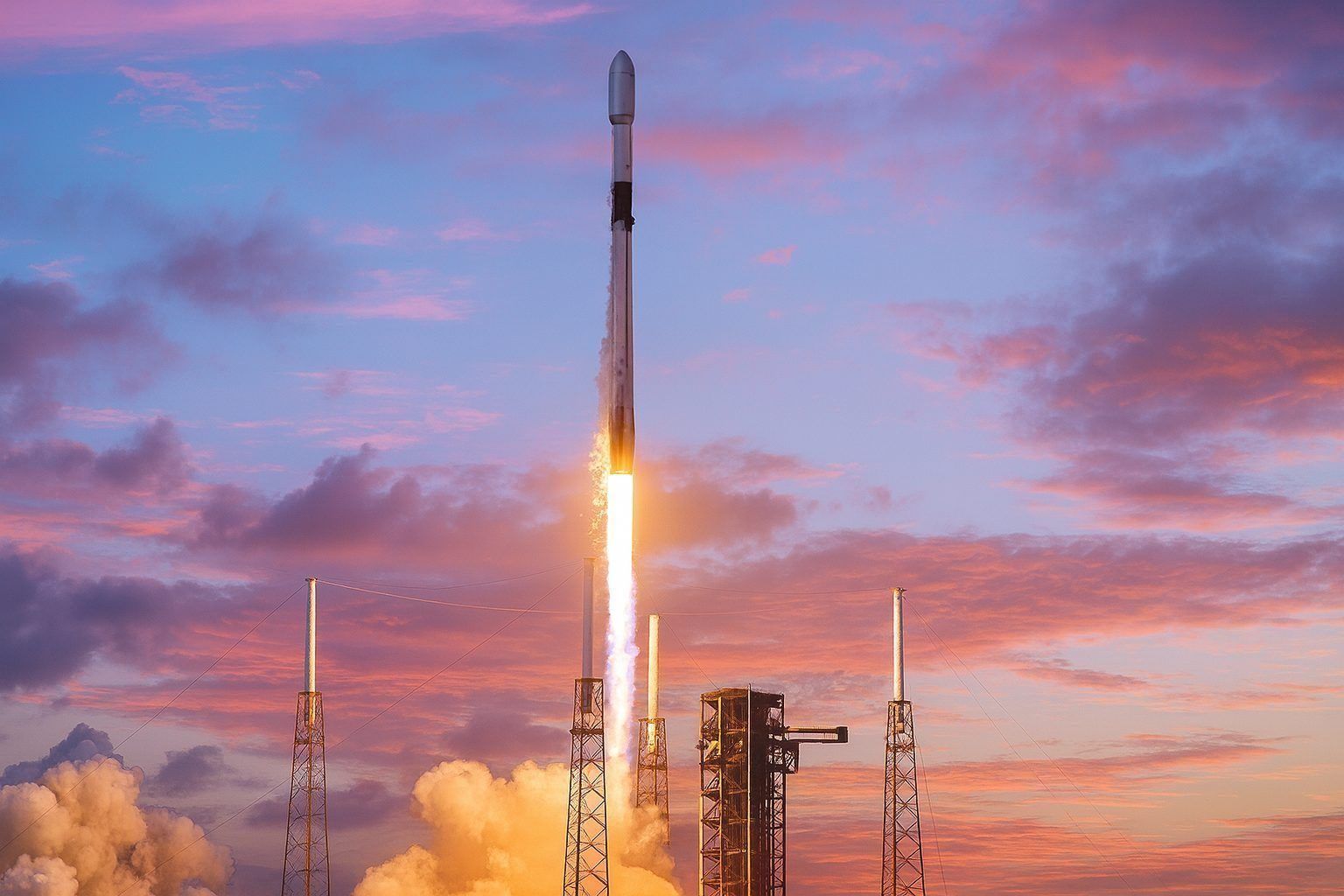
Tuesday, December 16, 2025 delivered a classic “modern spaceflight” mix: a broadband-constellation push from Florida, a high-resolution Earth-observation mission from China, and a scrubbed smallsat launch attempt that underscores how tightly packed — and technically unforgiving — today’s global launch calendar has become. Spaceflight Now+2Spaceflight Now+2
Below is a comprehensive roundup of the spaceflights and satellite-launch headlines published on 16.12.2025, plus the most notable launches now lined up over the next day or two.
ULA Atlas V launches 27 Amazon Leo satellites from Cape Canaveral
The day’s biggest U.S. launch headline came before sunrise on Florida’s Space Coast, when United Launch Alliance (ULA) launched an Atlas V 551 rocket carrying 27 Amazon Leo satellites (Amazon’s broadband constellation formerly known as Project Kuiper). Liftoff occurred from Space Launch Complex-41 (SLC-41) at Cape Canaveral Space Force Station at 3:28 a.m. EST (08:28 UTC).
Spaceflight Now reported the Atlas V departed “on time” and flew a north-easterly trajectory, with the RD-180 main engine augmented by five solid rocket boosters — the defining feature of the 551 configuration. Spaceflight Now
Why this mission matters: constellation momentum and a 2026 deployment clock
This flight — referred to by ULA as Amazon Leo 4 and by Amazon as LA-04 — is a key milestone in Amazon’s race to scale a global satellite internet network in the same competitive arena as Starlink.
Spaceflight Now notes that after LA-04, Amazon will have 180 Amazon Leo satellites in orbit, delivered across four Atlas V missions and three SpaceX Falcon 9 missions in 2025. The report also highlights a major deadline: Amazon is required to deploy half of its planned 3,200-satellite constellation by July 31, 2026 (with potential for extension/waiver).
Weather, as ever, shaped the schedule: ULA reportedly skipped a Monday attempt due to winds, with a much improved forecast (95% favorable) for Tuesday’s predawn window.
China launches Ziyuan III 04 on a Long March-4B from Taiyuan
While Florida watched Atlas V climb into the dark, China added a new spacecraft to orbit from the Taiyuan Satellite Launch Center. State media reported that a Long March-4B rocket launched the Ziyuan III 04 satellite at 11:17 a.m. Beijing time — part of the country’s sustained cadence of Earth-observation launches.
A “stereo mapping” satellite aimed at high-resolution 3D Earth data
CGTN describes Ziyuan III 04 as a stereo mapping satellite developed by the China Academy of Space Technology, designed to work alongside Ziyuan III 02 and 03 as a constellation. According to the report, the spacecraft carries payloads including a stereoscopic mapping camera, multispectral camera, and a laser altimeter, supporting applications such as geographic information development, natural resource monitoring, land spatial planning, and related oversight.
Xinhua also noted the launch as the 617th flight mission of the Long March rocket series — a data point that reflects just how mature (and busy) China’s launcher family has become.
Rocket Lab aborts an Electron liftoff at engine ignition for “Bridging the Swarm”
Not every “launch day” ends with a satellite in space — and Rocket Lab provided the clearest reminder of that on Dec. 16.
Spaceflight Now reported that Rocket Lab’s Electron rocket aborted at engine ignition on the “Bridging the Swarm”mission from Launch Complex 1 in Mahia, New Zealand. In an update, Rocket Lab said the abort occurred after a sensor detected “out-of-family data,” and the team was working a “straightforward fix” and would choose a new launch date. Spaceflight Now+1
The payload: KAIST’s Neonsat-1A Earth-observation spacecraft
The mission’s primary payload is Neonsat-1A, an Earth-observation satellite for the Satellite Technology Research Center (SaTReC) within KAIST (Korea Advanced Institute of Science and Technology). Spaceflight Now describes Neonsat-1A as intended to validate advanced satellite capability and expand operational utility, while also supporting the broader path toward a future constellation.
Spaceflight Now’s schedule details also included the planned target orbit: about 540 km altitude at 97.4 degrees inclination — a common geometry for consistent lighting and repeatable imaging conditions.
SpaceX Starlink: recent launches, but Dec. 16 missions slip to Dec. 17
Even on a day without a SpaceX liftoff, Starlink remains the gravitational center of launch cadence — and Dec. 16 coverage was shaped by schedule movement.
According to Spaceflight Now’s updated launch schedule, two Falcon 9 Starlink missions that had been targeting Dec. 16 were delayed to Dec. 17:
- Starlink 6-99 from Kennedy Space Center (LC-39A) — delayed from Dec. 16 (and earlier dates), with a published window opening 7:19 a.m. EST (12:19 UTC).
- Starlink 15-13 from Vandenberg Space Force Base (SLC-4E) — also marked as delayed from Dec. 16, with a window opening 7:10 a.m. PST.
For context on pace, Spaceflight Now’s launch log shows SpaceX successfully launched Starlink 6-82 on Dec. 15 from Cape Canaveral and Starlink 15-12 late Dec. 13/early Dec. 14 from Vandenberg — underscoring how quickly Falcon 9 missions can stack up even as individual attempts move around the calendar.
What’s launching next: Japan’s H3, Europe’s Ariane 6, Brazil’s Hanbit-Nano
Although Dec. 16 featured two major orbital successes (Atlas V and Long March 4B), the next 24–48 hours look crowded — with multiple regions preparing high-profile missions.
Japan: H3 F8 set for Michibiki (QZS-5)
Japan’s space agency JAXA issued a rescheduled timeline for Michibiki No. 5 (QZS-5) aboard the 8th H3 launch vehicle (H3 F8). The new target is December 17, 2025, with a launch time of 11:10:00 JST and a window extending to 11:24:30 JST, launching from Yoshinobu Launch Complex at Tanegashima Space Center.
Depending on where readers are, that corresponds to 02:10 UTC on Dec. 17 — which is still Dec. 16 in the U.S. evening. (This is one reason “today’s launch” coverage often has to speak in UTC.) JAXA+1
Europe: Ariane 6 to loft two Galileo satellites
Europe is also preparing a major navigation upgrade: ESA and French space agency CNES have publicized a Dec. 17 Ariane 6 mission carrying two Galileo satellites (SAT 33 and SAT 34) from Europe’s Spaceport in Kourou, French Guiana. CNES lists liftoff at 02:01 local time (05:01 CET / 06:01 UTC), and ESA is promoting live coverage as Galileo’s first launch on Ariane 6.
Brazil: Innospace targets “Spaceward” on Hanbit-Nano from Alcântara
Spaceflight Now’s launch schedule also flags a notable first: Innospace is aiming to fly its first Hanbit-Nano rocket on the “Spaceward” mission from Alcântara Launch Center (Brazil) on Dec. 17, carrying eight payloads to about 300 km altitude. Spaceflight Now
Russia and the ISS pipeline: Baikonur pad repairs become a Dec. 16 headline
Not all “launch news” is about rockets lifting off — sometimes the biggest story is what could keep them grounded.
Reuters reported on Dec. 16 that Russia’s space agency Roscosmos said repair work is underway on a damaged launch pad at Baikonur Cosmodrome (Pad 31), with the site expected to be back in use by February 2026. Reuters notes the pad was damaged during the successful November 2025 Soyuz MS-28 launch, and highlights why the repair matters: Pad 31 is described as the only pad currently able to handle Soyuz crewed missions and Progress cargo launches that support the ISS.
Spaceflight Now’s schedule also lists Russia’s Proton-M / Elektro‑L No. 5 weather satellite launch as delayed due to an upper-stage issue, with a new date still TBD — another reminder that late-year manifests can change quickly.
The takeaway: Dec. 16 shows the new normal for satellite launches
If you’re tracking rocket launches today and wondering what Dec. 16, 2025 says about the state of spaceflight, the answer is straightforward: constellations are driving the tempo, Earth observation remains a strategic priority, and tight schedules mean scrubs and reshuffles are routine rather than exceptional. That reality played out across three continents today — with successful orbital launches for Amazon Leo and Ziyuan III 04, an Electron abort in New Zealand, and a Starlink schedule that slid into tomorrow.