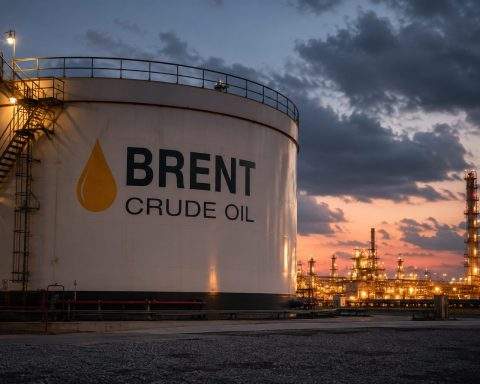

December 16, 2025 — Oil prices pushed lower on Tuesday, with Brent crude dipping under the psychologically important $60-a-barrel mark as traders weighed two powerful forces hitting the market at once: rising optimism that Russia-Ukraine peace negotiations could eventually loosen constraints on Russian supply, and fresh evidence that China’s demand engine is losing momentum.
By early afternoon in Europe, Brent crude futures were down about 1.3% at $59.75 a barrel, while U.S. West Texas Intermediate (WTI) traded near $55.98, down roughly 1.5%. Reuters The move takes crude toward the lower end of a multi-month slide that has been driven less by sudden disruptions and more by a steadily building narrative that global supply is outrunning demand heading into 2026.
Why oil is falling now: geopolitics is easing, but supply is not
For much of the past few years, oil has repeatedly rallied on geopolitical risk—war risk premiums, shipping disruptions, sanctions uncertainty, and the constant possibility of sudden supply outages. What’s different this week is that the dominant geopolitical storyline is de-escalation, not escalation.
Market participants are responding to signs that negotiators are getting closer to a framework that could reduce the intensity of the Russia-Ukraine conflict. While no deal is done, even the possibility of progress can shift expectations about future flows—especially if it implies fewer bottlenecks or softer enforcement around Russian exports.
That’s why sub-$60 Brent is being read as more than just a price level. It’s a signal that traders believe the market may have to absorb “more oil for longer”—at a time when demand growth is looking less convincing.
Ukraine peace talks: the market is pricing the possibility of more Russian supply
The clearest immediate catalyst for Tuesday’s drop is renewed optimism around Russia-Ukraine talks. According to Reuters, the United States has floated NATO-style security guarantees for Kyiv, and European officials have signaled progress—though the hardest issues, particularly territorial concessions, remain unresolved.
Key points driving the market narrative:
- U.S. proposal and “Article 5-like” guarantees: Reuters reported U.S. officials discussing security guarantees comparable to NATO’s collective defense principle, which would be a major shift in the negotiating posture—yet one presented as time-limited. Reuters
- Sticking point remains territory: Even as negotiators talk about convergence, Reuters reported that significant gaps persist over territory, and that Russia has not signaled willingness to soften its position.
- Ukraine signals flexibility on NATO path: In separate coverage, Reuters reported President Volodymyr Zelenskiy offered to drop Ukraine’s NATO aspirations in exchange for binding security guarantees—an important political shift, even if it doesn’t guarantee Russian acceptance.
From an oil-market perspective, the mechanism is straightforward: if an eventual deal reduces friction in trade flows—or leads to easier logistics and fewer sanction-related detours—then the effective amount of supply available to the market rises. The Financial Times described how a deal could ease the logistical constraints that have kept barrels tied up in longer, more complex supply chains.
And traders tend to price these shifts before they happen.
China demand worries intensify after November data disappoints
Even if geopolitics were neutral, oil would still be dealing with a second major headwind: soft demand signals from China, the world’s largest crude importer.
China’s National Bureau of Statistics (NBS) reported that in November:
- Industrial production (value added) rose 4.8% year over year
- Retail sales rose just 1.3% year over year
- Fixed-asset investment for January–November fell 2.6% year over year
- The surveyed urban unemployment rate held at 5.1% National Bureau of Statistics of China
For the oil market, the key takeaway isn’t just that growth is slower; it’s that the consumption side of the economy looks fragile at a time when China is also accelerating structural shifts—especially electric vehicle adoption—that can cap long-term fuel demand growth. Reuters noted that weak activity data adds to concerns about how resilient China’s oil demand can be.
China is still buying crude—just not burning it as fast
Here’s the twist that makes today’s China story more complicated (and more important for oil traders): China is importing aggressively, but much of the crude appears to be going into storage rather than into immediate processing.
A Reuters analysis estimated that China’s crude surplus—oil available from imports plus domestic production minus refinery runs—jumped to roughly 1.88 million barrels per day (bpd) in November, the highest in six months and nearly triple October’s implied surplus.
The math behind that estimate:
- Imports: ~12.43 million bpd (a 27-month high)
- Domestic production: ~4.31 million bpd
- Refinery throughput: ~14.86 million bpd Reuters
Because China doesn’t fully disclose strategic and commercial stockpile flows, analysts often infer storage changes by comparing supply with refinery processing. Reuters noted that not all “surplus” barrels necessarily go straight into storage (data coverage gaps exist), but the direction is clear: China has been bringing in more crude than required for near-term fuel output. Reuters
Why that matters for prices:
- Stockpiling can support imports even when consumption is soft, delaying the demand hit.
- But it also makes demand harder to read—raising uncertainty about what happens if prices rebound (or if storage fills).
Reuters also cited Kpler estimates suggesting China’s seaborne imports could rise again in December, reinforcing the view that buyers are taking advantage of a lower price environment.
Venezuela disruption: why a tanker seizure didn’t lift the market
Normally, news of a U.S. tanker seizure and tightened pressure on a sanctioned oil producer would be bullish. But this week it’s being overwhelmed by the bigger surplus story.
Reuters reported that the U.S. seized a sanctioned oil tanker off Venezuela’s coast earlier this month, escalating tensions with Caracas and raising questions about the impact on Venezuelan exports.
Yet traders have largely treated the disruption as manageable, especially in Asia, for three main reasons:
- Venezuelan supply is a small slice of China’s total imports. Reuters put it at about 4%.
- A wave of earlier shipments means barrels are already “on the way.” Reuters reported that arrivals of Venezuela’s Merey crude to China in December were expected to exceed 600,000 bpd (with Kpler estimating 664,000 bpd, subject to revision). Reuters
- Floating storage in Asia is elevated, reducing urgency. Reuters cited Kpler data showing Asian floating storage rising to 71 million barrels, up from 53 million at end-October.
In short: even genuine supply risk struggles to move prices when the market believes it is already well supplied.
The bigger driver: “glut” expectations for 2026
Behind the day-to-day headlines, the market is wrestling with a longer-run imbalance: supply growth that appears larger than demand growth.
The International Energy Agency (IEA) said in its December Oil Market Report that global oil demand is expected to rise by about 830,000 bpd in 2025 and 860,000 bpd in 2026, while supply growth is projected at 3.0 million bpd in 2025 and 2.4 million bpd in 2026.
The IEA also highlighted an implied surplus trajectory that can keep pressure on prices, noting balances that imply an average surplus of about 3.7 million bpd from 4Q 2025 through 2026.
Banks and analysts are building that view into price expectations. Reuters reported that Barclays analysts expect Brent to average about $65 per barrel in 2026, arguing the market is already pricing in a sizable surplus (Barclays put it at 1.9 million bpd).
Meanwhile, Bloomberg noted that U.S. crude futures have extended declines from the weakest close since 2021, underlining how the downtrend is starting to look cyclical rather than temporary.
What happens next: three signals traders will watch this week
With Brent back below $60 and WTI hovering in the mid-$50s, the next move likely depends on whether today’s bearish themes deepen—or crack.
1) Ukraine headlines (and whether “progress” turns into terms)
Markets can rally or sell off quickly on any indication that talks are stalling, accelerating, or producing concrete concessions. The geopolitical “discounting” effect works both ways.
2) China: stimulus vs. storage
If policymakers respond to weak consumption data with stronger support, oil could find a floor. But if imports remain high mainly because of stockpiling, traders will watch for signs that storage capacity or appetite is peaking.
3) Signs of supply discipline—or the lack of it
With surplus expectations growing, producers face a choice: accept lower prices, or tighten supply to defend a floor. That decision doesn’t happen overnight, but as 2026 approaches, the market’s patience is likely to thin.
Other energy headlines on December 16, 2025
Beyond crude pricing, several energy-sector developments also shaped the day’s wider market backdrop:
- Shell is again seeking buyers for its 37.5% stake in Germany’s Schwedt refinery, a strategic asset complicated by sanctions and Rosneft’s legacy role.
- Equinor faces a large penalty in Norway related to alleged pollution and maintenance issues at the Mongstad refinery, which the company said it will contest.
- TotalEnergies signed a long-term renewable power deal to supply Google’s data centers in Malaysia and separately announced an agreement to sell a stake in a Malaysian gas block—continuing its portfolio reshaping.
Related articles: Energy Markets