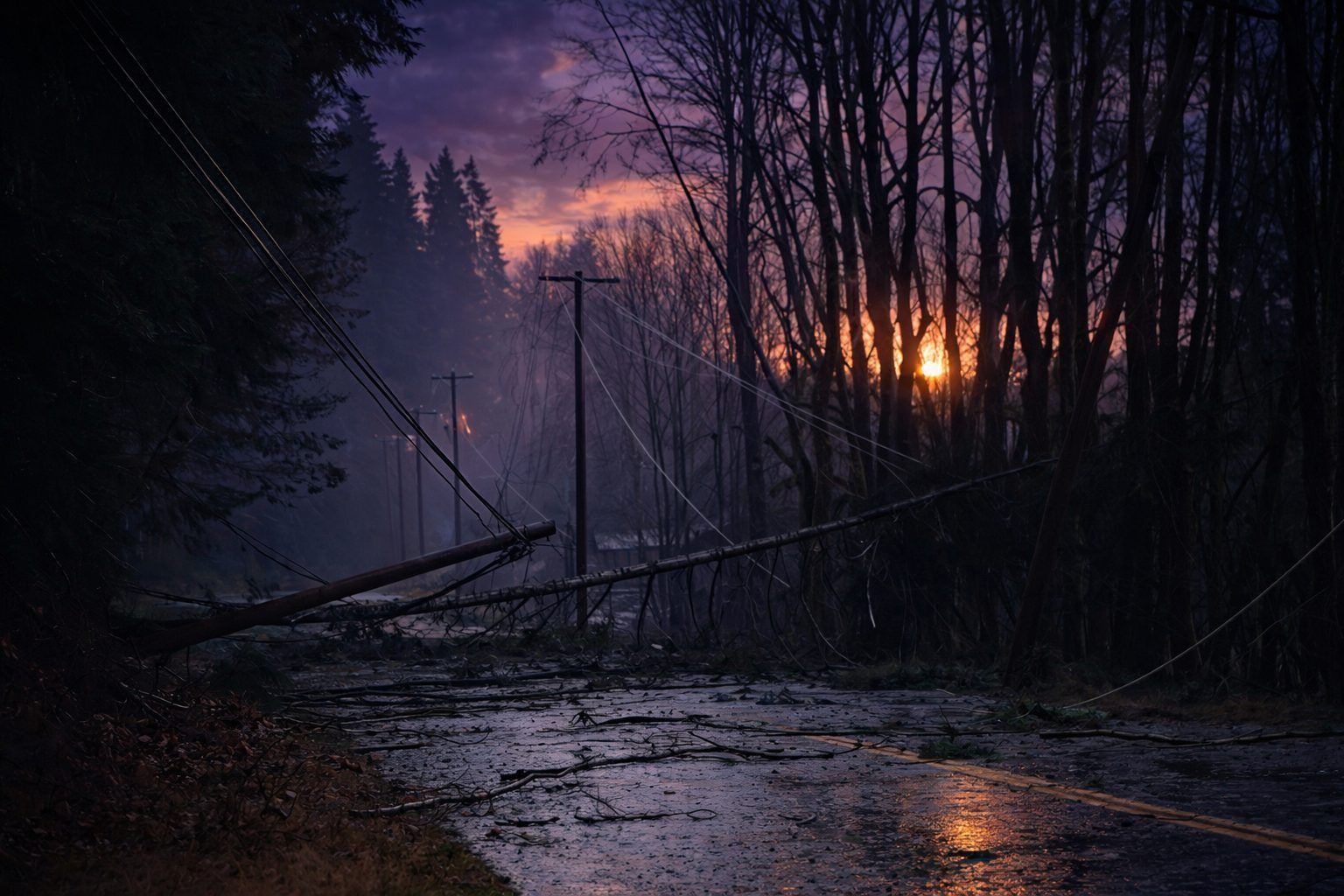
VANCOUVER, B.C. — A fast-moving series of storms continues to test British Columbia’s power grid, as BC Hydro crews push through windstorm repairs and additional wind and rain warnings remain in effect across parts of the South Coast and Vancouver Island.
The latest BC Hydro regional outage updates dated Dec. 17, 2025 point to ongoing work in Kent and Hope in the Lower Mainland, while some Gulf Islands and South Vancouver Island communities are being advised to prepare for overnight outages as crews work around safety constraints such as daylight-only repairs and difficult access.
Why this week’s outages spread so quickly
The broader disruption began earlier in the week when a powerful windstorm swept B.C.’s South Coast, cutting electricity to a huge swath of customers across the Lower Mainland, Sunshine Coast, Vancouver Island and the Gulf Islands.
Global News reported that more than 90,000 BC Hydro customers were without power as of Monday afternoon (Dec. 15), with BC Hydro warning that outages could climb as wind continued. The hardest-hit areas cited included Langley, Maple Ridge, Victoria, Duncan and Qualicum.
BC Hydro’s own operational update that day described the same pattern: widespread damage driven by trees and branches falling onto electrical infrastructure, forcing crews and contractors into large-scale repairs to lines, poles, and related equipment.
A key driver: vulnerable trees after years of drought
BC Hydro has also emphasized that the province is entering storms with a landscape made more fragile by recent conditions. In its storm update, the utility said several years of drought have weakened vegetation, making trees and branches more susceptible to wind damage—an important factor behind the volume of line damage and the scale of the outages.
That combination—strong gusts plus weakened trees—helps explain why outages can jump from scattered to region-wide in a matter of hours, and why restoration can take longer when crews must remove hazards and rebuild damaged sections before safely re-energizing lines.
Parksville–Qualicum Beach: thousands impacted as trees hit lines
On Vancouver Island, the storm’s impact was sharply felt in the Parksville–Qualicum Beach (PQB) area.
PQB News reported that thousands of customers lost power on Dec. 15, with downed trees taking out BC Hydro wires. The outlet said more than 3,000 homes were affected in a corridor stretching from the Alberni Highway in Parksville to Lee Road in French Creek, while more than 6,000 customers were affected in Qualicum Beach, Dashwood and Whiskey Creek—with some outages linked to trees across lines and others listed as under investigation at the time.
West Vancouver and the North Shore: transmission and circuit issues add complexity
Not every outage this week has been purely “tree on wire.”
CityNews Vancouver reported that as of 7 a.m. Monday (Dec. 15), over 15,000 homes and businesses in North and West Vancouver were without power due to what BC Hydro described as a transmission circuit failure just before midnight Sunday. The affected area was described as stretching from around Capilano Road in North Vancouver to 31st Street in West Vancouver. CityNews noted that by 9 a.m., fewer than 200 customers were still affected.
Separately, the North Shore News reported that more than 1,500 customers lost power in West Vancouver after a circuit failure at a North Vancouver substation, underscoring how equipment or circuit faults can compound storm-related repairs.
The Dec. 17 BC Hydro update: where crews are focused now
As of Dec. 17, 2025, BC Hydro’s outage communications describe a repair effort that is moving from the largest restoration work into smaller, stubborn pockets—often the last to return because they involve complex damage, access issues, or specialized equipment.
Lower Mainland: Kent and Hope remain priority zones
BC Hydro said crews have been repairing significant damage following Monday’s windstorm and “made good progress,” but were continuing efforts Tuesday evening to restore remaining customers—specifically calling out Kent and Hope. outage.bchydro.com
Notably, BC Hydro said crews will be on site at an outage at Flood Hope Road on Thursday morning, citing the need to coordinate specialized crane equipment and safety representatives. That’s a signal to residents that some restorations aren’t delayed by staffing alone—sometimes the fix itself requires heavy equipment and strict safety windows.
Vancouver Island and Gulf Islands: overnight work, but some repairs must wait for daylight
In a separate regional alert for South Vancouver Island, BC Hydro said all available crews would continue working through the evening and overnight, but cautioned that some customers should prepare to be without power overnight.
BC Hydro highlighted several island-specific constraints:
- On Salt Spring Island, an outage impacting 44 customers at Musgrave Landing was expected to continue overnight because daylight is required for safe work.
- On Galiano Island, outages at Serenity Lane, Porlier Pass and Active Pass were expected to continue overnight.
- BC Hydro also said it expected small outages on Mayne Island, Pender Island and Saturna Island to be restored overnight.
Weather outlook: more wind potential, more outage risk
While restoration continues, wind and rainfall risks remain part of the story—because each new burst of wind can re-damage lines or topple more weakened trees.
Environment Canada’s Special Weather Statement for Inland Vancouver Island (updated on Wed., Dec. 17) warned that strong westerly wind gusts up to 80 km/h were expected in areas including Metro Vancouver, the Fraser Valley (west, including Abbotsford), Howe Sound, Inland Vancouver Island near the Cowichan Valley, and East Vancouver Island near Duncan. The agency cautioned that strong winds may lead to tree damage, local power outages, and travel delays.
On Vancouver Island, Victoria News also summarized Environment Canada alerts describing localized winds that could gust higher in exposed areas, plus rainfall expectations that can complicate both travel and repair logistics—particularly around the southern Gulf Islands, Greater Victoria and the Malahat corridor.
For marine and coastal areas near mid-Island—where wind-driven outages can intersect with ferry disruption—Environment Canada’s marine forecast for the Strait of Georgia north of Nanaimo showed a gale warning in effect, including conditions “near Qualicum Beach.” Environment Canada Weather
Flood recovery and power restoration: the Fraser Valley overlap
Storm impacts this week have not been limited to electricity.
CityNews Vancouver reported that parts of Abbotsford remained under flood-related pressure as the region moved into cleanup, while additional rain was still in the forecast. In that same reporting, CityNews cited BC Hydro as saying power had been restored to most customers after the windstorm, with around 3,000 customers still without electricity as of Tuesday morning (Dec. 16) and crews working in communities including Mission, Kent, Hope, Squamish, and Abbotsford.
Safety reminders: what to do during storm outages
With wind still a factor, officials continue to stress electrical safety—especially around debris.
BC Hydro’s storm update and Global News coverage both reiterate a critical rule: treat every downed power line as an emergency. If you see one, call 911 immediately and stay at least 10 metres back.
Other practical steps for households in outage-prone areas:
- Check official status updates rather than relying on neighborhood social posts (use the BC Hydro outage map and outage list for the latest restoration estimates).
- Charge devices early when wind warnings are issued, and keep a battery pack ready.
- Use generators outdoors only and far from doors/windows to avoid carbon monoxide exposure.
- Refrigerator/freezer food safety: keep doors closed as much as possible during outages.
- Look in on neighbors who may be medically vulnerable or isolated—especially in hard-hit rural and island areas.
What happens next
As of Wednesday, Dec. 17, 2025, the story is shifting from the initial outage surge to the harder final stretch: restoring smaller pockets where damage is significant, access is difficult, or repairs require specialized equipment and safe-light conditions.
For residents in Kent, Hope, island communities, and wind-exposed coastal corridors, the key message from BC Hydro and Environment Canada is the same: restoration is progressing, but gusty weather can still trigger new outages—and patience plus preparedness remain essential as crews work through the remaining damage.