MONTREAL — A surreal “holiday heist” in one of Montreal’s best-known neighbourhoods has sparked a very real debate about hunger, grocery inflation, and the limits of protest.
According to Montreal police, multiple masked and costumed people walked out of a Metro grocery store on Laurier Street with food they hadn’t paid for — a theft the group behind it later framed as an act of “redistribution.” No one was hurt, no arrests had been announced as of Wednesday, and investigators say an inquiry is ongoing. tvanouvelles.ca+1
What made the incident travel fast across Quebec’s news cycle on December 17 wasn’t just the alleged dollar value — roughly $3,000 worth of food — but the optics: three “Santas” accompanied by a crowd dressed as “elves,” and a follow-up scene featuring gift bags placed under a Christmas tree with a message about free food for people who need it. tvanouvelles.ca+2urbania.ca+2
The moment is cinematic. The context behind it is not.
What happened at the Plateau-Mont-Royal Metro store
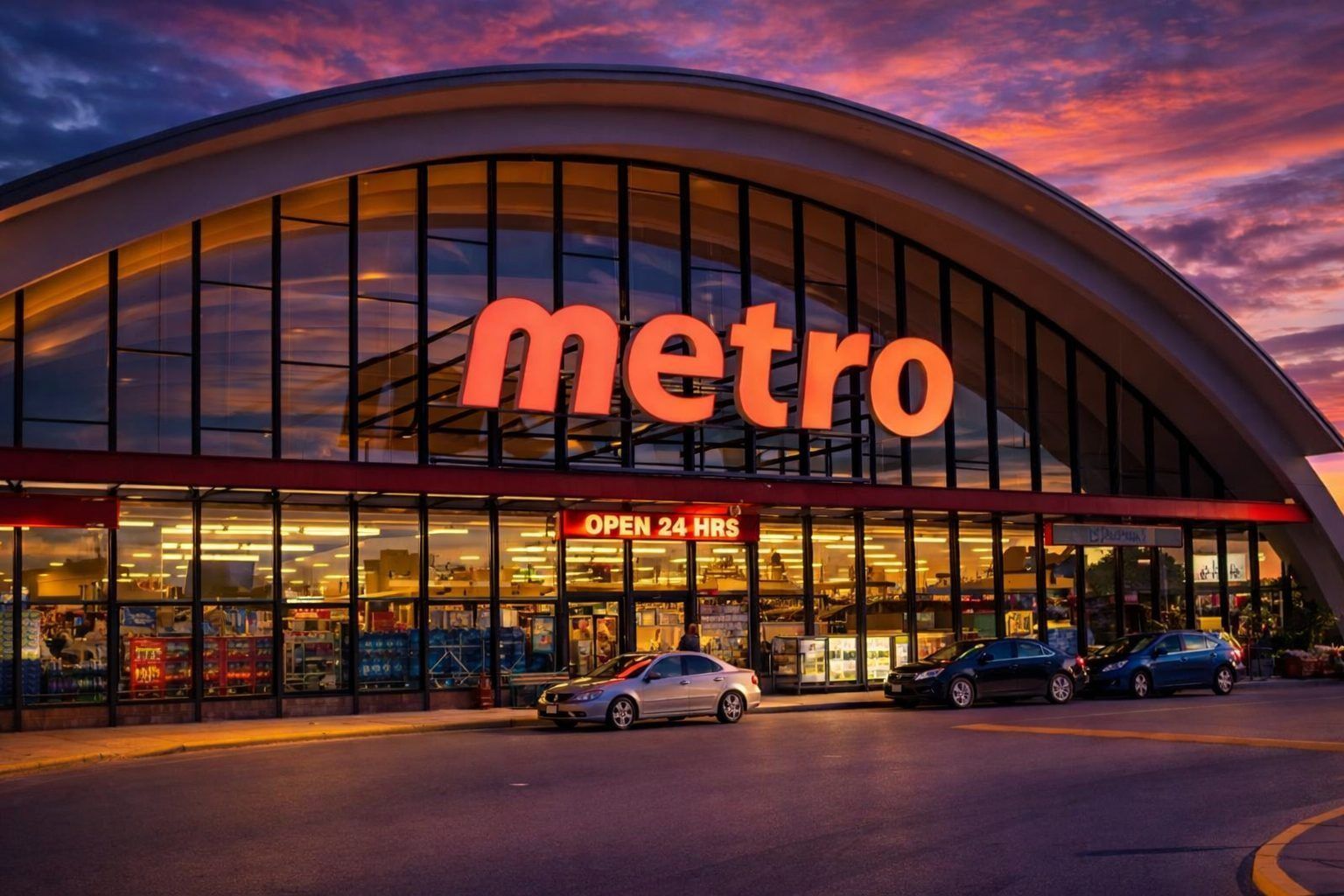
Police in Montreal (SPVM) confirmed that a shoplifting incident involving “several masked and costumed people” took place on December 15 at about 9:40 p.m. at a large retail grocery location on Laurier Street. Authorities said the group left with food without paying; there were no injuries and no arrests reported at the time of publication, with an investigation underway. tvanouvelles.ca+1
Multiple Quebec outlets identified the location as Metro Beaulieu Laurier, situated near the intersection of Avenue Laurier and Rue Chambord in the Plateau-Mont-Royal borough.
A group calling itself “Robins des ruelles” (a nod to Robin Hood) has claimed responsibility, describing the action as political. Reports describe three individuals dressed as Santa Claus backed by roughly forty people dressed as elves, who filled bags with goods and left the store without paying. Journal Métro+298.5 Montréal+2
The “redistribution” claim and the Christmas-tree drop
The group’s second act — the part designed to be seen — came after the store incident.
According to reporting that cited posts and images shared online, some of the goods were packaged in Christmas gift bags and placed under a tree at Place Valois in Montreal’s Hochelaga-Maisonneuve area, alongside a sign suggesting that Christmas is expensive and the food was free for those who needed it.
The same reports said additional items were distributed through community fridges around the city, a network often used by mutual-aid and community groups to provide low-barrier access to food.
It’s important to note that while the group claims the food was redistributed, the underlying event remains a police matter: the SPVM has characterized it as shoplifting and confirmed an active investigation.
How the “Santa-and-elves” operation allegedly worked
One detail that’s fueled the story’s virality is the reported choreography.
Urbania described a sequence in which the Santas went through the checkout process — scanning items — before signaling accomplices waiting outside. Then, a wave of costumed “elves” allegedly entered to grab the bagged goods and exit without paying. urbania.ca
This account, combined with video and images circulating on social media, has turned a conventional shoplifting investigation into a province-wide conversation about what pushes people — or movements — toward direct action.
Metro’s response: “We’re the last link in the chain”
Metro, through a spokesperson quoted in TVA Nouvelles, pushed back against the accusation that grocery retailers are the primary driver of food inflation, arguing that retailers are “the last link” between suppliers and consumers and that food inflation is heavily influenced by external factors. tvanouvelles.ca
The same report cited Metro’s charitable figures for 2025, including corporate donations and food donations, as part of the company’s broader response to criticism.
Meanwhile, the broader financial backdrop is also part of the story. Metro Inc.’s 2025 annual report lists net earnings of $1.0195 billion, up 9.4%, and notes a 10.5% increase in dividends per share, described as the 31st consecutive year of dividend growth.
Those numbers are now being pulled into the public argument — by critics who see “record profits” as proof of unfair pricing power, and by defenders who argue that profit figures alone don’t explain the cost pressures across the supply chain.
Why this story is resonating: Food insecurity is rising across Quebec
The heist’s symbolism lands in a province where food insecurity is no longer a marginal issue.
Food Banks of Quebec (Banques alimentaires du Québec) reported in its 2025 Hunger Count that its network is responding to more than three million food assistance requests per month — a threshold it described as a new record. The organization also reported that monthly visits across its network have reached about one million, and that around 600,000 unique individuals receive support each month.
In the detailed report, the network quantified the monthly demand at about 3.1 million services (based on data compiled during a “typical” month), underscoring the scale of need behind what can otherwise sound like an abstract statistic. Banques alimentaires du Québec
This backdrop matters because it helps explain why an incident involving $3,000 worth of groceries became more than a crime blotter item. For many Quebecers, it read as a flashpoint in a cost-of-living crisis that has stretched from rent to the checkout line.
“Misery has quintupled since COVID,” says a frontline organizer
On the same day the Metro incident dominated headlines, 98.5 Montréal aired a segment that connected the “Santas and elves” story directly to frontline accounts of poverty.
Rachel Lapierre, president of Le Book Humanitaire in Saint‑Jérôme, told 98.5 that, in her assessment, “misery has quintupled since COVID” and that conditions crossed a critical threshold this year. The segment also described cases she says she’s seeing more often — including seniors working while seriously ill and families living in their cars. 98.5 Montréal
Her message wasn’t that theft should be excused. It was that the desperation behind the headlines is getting harder for community organizations to absorb — especially during the holidays, when needs spike and donations don’t always keep pace.
Renters, especially, are being squeezed
One of the clearest statistical links between housing costs and hunger in Quebec comes from the Observatoire québécois des inégalités.
In an analysis published December 1, 2025, the observatory said food insecurity in Quebec has risen for a fourth consecutive year and cited data indicating that about 31% of renters were in food insecurity in 2023, compared with 14.5% of homeowners. The same analysis reported that Quebec’s overall food insecurity rate rose from 10.9% (2019) to 19.8% (2023) — more than 1.7 million people — and noted that housing and food components of the consumer price index had both increased 24% between 2020 and 2024 in Quebec.
This helps explain why holiday-season food stories now so often come paired with housing stories: for many households, rent is non-negotiable, and groceries become the adjustable line item — sometimes in brutal ways.
Grocery inflation is cooling overall — but food remains a pain point
While Canada’s headline inflation rate has eased compared with earlier peaks in the decade, food prices remain a stubborn driver of household anxiety.
Reuters reported that Canada’s annual inflation rate held at 2.2% in November 2025, but food prices rose 4.2% year over year, with grocery prices up 4.7%.
That kind of gap — general inflation near target while food runs hotter — creates a psychological reality many consumers recognize: even when the “inflation number” looks better, the shopping cart still feels heavier.
Looking ahead to 2026: Another $1,000 may be added to the average family’s food bill
The outlook isn’t offering much relief.
Canada’s Food Price Report 2026, published by Dalhousie University’s Agri‑Food Analytics Lab and partners, forecasts overall food prices will rise 4% to 6% in 2026. It estimates the average family of four will spend $17,571.79 on food next year — up to $994.63 more than in 2025 — and notes that food prices are 27% higher than five years ago.
That forecast has become part of the backdrop for the “Robins des ruelles” narrative: the group frames its action as a response to affordability collapse, while critics argue that shock tactics undermine legitimate anti-poverty advocacy and saddle workers and local stores with the fallout.
The debate Montreal is having now
The Metro “Santa and elves” case is playing out in two parallel conversations — and they’re colliding.
One is legal and practical: shoplifting is a crime, and police have said they are investigating a specific incident with identifiable time and location details.
The other is social and moral: what happens when food insecurity climbs into the millions of monthly requests, when renters are far more likely to go hungry, and when even people with jobs increasingly rely on food aid networks?