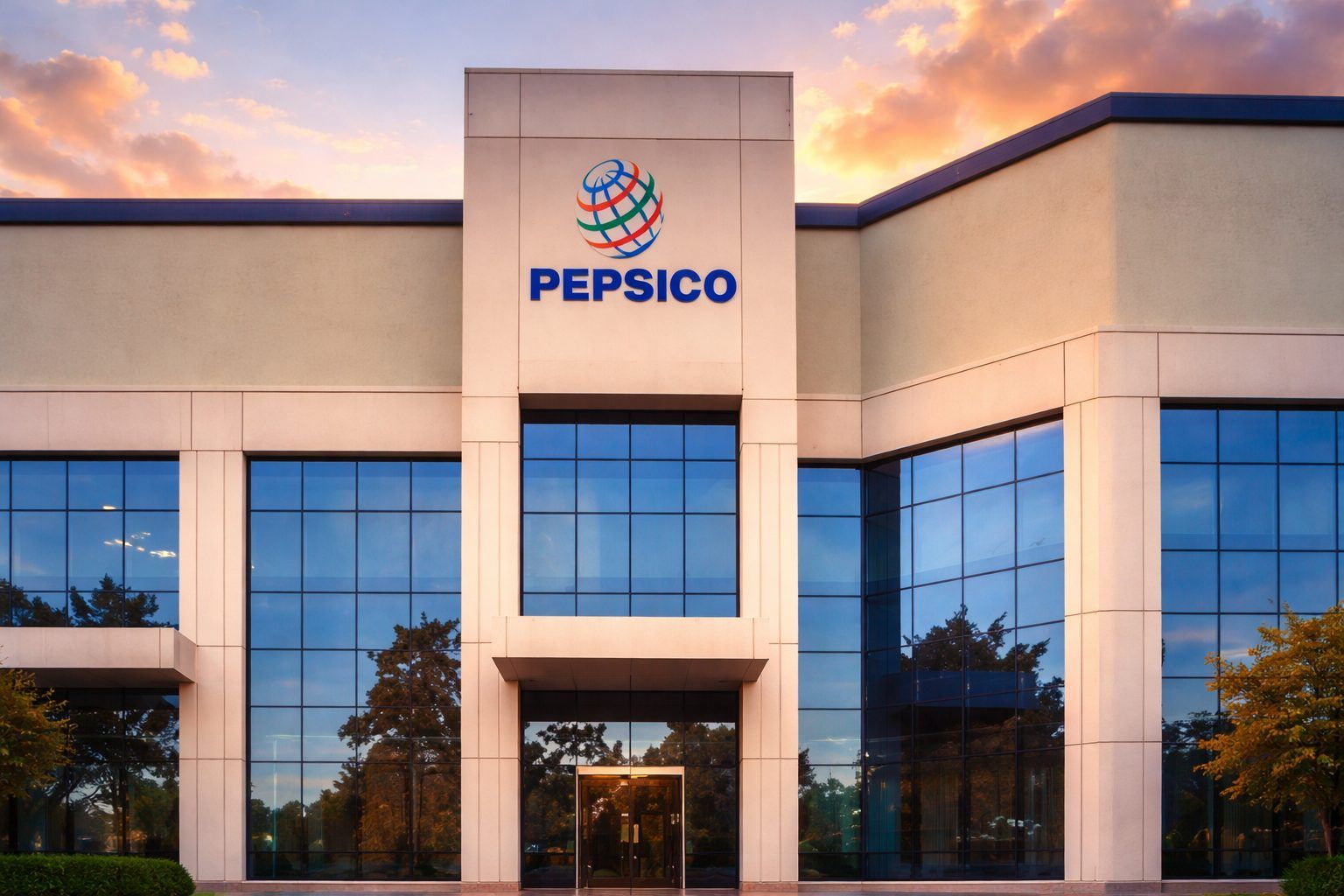

PepsiCo, Inc. NASDAQ:PEP ended Thursday, December 18, 2025, in the high-$140s as investors balanced a fresh wave of analyst commentary with an activist-driven push for improved execution, a newly announced leadership reshuffle, and a legal headline that has added near-term uncertainty.
While understood as a “defensive” consumer-staples name, PepsiCo is being treated more like a turnaround story in late 2025: the market is closely tracking whether pricing, promotions, portfolio pruning, and operational changes can stabilize North America performance and re-accelerate volumes in 2026. PepsiCo+2AP News+2
PepsiCo stock price today: PEP closes near $149.7 on Dec. 18
PepsiCo shares finished Dec. 18 at $149.67, down 0.27% on the session, after trading between $149.34 and $150.37. Volume was about 3.1 million shares, below the stock’s recent “normal” pace seen on heavier-news days earlier this month. StockAnalysis
The stock has been range-bound lately: it closed at $150.08 on Dec. 17 and $150.37 on Dec. 16, underscoring the market’s “wait-and-see” posture while PepsiCo outlines how it intends to improve growth and profitability heading into 2026. StockAnalysis+1
What’s driving PepsiCo stock in late December 2025
1) Analyst action: Citi boosts price target to $170, calls the stock “too low”
One of the most circulated Wall Street updates into the Dec. 18 session: Citi raised its PepsiCo price target to $170 from $165 and reiterated a Buy rating, framing PEP as undervalued relative to its growth profile and the company’s early 2026 outlook.
In Reuters-syndicated commentary, the upgrade rationale focused on a few key points investors are also watching:
- PepsiCo’s preliminary 2026 outlook and the company’s push to “fix” PepsiCo Foods North America and improve volumes
- The view that PepsiCo’s international business (roughly 40% of total sales, per the note) remains a strong grower and is undervalued within the overall multiple
- A belief that price cuts, promotions, and planned 2026 launches could help drive volume recovery (examples cited included Muscle Milk, Starbucks RTD Coffee + Protein, and Cheetos/Doritos innovations) TradingView
That same Reuters-syndicated data also pointed to a broader reality: analyst sentiment remains constructive—but not euphoric—with 9 of 26 brokerages at Buy/Strong Buy, 16 at Hold, and 1 at Sell, and a median price target of $164.
2) The “Elliott effect”: price cuts, portfolio simplification, and supply-chain review
PepsiCo’s strategic reset has been strongly influenced by activist investor Elliott Investment Management, which built a $4 billion stake earlier in 2025 and has pressed the company for clearer strategic priorities and stronger execution—particularly in North America.
In announcements tied to this push, PepsiCo has described plans to:
- Cut prices to improve consumer value
- Eliminate nearly 20% of product offerings by early 2026
- Accelerate innovation around “simpler” and more functional products, including items such as Doritos Protein and “Simply NKD” Cheetos/Doritos (no artificial flavors or colors), plus a prebiotic cola AP News
Operationally, PepsiCo has also pointed to a continuing productivity and simplification agenda—exactly the area where investors want proof the company can drive better volume/mix and margins without weakening brand equity.
3) Leadership changes: new global commercial role and new North America CEO starting Dec. 28
A second major theme in current PepsiCo coverage is management structure.
On December 15, 2025, PepsiCo announced organizational changes that will take effect December 28. Among the most notable moves:
- Steven Williams will become Executive Vice President and Vice Chairman, Global Chief Commercial Officer and Corporate Affairs
- Ram Krishnan will become CEO, PepsiCo North America
- Athina Kanioura will become CEO of Latin America Foods in addition to her Chief Strategy & Transformation Officer role PepsiCo
The company framed these changes as part of a broader strategy to unify selling capabilities, accelerate away-from-home growth, and improve integration of foods and beverages operations where it creates value—areas that have been central to the debate about PepsiCo’s North America execution.
4) Legal headline risk: class action alleges decade-long price-fixing scheme involving Walmart
Investors also had to digest a legal development earlier this week. On December 16, Reuters reported that PepsiCo and Walmart were hit with a proposed consumer class action in federal court in New York alleging a decade-long price-fixing scheme that inflated Pepsi soft drink prices at retailers nationwide.
PepsiCo said it “continues to operate in compliance with applicable laws” and remains committed to fair and non-discriminatory pricing, while Walmart said it is committed to negotiating to deliver value and everyday low prices. Reuters also noted the suit follows the FTC’s decision in May to drop a Robinson‑Patman Act case against PepsiCo. Reuters
For shareholders, the practical question is less about immediate financial impact (which is unknown at this stage) and more about whether litigation becomes a sustained overhang on sentiment—especially while PepsiCo is trying to show cleaner execution and rebuild investor confidence.
PepsiCo forecasts: how 2026 guidance compares with Wall Street expectations
Company outlook: 2%–4% organic revenue growth and 4%–6% core EPS growth in 2026
In its preliminary 2026 outlook, PepsiCo said it expects:
- Organic revenue growth of 2% to 4%
- Core constant currency EPS growth of 4% to 6%
- A core annual effective tax rate of ~22% PepsiCo
PepsiCo also outlined key investor communications, including its plan to release fourth-quarter and full-year 2025 results on February 3, 2026, alongside a live Q&A with CEO Ramon Laguarta and CFO Steve Schmitt, and a presentation at the CAGNY conference on February 18, 2026.
Street targets: most price targets cluster in the mid-$150s to mid-$160s, with a higher ceiling into the low $170s
Across widely tracked consensus dashboards, targets generally imply mid-single-digit upside from current levels:
- StockAnalysis lists a 12‑month price target around $160 and a “Buy”-leaning consensus rating. StockAnalysis
- TipRanks shows an average price target of about $159.69, with a high forecast of $172 and low forecast of $144, and a “Moderate Buy” consensus based on recent analyst ratings. TipRanks
- MarketWatch’s analyst-estimates snapshot (updated Dec. 18) shows targets spanning High $172 / Median $155 / Low $120—illustrating just how wide the dispersion remains while investors debate the credibility and timing of the turnaround.
Citi’s fresh $170 target sits near the top end of that range, and the Reuters-syndicated “median target” of $164 suggests the Street is not expecting a dramatic re-rating without clearer evidence that PepsiCo’s North America actions are translating into sustainable volume and margin improvement. TradingView
Next-quarter expectations: EPS around $2.24 and revenue around $29B (TipRanks)
Forward-looking forecasts continue to point to PepsiCo’s “steady but not spectacular” profile near-term. TipRanks lists a next-quarter EPS estimate of $2.24 (range roughly $2.22–$2.25) and a sales forecast of $28.96B (range roughly $28.48B–$29.34B). TipRanks
Those numbers matter because PepsiCo’s turnaround debate has increasingly narrowed to a simple question: can the company restore volume-led growth without relying primarily on price increases (a strategy that, in past periods, contributed to consumer pushback and “expensive brand” perceptions)?
Technical and trading backdrop: levels traders are watching on PEP
From a technical-analysis perspective, MarketScreener flagged short- and mid-term “bullish” trends but a more “neutral” long-term trend. It also identified nearby resistance around $151–$154 and support around $145.5 (short-term), with deeper support levels below that. MarketScreener
Technical levels don’t replace fundamentals—especially for long-term investors—but they often shape near-term flows, particularly when the news cycle is heavy on “strategy updates” and lighter on hard earnings beats/misses.
Dividend angle: PepsiCo’s income appeal remains a core part of the story
Even with the stock’s strategic debate, PepsiCo’s shareholder-return narrative is still anchored by dividends. The company declared a quarterly dividend payable January 6, 2026, to shareholders of record as of December 5, 2025, and noted it has paid consecutive quarterly dividends since 1965, with 2025 marking its 53rd consecutive annual dividend increase.
Dividend-focused commentary published Dec. 18 also highlighted PepsiCo’s yield around the mid‑3% range at current prices (data snapshots vary intraday), which remains a meaningful support for the stock’s valuation during periods when growth investors are cautious.
What to watch next: the catalysts that could move PepsiCo stock
Looking ahead from Dec. 18, several near-term milestones are likely to shape sentiment:
- Execution updates on pricing, promotions, and SKU reductions
Investors will want evidence that lower pricing and fewer SKUs translate into better shelf velocity and improved brand health—without eroding margins more than expected. - Leadership transition on Dec. 28
The market will pay attention to early signals about how the new leadership structure changes decision-making speed and accountability in North America. - Earnings day: February 3, 2026
PepsiCo has already mapped out the timing for earnings materials and a live analyst Q&A—an event that may serve as the first major “proof point” for whether the 2026 reset is gaining traction. PepsiCo - Litigation developments
Any additional filings or early procedural rulings in the price-fixing lawsuit could affect headlines and short-term sentiment, even if the long-run financial impact remains uncertain.
Bottom line: PepsiCo stock is acting like a “quality stalwart” — but priced like it needs to re-earn confidence
On Dec. 18, PepsiCo stock remained steady around $150, reflecting a market that sees the company’s global scale, cash generation, and dividend strength—but wants more convincing evidence that the North America turnaround will translate into durable volume growth and improved margins.
The latest analyst notes (including Citi’s higher target), PepsiCo’s own 2026 guidance, and the leadership shake-up collectively argue that management is responding with urgency. But the wide spread in price targets—and the continued prominence of “Hold” ratings—signals that many on Wall Street are still waiting for execution to show up clearly in the numbers. MarketWatch+3TradingView+3PepsiCo+3


![US Stock Market Today 08/28/2026 [UPDATE: 01:00 EDT] [Marvell Pins Near Overnight Low as Analyst Targets Diverge]](https://ts2.tech/wp-content/uploads/2026/08/US-market-dashboard-2026-08-28-0058-480x384.jpg "US Stock Market Today 08/28/2026 [UPDATE: 01:00 EDT] [Marvell Pins Near Overnight Low as Analyst Targets Diverge]")